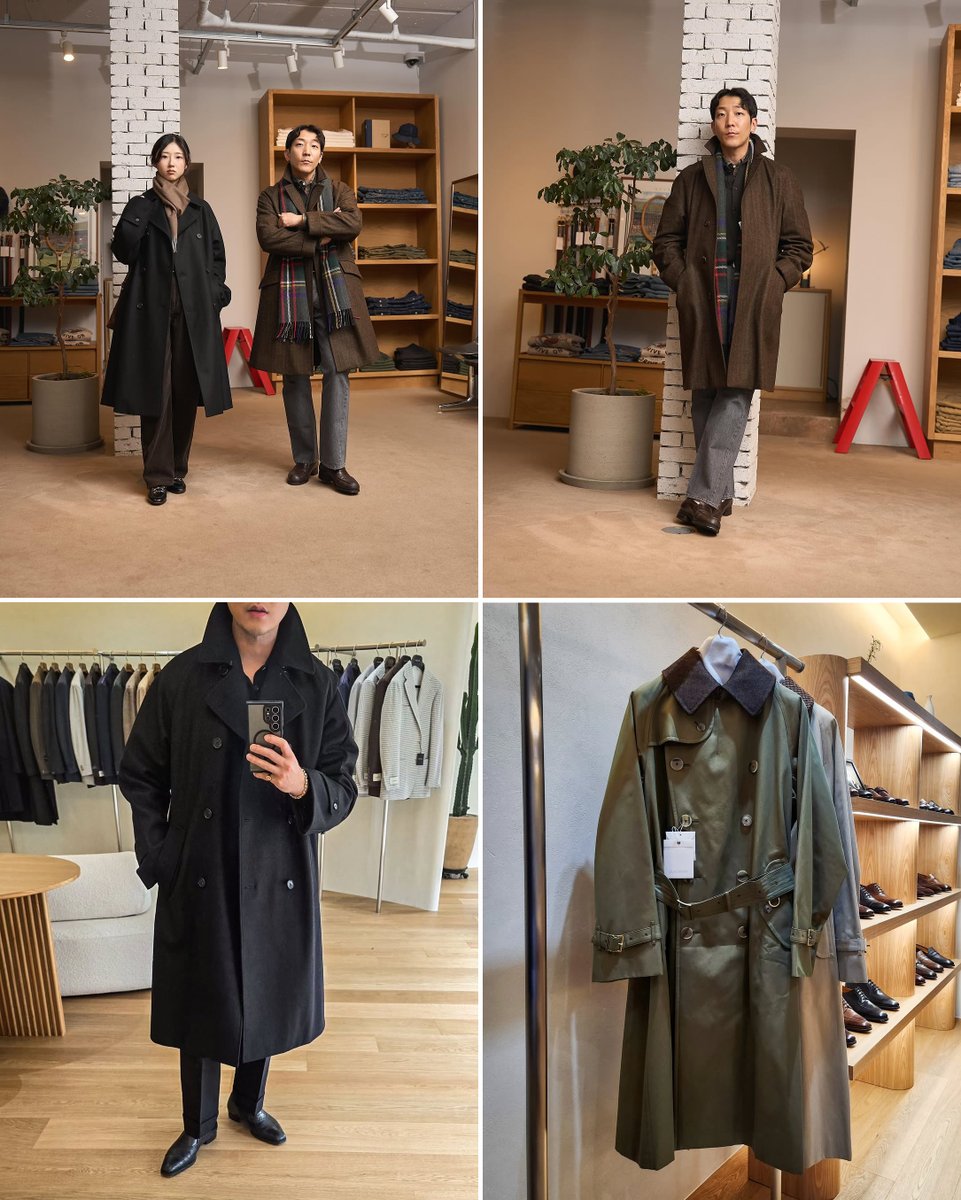
Some things I saw recently that I think are cool (fall outerwear edition):
— Valstar at No Man Walks Alone (bomber is 😮💨)
— Coherence at Random Walk and Andrea Seoul in Korea (green trench 😍)
— Phenix by Takahiro Miyashita and Daisuke Gemma
— Fox Chatsworth at The Merchant Fox
In our current debates about the US economy, critics of free trade often invoke haunting images of shuttered steel mills and abandoned clothing factories. And it's true: trade agreements such as NAFTA helped erode union power and shutter thousands of garment factories across the country.
Those who support Trump's approach (e.g. tariffs), argue that bold action is needed to bring back the manufacturing base of the 1960s . But this vision misses two fundamental points.
First, the Trump administration has paired its tariff agenda with calls to slash government spending. That’s a contradiction. The robust garment sector of the mid-20th century didn’t arise from market forces alone. For garment manufacturing, it was propped up by a lattice of public programs. Home economics classes, the USDA’s Bureau of Home Economics, and 4-H clubs all helped cultivate a sewing-literate, largely female workforce. Any serious plan to bring back clothing manufacturing would require similar investments in training. The government would also need to subsidize the erection of garment factories, which require manufacturing technology made abroad. All this requires gov spending.
Second, some reshoring advocates, such as @ac132 (CEO of Sticker Mule), openly admit they don’t intend to rehire US workers. They're waiting for robot technology to lower production costs. Certainly, even an automated system still requires some level of human labor: engineers to fix machines, technicians to monitor quality, and people to manage logistics. Those aren’t factory jobs of the past; they’re highly specialized roles, often requiring advanced degrees.
Which brings us back to the real issue. America doesn’t have an unemployment crisis—we have a wage stagnation crisis. Over the last half-century, wage growth has clustered in knowledge-intensive sectors such as law, engineering, and medicine, while blue-collar work has stagnated or disappeared. If manufacturing returns only when blue-collar workers are no longer needed, what kind of economy are we rebuilding?
Free trade hasn’t just destroyed jobs; it has also created them. Anthony and his team profit handsomely by selling $19 t-shirts printed on imported Nicaraguan blanks (which stretch out at the collar, fade in the wash, and pill after minimal wear). Tariffs might kill some of those jobs by raising costs on imported inputs. Maybe they’ll create a few robot maintenance gigs in Texas. But is that what rebuilding American industry looks like? Warehouses of R2-D2s supervised by a few graduate-degree holders in mechatronics?
In the US, real humans already make t-shirts. Why not support those companies now? In the last few months, I've been pointing out that the loudest advocates of reshoring US manufacturing often sell merch printed on blanks made abroad. Why don't their customers demand they put their money where their mouth is?
I support US garment manufacturing, although I don't think the goal should be to reshore the production of cheap $19 t-shirts and $40 jeans. I think we should use industrial policy to move the US towards upscale items, such as complicated outerwear, tailored clothing, and Goodyear welted shoes. We should have the "made in USA" label feel luxurious, like "made in Italy" or "made in Japan." This means crafted clothing made by real humans who are better protected from automation, and thus will see higher wage growth.
We also need to solve the housing crisis, so that people who haven't seen high wage growth are not burdened by astronomical rents. And ideally, affordable homes in walkable neighborhoods so that you don't have to buy a $47,000 machine to buy groceries and get to work.
I'm often the target of people who loudly want everyone to know they're against fashion. I secretly think they do so because they want everyone to pat them on the back for being morally superior and more intelligent than us "sheep."
Fashion is not limited to runways and red carpets. It surrounds us. Fashion includes how subcultural groups such as punks, skaters, and hip-hop fans dress. It's about cultural expression. People self-fashion even in non-capitalist societies. They even self-fashion in prison! Prisoners customize their dress as a way to regain some sense of humanity and individuality. It's central to human expression.
The Met Gala theme this year is “Superfine: Tailoring Black Style," which is based on Monica Miller's brilliant book "Slaves to Fashion: Black Dandyism and the Styling of Black Diasporic Identity." It tracks three centuries of Black dandyism, from when dandyism was imposed on Black men to when these clothes were a way for Black men to create new political and social possibilities. It's a great look at how clothing can be central to identity and self-empowerment.
I've always believed that fashion is uniquely disrespected because it has historically been considered a "feminine" subject. Areas of culture or the arts that have been historically coded as "masculine" are not routinely treated with such disrespect and disregard. It has been a struggle even to get academic institutions to recognize the importance of fashion as a field of study. Since fashion is coded as "feminine," it's thus also seen as "frivolous" and not "high minded."
IMO, you can take any area of study and link it to fashion: globalization, economics, politics, sociology, history, etc. If a story involves humans, it will likely include fashion because humans wear clothes.
Every time I see someone loudly and performatively declare how much they hate fashion, I notice that they, too, are very particular about their dress. These people, often men, will have specific preferences about clothes. If given a choice between a free pair of pink jeans and $50 blue jeans, they will choose one based on what they think the colors represent. Counter-cultural types will also dress in precise ways to signal their cultural identity. They are not, in fact, indifferent to clothes.
I try very hard to communicate that you should never judge a person's more profound, more important qualities based on their clothes. I've also spent the last 15 years writing about how to build a wardrobe on a budget (including doing three eBay roundups per week). I cover a breadth of styles, including workwear and Americana. The things many people project onto me are more about their narrow-mindedness regarding the importance of dress in society.
Fine to hate me, but at least please accurately represent my arguments. I'm not telling you to buy Gucci and Louis Vuitton. I'm simply saying that dress is important to culture and a form of cultural language.
What is incredible about the news of Dorchen surviving Nazi Germany...
If she survived as bad as it was then... we can today.
Trans people: Never forget. You inherit a tradition of resilience. 1000s of years ago they revered you as divine. Your continued existence is powerful.
🎇 Disco Elysium FLASH GIVEAWAY 🎇
Prize:
- DE sketchzine, HDB + KK stickers and a stickersheet!
RULES:
- must be 17+
- RT + Like (no need to follow!)
- reply with "🌅"
- ends Apr 14 7pm EST
- winner will have 48 hours to reply before I select another
tysm and good luck!!
@Uxia_JoLLyFooL@JackyHolyoake It’s interesting that these brain dead asswipes don’t appear to even understand what “transmasc” means. I know of Terfs who can barely handle sharing a restroom with butch women, much less trans masculine people that legally would be required to use the women’s restroom.
@Afro_Herper Found that lizard!!!
Just made it to 2 years at the lab I work at (&just started back in school!). I wasn’t selected when I first applied. After temp work that illustrated my accuracy with record keeping, I got in! Rejections suck, but continuing to apply is essential!