We've worked with Guardian since the 246 Club days.
Every engagement has been sharp, thorough, and adversarial in the best way, so choosing them for IRIS was easy.
Grateful to the @GuardianAudits team for a thorough, adversarial review of IRIS.
Two review rounds with 0 Critical and 0 High.
One step closer to launch.
Iris fixes rates on protocols that don't offer fixed rates.
Look at where they're pulling liquidity from: Fluid, Aave V3, Aave V4, Morpho. Deep liquidity, aggregated in one place and routed to the best rate.
I've seen versions of this before. @AltitudeFi_ did something similar, routing you to the cheapest loan while using part of your free LTV to farm and automatically pay down debt. It shut down recently, which I only found out the other day.
Fixed-rate lending feels necessary for real institutional adoption, and aggregation is almost always a net positive.
Curious to see how this one plays out.
Is IRIS a lending protocol?
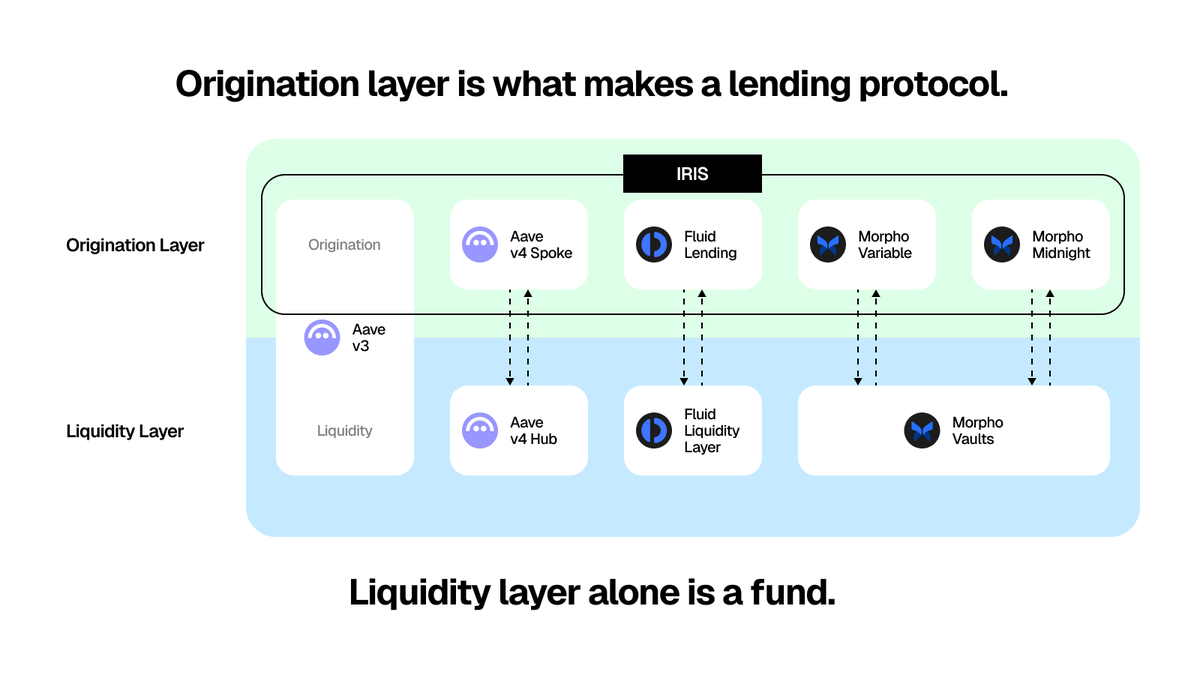
Let's start with what a lending protocol is. A lending protocol does two jobs :
Liquidity Layer
- One gathers capital, decides how much of it can be at risk, and holds it.
- Examples : @0xfluid Liquidity Layer / @aave Hub / @Morpho Vaults
Origination layer
- The other takes a borrower and turns what they need into a loan on stated terms.
- Examples : Fluid Lending / Aave Spoke / Morpho Markets
Replace the funding and nothing happens. We are already used to a single market having multiple liquidity sources and vaults.
Replace the origination and there is a different loan, or no loan. A liquidity layer without origination is a vault or a fund.
What's replaceable is an input and what you cannot swap is the product. And thus, in a lending protocol, origination layer IS the product.
So yes, IRIS is a lending protocol, building an origination layer with an externalized liquidity layer.
As a result, depth is every venue at once instead of one pool, price comes from whichever venue prices best, and with no pool to divide there is no calendar to defend, so a borrower who needs 37 days gets 37 days.
Played around on the @iris_credit testnet over the weekend. Ran a few loans across the three live markets.
The UI itself barely needs describing, which is sort of the point.
> You state what you need.
> Collateral, size, how long, the highest rate you'll accept.
> A quote comes back with a countdown.
> Take it or don't.
The maturity field is fully customizable. I wanted 4 days, so I entered 4 days. No limited dropdown, nothing rounding me into someone else's calendar.
What runs underneath is the more interesting part to me.
> You're not matched against a lender.
> You sign an intent, and solvers compete off-chain to underwrite it.
> The winner puts up its own capital as a guarantee, opens your loan as a normal variable position on whichever venue is cheapest right then, and hands you a fixed rate on top.
Then it keeps working. As rates move, the solver can shift that position across venues chasing cheaper funding.
Your rate never moves. Theirs does. If the real funding cost lands below your quote, that gap is their profit. If it runs above, their own capital eats the difference.
So the fixed rate isn't an asset sitting in a pool somewhere. It's a promise backed by capital, with a variable position underneath doing the work.
Which is exactly how a bank treasury desk operates.
> A bank issuing you a 10-year fixed mortgage doesn't go find a matching 10-year fixed deposit.
> It funds you with whatever's cheapest, rolls it, hedges what's left over, and manages that funding stack for the life of your loan.
> You see one rate. They run the machine behind it.
IRIS turns that into a competitive auction instead of something one bank keeps in-house. Treasury skill has always been a private moat. That part actually feels new to me.
Zoom out and @0xCheeezzyyyy's recent money stack framing seems pretty clean way to place this imo. M0 is capital entering. M1 is wrapping it so it circulates. M2 is credit, where capital gets amplified. Fixed-term credit sits right at the frontier of that top layer.
And within it, fixed rate is really two different products.
> Some borrowers need a date. The loan has to mature the day their obligation does. RWA funds, token unlocks, anything with dated liabilities.
> Others just need the rate to stop moving and don't care about the date.
@Morpho Midnight serves the first. Fixed as a property of the instrument. The rails.
IRIS serves the second. Fixed as a property of a managed service. The desk.
Both need deep variable markets underneath, and a matured Midnight just becomes one more venue a solver can source from.
One thing worth flagging: it's testnet, so not everything maps 1-1. But the rates are realistic. Solvers price against live venue rates, so a quote is close to what the same loan would actually cost.
Size is the part that won't be. They're rolling out with limited solving capacity at first, though it seems that scaling size isn't the bottleneck. Worth reaching out the the team if you need customized execution ig.
Still early, but this felt like stating a need rather than decoding a system to express one.
Good stuff from the @Glovin_ and the team.
As of today:
✔️ Internal Testnet is up
✔️ IRIS Solver is quoting
✔️ Two venue integrations are ready
✔️ End-to-end tests are running on SDK / Infra
Therefore, IRIS Club, which has been a private room for a while, is opening today while we wait for the testnet.
Welcome to the club.
https://t.co/EqK9STugwb
One of the clearest signs that DeFi credit is maturing isn't just higher TVL or lower borrow rates.
It's the structural shift in where capital is flowing.
Over the past few years, lending has grown from 26.7% to 55.5% of overall DeFi TVL according to @DefiLlama , reflecting how credit has gradually become one of the industry's foundational primitives.
Not surprisingly, this is accompanied by an increasing emphasis on institutional-grade credit infrastructure.
And I think the next leg of evolution is obvious: Fixed-term credit.
After all, the overwhelming majority of TradFi credit markets already operate this way.
Whether it's corporate bonds, private credit, structured finance or institutional lending, borrowers typically prioritise funding certainty over constantly repricing floating-rate exposure.
For years, the idea of fixed-term lending has existed across DeFi and the innovation today isn't that fixed-rate lending suddenly became possible.
It's that we're finally seeing the surrounding infrastructure evolve to support it at institutional scale.
What I am referring to is things like:
1. Scalable liquidity
2. Professional execution
3. Risk management
4. Sustained + optimised market-making.
These are the pieces that transform a primitive into an actual financial market.
As institutional capital gradually becomes a larger participant in DeFi, certainty becomes increasingly valuable.
Not every allocator wants floating-rate exposure.
Many care less about chasing the highest yield and more about matching liabilities, forecasting cash flows, and locking in funding costs.
That's exactly where fixed-term credit starts making sense.
To me, this represents one of the next major evolutions of on-chain lending.
We're moving beyond simple overcollateralised lending markets into a broader credit stack where floating rates, fixed rates, tokenised credit and RWAs can coexist + complement one another.
What's equally exciting is that we're still incredibly early.
Many of these primitives are only beginning to find PMF, which means the protocols building the right infrastructure today have a genuine opportunity to establish themselves as the default liquidity venues tomorrow.
That's why I'm particularly looking forward to seeing what @iris_credit is building.
Rather than viewing fixed and floating lending as competing products, I think the long-term opportunity lies in abstracting that complexity away altogether.
Users shouldn't have to actively manage interest-rate risk, optimise across multiple venues, or constantly refinance positions.
They should simply express the outcome they want (whether that's funding certainty or cost efficiency) and let the protocol handle the execution beneath the surface.
The future of DeFi credit won't be defined by having more lending markets.
It'll be defined by making increasingly sophisticated credit strategies feel invisible to the end user.
Great read from the team, feel free to check it out 👇
1/Adding a date to onchain credit does not remove the instability. It reassigns it, and it lands in the same place every time.
Midnight launched with fixed rates and fixed maturities, so I ran it as a thought experiment.
I intentionally read it from the short side because mechanism is easiest to understand by finding where it bends.
Real thanks to Hexens, their Builder Support program made a difference.
They took the part that actually matters in a multi-venue integrated lending protocol.
No audit is the final word on that, but this one came back clean, 4 Lows, nothing above.
We're almost ready.
Notice that every rate headline is written from the lender's chair. Hikes, cuts, the curve. Nobody writes the borrower's version, the one who took the loan and can't reprice it. Most of finance is built for the side that sets the rate, not the side that pays it.
IRIS is the borrower's version. You state the loan you want and we are here to serve.
https://t.co/lCNKDmT4Po
Fixed rate lending onchain is overdue, and Midnight moving this way matters.
One distinction TradFi spent decades learning, and it is easy to miss here that a fixed rate loan and a fixed rate are not the same product.
One is a lender committing principal at a fixed coupon for a term which is the bond market. The other is leaving your floating loan where it is and buying rate certainty from a separate party who is paid to carry it.
What makes the second work is that the rate can be separated from the funding without moving the principal. A treasurer with a floating loan rarely refinances into a fixed one. They keep the loan and add the swap, and the two together behave like a fixed rate loan.
Midnight is building the first onchain. IRIS sits on the second side, but it is not a rate swap. It takes the one idea underneath the swap, that the rate can be unbundled from the funding and carried by someone else, and delivers it a different way. The borrower keeps drawing from the deepest liquidity onchain, even Midnight itself, and a solver underwrites the outcome on top.
Swap-like, but not a swap. More on why that difference is the whole point soon.
Certainty is a symptom of running a single model; calibration comes from an ensemble.
Tetlock's forecasting tournaments found that hedgehogs (experts with one big theory who filter all evidence through it) predict worse than "foxes" who hold many small, partial models and aggregate them, despite (in fact because of) the hedgehog's greater confidence.
That is precisely why ensemble methods beat single models in statistics. A random forest outperforms one deep decision tree, model-averaging beats any single estimator because averaging many independent, individually-mediocre views cancels their uncorrelated errors.
The fox is an ensemble; the hedgehog is a single over-committed model; the felt experience of certainty is the sensation of having stopped averaging. You know your forecast is degrading at the exact moment it starts to feel clean.
A borrowing rate is a forecast too. Each lending venue is a single model - one utilization curve, one governance regime, pricing its own local noise as if it were the cost of capital. Accept a fixed rate from any single venue and you've trusted a hedgehog: it feels clean, one number from one source, which is the tell.
IRIS prices across venues at once. A solver's fixed rate isn't Aave's estimate or Morpho's but it's what remains once each venue's idiosyncratic noise cancels against the others: the systematic cost of capital, no longer padded for any single venue's local shocks. The ensemble, not the hedgehog.
The rate that survived aggregation.
https://t.co/yAEhtjuNwH
A bank does not write a thirty-year mortgage, fund it once with matched thirty-year debt, and forget it.
The rate the borrower pays is fixed. Everything beneath that rate stays in motion. Short-term paper rolled against long bonds, deposits repriced, positions hedged and re-hedged continuously to hold the cost of carrying that loan as low as it will go.
GOFR is a great example of active liability management. Galaxy sources across lending markets and hands the client a single optimized rate.
IRIS points the same machinery at a different target.
A solver does the same continuous cross-venue work but the number you hold is the one you set: fixed, at origination. The variability doesn't reach you. It stays with the solver, who took the job by winning your quote.
Over the past few weeks we've talked a lot about our thinking, but we haven't talked much about 'fixed rates' itself, or the problem with variable rates..
Yes, it does solve institutional adoption and provides predictability in funding costs.
But to us, fixed rates are simply the medium through which a borrower’s most specific intent can be expressed, fully and precisely.
Intent is what matters. Market structure is secondary.
https://t.co/Km826FqLCL
IRIS is already live as a demo at https://t.co/J8V4ifdF8j.
Testnet is next: @hexens is running the first round of our audit now, and testnet itself lands early August.
Open to everyone, with real quotes and the full flow of opening and closing a position.
Go try the demo and tell us what's still rough before testnet comes. Anyone who leaves thoughtful feedback will be prioritized.