US semiconductor funds are seeing unprecedented demand:
The semiconductor ETF, $SOXX, attracted +$5.4 billion in inflows on Tuesday, the largest daily intake since the fund’s launch in 2001.
This is more than +300% above the previous record daily inflow.
The 3x leveraged long semiconductor ETF, $SOXL, posted +$1.2 billion in inflows, the 2nd-largest daily inflow this year.
In total, US long semiconductor ETFs took in +$7.1 billion in fresh capital on Tuesday.
Year-to-date, $SOXX alone has posted +$13.3 billion in inflows.
Investors are buying the dip in semiconductors at an unprecedented pace.
$DRAM $SKHY Pink & Invalidation candles called it. -25% drawdown followed.
50 SMA holding its 3rd test in 3 different days. Third time's the charm? 🤔
300+ charts daily. Try it free:
https://t.co/ZQDP5HCFyq
Amazon $AMZN launched an eight-part U.S. investment-grade bond sale expected to price today, per Bloomberg News. The deal spans 2029 to 2066 maturities, with expected ratings of A1 from Moody’s, AA from S&P and AA- from Fitch.
DO NOT SELL YOUR WINNERS EARLY.
It is a shame that so many people miss out on meteoric rises in the stock market because they sold the winners early.
Could you imagine buying $TSLA in 2010 and holding until now or even buying back in 2019 and holding until now?
Or what about $NVDA in the early 2000s?
Hell, even $MU over the past year and especially $SNDK.
Even some boring plays like $COST, $WM and $WMT are great examples of stocks to not sell.
The stock market is volatile, it’s wild and it can be emotionally exhausting most of the time but the most important part of it is HOLDING through the good times and the bad times.
As long as the fundamentals hold true quarter after quarter and continues to show consistent growth/returns, DO NOT SELL YOUR STOCK.
If you do happen to sell your stock early, make sure you are taking that money and putting it to work in a stock you are even more bullish on.
It hurts when you sell and you the stock 10x’s essentially over night.
UBS, 키옥시아 목표주가 14만 4,000엔으로 상향…"낸드 업사이클은 아직 끝나지 않았다"
—————————————————
UBS가 키옥시아(Kioxia)의 목표주가를 14만 4,000엔으로 상향 조정했습니다.
메모리 가격 전망치가 10개월 연속 상향 조정되고, 장기 공급 계약(LTA)을 통해 실적 가시성이 높아지면서 낸드 업사이클이 예상보다 더 길고 강하게 이어질 수 있다는 판단입니다.
UBS는 최근 AI 수요의 지속 가능성을 둘러싼 논쟁이 커지고 있음에도 불구하고, 실제 산업 점검 결과 메모리 수급은 여전히 공급 부족 쪽으로 기울어져 있다고 분석했습니다.
핵심은 2026년 하반기 메모리 가격의 추가 상승 여력입니다.
UBS는 산업 점검을 바탕으로 2026년 2분기 DDR 계약 가격이 전분기 대비 67% 상승한 데 이어, 3분기 가격 상승률 전망치를 기존 17%에서 32%로, 4분기 전망치를 기존 12%에서 18%로 각각 상향 조정했습니다.
다만 장기 공급 계약 가격, HBM 가격, 제품 믹스 차이에 따라 실제 평균판매단가(ASP)의 상승 폭은 메모리 업체별로 다르게 나타날 것으로 봤습니다.
UBS는 D램 산업의 공급 부족이 최소 2028년 2분기까지 지속될 것이라는 기존 전망도 유지했습니다.
2027년 D램 비트 수요 성장률은 전년 대비 36.2%에 달하는 반면, 공급 성장률은 19.3%에 그칠 것으로 예상되기 때문입니다.
수요와 공급의 격차가 지나치게 커, 단기간에 수급 불균형이 해소되기 어렵다는 판단입니다.
특히 2027년에 전방 산업의 재고 소진이 없다고 가정할 경우, 즉 2026년 하반기에 고객사의 선제적 재고 축적이 없다고 보더라도 자급률은 2026년 -8.1%에서 2027년 -13.6%로 오히려 악화될 것으로 추정했습니다.
UBS는 두 수치 모두 지난 30년 동안 전례를 찾기 어려운 수준이라고 평가했습니다.
낸드 플래시 역시 강한 가격 흐름이 이어질 것으로 전망했습니다.
UBS는 낸드 가격이 2026년 2분기 전분기 대비 67% 상승한 뒤, 3분기에도 기존 전망치 17%를 크게 웃도는 30% 상승을 기록할 것으로 예상했습니다.
4분기 상승률 전망치는 기존과 같은 12%로 유지했으며, 낸드 업사이클은 최소 2027년 4분기까지 지속될 것으로 내다봤습니다.
결과적으로 UBS는 메모리 산업 매출이 2026년 9,920억 달러, 2027년 1조 7,630억 달러에 이를 것으로 전망했습니다.
이는 AI 인프라 투자 확대와 메모리 공급 제약이 동시에 맞물리며 만들어지는 전례 없는 업사이클이라는 해석입니다.
다만 리스크도 분명합니다.
UBS는 이번 상승 사이클의 가장 큰 변수로 고객사의 가격 감당 여력을 지목했습니다.
특히 막대한 AI 관련 자본 지출을 이어가기 위해 계속해서 자본 시장에 의존해야 하는 하이퍼스케일러들의 재무적 부담이 향후 메모리 수요의 지속성을 좌우할 핵심 요인이라고 분석했습니다.
요약하면, UBS의 이번 목표주가 상향은 단순한 단기 실적 조정이 아니라 메모리 사이클의 피크 시점이 계속 뒤로 밀리고 있다는 판단을 반영한 것입니다.
가격은 계속 오르고, 공급 부족은 장기화되고 있으며, 키옥시아는 그 중심에서 낸드 업사이클의 수혜를 가장 직접적으로 받을 수 있는 기업으로 재평가되고 있습니다.
How about this? Micron, a GREAT American Company, announced that they are putting in 250 Million Dollars into the Trump Accounts for the future benefit of children, and their stock went up 9 points today. Thank you Micron! President DJT
( TS: Jul 2 2026, 9:23 AM ET )
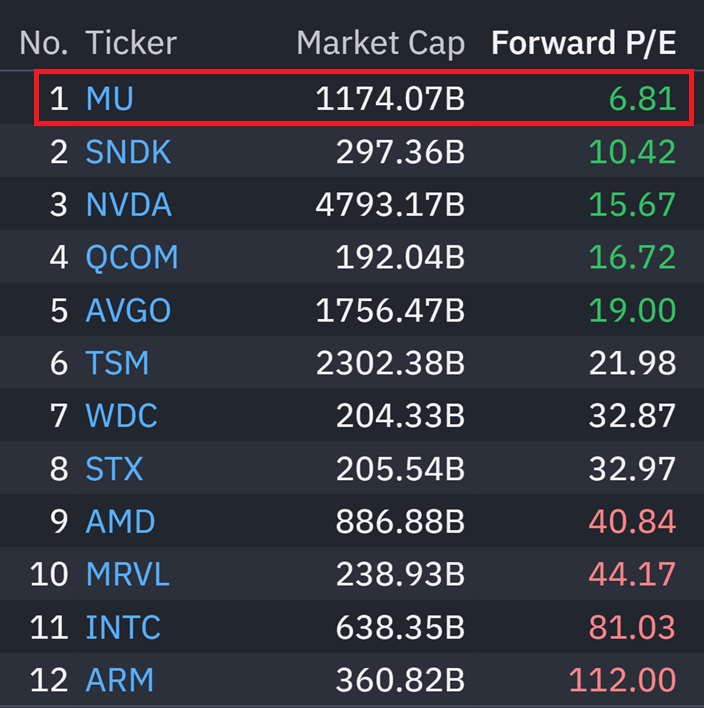
$MU 6.8x. Holy Jesus Christ. San Pedro de Dios.
Priced like it's going out of business next year. Reality is record profits bigger than any Mag6.
The gap is absurd.
Thank you @POTUS for your support. Micron is proud to be part of this historic initiative, which complements our over $200 billion investment in U.S. memory manufacturing and R&D, creating over 90,000 jobs across the country.