この見出しは、やや扇情的に見えます。
声明の冒頭には、"the push by AI companies to solve mathematical problems as a benchmark is detrimental to the science of mathematics, and to the mathematical community." とあります。「AI企業が数学問題の解決をベンチマークとして推し進めることは、数学という学問と数学コミ��ニティに有害だ」という趣旨です。
見出しの「科学に有害」は、原文の "the science of mathematics" を「科学」と縮めたもので、意味が広がりすぎるように思います。
批判の対象は、AIで数学をすること一般ではなく、数学難問の解決をAI性能のベンチマークにする企業側の動きです。声明自身も、AIが数学研究と理解を豊かにし、加速する可能性を認めています。
https://t.co/wByTmW3I3L
出典です。いずれも調査主体の一次資料です。
【日本:8.4%】
JILPT「AIの職場導入による働き方への影響等に関する調査」
2024年5月27日~6月27日、雇用者2.2万人を調査。AI利用者8.4%、生成AI利用者6.4%。
https://t.co/DACiimjR10
【米国:50%】
Gallup, “Rising AI Adoption Spurs Workforce Changes”
2026年2月4日~19日、米国雇用者23,717人を調査。仕事でAIを使う人は、年に数回以上50%、週に数回以上28%、毎日13%。
https://t.co/vhOrp8MaLn
【シンガポール:56%】
ADP, People at Work 2026
2025年7月21日~8月4日の調査。シンガポールでは、AIを週に複数回以上使う人が56%、ほぼ毎日使う人が23%。
プレスリリース本文では「AI」と要約されていますが、報告��本体の設問は、ChatGPT、Midjourney、Copilotなどを例示して、生成AIの個人的な利用頻度を尋ねています。
プレスリリース:
https://t.co/TNrTyLVLKY
報告書本体:
https://t.co/g5P4URnzqP
【日本の相対的な遅れについての比較】
OECD, Artificial Intelligence and the Labour Market in Japan
金融・保険業と製造業に限った比較では、日本のAI利用者割合が、比較可能なデータのある国の中で最も低いと報告されています。
https://t.co/SPnCP7Tt5V
調査・照合にはGPT-5.6-solとFable 5を使用しました。数値、調査時期、設問、定義については、各調査主体の一次資料に戻って確認しています。
5/5
Singapore’s 56% comes from ADP’s 2025 Global Workforce Survey, conducted from 21 July to 4 August 2025 and reported in People at Work 2026.
The question asked about personal use of generative AI, with examples including ChatGPT, Midjourney and Copilot. The 56% figure covers workers who used it multiple times per week or nearly every day; 23% were in the nearly-every-day category.
In short:
Japan: 2024 / AI, including generative AI / no stated minimum-frequency threshold
US: 2026 / AI / at least a few times a year
Singapore: 2025 / generative AI / multiple times per week or nearly every day
Japan’s relative lag is a legitimate concern. But these three percentages were not measured on the same basis and therefore cannot establish how far Japan lags behind the US or Singapore.
4/5
The US 50% reported by BBC matches Gallup’s survey of 23,717 US employees conducted from 4 to 19 February 2026.
In Gallup’s survey, the 50% figure is the share of employed American adults who say they use AI in their role “at least a few times a year.” In the same survey, 28% used it a few times a week or more, and 13% used it daily.
The 50% figure is therefore explicitly frequency-based and is not defined in the same way as JILPT’s 8.4%.
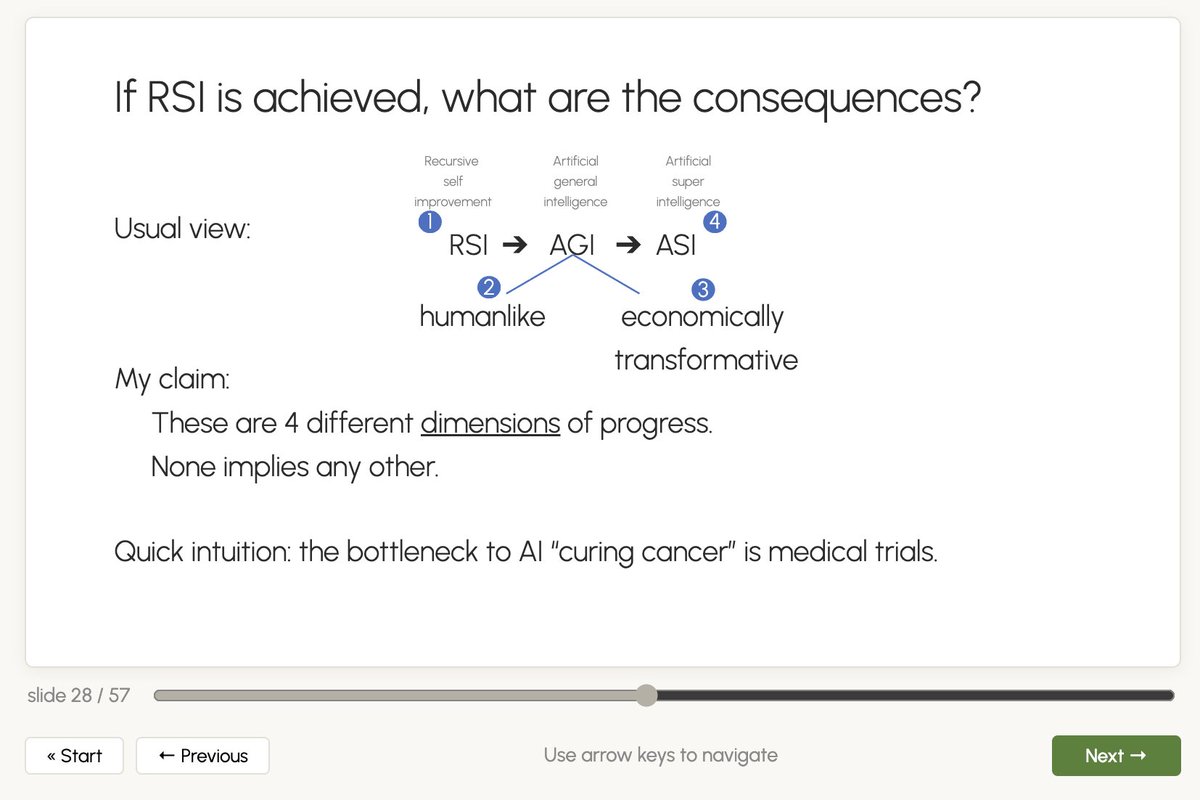
1) If you haven't read AI as Normal Technology, these annotated slides are probably the easiest way to get a high-level overview. https://t.co/vNgRJCKxi3
2) If you're already familiar with the core ideas, Part 1 of the talk is largely a summary of what I and @sayashk have already written, while Parts 2 and 3 have new ideas. There are a lot of unexamined assumptions in the discourse about Recursive Self-Improvement and I hope you find my pushback interesting.
3) I'm really grateful to the team (@steverab@sayashk@PKirgis & Felix Chen) for feedback on the talk. In my first version, Part 2 was about 3x too long and I was super frustrated with myself. They encouraged me to cut it down ruthlessly and turn the full version into essays on the newsletter, so that's what I plan to do! (https://t.co/ZwebetjZ4n)
4) I've received a few requests for the video. There's a video on the ICML website, but it is login-walled https://t.co/rYHlxPGEXY (I assume it's for ICML registrants only). Last year's videos are public, so presumably @icmlconf will make it public at some point.