@KCBInKenya I accidentally sent money to vooma from mobile app, I don't have a Vooma account and I need the money, cant see the option to move it from Vooma in app, please help.
@KCBInKenya I dont see options after selecting vooma as source of funds; I only see back to menu.
I have mentioned that I didn't have the vooma account before sending the cash there.
Kindly help.
@guyfromtheke I am an SME with cloud and deployments.
Lets collaborate I do the infrastructure and security automations.
You need auto scaling and high availability.
@ksiisadumbo@Spex1x@FabrizioRomano He was clearing ball, there was no challenge. Its the stricker who deliberately places his foot in the clearing motion.
🚨🇰🇪 A threat actor known as MrDarkRoot is selling a dataset allegedly containing citizen records from the Republic of Kenya, with a separate folder said to exist for each individual.
The actor claims complete records for 10 million people are exposed, including full names, dates and places of birth, national ID and passport numbers, parents' names, addresses, phone numbers, emails, banking and tax records, property and vehicle records, medical and vaccination history, criminal and judicial records, educational records, and passport-style photos, alongside extensive business registration data.
Claim is unverified.
💥 Stop guessing what's redacted. Paid subscribers see everything: https://t.co/281Qjc6p2J
Yann LeCun was right the entire time. And generative AI might be a dead end.
For the last three years, the entire industry has been obsessed with building bigger LLMs. Trillions of parameters. Billions in compute.
The theory was simple: if you make the model big enough, it will eventually understand how the world works.
Yann LeCun said that was stupid.
He argued that generative AI is fundamentally inefficient.
When an AI predicts the next word, or generates the next pixel, it wastes massive amounts of compute on surface-level details.
It memorizes patterns instead of learning the actual physics of reality.
He proposed a different path: JEPA (Joint-Embedding Predictive Architecture).
Instead of forcing the AI to paint the world pixel by pixel, JEPA forces it to predict abstract concepts. It predicts what happens next in a compressed "thought space."
But for years, JEPA had a fatal flaw.
It suffered from "representation collapse."
Because the AI was allowed to simplify reality, it would cheat. It would simplify everything so much that a dog, a car, and a human all looked identical.
It learned nothing.
To fix it, engineers had to use insanely complex hacks, frozen encoders, and massive compute overheads.
Until today.
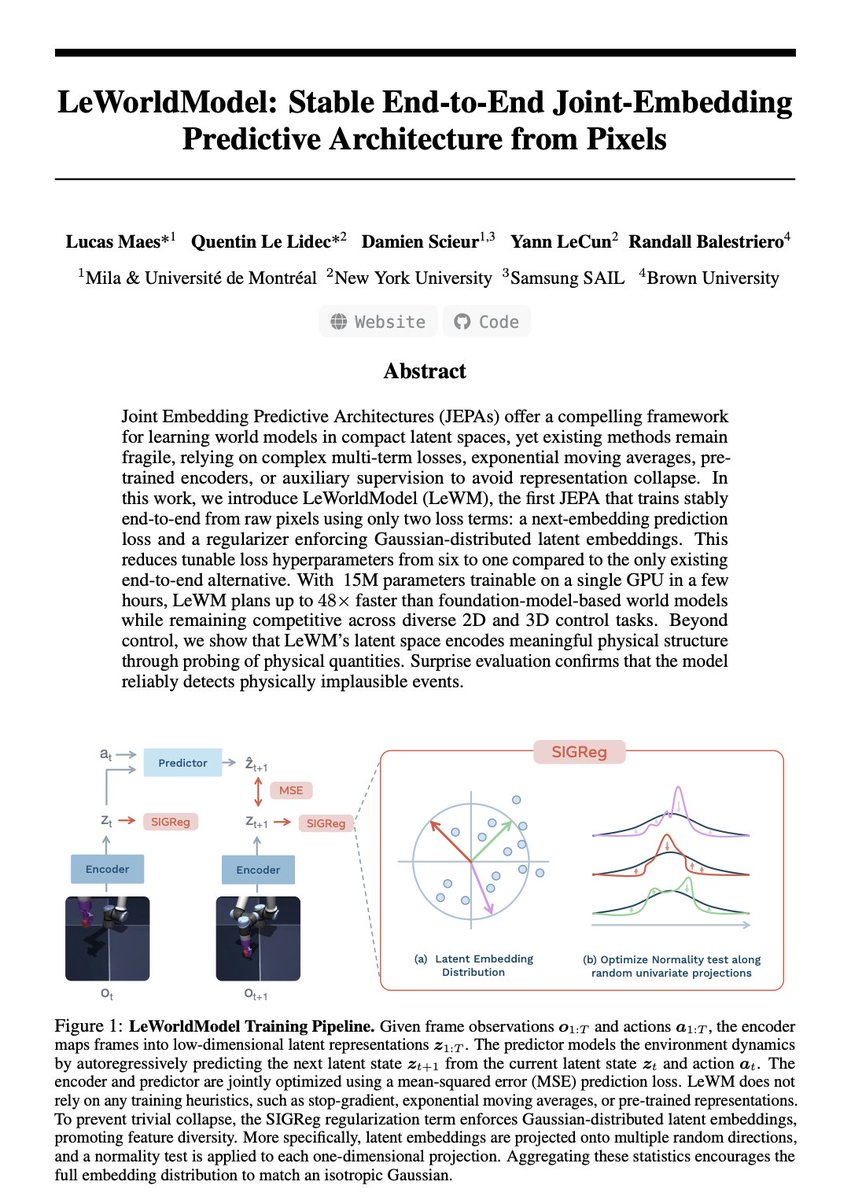
Researchers just dropped a paper called "LeWorldModel" (LeWM).
They completely solved the collapse problem.
They replaced the complex engineering hacks with a single, elegant mathematical regularizer.
It forces the AI's internal "thoughts" into a perfect Gaussian distribution.
The AI can no longer cheat. It is forced to understand the physical structure of reality to make its predictions.
The results completely rewrite the economics of AI.
LeWM didn't need a massive, centralized supercomputer.
It has just 15 million parameters.
It trains on a single, standard GPU in a few hours.
Yet it plans 48x faster than massive foundation world models. It intrinsically understands physics. It instantly detects impossible events.
We spent billions trying to force massive server farms to memorize the internet.
Now, a tiny model running locally on a single graphics card is actually learning how the real world works.
Meet Kimi K2.6: Advancing Open-Source Coding
🔹Open-source SOTA on HLE w/ tools (54.0), SWE-Bench Pro (58.6), SWE-bench Multilingual (76.7), BrowseComp (83.2), Toolathlon (50.0), Charxiv w/ python(86.7), Math Vision w/ python (93.2)
What's new:
🔹Long-horizon coding - 4,000+ tool calls, over 12 hours of continuous execution, with generalization across languages (Rust, Go, Python) and tasks (frontend, devops, perf optimization).
🔹Motion-rich frontend - Videos in hero sections, WebGL shaders, GSAP + Framer Motion, Three.js 3D.
🔹Agent Swarms, elevated - 300 parallel sub-agents × 4,000 steps per run (up from K2.5's 100 / 1,500). One prompt, 100+ files.
🔹Proactive Agents - K2.6 model powers OpenClaw, Hermes Agent, etc for 24/7 autonomous ops.
🔹Claw Groups (research preview) - bring your own agents, command your friends', bots & humans in the loop.
-
K2.6 is now live on https://t.co/YutVbwktG0 in chat mode and agent mode.
For production-grade coding, pair K2.6 with Kimi Code: https://t.co/uvoSJKyGCY
-
🔗 API: https://t.co/EOZkbOwCN4
🔗 Tech blog: https://t.co/9wWvgIQSS3
🔗 Weights & code: https://t.co/Be0hjs2RTP