This is where we need to interrogate what we have decided to call “progress” in the fight against galamsey.
Yes, reclaiming 735 acres of destroyed forest is necessary. But why should the destruction of our natural heritage and the subsequent restoration of a fraction of it be presented as an achievement in itself?
Reclamation is damage control. It is not prevention.
The real question is not how many acres we can reclaim after they have been excavated, poisoned and degraded. The question is how many acres we can protect from being destroyed in the first place.
And this is where the contradiction becomes difficult to ignore.
Government is spending public resources to restore forests that illegal mining has destroyed, while illegal mining continues to occur in other protected areas. The Forestry Commission itself reported arrests of illegal miners operating inside the Atewa Range Forest Reserve this month. NAIMOS has also acknowledged ongoing concerns about encroachment into Atewa.
So what exactly are we measuring?
735 acres reclaimed? Or 735 acres that should never have needed reclamation?
Because if one hectare is destroyed today, government spends money to restore it tomorrow, another hectare is destroyed somewhere else, and we celebrate that one being restored, we have created a revolving door of destruction and remediation — not solved the problem.
And there is an even deeper environmental question.
Can a reclaimed forest truly be considered equivalent to an intact forest?
You can reshape the land. You can plant trees. You can fill abandoned pits. You can attempt to restore vegetation. But you cannot simply recreate, overnight, the ecological relationships that existed before the excavation: the soil structure, biodiversity, groundwater systems, vegetation communities and natural functions of an established ecosystem.
The same applies even more seriously to our water bodies. You cannot pollute a river today and make the pollution disappear simply because you have a programme to clean it tomorrow.
This is why I struggle with celebrating reclamation as though it is the ultimate victory over galamsey.
The victory should be measured by prevention, enforcement and protection.
How many illegal mining operations were stopped before they entered protected areas?
How many excavators were prevented from reaching these sites?
How many financiers, concession holders and politically connected interests behind illegal mining were prosecuted?
How many water bodies remain untouched?
How many forest reserves have been permanently secured after reclamation so that miners cannot return?
Even the government has had to acknowledge that protecting reclaimed areas from renewed illegal mining is a challenge.
And this is why the announcement that Apapramprama is among the forests targeted for reclamation should not end the conversation. GoldBod has already announced plans involving Apapramma and other devastated forest reserves.
Reclaim them, absolutely. But don't make reclamation the substitute for prevention.
We should not arrive at a point where the state becomes exceptionally good at cleaning up environmental crimes while remaining unable to stop those crimes from happening.
Because every acre we reclaim is a reminder that an acre was first allowed to be destroyed.
Every polluted river we restore is a reminder that something failed before restoration became necessary.
And every forest we celebrate bringing back should make us ask a much harder question:
This is where the irony becomes difficult to ignore.
If the President is celebrating the reclamation of 735 acres of forest destroyed by galamsey, then the government clearly understands what galamsey does, where it is happening, how extensive the destruction is, and what it takes to repair the damage.
So the question is no longer whether the government knows.
The question is why are we still allowing the destruction to continue?
We are beginning to celebrate a very strange cycle in Ghana: destroy the forest, pollute the river, degrade the land, spend public money reclaiming it, then present the reclamation as an achievement.
But reclamation is not prevention.
The Forestry Commission itself disclosed that nearly 8,700 hectares of forest reserves had been degraded by illegal mining by the end of 2024. And just this month, the Commission reported arresting 12 illegal miners operating inside the Atewa Forest Reserve.
So while 735 acres are being restored, other parts of Ghana are still being destroyed.
That is the contradiction we should be discussing.
And I am particularly interested in the reference to Apraprama Forest Reserve being lined up for reclamation. The Forestry Commission recently used Apraprama as a case study in its discussions with NAIMOS, including a 40-year satellite analysis of changes to the reserve.
Because at what point do we stop asking, “How much can we reclaim?” and start asking, “How much destruction could we have prevented?”
There is a fundamental difference between these two approaches.
A government that prevents galamsey protects the forest before the damage occurs.
A government that fails to prevent it and subsequently reclaims the land is dealing with the consequences after the damage has already happened.
And those two things cannot be treated as equivalent achievements.
You cannot simply restore a destroyed ecosystem and pretend the destruction never happened. Forests are not just pieces of land that can be levelled, backfilled and replanted. They are watersheds, habitats, carbon stores and living ecosystems.
The Oda and Apraprama reserves themselves serve as watersheds for the Oda River and provide water for downstream communities.
So when polluted rivers, destroyed farmlands and degraded forests become a permanent line item in government reclamation programmes, we should be asking whether we are actually solving the problem or institutionalising the cost of cleaning up the problem.
And this is even more troubling because this government did not come to power promising to become better at reclaiming galamsey sites.
It campaigned on stopping galamsey.
Its own 120-day report said it promised to ban illegal and new mining activities in forest reserves and strengthen enforcement, alongside reclamation and alternative livelihoods.
So we believed the promise that the destruction would be stopped.
Now we are being asked to celebrate the government's ability to reclaim some of the destruction while the same battle is still being fought elsewhere.
What exactly are we celebrating?
@jdm@SammyGyamfi_ Why did we have to lose it before we decided to protect it?
Let me explain Ghana’s problem like we’re at a chop bar.
You enter, eat, order drinks for everybody and tell the woman, “My brother coming after me will pay.”
Your brother comes, sees your bill and gets angry.
“Ei! Look at the bill this guy left!”
He pays some, eats too, then leaves his own bill.
4 years later, you come back shouting about his bill. 😂
Ghana has been doing versions of this for years.
In 2014, under NDC, government owed billions of cedis it had not paid. They bought things, hired people to do work and did not finish paying the bills.
NPP came into power.
By the time NPP left in 2025, the new NDC government said it found GH¢68.8 BILLION worth of bills and demands for payment waiting to be checked.
After checking, GH¢47.8 BILLION was confirmed as money government really owed.
Now look at us.
NDC says, “Look at what NPP left!”
NPP says, “You people left bills too!”
Both can point backwards.
Meanwhile, who keeps paying?
YOU. 😂
Bro when government owes money, NPP headquarters doesn’t pay. NDC headquarters doesn’t pay.
Ghana pays and Ghana’s money is OUR money.
That is the trap.
Governments change.
Presidents change.
Party colours change.
The bill keeps finding us.
After 69 years, I don’t care who can explain the mess better.
STOP LEAVING US THE BILL because NPP → NDC → NPP → NDC without fixing this is just changing who is eating.
The chop bar bill is still ours. Ghana Must Work🇬🇭
"I shouldn't normally write such a piece on a matter that has yet to travel its full way in court.
Yes, the MP for Asante Akyem North is innocent until proven guilty.
At the same time, his story is a total indictment of the Ghana that elites have built!
The whole country is on the verge of becoming a scam-factory.
Let's walk through some of the highlights.
The MP was grabbed off a KLM flight on 10th May by Dutch Police on an American warrant.
Within a week, Parliament had found him a lawyer. The Majority Chief Whip nevertheless complained about lack of transparency on the part of the Dutch authorities.
Which suggests that local intelligence and law enforcement had zero awareness. ZERO.
Now we have the filla. Court records reported this week describe an 18-count indictment in the United States: 15 counts of money laundering and bank fraud, 3 of wire fraud, 6 alleged victims, and single transfers as large as $550,000, many during the pandemic.
The amounts in question run to millions of dollars.
Like I said, a court is yet to pronounce.
What interests me, however, is the pace of this MP's rise and how it aligns so closely with the chronology of scams in the indictment.
In January 2020 he opened Salt 95.9 FM in Agogo, with two of Ghana’s best-known broadcasters at the launch.
That is the same year that he is alleged to have defrauded a victim of $515,000 using the bank account of his parents' broke restaurant in Chicago.
A month later, he handed the National Chief Imam $4,000 and GH¢10,000, explaining that he had “succeeded after travelling outside”.
By 2021 profiles said he gave cash to more than 2,000 widows a year.
Then came the awards, half a dozen in about a year.
A whole bevy of news sites and bloggers published with gusto about how he had assembled a business empire within the few years since he returned from the US: Wealthbridge Limited, Smart Group, Real Estate, etc. etc.
The one I find most fascinating is the BOFROT.
Yes, some red-faced hype-guru actually said the MP's meteoric rise came from inventing a special mix for bofrot/puff-puff and then watching his business blow up. Bofrot. Specifically his "kub" brand of the round snack.
Clearly, most of us are dunces. But surely if there are such fortunes hiding in bofrot, Maa Yaa at Fanti New Town wouldn't have waited all this while for this burger to come and scoop it all up?
In January 2024, the paramount chief of Agogo commissioned a 3,000-capacity mosque the MP had built, and he used the occasion to announce his run for Parliament.
He later said he had “singlehandedly” funded Medikal’s sold-out night at the O2 Indigo in London in May 2024.
Every single one of those spending acts line up with the exact years the indictment mention as when the big romance scam transfers were made into various accounts he controlled.
In February 2024 the NPP held its primary in Asante Akyem North, a stronghold once dominated by a finance minister. The incumbent won, amid widespread allegations of vote-buying by various contestants.
The indicted MP ignored that market. He went straight to the 38,000 people who would vote in December, with a mosque, a clinic, cash for widows and a radio station staffed by his hype-men.
It was a landslide! 70.3% as an independent.
In parliament, he went straight for the ruling party benches. How else to get close to power?
CDD says the cost of winning a parliamentary nomination escalated from GH¢390,000 in the 2016 cycle to ~GH¢4 million by 2020.
It found nine political financiers engaged in serious organised crime, seven of them in galamsey.
IMANI has crazier intel it is still validating.
Open buying season for political power fueled by galamsey.
And now, it looks like cocaine is refusing to accept that galamsey alone can take the glory.
In early September French customs at Dunkirk opened a container of plastic waste shipped from Ghana and found 3.9 tonnes of cocaine, worth €225 million.
Ghana’s Narcotics Control Commission (NACOC) links it to the network of Jos “Bolle Jos” Leijdekkers, a Dutch fugitive convicted in absentia in the Netherlands and Belgium and believed to be sheltering in Sierra Leone.
Bolle Jos is said to employ Ghanaian bodyguards.
Four people are before the High Court in Accra, among them a 34-year-old East Legon spa owner whom the local press calls a “big girl”, and her fiancé, known as “Accra Chief” and suspected of being the network’s Ghana point man.
She says she did not know the nature of his business. They too are presumed innocent.
Dunkirk was not an outlier. In March 2025 intelligence officers pulled 3.3 tonnes of cocaine from beneath the sand in a tipper truck at Pedu Junction in Cape Coast; eighteen months on, the driver and his mate have been charged and the “prime suspects” remain free.
In April, Australian border officers found 320 kilograms of methamphetamine in charcoal shipped from Ghana. The opposition says a ship called MV Sankofa left Ghana after paying a fraction of its fine and was later caught with narcotics in Senegal.
A mess wearing a top hat!
The MP's fraud case is hardly an isolated case.
In August 2025 Ghana extradited three alleged leaders, two of them styled “chairmen”, of a ring that US prosecutors say stole more than $100 million through romance scams and email fraud; one was sentenced in July to 85 months.
One of the fraudsters in the long chain to that moment was or probably still is the most-followed Ghanaian on Instagram.
In Interpol’s 2025 romance-scam sweep across fourteen African countries, Nigeria included, Ghana supplied 68 of the 260 arrests: more than a quarter.
The Global Organized Crime Index now calls Ghana “a known hub” for romance fraud and scores the role of state-embedded actors in crime at 7.5 out of 10.
Friends, we are dealing with an epidemic!
With a consistent pattern.
But katanomics means that there is no real national learning so expect the pattern to replicate and eventually overwhelm.
Expect Big Money to keep showing up without any serious sign of genuine business acumen.
Often through a diaspora triangle of Accra, London and an American city.
Packaged into overnight philanthropy.
Expect every gate in the country leading to prestige and power to be opened up immediately money drops on the table.
Expect the Scam-Lords to continue playing on the stagnant Ghanaian sense of respectability and buy their way to palaces, mosques, churches, and dens of socialites.
With an occasional radio station to boot.
Expect these "glamorous entanglements" with power and prestige to buy immunity.
Of fourteen major scam/fraud/drug cases I examined for this piece, ten were set in motion by foreign agencies.
Ghanaian institutions predictably arrive on the scene later. To confirm, to remand, and set up committees.
The country has outsourced risk management to the American FBI.
Even as I write, another overnight sensation is probably cooking up the same pattern for overnight success.
He or she is probably dishing out charity to widows somewhere in the country.
Soon, there will be clerical blessings, then chiefly patronage, and, finally, floodgates thrown wide open. The "Dr." title follows and media coronation paves the way into parliament.
As the same Ghanaian elites mouth off pious platitudes about "national development" and what have you.
Howzat? "- Bright Simons @BBSIMONS on X.
(Image from midjourney.)
Just bought the MTN 399 bundle
I want to firstly say thank you to God Almighty
Then to my parents, my friends, acquaintances and all my enemies 🙏🏾
Thanks for all the support 🥹
Friends sent me messages asking what I knew about the ICC arbitration award of $235 million issued against Ghana in favour of a Spanish company and Standard Bank of South Africa on 17 September 2026 for breach of a water desalination contract.
Truth is I had been studying the project for years until 2024 when it slipped off my radar.
Thing, though, is that those asking know perfectly well that the account will just increase their blood pressure. So, why bother?
Still, I will tell you about it. If only to keep alive our anti-katanomics campaign.
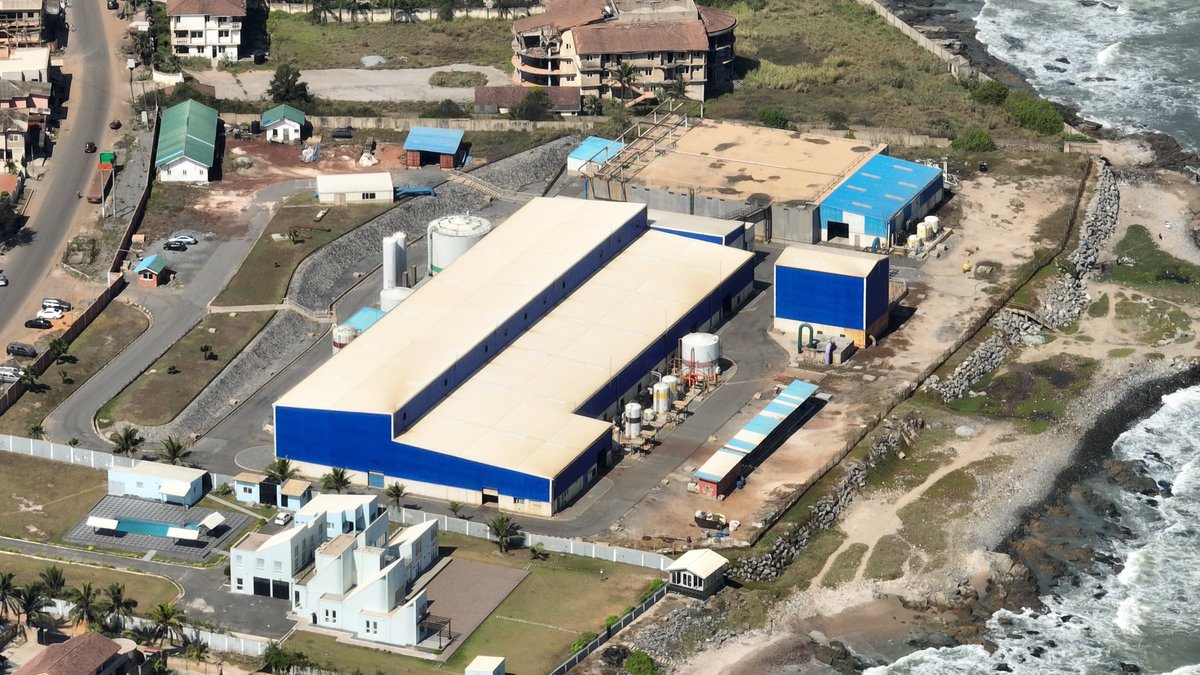
1. A desalination plant removes salt from water to make it drinkable and usable in various ways.
2. Why should a country full of rivers be pumping seawater into a plant to filter it? The rough argument was something like the following.
3. Teshie Nungua and other coastal areas have seen a population explosion. Water treatment plants near enough to distribute water to those areas simply aren’t able to keep up. Meanwhile the sea is just next door. Why not just pump the water from it and bypass some of the low pressure constraints?
4. The problem is that pumping seawater and cleaning it of salt is very energy-intensive. It costs considerably more than treating inland water. Also, it is the same pipe network one has to use to distribute the desalinated water anyway. Which is probably why desalination has never featured on any of Ghana’s water strategies to date.
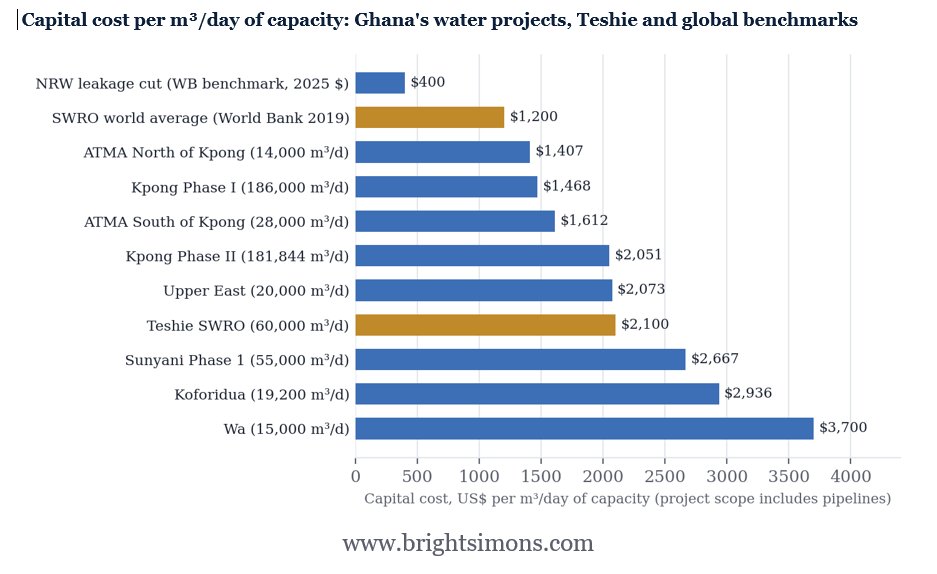
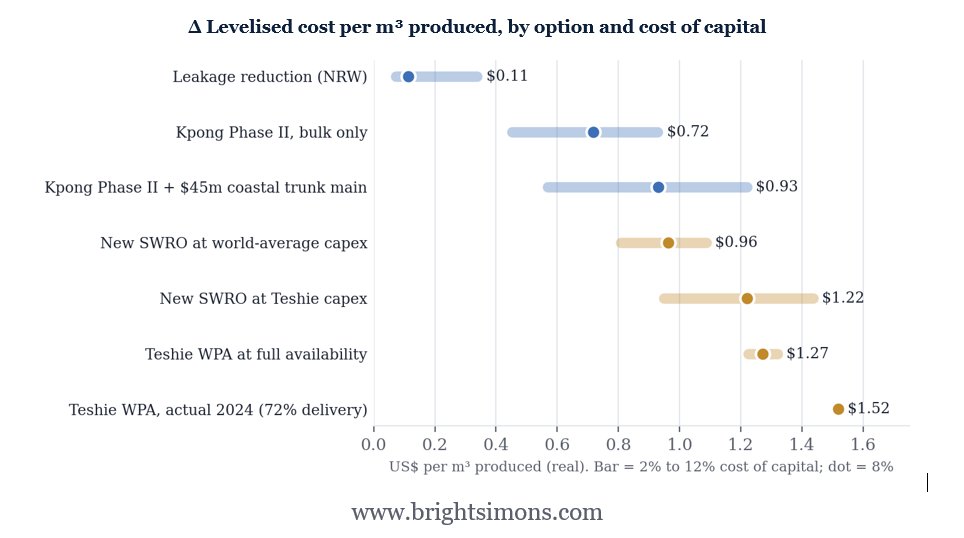
5. The Spanish offer to build the Teshie (Befesa) desalination plant was unsolicited. The advantage was that construction wasn’t all that more expensive than other projects on the drawing board (see attached chart) and they could move fast (Kpong phase II has stalled since 2015). Clearly, no one paid much attention to running costs.
6. The Spanish-Japanese consortium’s proposal came in April 2010. By March 2012, it was already before Parliament, which promptly waived $73 million in taxes. Anyone who knows Ghana would tell you that this is not routine. Their local partners, Hydrocol, must have been super effective.
7. Though Parliament was told it would cost $110 million, the investors say they spent ~$125 million.
8. The investors (Abengoa-Sojitz) were to run it for 25 years, produce 13.2 million (UK) gallons of water a day, get paid by Ghana Water (GWL) for it, and hand over the plant to Ghana in 2040. (Accra consumes ~140 million gallons of the ~230 million gallons of water GWL produces daily nationwide.)
9. For every 220 gallons, GWL was to pay $1.52. But there was also a fixed charge of $1.42 million that was payable every month regardless of how much water was being produced. I.e. Take or Pay. And $6.98m for electricity on top.
10. But in 2020, SIGA seemed to suggest that costs were higher. Its 25-year revenue forecast of about $1.3 billion for the plant works out at roughly $52m a year, or about $2.37 for every 220 gallons of water.
11. Ghana Water later told reporters that between February and August 2015 it received GH¢5.72m from selling the plant's water and spent GH¢48.68m buying and moving it, a cost recovery ratio of 11.8 per cent.
12. By October 2017 the utility said it was paying about GH¢8m a month to the project and collecting GH¢2m, a monthly loss of GH¢6m.
13. On 1 January 2018 Ghana Water shut the plant, with its communications head citing excessive operating costs.
14. Abengoa-Sojitz threatened, politely, to call the World Bank guarantee (~$179m). The shutdown was eventually reversed.
15. Five weeks later, Abengoa announced that AquaVenture Holdings Curaçao N.V. would acquire the Ghana project for $47m (minus offsets for the loans etc.)
16. Despite $50m from American DFI, OPIC, the deal fell apart and was cancelled in November 2019.
17. After the AquaVenture deal collapsed, the arrangement settled into an uneasy routine. The Finance Ministry quietly took over most of the payments because despite charging all Ghanaian consumers a special surcharge for the Teshie plant, GWL still couldn’t afford to pay the investors when bills came due.
18. All this while, the plant had constantly delivered below 70% of the contracted capacity (~60% in 2022.)
19. By 2023, Abengoa, then an $18bn infrastructure juggernaut, was on the verge of bankruptcy. It went under in April and was bought by Cox for $618 million. Scaling the purchase price proportionately means the Ghana assets changed hands for barely $1.6 million.
20. In May 2024, Befesa (the Teshie plant now run by Cox) told Ghana that heavy rains had rendered the plant inoperable, and that surveys found structural defects and inadequate bracing.
21. On 23 October 2024, Cox and Standard Bank commenced ICC arbitration against Ghana Water, with a companion case against the Republic under the World Bank guarantee.
22. The World Bank’s records show, however, that the guarantee on Standard Bank's loan and swap was cancelled on 31 December 2023 and 24 October 2024. The second date falls one day after the arbitration began. What a coincidence.
23. After the change of government in January 2025, the budget support which had kept the plant paid seemed to have been withheld.
24. On 31 October 2025 Ghana Water shut the plant. In January 2026 it published a rationing schedule.
25. After Cox and Standard Bank won against Ghana, the government announced that it is negotiating to buy the plant. Ghana Water's proposal for the 2026 to 2030 tariff period included a desalination cost of GH¢482.97m for 2026, including a capacity charge of GH¢316.01m. That is about $30.2m, nearly double the $15m to $17m a year seen in actual invoices.
26. Essentially, Ghana now wants to buy a plant and run it at double the cost of what it couldn’t pay before that got it whopped at arbitration.
27. Meanwhile the reverse osmosis membranes are all a mess, meaning another big refurbishment contract.
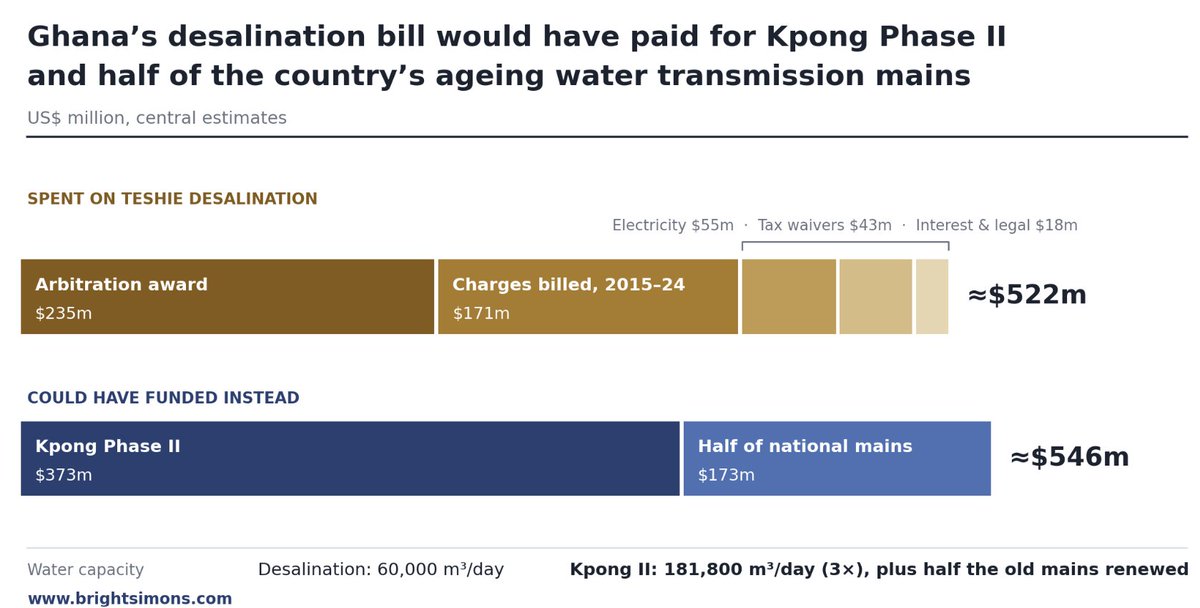
28. The crazy thing in all of this is that since 2010, the amount of water wasted in the Ghana Water system has increased significantly to 52% of all water produced. Fixing half of that would deliver nearly 8x the desalination plant’s output at ~5% of the cost.
29. Kpong Phase II, which would cost $373 million, deliver 3x the amount of water being supplied by the desalination plant, and at a cost of 40% (using the SIGA benchmark) remains stalled.
30. If you add up Ghana’s spending on this project so far plus the arbitral award, you come to more than $500m. For that money, Kpong Phase II and half of all neglected transmission mains' repairs could have been done. Delivering 72 million more gallons per day, nearly the entire pipe water shortfall in Greater Accra.
A printing company reached out and said chef Abbys, we love you. We want to personally take care of all your Big street feast branding expenses. Oh Chale. I wan cry sef
BIG ANNOUNCEMENT!!!
We are incredibly excited to announce Coca-Cola as our Headline Beverage Partner for The Big Street Feast 2.0! 🥳❤️
Coca-Cola is supporting The Big Street Feast with over 75,000 FREE bottles of Coca-Cola and Voltic Drinking Water to be distributed across the event! I am actually crying😭
The world may not transform overnight because of the speeches delivered in this August Assembly. But history faithfully records the truth we choose to speak, and the silence we choose to keep, when we are granted the privilege of addressing this global town hall. #UNGA81
The Ghana Bar Association has issued a statement to condemn the attempted unlawful arrest of Baffour Awuah. I want to commend them for it.
For years the Ghana Bar Association forgot I was a lawyer too. I was at the mercy of the regime. On my way to court I was even arrested for not observing road markings when I was driving on a road that had no road markings. 😂
A lawyer coming to represent us when we were arrested was slapped and the GBA fought against the Regional Bar that spoke up. Several young law students awaiting their call to the Bar including Timothy Selikem Donkor; Agaaya Adongo and many others were manhandled and locked up for showing up at a protest.
When Ama Governor was arrested after she was called to the Bar for attending a protest, the GBA looked away. She was either not enough of a lawyer or it era the wrong era.
This is why many people accuse the GBA of partisanship.
So yes, I like the new found voice of the GBA. I only wish it didn’t lose it ever so often in 8 year cycles.
Shalom
President @JDMahama yesterday gave a fantastic and heartfelt speech at the UN; calling for more international action on ending Genocide in Gaza and holding Isreal accountable.
All over, from international friends and former colleagues at the UN, I was basking in congratulations as if na me be the President.
Then on the same day, the Minister for Defense was hosting the Israeli Ambassador, and said he was “reaffirming shared commitment to peace, security and sustainable development.” and “acknowledged the warm and longstanding relationship between Ghana and Israel and expressed confidence in the prospects for further strengthening the partnership.”
The Defence Minister also called for “enhanced collaboration in critical areas such as surveillance systems, cyber defence and advanced technologies.“
🤦🏿♂️
I su-err the continuing Policy and ideological incoherences are what make Ghana such a baffling country.
A couple of days ago, the President through Callistus Mahama warned against creating unnecessary martyrs of offensive speech and cautioning restraint in the security agencies. They even went further to ask MFWA and GIJ to convene an event. The Next day EOCO creates an unnecessary publicity stunt when a lawyer went to court over these same issues.
Sometimes I feel like we have a progressive presidency, surrounded by some persons with real ideological depth; who still haven’t found a way to get the substructure to align with the vision. That’s baffling to me.
The Presidency must command the State machinery that produces more of its politics, takes directions from the top or the reset is just a pipe dream.
The president cannot be chasing after his workmen, walking back “Arabic” policies, positioning the right messaging after the horse has bolted from the stable.
The President is in charge! What happens then when he becomes perceived as a lame duck? The pigs will take over and run the farm.
Unless of course the incoherences are intentional! Which would be much disappointing!
Shalom
In a 2024 report, WaterAid warned that Ghana might have to import water by 2030 under a “business-as-usual” scenario as drinking water sources shrink due to pollution, especially from galamsey.
The state water utility has repeatedly cautioned that without curbing illegal mining and pollution, Ghana risks becoming an importer of water by 2030.
Researchers from the University of Cape Coast have stated that Ghana may have to import water by 2030 because of the inability to treat highly turbid
The Water Research Institute has warned that if current pollution trends continue, there could be no treatable surface or groundwater by 2030, implying the need to import water.
The core driver is severe pollution of major rivers, such as the Pra, Ankobra, and others from galamsey, which has:
* Raised turbidity levels far beyond treatment thresholds
* Reduced GWCL’s capacity to supply clean water in some areas by up to 75%
* Increased treatment costs and made some sources effectively untreatable with current infrastructure
Why is the government not actively implementing measures to address galamsey?
#StopGalamseyNow
Ghana is at a strange point where some people would rather convince you to accept the “lesser evil” than demand better from whoever is actually in charge.
“The other party was worse” does not fix your road, give you water or improve your hospital.
Elections are for choosing governments.
The years between elections are for holding them accountable. Ghana Must Work. 🇬🇭
You people do not realize how terrible this situation is. We are in a water crisis. The contamination is not just the silt and mud you can see, it also includes toxic substances such as mercury and other pollutants from illegal mining. When will you people wake up #StopGalamseyNow
Sir, please, can you come back and check on the progress on this road? It’s really terrible!
There is SERIOUS DUST on the road, and the worst part is that nobody is working or doing anything on it. It’s been months now and NO PROGRESS at all. It’s really sad.
These are “illegal mining” visuals I captured earlier today while travelling to a location I can’t disclose just yet.
Along the route, particularly around and beyond Konongo, we came across several pockets of surface mining activity happening remarkably close to the highway and surrounding communities.
Whether these operations are licensed or not is something that requires verification and that’s exactly where the questions begin.
We know the environmental damage left behind by mining in some areas around Konongo. The bigger question is: what happens to these lands when the gold is gone?
And as new mining activity emerges, especially close to major roads and communities, perhaps it is worth asking: Who is monitoring these operations, what are the regulations, and are they being followed?
For now, I’ll leave you with the visuals. What do you see?
Has NAIMOS seen these or they are licensed?
#StopGalamseyNow
As a Third World country, we can’t keep skipping industrialization and jumping straight into digitalization. We cannot be talking about owning our own AI when we don’t have the electricity day to day activities less to talk about a data center