For a few years now, a group of us have tried to explain that the biggest challenge in African democracies like Ghana, Nigeria, and Kenya is not really the POLITICS.
The real mess is in POLICY. We call this KATANOMICS.
But we have done most of our explaining using essays. Everyone tells us, however, that reading nowadays is hard! People are too swamped and busy.
So, we are trying our hands at using videos and photos. 😊
First video:
https://t.co/Sf5XeA8VwY
We are new to this so forgive the quality and focus on the message. But we are very welcome to all feedback. Keep them coming.
COCOBOD WANTS GH¢16.3 ($1.4) BILLION; PENSION MONEY IS ON THE LINE
There was a time when international banks used to queue up to give COCOBOD money. Then the company bungled its credit and lost international market access.
Turning necessity into virtue, Ghana's only cocoa trading monopoly is waiving "domestic financing" as a banner to be proud of. It is turning to the domestic capital market for GH¢14 billion in commercial paper and GH¢2.3 billion in bonds (~$1.4 billion in total). Pension funds are a major target.
Before committing workers’ savings, pension trustees should ask some serious questions. And if they don't, the TUC should force them.
Because, as of now, the whole affair looks too much like a clique gig.
First: Where are COCOBOD’s audited accounts? For 2 financial years, COCOBOD hasn't been able to pass audit.
The prospectus being used to raise money on the Ghana Stock Exchange through the shell company (SPV) Cocobod has set up (Cocoa Capital) only contains the limited review of revenue performed by PwC. Yet it attributes to PwC a conclusion about the sponsor’s “financial position” that isn't possible for that kind of review (see prospectus PDF pages. 4 & 140).
Where is the issuer’s cash? Cocoa Capital’s audited statement records zero cash and GH¢5 million owed for its shares on 8 September. The prospectus later calls those shares “fully paid for in cash”. (see pages 74 & 174 - 177).
The notes being sold to pension funds and others are described as "unsecured" and "limited recourse". However, the directors’ model assumes they are secured by cocoa receivables. Which is true? How are workers' pension savings being protected? (See pages 70, 98, & 154).
Where is the promised cover? Assigned contracts must equal at least 1.2 times outstanding notes. Using the prospectus’s 650,000 tonnes, US$4,500 price and GH¢11.95 exchange rate, a 40% assignment yields GH¢13.98 billion: below even the GH¢14 billion principal (before interest) at the full outstanding amount. (See pages 28 & 88 to 89).
Which is the right rating? 2-year old Beacon rated the notes, true. But the CP supplement in the prospectus in circulation claims Beacon gave the notes “A1 with a stable outlook” when Beacon’s enclosed letter says it assigned the commercial paper ST1(SO), with no stated outlook (see pages 120 & 126). So, who is to be believed? Let's see a correction by Monday.
Which terms govern the transaction? The Commercial Paper matures after 270 days, but another condition prohibits redemption within 12 months. The supplements close subscriptions on 29 September; the public announcement and GCB flyer says 30 September (see prospectus PDF pages 102, 116, & 120 - 121).
Who receives the refinancing proceeds? COCOBOD says it paid GH¢2.306 billion to DDEP bondholders in 2026. The programme still proposes GH¢2.3 billion for legacy refinancing. (see page 153).
Which trustees intend to buy, and on whose independent analysis? Ghana’s SEC has itself warned about credit, liquidity and concentration risks in commercial paper. It is even unclear if the SEC has waived the net worth and audited accounts requirements and if so, on what basis.
Workers deserve answers before their retirement savings are sunk into fresh debt for Cocobod. Surely, we haven't forgotten so soon the defaults on cocoa bills in 2023?
(See linked post in the thread for the full note.)
You have to be careful when using high-level press pieces to examine a relatively technical subject. This is even more surprising (that you are hoisting a BBC article) given your stated distrust of "the West".
If you really want to research the topics, here is my contribution to assist:
https://t.co/ZUrUN3NMth
Having been one of the people who strongly disagreed with the African Union's decision to endorse a single mapping projection - Equal Earth - over all others without bothering with a technical consultation among Africa's mapping, geolocation, and broader digital communities, you can imagine how many friends have sent me the UN's resolution which seems to endorse the AU's position. 😊
I have now had time to read the actual resolution (full text in thread), and I am glad to say that the UN's position is more aligned with my original view even if it still retains some technical gaps.
1. This is the relevant portion of the resolution text:
"That no single projection can perfectly represent the curved surface of the Earth on a plane, and that each projection is therefore suited to particular purposes, while noting that the present resolution is particularly concerned with projections that preserve the relative sizes of the world’s regions and the proportional representation of their surface areas, and is without prejudice to the established practice with regard to the use of cartographic material for navigational purposes."
2. To be clear: the non-binding UN resolution did NOT ban the use of the old Mercator projection or its modern incarnations like Web Mercator. Here is the relevant portion of the text:
"Declares that the Equal Earth cartographic projection offers a more accurate representation of the sizes of continental landmasses and to this end is a relevant option for improving the accuracy of the cartographic representation of the world."
3. What the resolution does is offer Equal Earth as a RELEVANT OPTION.
4. It would have been technically unconscionable for the UN to accept the AU's proposition to impose one projection on the world when anyone with the barest of understanding in this space knows that ALL flat projections of an almost-spherical world would have serious trade-offs, and that the 20 or so different projections (including Web Mercator) are all good for different things.
5. The mapping projection the AU wanted imposed by fiat, Equal Earth, was developed by Bojan Šavrič (Esri, Redlands, California), Tom Patterson (US National Park Service), and Bernhard Jenny (Monash University, Melbourne). It is mostly American with European roots. It is not, as some people think, an African creation to challenge western hegemony. It is one of several western-made map projections that has been competing for attention. Attention which the AU lavished on it.
6. In fact, Equal Earth interpolates between Putniņš P4ʹ (Latvia, 1934) and Eckert IV (Germany, 1906) both being European endeavours. It was developed in response to a controversy in Boston where public schools had adopted another mapping projection called Gall-Peters that they felt lacked certain aesthetic qualities.
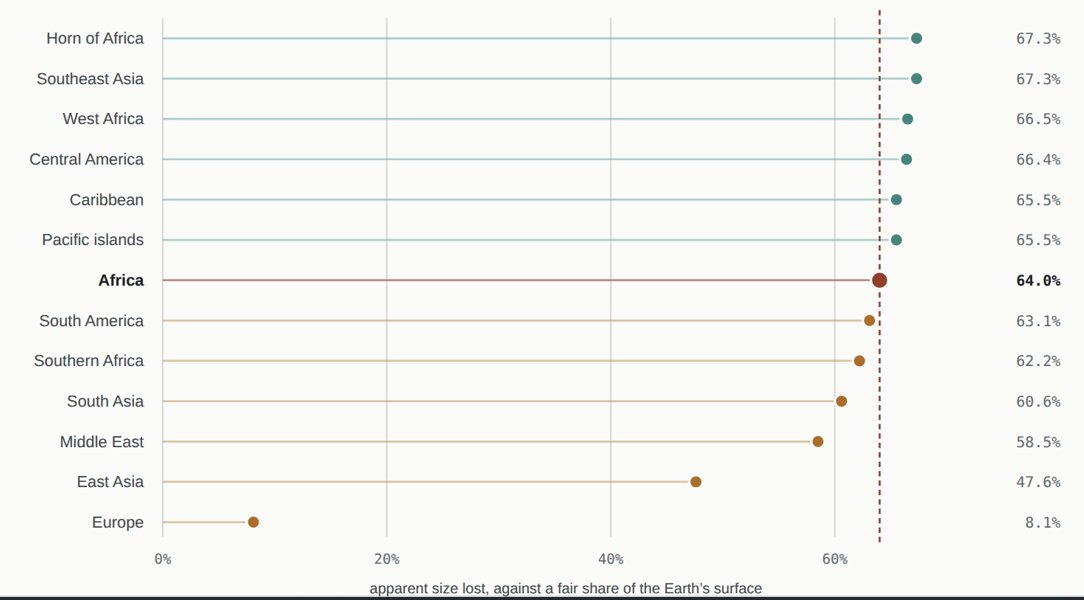
7. The whole maps debate has been so wrongly framed in the media that even highly educated people have come to believe that the 16th Century Mercator somehow penalised only Africa by shrinking it hard. But this is incorrect, all equatorial regions were impacted as a tradeoff for preserving angles and shapes when transforming a sphere to a flat surface. Several places in Asia and Latin America were actually compressed worse than Africa (see attachment).
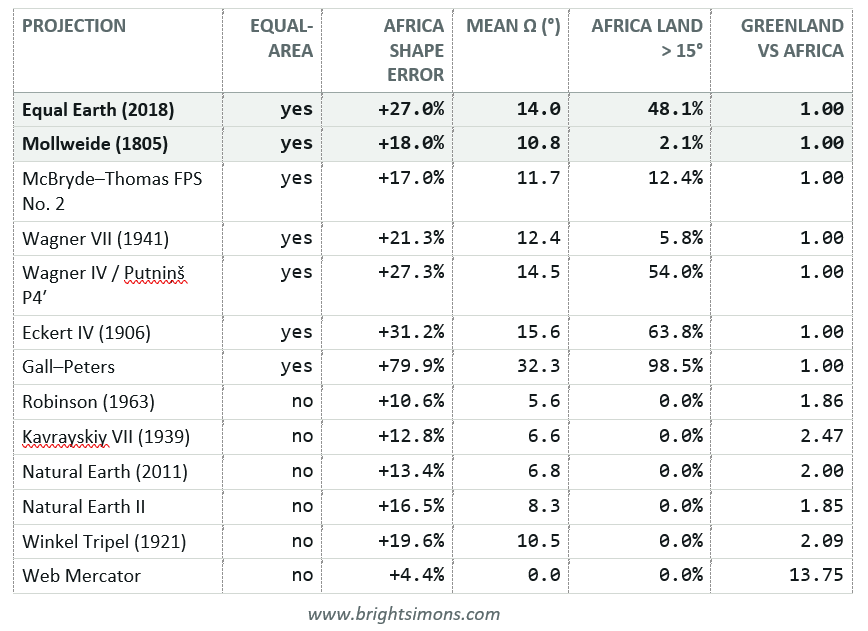
8. The UN's decision to encourage the use of all "equal area projections" is superior to the AU's promotion of Equal Earth alone because there are multiple equal area projections that are superior in additional ways to Equal Earth. Mollweide, published in 1805, is exactly as equal-area and beats Equal Earth on every African measure. It deforms the shape of Africa 9 percentage points lower than Equal Earth. McBryde–Thomas FPS2 and Wagner VII are also superior in important respects.
9. Equal Earth doesn't actually depict Africa accurately in geographic terms. Across the whole continent, Africa comes out 27 per cent too tall for its width, and 48 per cent of Africa’s land surface is drawn in such a way that angles are deformed by more than 15°.
10. Even though I don't endorse the tone of the United States in the UN debate, the "superfluous" point has some bite. In August 2018, Google Maps replaced flat Mercator with a 3D globe at low zoom. Using a globe ends all these confusions and digital enables such stereoscopic flexibility. It allows for the use of multiple projections to fix each trade-off whenever necessary to achieve any navigational goal in mind.
11. The irony however is that the Mercator that the AU is condemning still rules when you want to zoom in and handle street-view. Because there, conformality is essential. And there is nothing UN votes (or AU angst) can do about that. In fact, measured on the continental outline, Mercator renders Africa’s *proportions* more faithfully (+4.4%) than Equal Earth does (+27.0%).
12. Africa has sacrificed essential accuracy for size because politics favours the large and shiny and policy favours the small and critical. This battle between geopolicy and geopolitics mimics the domestic war in African countries that I call Katanomics. See the thread for my previous writings on the issue.
I smiled watching a video someone sent to me.
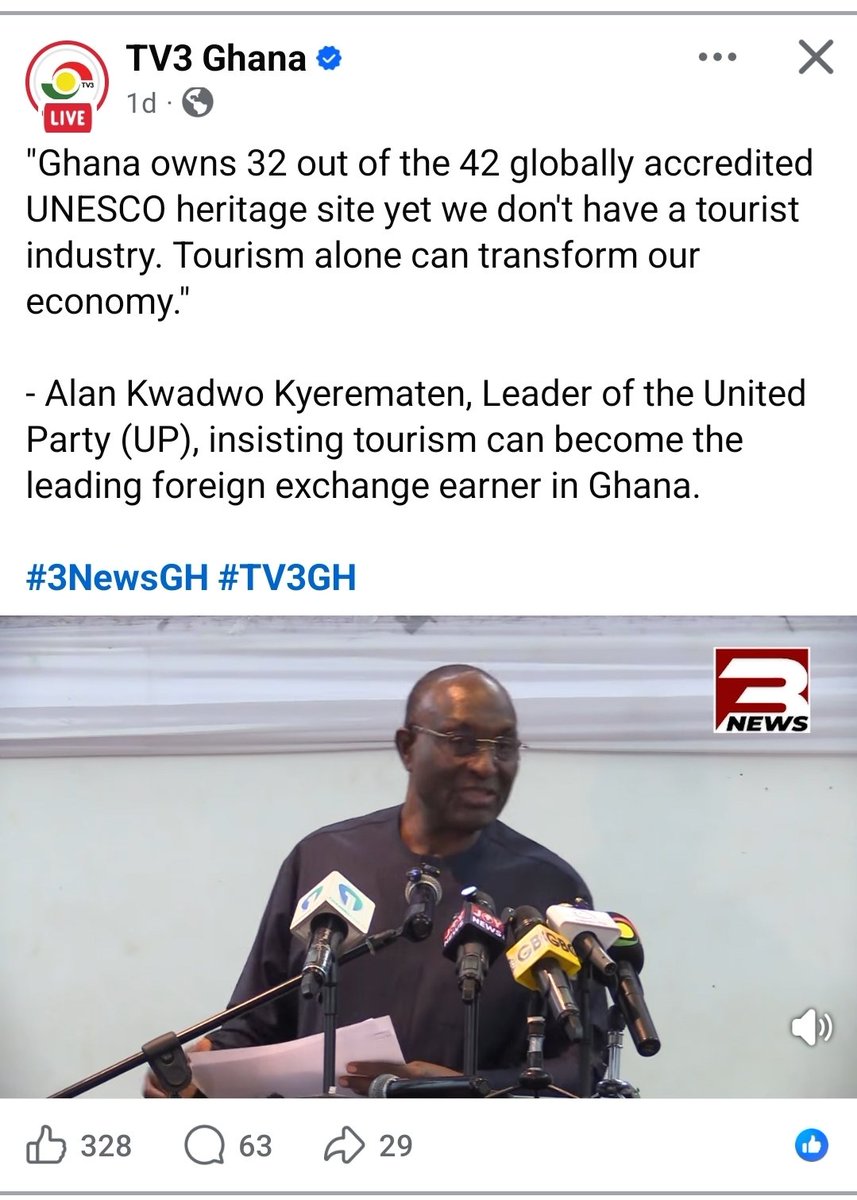
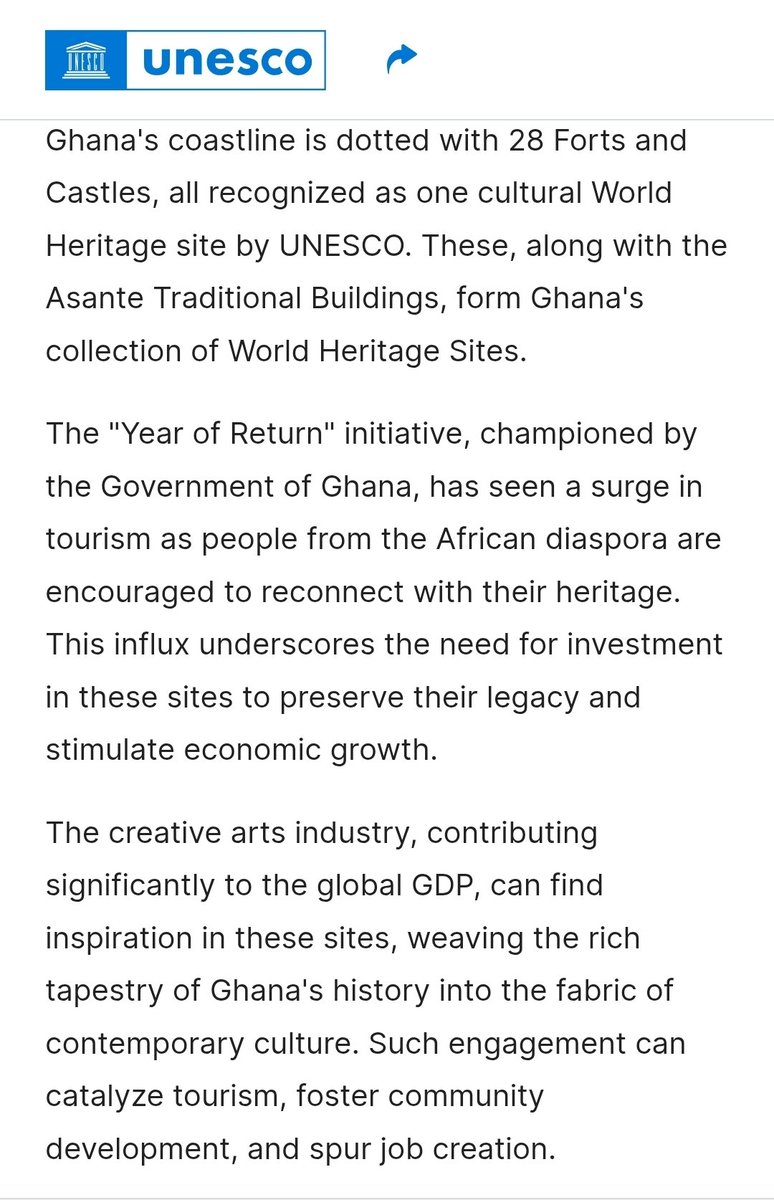
A very eminent former Trade Minister of Ghana, and one-time presidential contender of the current main opposition party, claimed that Ghana has 32 out of the 42 (76%) UNESCO World Heritage Sites.
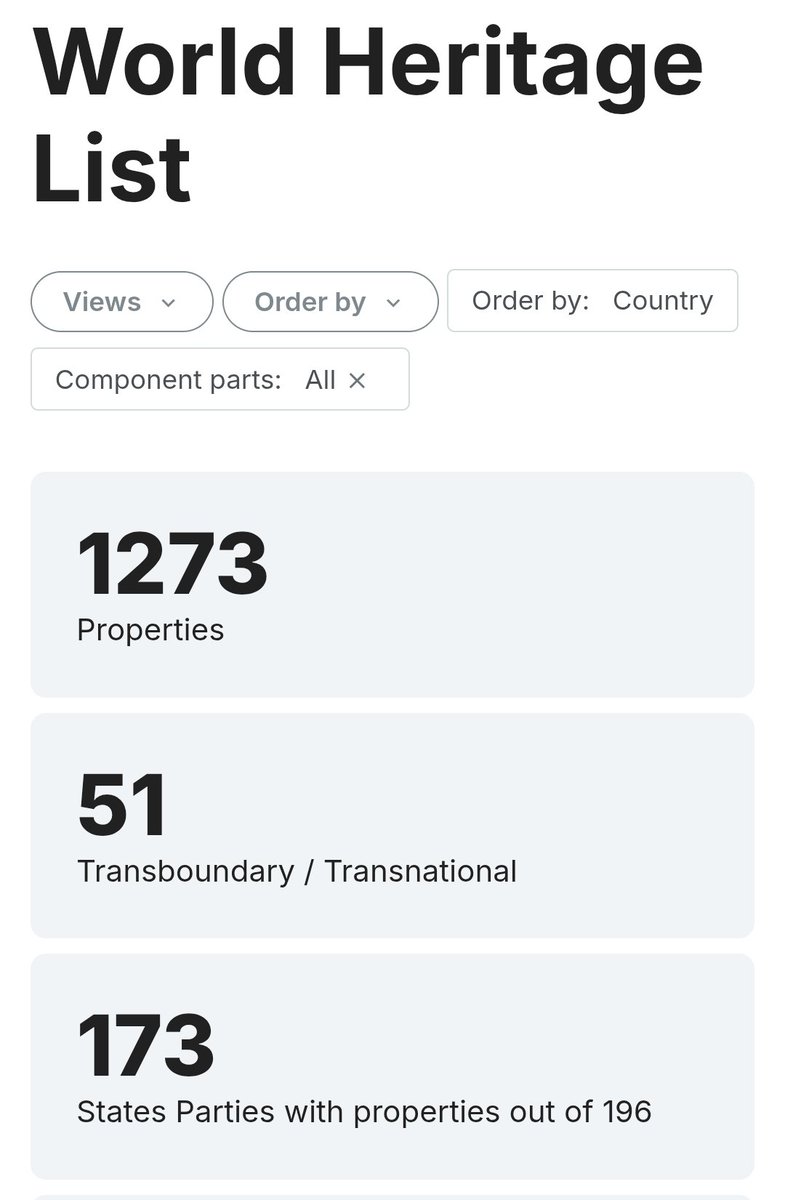
Actually Ghana has 2 out of 1273 (less than 0.2%) of UNESCO's world heritage sites.
But the pattern is what matters, right?
Just like many Ghanaians believing that Ghana was the first African country to gain independence from colonialism (it was actually about the 7th) or many highly educated Africans believing that Africa has 30% of the world's minerals (somewhere between 5% and 10% depending which list you use). 😊
I once coined the term "zombie statistics" to describe part of this pattern.
But the underlying issue, as has become clear to me over time, is that when it comes to matters of national or cultural pride, facts are optional. What matters is confidence.
@pleisus I wrote a very detailed analysis on the subject. Please check my wall and use the leads for your research. The UN didn't do what was reported. And the African Union got their whole argument wrong.
Friends sent me messages asking what I knew about the ICC arbitration award of $235 million issued against Ghana in favour of a Spanish company and Standard Bank of South Africa on 17 September 2026 for breach of a water desalination contract.
Truth is I had been studying the project for years until 2024 when it slipped off my radar.
Thing, though, is that those asking know perfectly well that the account will just increase their blood pressure. So, why bother?
Still, I will tell you about it. If only to keep alive our anti-katanomics campaign.
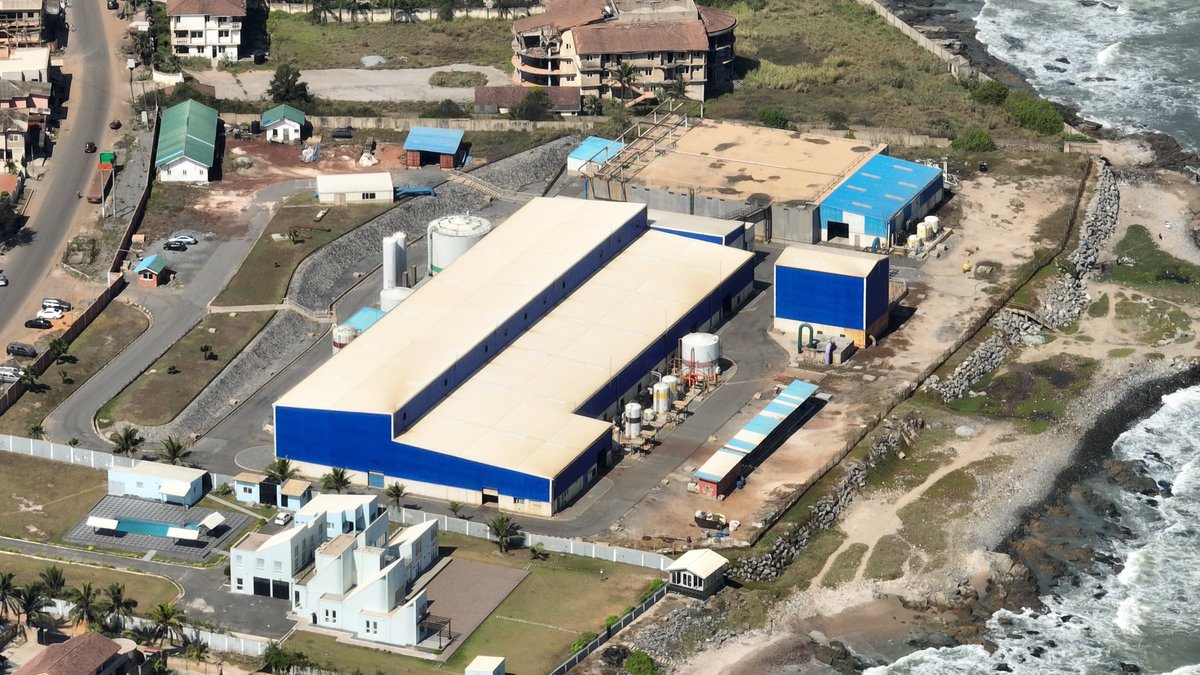
1. A desalination plant removes salt from water to make it drinkable and usable in various ways.
2. Why should a country full of rivers be pumping seawater into a plant to filter it? The rough argument was something like the following.
3. Teshie Nungua and other coastal areas have seen a population explosion. Water treatment plants near enough to distribute water to those areas simply aren’t able to keep up. Meanwhile the sea is just next door. Why not just pump the water from it and bypass some of the low pressure constraints?
4. The problem is that pumping seawater and cleaning it of salt is very energy-intensive. It costs considerably more than treating inland water. Also, it is the same pipe network one has to use to distribute the desalinated water anyway. Which is probably why desalination has never featured on any of Ghana’s water strategies to date.
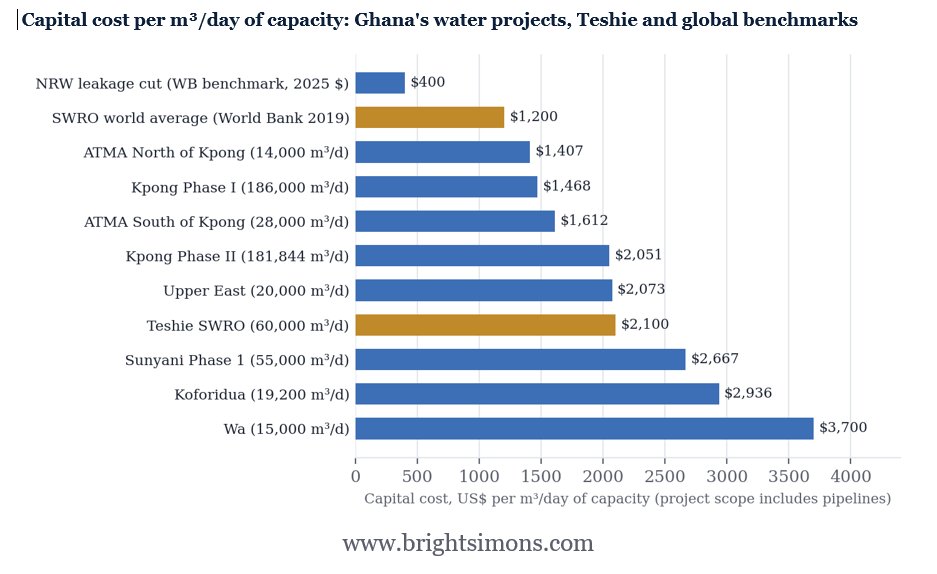
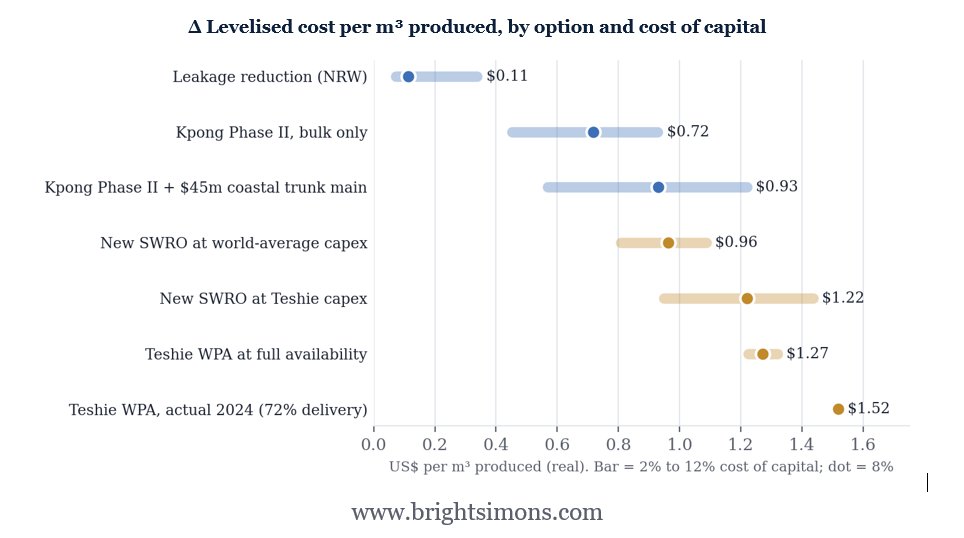
5. The Spanish offer to build the Teshie (Befesa) desalination plant was unsolicited. The advantage was that construction wasn’t all that more expensive than other projects on the drawing board (see attached chart) and they could move fast (Kpong phase II has stalled since 2015). Clearly, no one paid much attention to running costs.
6. The Spanish-Japanese consortium’s proposal came in April 2010. By March 2012, it was already before Parliament, which promptly waived $73 million in taxes. Anyone who knows Ghana would tell you that this is not routine. Their local partners, Hydrocol, must have been super effective.
7. Though Parliament was told it would cost $110 million, the investors say they spent ~$125 million.
8. The investors (Abengoa-Sojitz) were to run it for 25 years, produce 13.2 million (UK) gallons of water a day, get paid by Ghana Water (GWL) for it, and hand over the plant to Ghana in 2040. (Accra consumes ~140 million gallons of the ~230 million gallons of water GWL produces daily nationwide.)
9. For every 220 gallons, GWL was to pay $1.52. But there was also a fixed charge of $1.42 million that was payable every month regardless of how much water was being produced. I.e. Take or Pay. And $6.98m for electricity on top.
10. But in 2020, SIGA seemed to suggest that costs were higher. Its 25-year revenue forecast of about $1.3 billion for the plant works out at roughly $52m a year, or about $2.37 for every 220 gallons of water.
11. Ghana Water later told reporters that between February and August 2015 it received GH¢5.72m from selling the plant's water and spent GH¢48.68m buying and moving it, a cost recovery ratio of 11.8 per cent.
12. By October 2017 the utility said it was paying about GH¢8m a month to the project and collecting GH¢2m, a monthly loss of GH¢6m.
13. On 1 January 2018 Ghana Water shut the plant, with its communications head citing excessive operating costs.
14. Abengoa-Sojitz threatened, politely, to call the World Bank guarantee (~$179m). The shutdown was eventually reversed.
15. Five weeks later, Abengoa announced that AquaVenture Holdings Curaçao N.V. would acquire the Ghana project for $47m (minus offsets for the loans etc.)
16. Despite $50m from American DFI, OPIC, the deal fell apart and was cancelled in November 2019.
17. After the AquaVenture deal collapsed, the arrangement settled into an uneasy routine. The Finance Ministry quietly took over most of the payments because despite charging all Ghanaian consumers a special surcharge for the Teshie plant, GWL still couldn’t afford to pay the investors when bills came due.
18. All this while, the plant had constantly delivered below 70% of the contracted capacity (~60% in 2022.)
19. By 2023, Abengoa, then an $18bn infrastructure juggernaut, was on the verge of bankruptcy. It went under in April and was bought by Cox for $618 million. Scaling the purchase price proportionately means the Ghana assets changed hands for barely $1.6 million.
20. In May 2024, Befesa (the Teshie plant now run by Cox) told Ghana that heavy rains had rendered the plant inoperable, and that surveys found structural defects and inadequate bracing.
21. On 23 October 2024, Cox and Standard Bank commenced ICC arbitration against Ghana Water, with a companion case against the Republic under the World Bank guarantee.
22. The World Bank’s records show, however, that the guarantee on Standard Bank's loan and swap was cancelled on 31 December 2023 and 24 October 2024. The second date falls one day after the arbitration began. What a coincidence.
23. After the change of government in January 2025, the budget support which had kept the plant paid seemed to have been withheld.
24. On 31 October 2025 Ghana Water shut the plant. In January 2026 it published a rationing schedule.
25. After Cox and Standard Bank won against Ghana, the government announced that it is negotiating to buy the plant. Ghana Water's proposal for the 2026 to 2030 tariff period included a desalination cost of GH¢482.97m for 2026, including a capacity charge of GH¢316.01m. That is about $30.2m, nearly double the $15m to $17m a year seen in actual invoices.
26. Essentially, Ghana now wants to buy a plant and run it at double the cost of what it couldn’t pay before that got it whopped at arbitration.
27. Meanwhile the reverse osmosis membranes are all a mess, meaning another big refurbishment contract.
28. The crazy thing in all of this is that since 2010, the amount of water wasted in the Ghana Water system has increased significantly to 52% of all water produced. Fixing half of that would deliver nearly 8x the desalination plant’s output at ~5% of the cost.
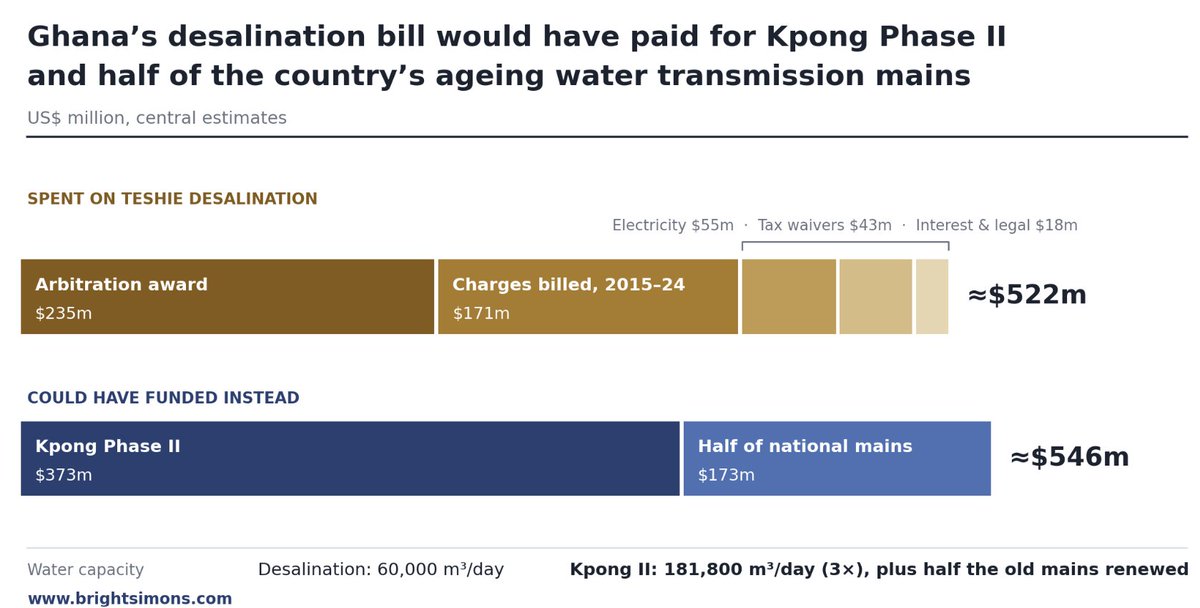
29. Kpong Phase II, which would cost $373 million, deliver 3x the amount of water being supplied by the desalination plant, and at a cost of 40% (using the SIGA benchmark) remains stalled.
30. If you add up Ghana’s spending on this project so far plus the arbitral award, you come to more than $500m. For that money, Kpong Phase II and half of all neglected transmission mains' repairs could have been done. Delivering 72 million more gallons per day, nearly the entire pipe water shortfall in Greater Accra.
Which of the following widely acknowledged "sub-Saharan" countries sit completely below the Sahara:
Chad
Mauritania
Niger
Mali
?
Even parts of Nigeria and Burkina Faso touch the Sahara.
"Sub-Saharan", like "Global South", is a geopolitical term of art. It isn't a literal definition in the way you wish to deploy just to hold on to your favourite myth. 😊
That is why you must throw your weight behind the anti-katanomics campaign. It is very rational to neglect policy and play only politics in Ghana. Without enough citizens pushing on policy even the most angelic politicians won't prioritise sound policymaking when the power and wealth is in politics.
@adusly1 You are reading the blogpost. Read the full length paper that compares the European and African experiences. You will see an appendix with the sourcing.
@adusly1 Read the papers I shared with you. I have looked at the original databases and done the computations. All these people you are citing have never linked to any source data.