Tired of manual prompt engineering to solve new task with your LLM?
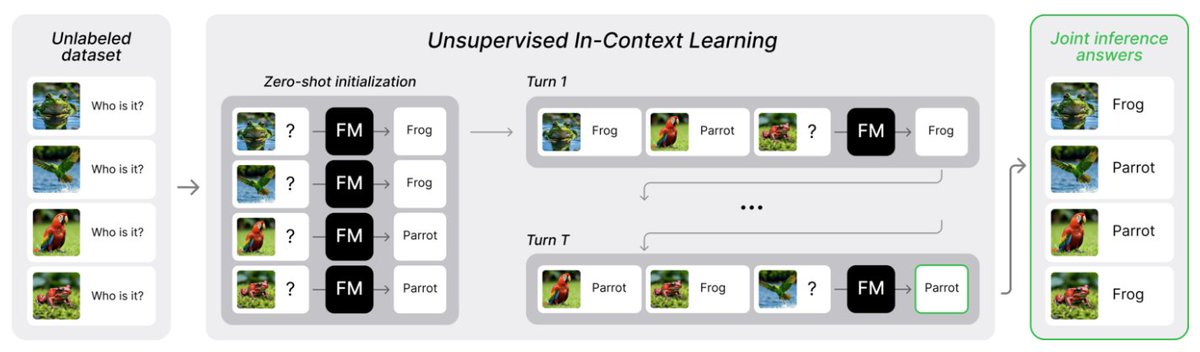
We introduce Joint Inference—a framework for fully unsupervised adaptation of large (vision) language models that often performs on par with supervised approaches 🔥 #ICLR2025
In collaboration with @zamir_ar lab — huge kudos to our amazing students: @artygadetsky, @andrew_atanov, @YulunJiang, @zhitong_gao, Ghazal Hosseini Mighan
🔗 Website: https://t.co/CKPlJew36O
📄 Paper: https://t.co/l8GrOVcVvu
💻 Code: https://t.co/qe68JlxTVS
1/ GFlowNets are known for training a forward policy to generate complex objects step by step. However, an equally important piece specific to the GFlowNet paradigm is a backward policy, which undoes these steps and plays a crucial role in training.
Can unsupervised transfer outperform zero-shot transfer?
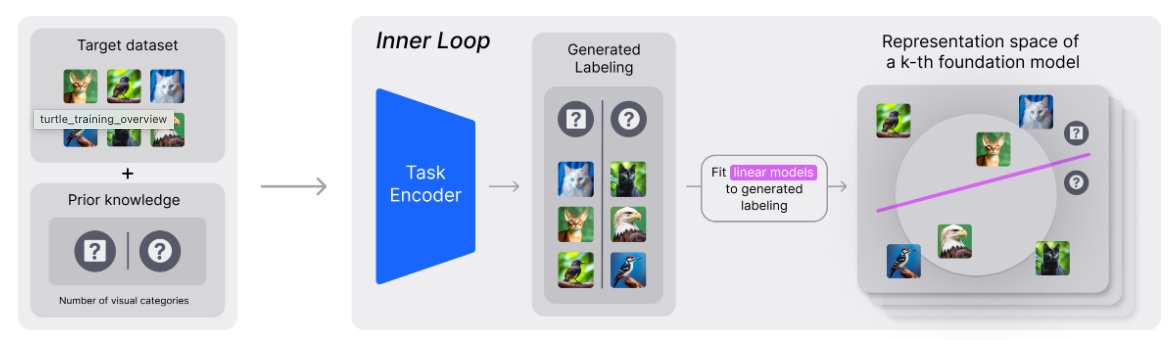
In our #ICML2024 paper we show it can! 🔥 We present 🐢TURTLE , a method for fully unsupervised transfer with any foundation model! TURTLE also achieves SOTA unsupervised performance 🔥
Kudos to @artygadetsky@YulunJiang
Paper: https://t.co/5fGw0MwhWC
Website: https://t.co/ScJOjej9UQ
Code: https://t.co/TCT7xVEQDp
How to infer human labelling of a given dataset in a model-agnostic way?
Check our new method HUME accepted at @NeurIPSConf as #spotlight!🌟 HUME provides a new view to tackle unsupervised learning.
Kudos to my fantastic PhD student @artygadetsky!
Paper https://t.co/ILNk2mJQm0
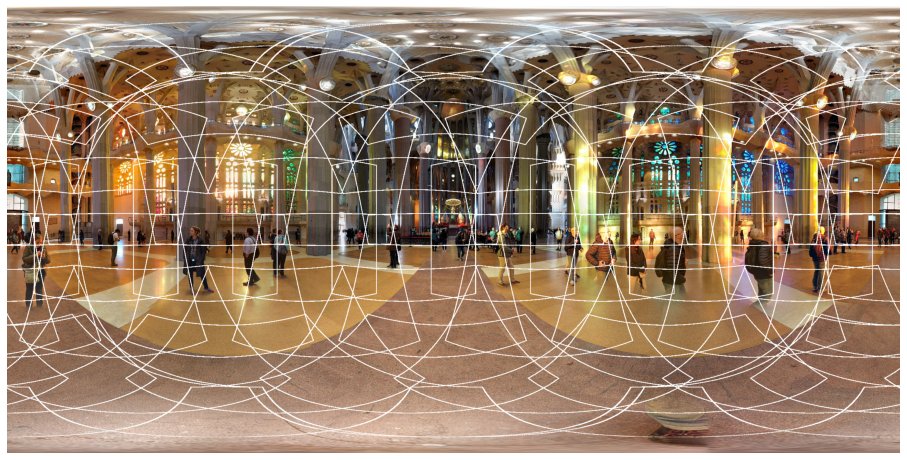
@SomeoneSerge Yes. The idea was to take a google photo sphere image (e.g., https://t.co/AzzbRSKaNx) and convert it into a 3D scene. You can try capturing such an image with the Google Street View app.
I was surprised with the overall quality of depth estimation. The example above can be further improved through better image processing. However, I chose to cover up the flaws with a fancy visualization instead.
So I divided the photo into multiple patches and generated depth maps for each patch individually. The tricky part was to stitch the depth estimates over multiple overlapping views. Depth maps were neither calibrated nor consistent.
We will be presenting “Leveraging Recursive Gumbel-Max Trick for Approximate Inference in Combinatorial Spaces” during #NeurIPS2021 poster session 8! We iteratively apply the Gumbel-Max trick to obtain structured variables instead of categorical.
Poster: https://t.co/Z8PY15pndX
@cjmaddison Thrilled about the further progress of the Gumbel machinery! In https://t.co/Vqh1RTmNoZ, we found that an additional orthogonal regularizer on X_t may be a game-changer for finding a topological sort of a causal graph. It could also be helpful for the subset selection.