Groq's LPU is faster than Nvidia GPUs, handling requests and responding more quickly.
Groq's LPUs don't need speedy data delivery like Nvidia GPUs do because they don't have HBM in their system. They use SRAM, which is about 20 times faster than what GPUs use. Since inference runs use way less data than model training, Groq's LPU is more energy-efficient. It reads less from external memory and uses less power than a Nvidia GPU for inference tasks.
The LPU works differently from GPUs. It uses a Temporal Instruction Set Computer architecture, so it doesn't have to reload data from memory as often as GPUs do with High Bandwidth Memory (HBM). This helps avoid issues with HBM shortages and keeps costs down.
If Groq's LPU is used in places that do AI processing, you might not need special storage for Nvidia GPUs. The LPU doesn't demand super-fast storage like GPUs do. Groq is claiming that its technology could replace GPUs in AI tasks with its powerful chip and software.
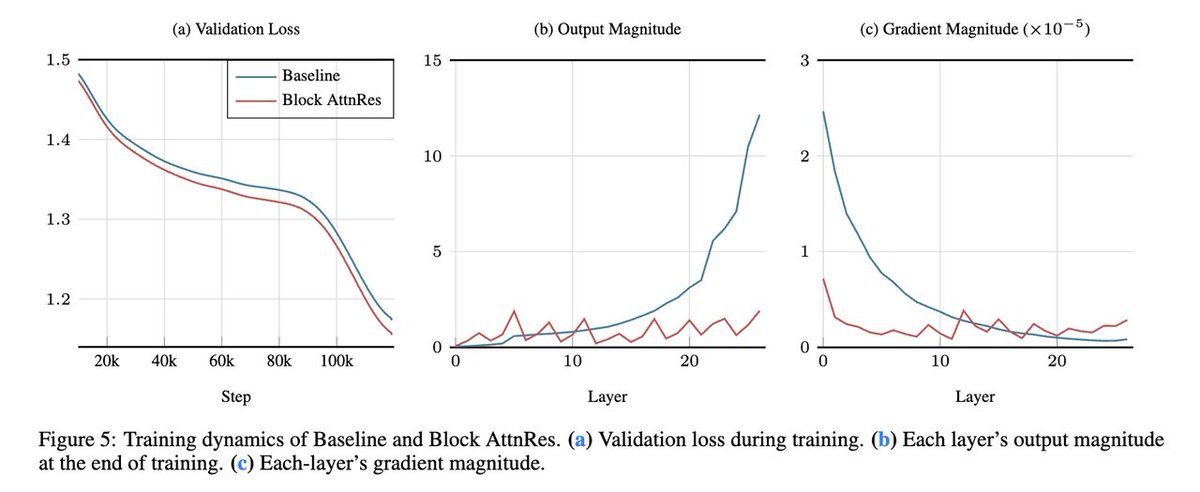
Analysis of training dynamics demonstrates how AttnRes naturally mitigates hidden-state magnitude growth and yields a more uniform gradient distribution across depth.
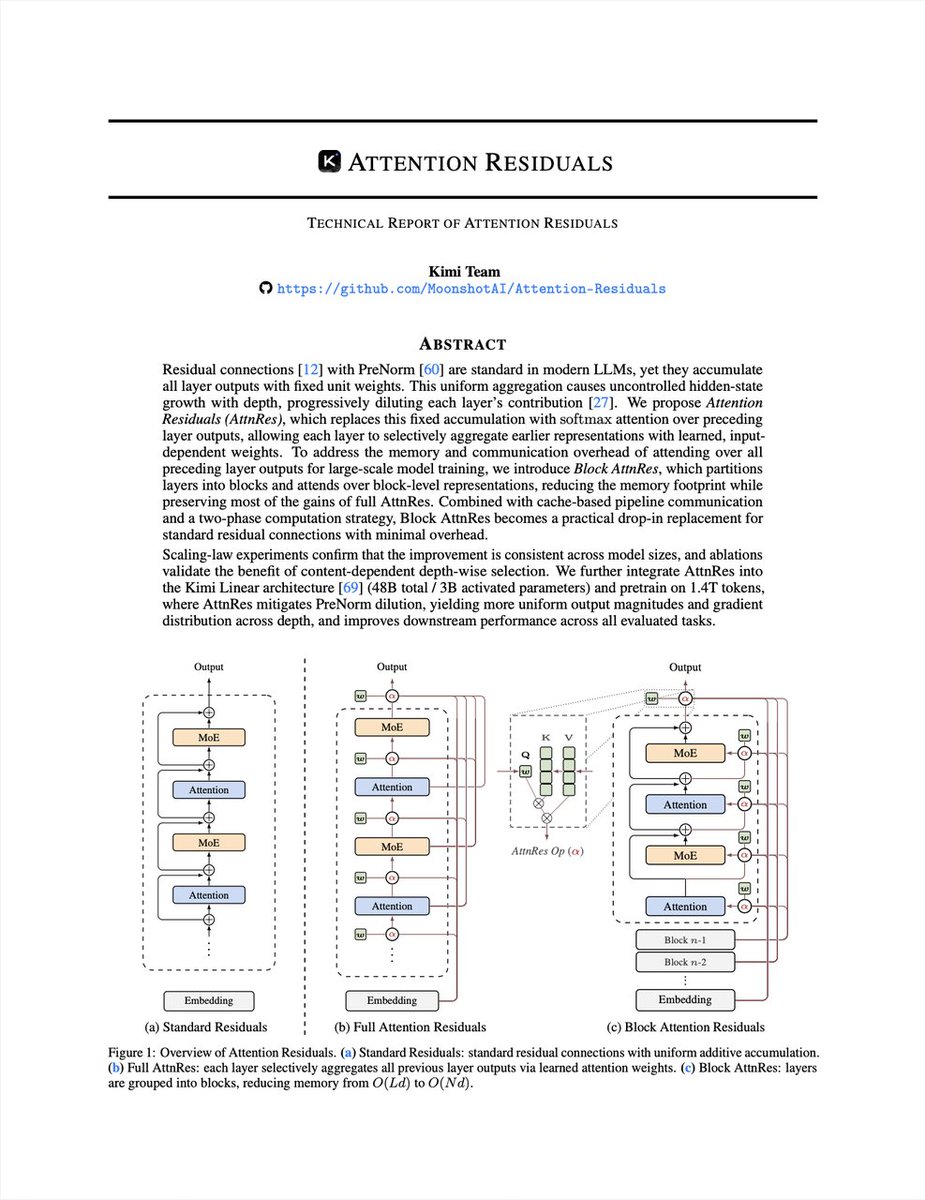
Introducing 𝑨𝒕𝒕𝒆𝒏𝒕𝒊𝒐𝒏 𝑹𝒆𝒔𝒊𝒅𝒖𝒂𝒍𝒔: Rethinking depth-wise aggregation.
Residual connections have long relied on fixed, uniform accumulation. Inspired by the duality of time and depth, we introduce Attention Residuals, replacing standard depth-wise recurrence with learned, input-dependent attention over preceding layers.
🔹 Enables networks to selectively retrieve past representations, naturally mitigating dilution and hidden-state growth.
🔹 Introduces Block AttnRes, partitioning layers into compressed blocks to make cross-layer attention practical at scale.
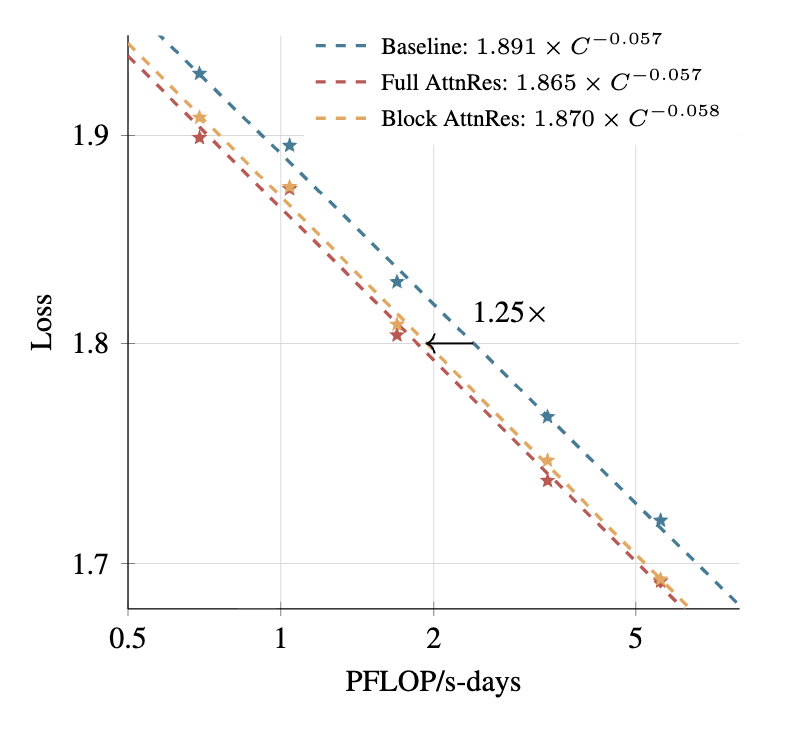
🔹 Serves as an efficient drop-in replacement, demonstrating a 1.25x compute advantage with negligible (<2%) inference latency overhead.
🔹 Validated on the Kimi Linear architecture (48B total, 3B activated parameters), delivering consistent downstream performance gains.
🔗Full report:
https://t.co/u3EHICG05h
We've raised $6.5M to kill vector databases.
Every system today retrieves context the same way: vector search that stores everything as flat embeddings and returns whatever "feels" closest.
Similar, sure. Relevant? Almost never.
Embeddings can’t tell a Q3 renewal clause from a Q1 termination notice if the language is close enough.
A friend of mine asked his AI about a contract last week, and it returned a detailed, perfectly crafted answer pulled from a completely different client’s file.
Once you’re dealing with 10M+ documents, these mix-ups happen all the time.
VectorDB accuracy goes to shit.
We built @hydra_db for exactly this.
HydraDB builds an ontology-first context graph over your data, maps relationships between entities, understands the 'why' behind documents, and tracks how information evolves over time.
So when you ask about 'Apple,' it knows you mean the company you're serving as a customer. Not the fruit.
Even when a vector DB's similarity score says 0.94.
More below ⬇️
Mercury 2 is live 🚀🚀
The world’s first reasoning diffusion LLM, delivering 5x faster performance than leading speed-optimized LLMs.
Watching the team turn years of research into a real product never gets old, and I’m incredibly proud of what we’ve built.
We’re just getting started on what diffusion can do for language.
We built Talos - a full CNN inference engine running directly on silicon.
Every multiply, buffer, and data path lives as real digital logic on the FPGA.
This is what deep learning looks like when the model becomes hardware👇
Today, Valar Atomics became the first startup in history to split the atom.
Announcing Project Nova, a series of zero power critical tests on Valar Atomics' Nova Core in collaboration with Los Alamos NCERC and NNSS.
Nova went critical for the first time this morning at 11:45am.
Recently published in @Nature, Decoded Quantum Interferometry (DQI), a new quantum algorithm achieving exponential speedup on select optimization problems. Learn more → https://t.co/U7VPMI1TKS
not that far of prediction almost a year ago — the gibbs de-noising and ising machine like + solving the valley problem — congrats again for the TSU @extropic
https://t.co/ouAfeFVwov
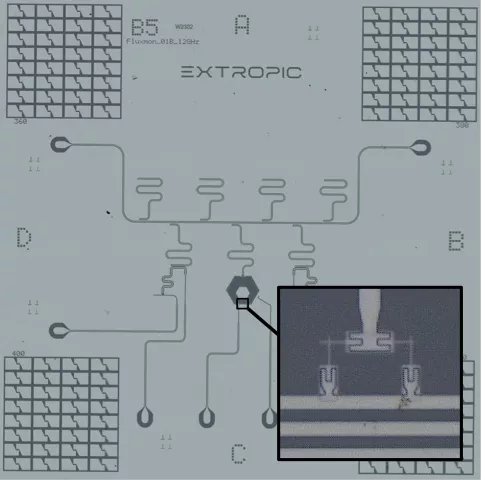
@extropic Extropic @GillVerd@trevormccrt1 saw more than anyone that, in order to explain this new AI chip, they had to embrace uncertainty that:
Extend computing scaling well beyond the constraints of digital computing.
Enable AI accelerators that are many orders of magnitude faster and more energy-efficient than digital processors (CPUs/GPUs/TPUs/FPGAs) at room temperature (**not at ~0 kelvin or -273.15°C) .
Unleash powerful probabilistic AI algorithms that are not feasible on digital processors, inheriting a physical entropy/randomness nature that results in an immense amount of noise** (very important/ tun·a·ble ).
Extropic AI chip will use far-less energy **by a magnitude is certain; It would disrupt the industry altogether, from its foundation (fab, engineering, software, ml, llm) — Keep your mind open about this; as—it would re-define all various learning concepts RL/SL/USL/TL/CL/AL/SSL and paradigms possible through quantum tunnelling along with a immense space of hallucination/uncertainty.
There will be an enormous number of tunable physical entropy not less than that of 𝑆=𝑘⋅𝑙𝑛(𝑊) and enormous h/parameters that will be possible for AI; far beyond that of digital computing CPU/GPU acceleration of matrix multiplication.