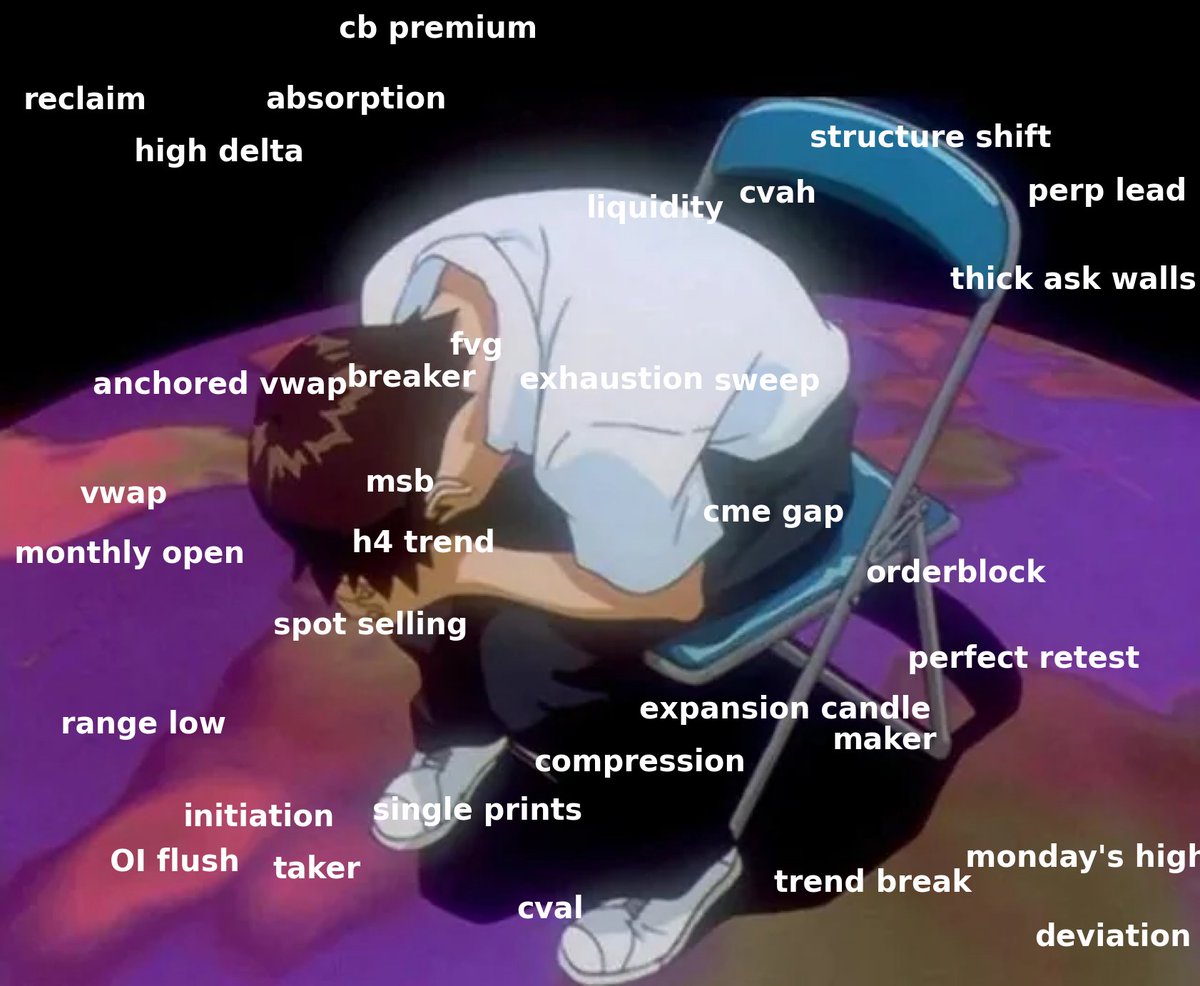
Beyond A Decade of Setups
The technicals, the probabilities, the execution, and the trader.
---THE TECHNICALS---
For me, technical improvements came from being able to read the market in real time and understand what was likely happening underneath the surface at inflection points: the flows, the positioning, and the reaction at a level.
That’s where microstructure started to matter.
The signs of price failure. The shift in momentum. Tape speed and volume being supported by flows. Understanding price and flow mechanics when the same conditions kept showing up again and again.
I saw it enough times that eventually it stopped feeling like noise. It became data I could interpret and reason about.
Once I could define the structure, understand the pattern, and recognise the flows behind it, I knew I could read the market in almost real time and identify a possible execution trigger.
But from experience, that was still only a small part of the game.
---THE PROBABILITIES---
One of the questions I started asking myself was: how do I grade my performance if I don’t even know how to measure or quantify what I’m actually trading?
For example, placing a stop at some random swing high. How do I measure that over 100 trades? What parameters am I actually tuning? How do I know what’s improving and what’s just noise? Are my MAE/MFE stats meaningful at all?
That was a big realisation for me. How could I really perform at a high level if parts of my process were still random and carrying a high degree of variance?
Maybe I could do okay.
But was okay good enough?
The real question became whether I could trade this with a measurable probability in my favour.
Not perfectly.
But consistently enough to know I wasn’t just operating from randomness.
I was operating with purpose and probability.
---THE EXECUTION---
The deeper work, for me, has been myself as the trader and the process - not just the technicals alone.
I spent a long time obsessing over price action, order flow, and technicals, while neglecting the part that was actually affecting my performance.
I realised I could study price charts all I wanted.
Technical skill alone wasn’t going to move the needle.
I got better technically, but the same flaws in my game kept resurfacing because I hadn’t dealt with them properly.
For me, the strategy in isolation was never really the issue. It was executing when emotion was at its highest.
In my own trading, the problem often wasn’t that I lacked a setup. It was the execution around it - entering too early, exiting too late, cutting too soon, sizing poorly, or freezing when the decision actually mattered.
So I had to ask myself...
Could I explain one of my execution strategies in detail, beyond just saying “look for an SFP”?
Could I explain the logic behind it?
Why it works?
Where it should work?
What I’m actually trying to capture?
Because “look for an SFP” isn’t a strategy.
It’s a label.
Second-guessing, hesitating, cutting too early, oversizing, and letting fear, frustration, or ego influence the decision-making process.
I’ve dealt with all of it for years. And if I’m not fully locked in, it can still creep back in.
For me, the struggle hasn’t always been finding opportunity. Opportunities always exist.
The challenge is executing cleanly when it matters.
The entry. The management. The exit. The full trade life cycle and the statistics around it.
That’s the part I obsess over most now. It serves as a constant feedback loop - the quality of which depends on how honest I’m willing to be with myself.
I know what I’m looking for. The countless hours spent testing, reviewing trades, studying price, and collecting data are all part of turning that into a real strategy.
So the focus is simple: better preparation, better review, better sizing, more patience, and cleaner execution.
Small improvements, repeated consistently.
The 1% changes that compound - think Atomic Habits.
---THE TRADER---
At some point, trading became less about proving I was right and more about executing what I said I would execute.
Not forcing trades. Not reacting emotionally. Not needing to be right. Not caring as much about what everyone else is doing on X.
Just trying to execute a defined process with purpose.
Variance will always exist. Losses will always be part of the game. But with enough data, review, and self-awareness, I started to move away from randomness.
I started narrowing the window of variance - which, in my opinion, is one of the hardest parts of becoming a better trader.
Because if the parameters I journal aren’t quantifiable, what am I really journaling?
Dogshit data.
Randomness.
This matters with things like stop placement, sizing, and trade management.
By bringing more systemisation into my execution - whether that’s structured sizing, defined risk, Kelly Criterion, or whatever framework suits the way I trade - I can narrow the window of variance and trade with more intent.
Let the process do its work.
That’s what it comes down to for me:
Building the structure.
Refining the performance.
Becoming the trader capable of executing it.
Because performance isn’t just the setup.
Performance is how I execute the setup and manage the entire trade life cycle - from strategy creation, to initiation, to execution, to performance review.
Not really giving a flying f**k what anyone else says or does.
Just me against me - sharing my experiences and own journey... mainly talking to myself but hope someone finds it insightful.
I resigned from Anthropic today. I spent the last three years doing pretraining research at both OpenAI and Anthropic. Neither company is acting responsibly. They are racing straight to self-improving superintelligence and gambling with our lives. More thoughts below.
You need 2-3 bull runs to make it in crypto.
First one, you get rekt chasing pumps.
Second one, you make money but never take profit.
Third one, you finally make it.
Most people quit after the first.
What a trade looks like for me from analysis -> execution -> TP/invalidation:
1) Context
What environment am I trading in?
First I define the market regime: trend vs. range, vol expansion vs. compression, risk-on vs. off, HTF directional pressure, location relative to EMA/VWAP/HTF levels, within value or outside?
This step answers if this is a market that I want to be pressing directionally (playing inside out), or fading extremes (playing outside in).
2) Thesis
What is the asymmetric bet?
From context, I begin to form a directional thesis: continuation, mean reversion/rotation within value.
This is not a prediction; it’s a hypothesis about which side has structural advantage given existing positioning, who's creating pressure and whether parties are being rewarded for that pressure at local extremities.
3) Location
Where does the trade make sense?
I define actionable zones: HTF/LTF confluence, VWAP SD bands, prior value highs/lows, FRVP extremities, gaps, structural highs/lows.
If price is not at a EV+ location, I am not a participant.
This enforces selectivity and avoids chasing flow mid-range in order to maintain a EV+ trade structure. I try to avoid executing within value most of the time as execute mean reversion more than momentum continuation.
4) Alignment
Who do I want to trade with?
I gauge passive liquidity and positioning. Where is liquidity is stacked? Where are large resting orders that could be useful for absorbing active participants? Are there limit chasers? Where is one side structurally advantaged?
This step answers: Am I trading with pressure or fighting it?
5) Trigger
What confirms timing?
I wait for real-time flow: absorption, exhaustion, initiation, climax, momentum loss i.e. is aggression being rewarded/unrewarded?
ex: If I'm looking for mean reversion I want to speculate on effort at extremities going unrewarded. aggressive longs opening into stacked asks at 2sd dval / wvwap confluence on a down sloping week. There is no confirmation. There is only EV+ speculation.
This is the execution filter.
No trigger = no trade, even if thesis is “right.”
Missed execution off trigger (late, hesitated, away from desk etc.) = no trade.
This part requires the most speed of thought, discipline and courage.
6) Risk Definition
Where am I wrong?
As I enter I want my invalidation defined.
For reversion: failure of absorption, continued effort through level, new late positioning being rewarded, high volume or expansionary moves not retracing, acceptance outside of value.
For continuation: effort retracing, late new positioning going underwater, exhaustion of active flow, absorption.
Mental stops are placed where the thesis is objectively wrong, not where PnL pain is tolerable. Positions are closed manually, not at arbitrary levels.
7) Execution
Enter with strong EV+ speculation, not confirmation.
Entries are taken only when location, flow alignment, and triggers converge. Size is fixed in # of btc and variance in outcome is allowed. I do not abide by the (imo) rookie 1r concepts. Execution quality must be maintained (if I'm late by a few minutes, I won't chase, I must wait for a new setup). I only want to execute where I know I'll be wrong quickly, I do not want to sit in a trade where I'm "hoping" the market proves my thesis correct or thinking "eh, it's close enough".
8) Trade Management
Is the market confirming or degrading my thesis?
Post-entry, I monitor whether initiative is sustained, whether active flow continues to support my side, if the person I'm countering is underwater and under pressure and whether momentum decays or maintains strength.
Scaling, partials, or scratch exits are dictated by market behavior around key levels or trade thesis- not running pnl, emotional stress or desire to win (not lose).
9) Exit
Monetize edge, not PnL
Exits are driven by objective EV+ targeted levels (dval -> dvwap), protagonist flow winning/antagonist flow losing, failure to sustain initiative flow, momentum loss, targeted positional exits (entry on fading large long opening and waiting for long closing), or clear regime shift.
I’m not paid for being right on bias. I’m paid for exiting when the EV of my trade diminishes or when the market’s willingness to continue diminishes.
--
Well that about summarizes it.
Thanks for reading (bookmarking and never reading)
Anthropic ha lanzado una guía de 37 minutos para construir Agentes de IA que automatizan una empresa entera.
Gratis. De los ingenieros que construyeron Claude.
Agentes que trabajan, se reparten tareas y ejecutan todo solos.
Subtitulado al español.
Guárdate este post. 🔖
🚨 Here is the truth from Ceuta, Spain:
60,000+ migrants from Morocco’s border stormed the small town and are now hiding in the mountains and city to reach mainland Europe.
Moroccan migrants said Moroccan authorities let them through their border and Spain literally opened their gates upon arrival. Many migrants thank PM Pedro Sánchez for opening the border... Ceuta is now effectively shut down due to looting concerns, and the military is losing power as migrants outnumber them and continue to escape into the mountains.
Now thousands of military age men are set to spread throughout Europe due to one country’s “failure.”
$1.6 million dollars in Bitcoin was drained from my account on July 29th in the Cold Card wallet hack.
My Bitcoin was in cold storage. My keys were on a ColdCard device kept in a safety deposit box that had never been connected to the internet.
This part's nerdy, but here's what happened:
Hackers discovered a vulnerability in the part of the hardware wallet code used to create seed phrases.
This allowed them to use AI to brute force guessing seed phrases.
I was at our cottage and heard about the hack today.
"No way this affects me." I thought.
I logged into Wasabi––software that lets me view my bitcoin wallets online.
Right away I saw lines of red transaction–withdrawals–and I knew.
From 9:36pm - 9:43pm on July 29th, every wallet I had had been emptied.
18.25245043 btc gone. That's just over $1.6 million dollars CAD.
Perhaps the hardest part about this is that I did everything right.
I never shared my seed phrase with anybody. My devices never touched the internet. Everything was kept in multiple safes and safety deposit boxes.
None of it mattered. All because the hardware that created the seed phrase originally had one line in their code from 2021 that had a vulnerability.
I'm filing a police report and a report with the Ontario Securities Commission. But I don't expect to recoup anything.
A part of me is trying to make sense of what just happened. Or try to figure out a lesson in it. I'm struggling. $1.6 million is a staggering amount of money to have stolen.
I guess all that I can think about right now is that I'm so damn happy that I'm an entrepreneur and that my earning potential is under my control. Mark my damn words. I'll recover.
I recorded a 10-minute trade breakdown using the footprint in real time
0:11 - weekend context
1:10 - level of interest
1:51 - ltf context & orderflow
2:59 - live footprint
4:22 - footprint nuance
6:02 - execution
7:24 - trade management
8:55 - pattern recognition
STEP BY STEP TUTORIAL ON HOW TO READ THE DOM
0:11 - layout overview
0:52 - dom basics
2:30 - tick sizes
3:21 - slippage
4:27 - pulling & stacking
5:53 - aggregated data
6:54 - iceberg orders
9:58 - footprint with dom
Footprint Absorption:
Increasingly useful for catching short term reversion setups.
> good initial high
> increasingly agressive buying
> lower high (absorption)
Clear invalidation above initial high as that should be protected by the limit orders absorbing the aggressor.
🚨 Anthropic just showed a 27-minute workshop on how to actually do prompts for Claude.
Taught by the people who built it.
Free. No registration. No paywall.
I've seen $300 courses that don't cover what they teach in the first 8 minutes.
Watch it and Bookmark it now
Jane Street pays $750k/ year for quants who can answer how to use Stochastic Process and Markov Chains in quant trading.
This 1-hour MIT lecture on probability gives you the same insights quants get paid $60K/month for.
Bookmark & watch today. Then read the article below.