Bruce Power Unit 3 reconnected to the grid just after 1:00 EDT today following refurbishment, ready to operate for another 30-45 years.
Its first grid connection occurred in 1977.
#CANDU 🍁 #NuclearEnergy 🇨🇦
The uncomfortable truth: The 🇺🇸 pulls the strings on most AI tooling, cloud storage, & satellite infrastructure used by 🇨🇦's.
Further, data residence ≠ data sovereignty. 🇨🇦 servers owned by 🇺🇸 firms are subject to 🇺🇸 law in many ways.
It doesn't have to stay this way.
As ever the problem is that credentialism means that students think the goal of getting a degree is to get a bit of paper when in fact it is to learn things and when they use AI to do the learning for them the primary person they cheat is themselves.
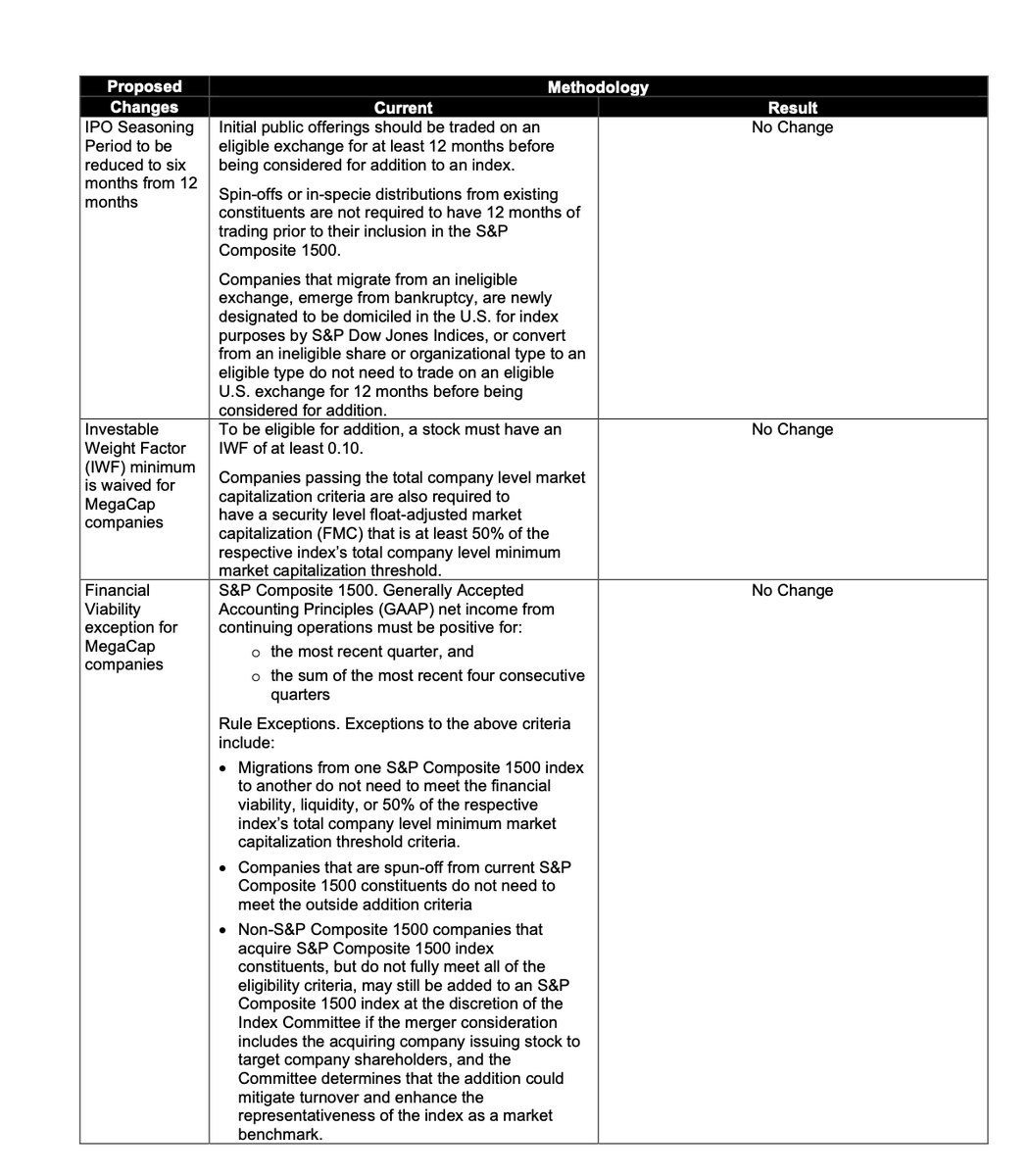
Wow, the S&P Dow Jones Indices has just officially announced that they will NOT be changing their inclusion rules to make it easier for “MegaCap” companies (such as @SpaceX) to be fast-tracked into the S&P 500.
Their reasoning:
"S&P DJI determined that exceptions to the financial viability, seasoning, and IWF requirements should not be granted solely based on market capitalization. The decision not to adopt the proposed exceptions preserves core index principles by maintaining consistent application of these key requirements. Although there may be trade-offs between strict adherence to these eligibility requirements and broad representativeness, the current methodology provides substantial market coverage and sector balance. As a result, the indices can continue to meet their stated objectives while preserving their role as representative and investable benchmarks for the U.S. equity market.
No changes will be made to the eligibility criteria including financial viability screens, seasoning period, or minimum IWF, for the S&P 500, S&P MidCap 400, or S&P SmallCap 600 as a result of the S&P Dow Jones Indices consultation on the treatment of MegaCap companies. Accordingly, there will be no changes to existing methodology for this index family."
This means that the earliest @SpaceX could be eligible to be added to the S&P 500 would now be June 2027.
The requirements that will now remain in place are:
• No changes to S&P 500 eligibility rules for mega-cap companies.
• Mega-cap companies will still need to wait 12 months after their IPO before being considered for S&P 500 inclusion.
• S&P will not waive profitability requirements for mega-cap companies. The company must have positive GAAP net income in the most recent quarter, and the sum of the most recent four consecutive quarters.
• S&P will not waive minimum public float requirements for mega-cap companies. At least 10% of a company's shares must be publicly tradable ("free float").
The S&P rejected proposals that would have:
• Reduced the IPO seasoning period from 12 months to 6 months
• Waived profitability requirements
• Waived minimum public float requirements
Would the US national hockey team fly to Berlin in 1943 to play an exhibition game? Imperialist and terrorist Russia is no better than fascist Germany was. And criminal and murderer Putin is no better than Hitler!
Fewer than half of Albertans say they would stay in a newly independent province: poll https://t.co/h1DAXQ0iey
Find out more at https://t.co/1zbPY5GAhV
I hope it happens just so we see the reaction of the centrist accounts who still think Bari Weiss is nothing more than a principled and serious journalist who wants to give America "just the facts.
So, I've worked in the beef industry. I have a fairly detailed knowledge of beef markets, the supply chain, parasites and parasiticides, etc. Suffice it to say, this is a nightmare scenario, but one we've known was coming since at least 2022.
New World Screwworm was eradicated from North and Central America in the mid-90's. The US gov't (APHIS) funded a program of screwworm drops, where they bred sterile males so that extant populations couldn't reproduce and move northwards. But in 2022 NWS jumped the Darien gap and started moving northwards once again. It's most likely that they came undetected on livestock brought alongside migrants fleeing political instability in South and Central America. Elon Musk/DOGE, of course, cut several monitoring programs that would have detected this exact scenario. The screwworm drops are still funded, but the monitoring programs are what have been cut - a stupid move if there ever was one.
A serious Central/South America policy would have worked hand-in-hand with CA/SA governments to help contain this, but we've never had a serious policy towards South America, not during the Biden years, and especially not under Trump. The USDA broke ground on a sterile screwworm facility in Texas... last month. I worry it's too little, too late.
Screwworm is so dangerous because, unlike other fly larvae, they lay eggs and feed on living flesh. So something like a small scratch (or even bug bite) can quickly becomes infested, and the larvae will burrow into the flesh, growing the wound and attracting more screwworm. They don't only parasitize cattle, but will also feed on wildlife, domestic pets, even humans. Since they have detected screwworms in domesticated cattle right now, it's likely that there is a wild reservoir as well. We can quarantine herds and pets, but we can't quarantine deer and armadillos. They will move, and so will the NWS.
Under normal circumstances, cattle are moved around - a lot. Calves will be sent to stockers through their adolescence, then shipped to feedlots for finishing. A lot of calving operations (like 70%) are small, and small-time producers don't always catch parasite infestations. Cattle moved in-state don't require a certificate of veterinary inspection, so it's easy for an infested animal to be moved without being noticed. Animals crossing state lines do need a CVI, but Texas has such an enormous cattle population (something like 13 million head) that as goes Texas, so goes the nation.
Fortunately, we have a lot of drugs that treat NWS. The FDA has issued several emergency use authorizations in the last year or so. But every input raises the price of beef, and treatment only makes a difference if producers catch an infestation early. If an infestation spreads unnoticed on a large feedlot, it can hit hard, both in terms of cattle that have to be killed, and treatments that then have to be deployed. Producers will spend days at a time running cattle through the chute, inspecting them and applying parasiticides. It costs a lot of money, which is then passed on to the consumer.
What does that mean for you? Beef is a commodity, and just because there's no NWS up here in Illinois doesn't mean that prices won't skyrocket - and they will skyrocket. US herd size is already at record lows, and this will result in culls. Consumer prices also run 18-24 months behind, which means that shocks to the supply chain now are still going to be felt by consumers in 2028.
It's hard to say if our government will be able to muster an effective response - though I don't trust our current administration, which can't even throw a 250th anniversary party, to be able to deal with an ecological issue of this magnitude. It doesn't help that our current USDA secretary is a lawyer and think-tank creature. I don't much trust the state government of Texas either. The industry has also taken the workforce of large animal veterinarians for granted - a monopoly/market power issue that I just can't get in to here.
For me, it comes back to our federal government having an incoherent policy on Central and South America. We knew what was coming, we know what's going to happen, but we cut the program meant to prevent this scenario. Instead of taking those countries seriously as partners, the government has been stupid and domineering.
Here's the kicker: this is what the industry voted for. They might scream, they might get bailed out, but all that means is that you, the consumer, are going to be paying more for beef, plus whatever bailout gets shoveled their way. Until the industry accepts that they are part of a larger system; that they cannot eternally privatize the gains and publicize the losses of beef production; that they need to consider sustainability and stewardship in the management of their operations, this is only going to keep happening. Eventually, they may find that there is very little goodwill for them among the public, and people will decide that a Brazilian ribeye tastes just as good as one from Texas.
“Better to be a member of the EU than a U.S. state” — Finland’s president made Canada an unexpected proposal
Alexander Stubb suggested expanding the EU to around 40 countries. He said Europe needs to become stronger on the global stage and more actively attract new partners.
Among possible candidates, Stubb named the United Kingdom, Canada, Turkey, Norway, and Iceland.
According to him, now is the right moment due to the war in Ukraine and shifts in U.S. policy.
“Better to be a member of the EU than a U.S. state” — Finland’s president made Canada an unexpected proposal
Alexander Stubb suggested expanding the EU to around 40 countries. He said Europe needs to become stronger on the global stage and more actively attract new partners.
Among possible candidates, Stubb named the United Kingdom, Canada, Turkey, Norway, and Iceland.
According to him, now is the right moment due to the war in Ukraine and shifts in U.S. policy.