3) In fiqh, taʿzīr is punishment for sin
والتعزير: تأديب على ذنوب لم تشرع فيها الحدود
“Taʿzīr is disciplinary punishment for sins for which the fixed punishments were not legislated.”
[al-Aḥkām al-Sulṭāniyya], Vol. 1, p. 344.
So when the text says ويعزر, it is explicitly classifying the act as a sin subject to disciplinary punishment. That is the exact opposite of permissibility.
4) Ghusl after a sinful act does not make the act lawful
A very explicit clarification:
وَعَلَيْهِمَا الِاغْتِسَالُ مِنْ الْجَنَابَةِ، تَرْتَفِعُ الْجَنَابَةُ مِنْ الِاغْتِسَالِ؛ لَكِنْ لَا يَطْهُرَانِ مِنْ نَجَاسَةِ الذَّنْبِ إلَّا بِالتَّوْبَةِ
“And both of them must perform ghusl from janābah. Janābah is removed by ghusl; but they are not purified from the filth of the sin except through repentance.”
[al-Fatāwā al-Kubrā], Vol. 3, p. 413.
This is exactly the distinction the screenshots try to erase. A fiqh text can say ghusl is obligatory after an act because ritual impurity occurred, while simultaneously affirming that the act itself was a sin requiring repentance.
5) Classical scholars describe these acts as crime, sin, and violation of sanctity
وأما وطء الميتة، ففيه قولان للفقهاء، وهما في مذهب أحمد وغيره. أحدهما: يجب به الحدّ، وهو قول الأوزاعي، فإنّ فعله أعظم جرمًا وأكثر ذنبًا لأنه انضمّ إلى فاحشته هتكُ حرمةِ الميتة.
وأما وطء البهيمة، فللفقهاء فيه ثلاثة أقوال: أحدها: أنّه يؤدَّب،
ولا حدّ عليه.
“As for intercourse with a corpse, the jurists have two opinions about it, and they are found in the madhhab of Aḥmad and others. One of them is that the fixed punishment is due for it, and this is the view of al-Awzāʿī, for his act is a greater crime and a more abundant sin, because joined to his obscenity is the violation of the sanctity of the corpse.
And as for intercourse with an animal, the jurists have three opinions concerning it. The first is that he is disciplined, and there is no fixed ḥadd upon him.”
[al-Dāʾ wa al-Dawāʾ = al-Jawāb al-Kāfī], Vol. 1, p. 410.
That is not the language of permission. It is the language of crime, sin, obscenity, violation of sanctity, and punishment. +
The screenshots do not show permission. They show two very different things:
first, a ṭahāra ruling about when ghusl becomes obligatory after penetration, even in sinful or forced cases; and second, a jināyāt/ḥudūd ruling saying that some acts do not receive the fixed ḥadd of zinā, but the offender is still punished with taʿzīr. That is the opposite of “permitted.”
1) The al-Nawawī screenshot is about ghusl, not permission
قَالَ أَصْحَابُنَا وَلَوْ غَيَّبَ الْحَشَفَةَ فِي دُبُرِ امْرَأَةٍ أَوْ دُبُرِ رَجُلٍ أَوْ فَرْجِ بَهِيمَةٍ أَوْ دُبُرِهَا وَجَبَ الْغُسْلُ سَوَاءٌ كَانَ الْمَوْلَجُ فِيهِ حَيًّا أَوْ مَيِّتًا صَغِيرًا أَوْ كَبِيرًا وَسَوَاءٌ كَانَ ذَلِكَ عَنْ قَصْدٍ أَمْ عَنْ نِسْيَانٍ وَسَوَاءٌ كَانَ مُخْتَارًا أَوْ مُكْرَهًا أَوِ اسْتَدْخَلَتِ الْمَرْأَةُ ذَكَرَهُ وَهُوَ نَائِمٌ وَسَوَاءٌ انْتَشَرَ الذَّكَرُ أَمْ لَا وَسَوَاءٌ كَانَ مَخْتُونًا أَمْ أَغْلَفَ فَيَجِبُ الْغُسْلُ فِي كُلِّ هَذِهِ الصُّوَرِ عَلَى الْفَاعِلِ وَالْمَفْعُولِ بِهِ
“Our companions said: if the glans is concealed in the anus of a woman, or the anus of a man, or the vagina of an animal, or its anus, then ghusl becomes obligatory, whether the one into whom it is inserted is living or dead, young or old; whether that happened intentionally or by forgetfulness; whether he did it willingly or under compulsion; or a woman caused his penis to enter while he was asleep; whether the penis was erect or not; whether he was circumcised or uncircumcised. So ghusl is obligatory in all of these cases upon the active party and the one acted upon.”
[Sharh al-Nawawi ʿalā Muslim], Vol. 4, p. 41.
This passage destroys your reading by its own wording. Al-Nawawī explicitly includes forgetfulness, compulsion, and even the case where a woman causes penetration while he is asleep. No sane reader can turn that into approval. The subject here is only: when does janābah occur such that ghusl is required? It is a purity consequence, not a permission.
And al-Nawawī continues with the specific line shown in the screenshot:
وَلَوِ اسْتَدْخَلَتِ الْمَرْأَةُ ذَكَرَ بَهِيمَةٍ وَجَبَ عَلَيْهَا الْغُسْلُ
“And if a woman causes the penis of an animal to enter herself, ghusl becomes obligatory upon her.”
[Sharh al-Nawawi ʿalā Muslim], Vol. 4, p. 41.
Again: this is a ghusl ruling only. It says nothing about lawfulness. It says that janābah exists and ghusl is due.
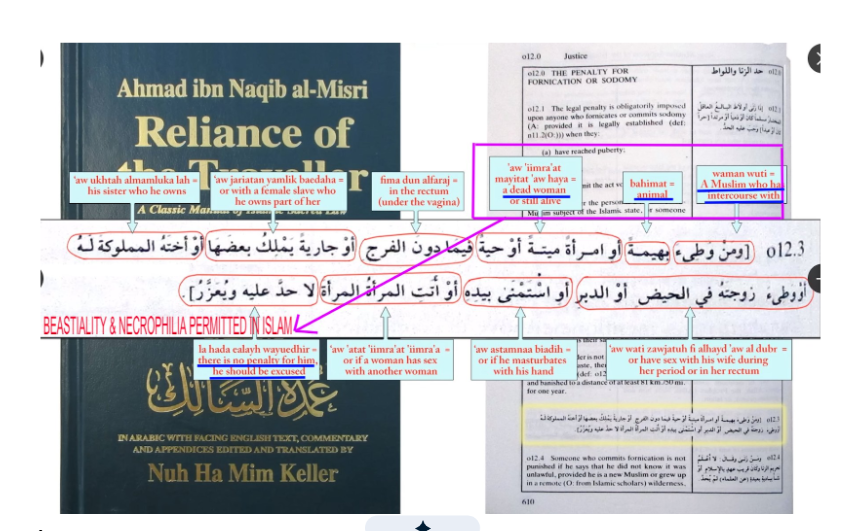
2) The “Reliance” screenshot is not saying ‘permitted’; it says ‘punished’
[باب الزنا]
إذا زنى أو لاطَ البالغُ، العاقلُ، المُختارُ، مُسلماً كانَ أو ذِمِّيّاً أو مُرْتدّاً، حُرَّاً كانَ أو عبْداً، وجبَ عليهِ الحدُّ، فإنْ كانَ مُحْصَناً رُجِمَ حتَّى يموتَ.
...
ومنْ وطِئَ بهيمةً، أو امرأةً ميتةً أو حيَّةً فيما دونَ الفرجِ، أوجاريةً يمْلِكُ بعضَها، أو أُختهُ الممْلوكة لهُ، أو وطِئَ زوجتَهُ في الحيضِ أو الدُّبُرِ، أو استمنى بيدهِ، أو أتتِ المَرْأةُ المرأةَ، لا حدَّ عليهِ ويُعَزَّرُ.
“[Chapter: Zinā] If an adult, sane, voluntary person commits zinā or sodomy—whether he is Muslim, a dhimmī, or an apostate; free or a slave—the fixed punishment becomes obligatory upon him. If he is muḥṣan, he is stoned until he dies.
…
And whoever has intercourse with an animal, or with a dead woman, or with a living woman in something other than the vagina, or with a slave-girl of whom he owns only a part, or with his slave sister whom he owns, or has intercourse with his wife during menstruation or in the anus, or masturbates with his hand, or a woman has sex with a woman—there is no fixed ḥadd upon him, but he is to be disciplinarily punished.”
[ʿUmdat al-Salik wa ʿUddat al-Nasik], Vol. 1, p. 237.
The decisive phrase is لا حد عليه ويعزر. That does not mean “allowed.” It means: the fixed ḥadd of zinā does not apply, but he is punished with taʿzīr. The screenshot’s conclusion that it is “permitted in Islam” is therefore a flat falsification of the source it is pretending to cite. Also, the Arabic says فيما دون الفرج; the English overlay inserts its own glossing, but the actual Arabic line ends with punishment, not permission. +
If by ‘feminism’ one means ideas that challenge, nullify, or resent the rulings that Allah and His Messenger clearly established, then the issue is not a slogan but opposition to revelation. In Islam, marriage is not built on rival authority. The husband has qiwāmah over his wife, and the wife is commanded to obey him in what is right and lawful. That is why a husband may tell his wife to observe hijab, because hijab is an obligation from Allah, and the husband is charged with maintaining obedience to Allah within his household. Likewise, if a wife falls into nushūz, the Qur’an itself gives a graduated process: admonition, abandonment in bed, and then a strictly limited, non-injurious disciplinary strike, not abuse or oppression. If she returns to obedience, he has no right to continue against her in any way. So this is not a question of whether men or women are more intelligent. It is a question of what Allah legislated. Whoever knowingly rejects a ruling that is manifest and established in the religion falls into a grave matter, and the scholars state that denial of what is known of the religion by necessity is disbelief.
الرجال أهل قيام على نسائهم، في تأديبهن والأخذ على أيديهن
Men are those charged with overseeing their women, in disciplining them and restraining them regarding what is obligatory upon them. — [Jāmi‘ al-Bayān], Vol. 8, p. 290.
This explicitly states that qiwāmah means male authority and supervision within marriage, including correction and restraint regarding obligations, not a flat model of interchangeable authority.
يعني: أمراء، عليها أن تطيعه فيما أمرها به من
طاعته
It means: they are commanders over them; she must obey him in what he commands her of the obedience due to him. — [Tafsīr Ibn Kathīr], Vol. 2, p. 256.
This is direct on the marital structure: the husband has authority, and the wife owes obedience in what belongs to his lawful right.
وله منعها من الخروج عن منزله ... ويحرم عليها الخروج بلا إذنه
He has the right to prevent her from leaving his residence … and it is forbidden for her to leave without his permission. — [al-Inṣāf], Vol. 21, p. 421.
The wife is not independent from the husband’s authority in the marriage bond.
تضربها ضربًا غير مبرح، ولا تكسر لها عظمًا
You may strike her with a non-severe strike, and you must not break any bone of hers. — [Jāmi‘ al-Bayān], Vol. 8, p. 314.
فإذا أطاعت المرأة زوجها ... فلا سبيل له عليها بعد ذلك
If the woman obeys her husband … then he has no way against her after that. — [Tafsīr Ibn Kathīr], Vol. 2, p. 295.
@OmkarParanjpe1@faizulhaque95 Cow worshipping mushrik pajeet does not know what taqiyyah is.
Subhuman scum. Go and bath in poop or join a poop festival you naajis poopjeet.
2/2
«جلس للإقراء في خلافة عثمان»
“He sat to teach recitation during the caliphate of ʿUthmān.” — [Tuhfat al-Tahsil fi al-Marasil], Vol. 1, p. 235.
This establishes his public role in transmitting Qur’an.
«كان زر ... الثبت فيه»
“Zir … was among the firm authorities in it.” — [Ikmal Tahdhib al-Kamal], Vol. 5, p. 53; [Taqrib al-Tahdhib], Vol. 1, p. 336.
Zir b. Ḥubaysh, the other major teacher in ʿĀṣim’s chain, is also described as a firm authority.
I could not find the specific charge that Abū ʿAbd al-Raḥmān was “demented”.
The science of qirāʾāt does not collapse because a Christian repeats hadith-jarḥ slogans.
Even where Ḥafṣ is attacked in hadith, the qirāʾāt authorities still classify him as an imam in recitation, a precise transmitter, and one of the two recognized rawis of ʿĀṣim. That is why the slogan “bad hadith narrator = false Qur’an reading” is not the method of the qirāʾāt scholars themselves.
- If ʿĀṣim was unreliable in the Qur’an, why do the sources call him “صاحب قرآن,” “ثقة,” and say the people of Kufa preferred his recitation and Aḥmad preferred it too?
- If hadith criticism automatically destroys qirāʾa, why does Ibn Ḥajar say of Ḥafṣ: “متروك الحديث مع إمامته في القراءة”?
- If Ḥafṣ is unusable in qirāʾa, why does al-Dhahabī say: “أما في القراءة فثقة ثبت ضابط لها بخلاف حاله في الحديث”?
- If ʿĀṣim was weak in Qur’an retention, how do you explain the report: “قرأت القرآن فما أخطأت حرفا” and the testimony “ما رأيت أحدا أقرأ للقرآن من عاصم”?
- If you claim the Ḥafṣ transmission from ʿĀṣim is false, how do you explain Yaḥyā b. Maʿīn being quoted as saying:
«الرواية الصحيحة التي رويت عن قراءة عاصم هي رواية حفص بن سليمان»
Translation: “The sound transmission reported from the reading of ʿĀṣim is the transmission of Ḥafṣ b. Sulaymān.”
@dare092003
1/2
“ʿĀṣim was a liar / fraud / fabricator”
«محله عندي محل الصدق، صالح الحديث»
“In my view, his standing is the standing of truthfulness; his hadith is acceptable.” — [al-Jarh wa al-Taʿdil], Vol. 6, p. 340.
«ثقة»
“Trustworthy.” — That is Abū Zurʿa’s judgment on ʿĀṣim. A Christian critic cannot honestly turn “trustworthy” into “liar.”
[al-Jarh wa al-Taʿdil], Vol. 6, p. 340.
«ثقة رجل صالح خير ثقة»
“Trustworthy, a righteous man, an excellent trustworthy man.” — [al-Jarh wa al-Taʿdil], Vol. 6, p. 340.
This is Imam Aḥmad’s wording.
The claim “all hadith linked to ʿĀṣim are very weak” is also false as stated.
«حديثه في الصحيحين مقرون»
“His hadith in the two Ṣaḥīḥs is accompanied.” — [Taqrib al-Tahdhib], Vol. 1, p. 471.
That alone is enough to destroy the blanket claim “all his hadith are very weak.” The source is explicitly saying his hadith appears in al-Bukhārī and Muslim in paired form.
«حجة في القراءة»
“An authority in recitation.” — [Taqrib al-Tahdhib], Vol. 1, p. 471.
So even where his hadith precision is discussed, the same source still affirms his authority in qirāʾa.
The qirāʾāt and rijāl authorities praises ʿĀṣim as a Qur’an authority.
«عاصم صاحب قرآن»
“ʿĀṣim is a man of Qur’an.” — [al-Jarh wa al-Taʿdil], Vol. 6, p. 340.
Aḥmad says this explicitly. That is a direct rebuttal to the smear that he was some discredited figure who could not transmit the Qur’an.
«كان رجلا صالحا قارئا للقرآن»
“He was a righteous man, a reciter of the Qur’an.” — [Tahdhib al-Tahdhib], Vol. 2, p. 250.
«وأهل الكوفة يختارون قراءته وأنا أختارها»
“The people of Kufa preferred his recitation, and I prefer it.” — [Tahdhib al-Tahdhib], Vol. 2, p. 250.
«وكان ثقة، رأسا في القراءة»
“He was trustworthy, a head in recitation.” — [Tahdhib al-Kamal], Vol. 13, p. 473.
It directly refutes the claim that Islamic sources present ʿĀṣim as unreliable in Qur’an transmission.
The sources explicitly attest ʿĀṣim’s strength in Qur’an mastery and retention.
«معروفا بالإتقان»
“Known for precision.” — [al-Sabʿa fi al-Qiraʾat], Vol. 1, p. 70.
«ما رأيت أحدا أقرأ للقرآن من عاصم»
“I did not see anyone more proficient in reciting the Qur’an than ʿĀṣim.” — [al-Sabʿa fi al-Qiraʾat], Vol. 1, p. 70.
That is a very strong testimony. A man described like this is not being portrayed by the tradition as incapable of transmitting the Qur’an.
«فما أخطأت حرفا»
“I did not make a mistake in a single letter.” — [al-Sabʿa fi al-Qiraʾat], Vol. 1, p. 70.
The report says that after illness he recited the Qur’an without a single-letter mistake. That is direct evidence of recitational retention.
Ḥafṣ was criticized in hadith, but the same tradition explicitly separates that from recitation.
«متروك الحديث مع إمامته في القراءة»
“Abandoned in hadith, despite his being an imam in recitation.” — [Taqrib al-Tahdhib], Vol. 1, p. 257.
This line is fatal to the Christians ignoramuses. The source itself distinguishes his hadith status from his qirāʾa status.
«أما في القراءة فثقة ثبت ضابط لها»
: “As for recitation, he was trustworthy, firmly established, and precise in it.” — [Maʿrifat al-Qurraʾ al-Kibar], Vol. 1, p. 85.
Again, the distinction is explicit. Weakness in hadith is not automatically weakness in qirāʾa.
«كان حفص أعلمهم بقراءة عاصم»
“Ḥafṣ was the most knowledgeable of them regarding the reading of ʿĀṣim.” — [Ghayaat al-Nihaya fi Tabaqat al-Qurraʾ], Vol. 1, p. 254.
This is direct qirāʾa praise from within the same scholarly tradition.
The teachers in ʿĀṣim’s chain are themselves treated as reliable Qur’an authorities.
«ثقة ثبت»
“Trustworthy and firmly established.” — [Taqrib al-Tahdhib], Vol. 1, p. 499.
This is Ibn Ḥajar’s ranking for Abū ʿAbd al-Raḥmān al-Sulamī.
«الضرير المقرئ ... ثقة»
“The blind reciter … trustworthy.” — [Tahdhib al-Kamal], Vol. 14, p. 408.
: قال الشافعي رحمه الله تعالى: " اختلفت الأخبار عن عمر بن الخطاب رضي الله عنه في نصارى العرب من تنوخ وبهراء وبني تغلب فروي عنه أنه صالحهم على أن يضعف عليهم الجزية ولا يكرهوا على غير دينهم وهكذا حفظ أهل المغازي قالوا رامهم عمر على الجزية فقالوا نحن عرب لا نؤدي ما يؤدي العجم، ولكن خذ منا كما يأخذ بعضكم من بعض يعنون الصدقة فقال عمر رضي الله عنه لا، هذا فرض على المسلمين فقالوا فزد ما شئت بهذا الاسم لا باسم الجزية فراضاهم على أن يضعف عليهم الصدقة (قال) فإذا ضعفها عليهم فانظر إلى مواشيهم وذهبهم وورقهم وأطعمتهم وما أصابوا من معادن بلادهم وركازها وكل أمر أخذ فيه من مسلم خمس فخذ خمسين أو عشر فخذ عشرين أو نصف عشر فخذ عشرا أو ربع عشر فخذ نصف عشر وكذلك ماشيتهم خذ الضعف منها ".
قال الماوردي: أما دين العرب، فلم يكونوا أهل كتاب، وكانوا عبدة أوثان، فجاورت طائفة منهم اليهود، فتهودوا وجاورت طائفة منهم النصارى، فتنصروا، فكان في قحطان بالشام تنوخ وبهراء وبنو تغلب مجاورين للنصارى، فتنصروا وأشكلت حالهم عند فتح الشام على عمر رضي الله عنه هل دخلوا في النصرانية قبل التبديل فيقرون أو بعد التبديل مع المبدلين، فلا يقرون، فغلب فيهم حكم الحظر في حقن دمائهم، وتحريم مناكحهم وذبائحهم، فأقرهم على هذا، وشرط عليهم ألا ينصروا أولادهم، ثم طالبهم بالجزية حين أقرهم على النصرانية، فأبوا أنفة من ذل الجزية، وقالوا: نحن عرب لا نؤدي ما يؤدي العجم، ولكن خذ منا كما يأخذ بعضكم من بعض الصدقة، فقال عمر: لا آخذ من مشرك صدقة فرضها الله على المسلمين طهرة فنفر بعضهم ولحق بالروم، وكاد الباقون أن يلحقوا بهم، فقال عبادة بن النعمان التغلبي يا أمير المؤمنين إن للقوم بأسا وشدة، فلا تعز عدوك بهم، وخذ منهم الجزية باسم الصدقة، فأعاد من رحل إلى من أقام، وقالوا: زد ما شئت بهذا الاسم لا باسم الجزية، فراضاهم عمر على أن أضعف عليهم الصدقة وجعلوها جزية باسم الصدقة،
Kaafir,
You do not understand that hadith.
You said:
"Imagine living your whole life "for Allah" and following Mohammed. Then you die and realize you were created for hell."
----
Aḥmad ibn ʿAlī ibn al-Muthanná informed us, saying: Muḥammad ibn ʿAbdullāh ibn Numayr narrated to us, saying: Zayd ibn al-Ḥubbāb narrated to us, saying: ʿAbd al-Raḥmān ibn Shurayḥ narrated to us, saying: Abū Hāniʾ al-Tujībī narrated to me, from Abū ʿAlī al-Hamdānī, that he heard Abū Saʿīd al-Khudrī saying:
The Messenger of Allah ﷺ said: "Whoever says: 'I am pleased with Allah as my Lord, with Islam as my religion, and with Muḥammad ﷺ as my Prophet' — Paradise is guaranteed for him."
[Sahih Ibn Hibban: al-Taqasim wa al-Anwa'], Vol. 1, p. 385.
@HabibiResponds
«عن عائشة ﵂: "أن النبي ﷺ تزوجها وهي بنت ست سنين، وأدخلت عليه وهي بنت تسع سنين، ومكثت عنده تسعًا" متفق عليه. وفي رواية: "تزوجها وهي بنت سبع، وزفت إليه وهي بنت تسع سنين" رواه أحمد، ومسلم.
قلت: ووفق بأنها كانت في السابعة ولم تستكملها، فمن قال ست لم يعتبر ما دخل من السابعة، ومن قال سبع لم يعتبر ما بقي منها والله أعلم.»
“From ʿĀʾishah: ‘The Prophet ﷺ married her when she was six years old, she was brought to him when she was nine years old, and she remained with him for nine [years]’ — agreed upon. And in one narration: ‘He married her when she was seven, and she was escorted to him when she was nine years old’ — reported by Aḥmad and Muslim.
I say: it was reconciled by saying that she was in her seventh year but had not completed it. So whoever said six did not count what she had entered of the seventh year, and whoever said seven did not count what remained of it. And Allah knows best.”
That is the answer: six vs seven at the contract is a reckoning issue, not a collapse of the report.
[al-Taʿrīf wa-al-Ikhbār bi-Takhrīj Aḥādīth al-Ikhtiyār], Vol. 3, p. 25.
Al-Nawawī states the same basic point in his commentary on Muslim:
«فِيهِ حَدِيثُ عَائِشَةَ رَضِيَ اللَّهُ عَنْهَا قَالَتْ (تَزَوَّجَنِي رَسُولُ اللَّهِ صَلَّى اللَّهُ عَلَيْهِ وَسَلَّمَ لِسِتِّ سِنِينَ وَبَنَى بِي وَأَنَا بِنْتُ تِسْعِ سِنِينَ) وَفِي رِوَايَةٍ تَزَوَّجَهَا وَهِيَ بِنْتُ سَبْعِ سِنِينَ»
“In it is the hadith of ʿĀʾishah, may Allah be pleased with her: ‘The Messenger of Allah, may Allah bless him and grant him peace, married me when I was six years old and consummated with me when I was nine years old.’ And in one narration: ‘He married her when she was seven years old.’”
Al-Nawawī reports both wordings together, not as a fatal contradiction, but as known variant wording within the same discussion.
[Sharḥ al-Nawawī ʿalā Muslim], p. 206.
The seven wording still says nine at consummation.
Pagan @GodLogic_GL
Awaiting your response. You do not know what territory you have entered and you will be refuted.
So come on boy. You have no knowledge.
«متروك الحديث مع إمامته في القراءة»
“Abandoned in hadith, despite his leadership in recitation.” — [Taqrib al-Tahdhib], Vol. 1, p. 257.
He can be rejected in hadith and still be an imam in qirāʾah.
«ثبت في القراءة، واهي الحديث»
“Firm in recitation, weak in hadith.” — [al-Kashif fi Ma‘rifat man Lahu Riwayah fi al-Kutub al-Sittah], Vol. 2, p. 297.
The fields are not collapsed into one. The critics themselves did not do what the Christian is demanding.
«كان حفص وأبو بكر من أعلم الناس بقراءة عاصم، وكان حفص أقرأ من أبي بكر»
“Ḥafṣ and Abū Bakr were among the most knowledgeable of people regarding the recitation of ʿĀṣim, and Ḥafṣ was a stronger reciter than Abū Bakr.” — [Tahdhib al-Kamal], Vol. 7, p. 10.
The Christian’s argument assumes: “If a narrator is weak in one discipline, he is therefore unusable in every discipline.”
«عاصم صاحب قرآن، وحماد صاحب فقه»
“ʿĀṣim is a man of Qurʾān, while Ḥammād is a man of jurisprudence.”
And:
«حجة في القراءة، وحديثه في الصحيحين مقرون»
“He is a proof in recitation, and his hadith in the two Ṣaḥīḥs is only in corroborated form.”
And:
«كان ثقة، رأسا في القراءة»
“He was trustworthy, a chief in recitation.” — [Tahdhib al-Kamal], Vol. 13, p. 473.
These do not describe a man whose qirāʾah authority is collapsing. They describe a man whose specialty and imamate were in Qurʾān recitation.
And Ibn Mujāhid records ʿĀṣim’s own rootedness in transmission:
«قال لي عاصم ما أقرأني أحد حرفا إلا أبو عبد الرحمن السلمي وكان أبو عبد الرحمن قد قرأ على علي رضي الله تعالى عنه وكنت أرجع من عند أبي عبد الرحمن فأعرض على زر بن حبيش وكان زر قد قرأ على عبد الله ابن مسعود ... وكان عاصم مقدما في زمانه مشهورا بالفصاحة معروفا بالإتقان ... ما رأيت أحدا أقرأ للقرآن من عاصم بن أبي النجود ...»
“ʿĀṣim said to me: No one taught me a single letter except Abū ʿAbd al-Raḥmān al-Sulamī, and Abū ʿAbd al-Raḥmān had recited to ʿAlī, may Allah be pleased with him. And I would return from Abū ʿAbd al-Raḥmān and present it to Zir ibn Ḥubaysh, and Zir had recited to ʿAbd Allāh ibn Masʿūd ... ʿĀṣim was foremost in his time, famous for eloquence, known for precision ... I have not seen anyone more proficient in the Qurʾān than ʿĀṣim ibn Abī al-Najūd ...” — [Kitab al-Sab‘ah], Vol. 1, p. 70.
«وحَدثني الْكسَائي مُحَمَّد بن يحيى عَن أبي الْحَارِث عَن أبي عمَارَة عَن حَفْص عَن عَاصِم
وحَدثني أَحْمد بن عَليّ الخزاز قَالَ حَدثنَا ابو عمر هُبَيْرَة بن مُحَمَّد التمار عَن حَفْص بن سُلَيْمَان عَن عَاصِم
وحَدثني أَبُو مُحَمَّد الرقي عَن أبي عمر الدوري عَن أبي عمَارَة عَن حَفْص عَن عَاصِم
وَأَخْبرنِي مُحَمَّد بن حَمَّاد بن ماهان الدّباغ قَالَ حَدثنِي أَبُو الرّبيع عَن حَفْص عَن عَاصِم»
“Al-Kisāʾī Muḥammad ibn Yaḥyā narrated to me from Abū al-Ḥārith from Abū ʿImārah from Ḥafṣ from ʿĀṣim.
Aḥmad ibn ʿAlī al-Khazzāz narrated to me: Abū ʿUmar Hubayrah ibn Muḥammad al-Tammār narrated to us from Ḥafṣ ibn Sulaymān from ʿĀṣim.
Abū Muḥammad al-Raqqī narrated to me from Abū ʿUmar al-Dūrī from Abū ʿImārah from Ḥafṣ from ʿĀṣim.
Muḥammad ibn Ḥammād ibn Māhān al-Dabbāgh informed me: Abū al-Rabīʿ narrated to me from Ḥafṣ from ʿĀṣim.” — [Kitab al-Sab‘ah], Vol. 1, p. 95.
This shows the qirāʾah was being carried through multiple qirāʾah routes in the qurrāʾ literature.
And Ibn Mujāhid also documents the Abū Bakr ʿan ʿĀṣim routes separately:
«وَمَا كَانَ من قِرَاءَة عَاصِم بن أبي النجُود عَن أبي بكر بن عَيَّاش ...»
“As for what was from the recitation of ʿĀṣim ibn Abī al-Najūd through Abū Bakr ibn ʿAyyāsh ...” — [Kitab al-Sab‘ah], Vol. 1, p. 94.
So even within ʿĀṣim’s school, the transmission is not reducible to one man in one context.
The Christian argument trades on category mistakes.
It mistakes hadith weakness for total incompetence in qirāʾah.
«متروك الحديث مع إمامته في القراءة»
“Abandoned in hadith, despite his leadership in recitation.” — [Taqrib al-Tahdhib], Vol. 1, p. 257.
He can be rejected in hadith and still be an imam in qirāʾah.
«ثبت في القراءة، واهي الحديث»
“Firm in recitation, weak in hadith.” — [al-Kashif fi Ma‘rifat man Lahu Riwayah fi al-Kutub al-Sittah], Vol. 2, p. 297.
The fields are not collapsed into one. The critics themselves did not do what the Christian is demanding.
«كان حفص وأبو بكر من أعلم الناس بقراءة عاصم، وكان حفص أقرأ من أبي بكر»
“Ḥafṣ and Abū Bakr were among the most knowledgeable of people regarding the recitation of ʿĀṣim, and Ḥafṣ was a stronger reciter than Abū Bakr.” — [Tahdhib al-Kamal], Vol. 7, p. 10.
The Christian’s argument assumes: “If a narrator is weak in one discipline, he is therefore unusable in every discipline.”
«عاصم صاحب قرآن، وحماد صاحب فقه»
“ʿĀṣim is a man of Qurʾān, while Ḥammād is a man of jurisprudence.”
And:
«حجة في القراءة، وحديثه في الصحيحين مقرون»
“He is a proof in recitation, and his hadith in the two Ṣaḥīḥs is only in corroborated form.”
And:
«كان ثقة، رأسا في القراءة»
“He was trustworthy, a chief in recitation.” — [Tahdhib al-Kamal], Vol. 13, p. 473.
These do not describe a man whose qirāʾah authority is collapsing. They describe a man whose specialty and imamate were in Qurʾān recitation.
And Ibn Mujāhid records ʿĀṣim’s own rootedness in transmission:
«قال لي عاصم ما أقرأني أحد حرفا إلا أبو عبد الرحمن السلمي وكان أبو عبد الرحمن قد قرأ على علي رضي الله تعالى عنه وكنت أرجع من عند أبي عبد الرحمن فأعرض على زر بن حبيش وكان زر قد قرأ على عبد الله ابن مسعود ... وكان عاصم مقدما في زمانه مشهورا بالفصاحة معروفا بالإتقان ... ما رأيت أحدا أقرأ للقرآن من عاصم بن أبي النجود ...»
“ʿĀṣim said to me: No one taught me a single letter except Abū ʿAbd al-Raḥmān al-Sulamī, and Abū ʿAbd al-Raḥmān had recited to ʿAlī, may Allah be pleased with him. And I would return from Abū ʿAbd al-Raḥmān and present it to Zir ibn Ḥubaysh, and Zir had recited to ʿAbd Allāh ibn Masʿūd ... ʿĀṣim was foremost in his time, famous for eloquence, known for precision ... I have not seen anyone more proficient in the Qurʾān than ʿĀṣim ibn Abī al-Najūd ...” — [Kitab al-Sab‘ah], Vol. 1, p. 70.
«وحَدثني الْكسَائي مُحَمَّد بن يحيى عَن أبي الْحَارِث عَن أبي عمَارَة عَن حَفْص عَن عَاصِم
وحَدثني أَحْمد بن عَليّ الخزاز قَالَ حَدثنَا ابو عمر هُبَيْرَة بن مُحَمَّد التمار عَن حَفْص بن سُلَيْمَان عَن عَاصِم
وحَدثني أَبُو مُحَمَّد الرقي عَن أبي عمر الدوري عَن أبي عمَارَة عَن حَفْص عَن عَاصِم
وَأَخْبرنِي مُحَمَّد بن حَمَّاد بن ماهان الدّباغ قَالَ حَدثنِي أَبُو الرّبيع عَن حَفْص عَن عَاصِم»
“Al-Kisāʾī Muḥammad ibn Yaḥyā narrated to me from Abū al-Ḥārith from Abū ʿImārah from Ḥafṣ from ʿĀṣim.
Aḥmad ibn ʿAlī al-Khazzāz narrated to me: Abū ʿUmar Hubayrah ibn Muḥammad al-Tammār narrated to us from Ḥafṣ ibn Sulaymān from ʿĀṣim.
Abū Muḥammad al-Raqqī narrated to me from Abū ʿUmar al-Dūrī from Abū ʿImārah from Ḥafṣ from ʿĀṣim.
Muḥammad ibn Ḥammād ibn Māhān al-Dabbāgh informed me: Abū al-Rabīʿ narrated to me from Ḥafṣ from ʿĀṣim.” — [Kitab al-Sab‘ah], Vol. 1, p. 95.
This shows the qirāʾah was being carried through multiple qirāʾah routes in the qurrāʾ literature.
And Ibn Mujāhid also documents the Abū Bakr ʿan ʿĀṣim routes separately:
«وَمَا كَانَ من قِرَاءَة عَاصِم بن أبي النجُود عَن أبي بكر بن عَيَّاش ...»
“As for what was from the recitation of ʿĀṣim ibn Abī al-Najūd through Abū Bakr ibn ʿAyyāsh ...” — [Kitab al-Sab‘ah], Vol. 1, p. 94.
So even within ʿĀṣim’s school, the transmission is not reducible to one man in one context.
The Christian argument trades on category mistakes.
It mistakes hadith weakness for total incompetence in qirāʾah.
a fixed alternative age goes well beyond the wording itself. See: Ṣaḥīḥ al-Bukhārī (p. 275).
10) “Asmāʾ was ten years older and died at one hundred in 73 AH, so that gives an independent cross-reference.”
Even if someone accepts the biographical reports about Asmāʾ, that is still an indirect historical inference. By contrast, the six-and-nine report is a direct transmission from ʿĀʾishah through ʿUrwah and Hishām, preserved in the two Ṣaḥīḥs and preferred by Ibn ʿAbd al-Barr from the standpoint of transmission. More importantly, none of the classical hadith scholars or jurists cited here uses the Asmāʾ calculation to dislodge the direct report. So moving from “Asmāʾ’s age” to “therefore ʿĀʾishah was nineteen” is simply not something established by the classical sources being appealed to. See: Ṣaḥīḥ al-Bukhārī (Vol. 3, p. 469), Ṣaḥīḥ Muslim (Vol. 2, p. 1039), and al-Tamhīd (Vol. 19, p. 108).
11) “Some narrations in the Ṣaḥīḥayn were rejected because they were really from Kaʿb al-Aḥbār and Israʾīliyyāt.”
That is beside the point here. This age report is not a Kaʿb al-Aḥbār report to begin with. Its chain runs from ʿĀʾishah through ʿUrwah through Hishām and others. Ibn ʿAbd al-Barr explicitly says that Hishām’s narration is the strongest thing reported on this issue. So bringing up Kaʿb al-Aḥbār and Israʾīliyyāt here does not really affect the case at all. See: Ṣaḥīḥ al-Bukhārī (Vol. 3, p. 469), Ṣaḥīḥ Muslim (Vol. 2, p. 1039), and al-Tamhīd (Vol. 19, p. 108).
12) “If Ibn Ḥajar had lived in our time and seen modern polemics, he probably would have examined this more rigorously.”
That is just speculation. It is not evidence. What matters is what Ibn Ḥajar actually wrote, not what someone imagines he might have done in a hypothetical modern debate. And what he actually wrote was the standard report under al-Bukhārī’s chapter on consummation at nine. See: Fatḥ al-Bārī sharḥ Ṣaḥīḥ al-Bukhārī (Vol. 9, p. 224).
So the conclusion is simple.
Yes, our scholars could scrutinize narrations in principle. But that general principle does not justify moving from six and nine to nineteen in this specific case. The classical treatment here is plain: they accepted the core report, reconciled the six/seven wording, preferred Hishām’s route in transmission, and used the report in marriage law.
That is the opposite of the modern reconstruction being pushed here.
Wa-Allāhu aʿlam.
that this age report should be set aside. But the sources here do not do that. Rather, they do the opposite. Ibn Ḥajar repeats al-Bukhārī’s chapter heading about consummation at nine and repeats the hadith itself without turning it into a nineteen-year reinterpretation. So citing al-Dāraquṭnī in the abstract does not really touch this specific report. See: Fatḥ al-Bārī sharḥ Ṣaḥīḥ al-Bukhārī (Vol. 9, p. 224), Taghlīq al-Taʿlīq, and Manhaj al-Imām al-Bukhārī (p. 218).
5) “Albani said this in a YouTube clip..."
As it is being presented, this is not a serious proof. A YouTube clip is not the same as a properly sourced classical argument. And even if a later scholar made a broad statement that books besides the Qur’an are not infallible, that still would not outweigh the very specific way this report was handled by al-Bukhārī, Muslim, al-Nawawī, Ibn ʿAbd al-Barr, and al-Sarakhsi. The question here is not general fallibility in theory. The question is how this report was actually treated in the tradition. And in the sources here, it was treated as accepted. See: Ṣaḥīḥ al-Bukhārī (Vol. 3, p. 469), Sharḥ al-Nawawī ʿalā Ṣaḥīḥ Muslim (Vol. 9, p. 206), al-Tamhīd (Vol. 19, p. 108), and al-Mabsūṭ (Vol. 4, p. 212).
6) “ʿĀʾishah said the Prophet ﷺ never urinated standing, but Hudhayfah reported that he did once, and scholars reconciled them.”
That part is basically true, but it does not help your argument. The scholars did not throw out ʿĀʾishah’s report. They reconciled two direct reports. Their explanation was that her wording described what was normal and habitual, while Hudhayfah’s report described an exceptional incident. That is classical reconciliation between two direct narrations. It is not the same as taking a direct report and overriding it with indirect historical speculation. See: al-Ijābah li-Īrād mā Istadrakathu ʿĀʾishah ʿalā al-Ṣaḥābah (p. 160).
7) “So just as they qualified her report there, the same can be done with her age reports.”
This is where the comparison breaks down. In the urination case, there are two direct reports within the hadith corpus about the same issue, so reconciliation makes sense. In the age case, the alternative claim is not another direct hadith from ʿĀʾishah رضي الله عنها or another Companion saying she was nineteen. It is a modern reconstruction built from indirect chronology. That is a far weaker method than relying on a direct transmitted report preserved in the two Ṣaḥīḥs and used by jurists as legal evidence. See: Ṣaḥīḥ al-Bukhārī (Vol. 3, p. 469), Ṣaḥīḥ Muslim (Vol. 2, p. 1039), and Sharḥ al-Nawawī ʿalā Ṣaḥīḥ Muslim (Vol. 9, p. 206).
8) “This shows that weighing her age reports against other historical evidence follows classical method.”
Not really. The classical method shown in these sources is to preserve the direct report, reconcile small variations within the transmission, and then use the result in fiqh. Ibn Quṭlūbughā reconciles six and seven. Ibn ʿAbd al-Barr says Hishām’s route is the strongest in transmission. Al-Nawawī and al-Sarakhsi use the report in legal reasoning. That is not the method of sidelining a direct hadith through indirect timeline reconstruction. See: al-Taʿrīf wa-l-Ikhbār bi-Takhrīj Aḥādīth al-Ikhtiyār (Vol. 3, p. 25), al-Tamhīd (Vol. 19, p. 108), Sharḥ al-Nawawī ʿalā Ṣaḥīḥ Muslim (Vol. 9, p. 206), and al-Mabsūṭ (Vol. 4, p. 212).
9) “ʿĀʾishah said she remembered her parents practicing Islam before the Hijrah, which raises questions.”
That report does not really do the work you want it to do. All it says is that from the earliest point she could remember, her parents were already following Islam. It does not give a number. It does not say she was a teenager. It does not say she was close to puberty. It simply says that her earliest memories were of her parents being Muslim and of the Prophet ﷺ visiting. Turning that into... +




![kafirkounter's tweet photo. Kaafir,
You do not understand that hadith.
You said:
"Imagine living your whole life "for Allah" and following Mohammed. Then you die and realize you were created for hell."
----
Aḥmad ibn ʿAlī ibn al-Muthanná informed us, saying: Muḥammad ibn ʿAbdullāh ibn Numayr narrated to us, saying: Zayd ibn al-Ḥubbāb narrated to us, saying: ʿAbd al-Raḥmān ibn Shurayḥ narrated to us, saying: Abū Hāniʾ al-Tujībī narrated to me, from Abū ʿAlī al-Hamdānī, that he heard Abū Saʿīd al-Khudrī saying:
The Messenger of Allah ﷺ said: "Whoever says: 'I am pleased with Allah as my Lord, with Islam as my religion, and with Muḥammad ﷺ as my Prophet' — Paradise is guaranteed for him."
[Sahih Ibn Hibban: al-Taqasim wa al-Anwa'], Vol. 1, p. 385.](https://pbs.twimg.com/media/HFxrWzKXwAAOY7Z.jpg)


