one $NEAR account holds native bitcoin, native ethereum and native solana at the same time. most people still assume that's not possible.
bitcoin. ethereum. solana. tron. ton. the real asset on the real chain, all from a single near account.
not wrapped versions. not IOUs minted somewhere else. the account controls a real address on each chain and signs there through near's mpc network, the same way any native wallet does.
no bridge in the middle. no lock-and-mint contract sitting on your funds. nothing to drain.
templar and ria already run on it - borrow stablecoins against native bitcoin, nothing wrapped anywhere in the flow. same model across 40 chains, and near keeps adding more.
"chain abstraction" sat on pitch decks for years before anyone actually built it. near shipped it and let other apps build straight on top.
it happens with no noise. you hold btc, you spend it on solana, you stop thinking about which chain anything is on.
real btc on bitcoin, spent on solana, no bridge anywhere in the path. that part already works.
Prompt:
“Create a 3-of-4 wallet. After 2 years, it becomes 2-of-4. After 5 years, it becomes 1-of-4.”
What this is:
A decaying multisig created with an AI agent using Nunchuk CLI + Agent Skills.
No Miniscript knowledge needed.
It starts as 3-of-4.
After 2 years, it becomes 2-of-4.
After 5 years, any 1 of the 4 keys can spend.
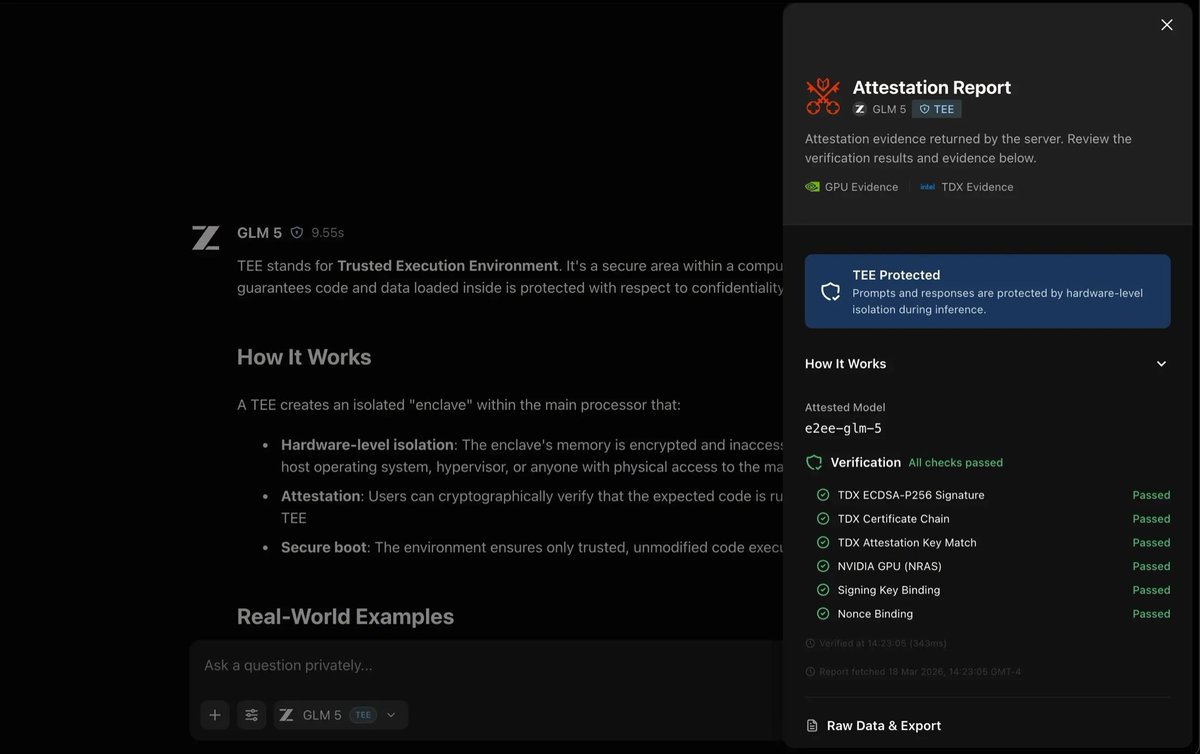
This is what NEAR AI private inference looks like in production.
An @AskVenice ($VVV) user selects a TEE model, sends a prompt, and receives a hardware-signed attestation report. Six cryptographic checks passed and verified in 343ms.
Martti Malmi, one of Bitcoin's earliest developers, just released a new version of Nostr VPN, an open-source mesh VPN that replaces the entire trust model of traditional VPN services.
Traditional VPNs route all your traffic through a central server operated by a company you have to trust. They see your data. They require your email. They can log your activity. They can be subpoenaed, hacked, or shut down. Even modern mesh VPNs like Tailscale, which improved on this by sending data peer-to-peer, still require you to authenticate through a centralized coordination server using third-party accounts like Google or Microsoft.
Nostr VPN eliminates the central server entirely. Your identity is a Nostr keypair, a self-generated cryptographic key pair with no registration, no email, no third-party account. The underlying transport layer is FIPS (Free Internetworking Peering System), a self-organizing encrypted mesh network where nodes authenticate each other, route traffic for each other, and establish connections without any central authority or global topology knowledge. Each node's Nostr public key (npub) serves as its network address.
The architecture uses two layers of encryption: hop-by-hop encryption between peers and independent end-to-end encryption between mesh endpoints with periodic rekeying for forward secrecy. When direct connections fail due to NAT issues, the system falls back to Nostr-based multihop routing through other FIPS nodes rather than relying on company-operated relay servers. Peer discovery and NAT traversal happen through public Nostr relays using encrypted gift-wrapped messages.
The new release adds native desktop apps for macOS, Linux, and Windows, an Android app, Nostr-based multihop routing for when NAT holepunching fails, and improved network management. It supports UDP, TCP, Ethernet, Tor, and Bluetooth transports simultaneously on a single mesh.
This is what happens when you apply Bitcoin's design philosophy, permissionless, self-sovereign, no trusted third parties, to networking infrastructure. Built by one of the people who helped Satoshi build Bitcoin in 2009.
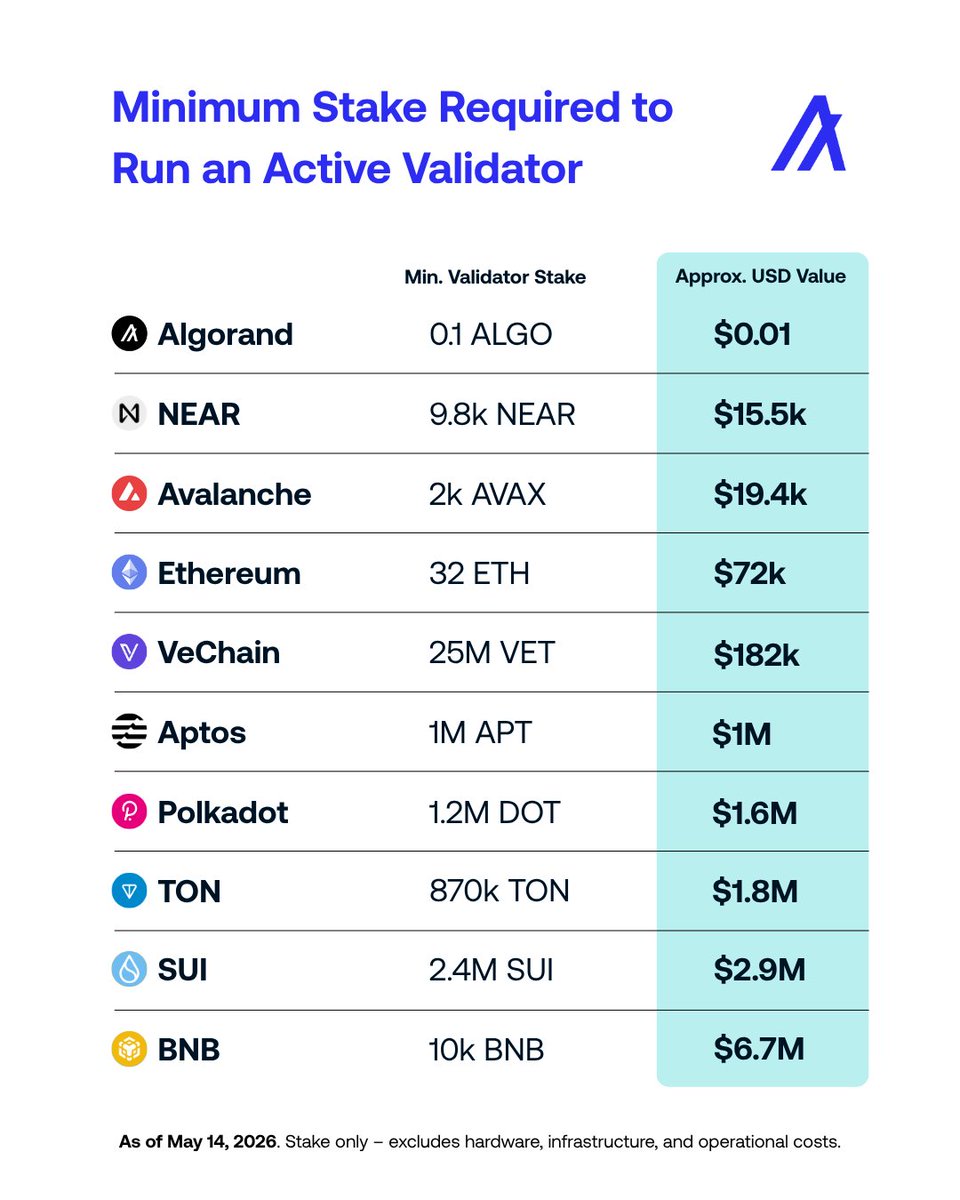
Running a validator on some networks requires millions of dollars in stake, before even thinking about hardware.
On Algorand, the minimum is 0.1 ALGO.
Low barriers matter for decentralization!
🚨LATEST: The US has officially lifted the chip ban on China, per Reuters.
Alibaba, Tencent, and ByteDance are among 10 Chinese firms now approved to buy Nvidia's H200 chips.
China previously represented a market worth up to $8B annually and nearly a quarter of Nvidia’s revenue before the October 2023 export controls crushed the company’s market to nearly zero.
$NVDA shares surged to a new 52-week high, up +8% today after the U.S. Department of Commerce's approval.
@realLoyalSoon Since the United States Air Force and other dod research programs are involved, do you think those involved in those programs will sell or continue building and researching?
What privacy-first software looks like — Part II:
Whonix(@Whonix) → security-focused operating system that routes all traffic through Tor to help isolate applications and reduce IP leaks.
SMSPool(@smspoolnet) → temporary phone number platform useful for compartmentalization and reducing exposure of personal numbers online.
Qubes OS(@QubesOS) → compartmentalized operating system that isolates tasks into separate virtual machines for stronger security boundaries.
LibreOffice(@LibreOffice) → open-source office suite that gives users local control over documents without dependence on cloud ecosystems.
SimpleX(@SimpleXChat) → messenger designed without user IDs or persistent identifiers, reducing metadata exposure by design.
ExifTool → powerful metadata analysis and removal tool for inspecting hidden information inside files and images.
Proton Drive(@ProtonDrive) → end-to-end encrypted cloud storage focused on protecting files from provider-side access.
Tails(@Tails_live) → portable live operating system that routes internet traffic through Tor and leaves minimal traces on the device used.
YubiKey(@Yubico) → hardware security key that adds phishing-resistant multi-factor authentication for accounts and devices.
NEW: Running a full validating Bitcoin node on your phone is nearing reality.
Floresta + Utreexo enables Android users to verify the network without storing the full blockchain.
Wallet connects to your own Electrum server. Mainnet support coming soon.
Cryobrick es un proyecto de cold storage Bitcoin airgapped que corre en feature phones basicos, esos celulares de teclado fisico que cuestan pocos dolares, el concepto es simple, el celular queda completamente desconectado de internet y funciona como hardware wallet de bajo costo, el app se llama Compass y permite crear y restaurar carteras Bitcoin sin ninguna conexion de red, costo de hardware cero, plausible deniability porque parece cualquier otra app, your keys your control, proyecto nuevo creado en diciembre de 2025, vale la pena seguirlo en https://t.co/OrdzRAdscn 🧡⚡️