I have pondered on Jesus Christ for the last 6 months because it seemed many of the most intelligent people I admired were believers. The biggest growth hack I've ever utilized when trying to learn things is, "Just because you don't immediately understand something, doesn't mean you should dismiss it. Try to figure out what you're not seeing." So I did. I kept trying.
Anyway, it hit me a while back while I was sitting in traffic, after months of trying to tease out the question of Jesus. It was a huge, gnostic flood of epiphanies that immediately made me start weeping. It hit me so suddenly that I'm still trying to parse it into words without sounding like a schizo.
But it's something like: On every level of reality, from the personal to the global, we need to be able to move on from our mistakes. It is integral to our survival. Yet justice must also be served. We know on an instinctual level that blood is the cost of an error. And that price was paid, forever and ever, on a cross that extended in all four directions, past and future, fact and fiction, regenerating eternally, healing all wounds.
We've all seen what happens when people believe in justice, but not forgiveness. And we've all seen what happens to those who believe in forgiveness, but not justice. I don't think it is*believing* in Jesus that is the most important thing. It is accepting and holding these two ideas in tandem and adapting it as a way of being.
The most powerful thing you can ever tell your kids.
“There’s nothing you can do for me to love you more or less. Love is unconditional.”
Best in the school or worst.
Best player on the team or the worst.
But if you want me to be proud of you, that part must be earned.
I cannot stress enough just how wide the gap is between the tech that product designers at the top 1% of companies get to work on compared to the tech that designers at the other 99% have to work on.
The move of Claude Code from Pro to Max is better than the alternative. Paying with money is often preferable to many, many other ways these companies can extract value from you.
- What if I need to select a date in the future?
- What if I need to select a date far in the past, like my birthday?
- How do I control this with a keyboard?
- What if I struggle with fine motor skills?
- How do I interact with this or know what's clickable on a mobile screen?
a lot of things are fast now. like—really fast. but i don’t think we’ve figured out when to be slow yet.
it feels like that’s a new skill that’ll differentiate us as people, companies, and products. how we choose when to go slow.
The only surviving chronicle of the 21st century speaks of men who tried to “summon angels to replace men, but brought forth demons and cataclysms.” However these events are known to be fictitious, as the men’s names, Altman and Amodei, mean “alternative to man” and “love of God”
Flight of the Navigator (1986) is seriously underseen. A kid vanishes for eight years, returns the same age, and ends up piloting a sleek alien ship with a wisecracking AI. It’s smart, emotional, and pure 80s wonder. More people should be talking about it.
Why do frontend devs put all their logic in "components"?
I came up in the winform desktop all days and knew back then, as juniors, that it was an anti pattern to couple business logic and UI so tightly.
How does frontend still not have a concept of architecture?
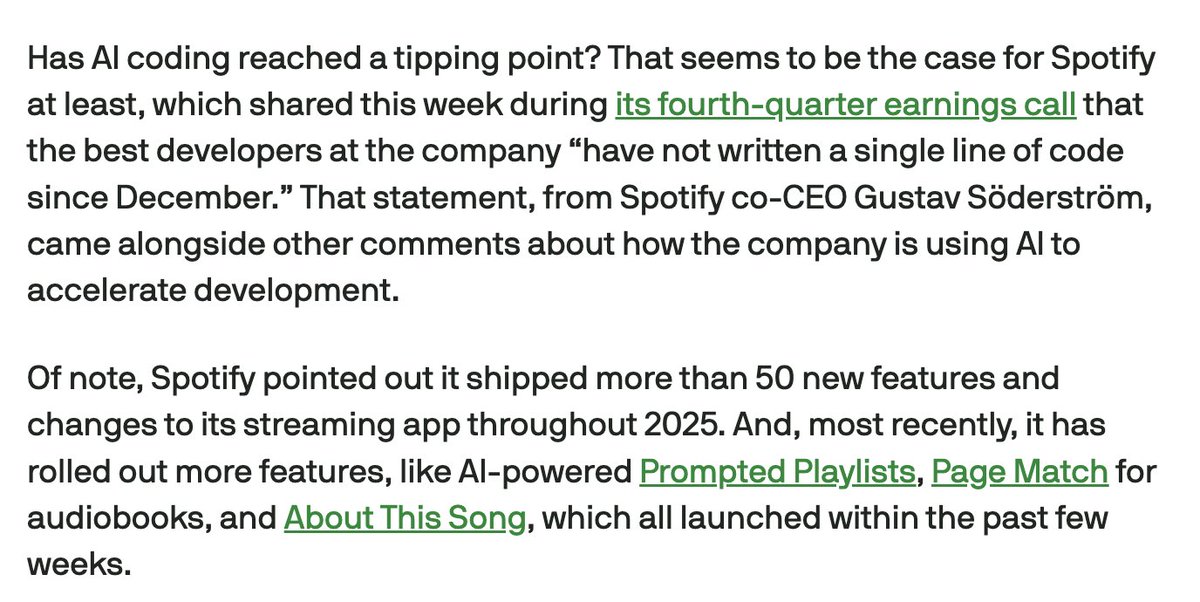
Spotify revealed that its top engineers haven’t written a single line of code since December, thanks to an internal AI system called “Honk” powered by Claude.
The company shipped 50+ new features in 2025 alone, with AI now enabling real-time bug fixes and feature deployments straight from a phone during a commute, dramatically accelerating product velocity
The problem with tiny UI issues like spacing/misalignment isn't usability.
The problem is that they make you look dumb, and people don't like paying dumbasses.