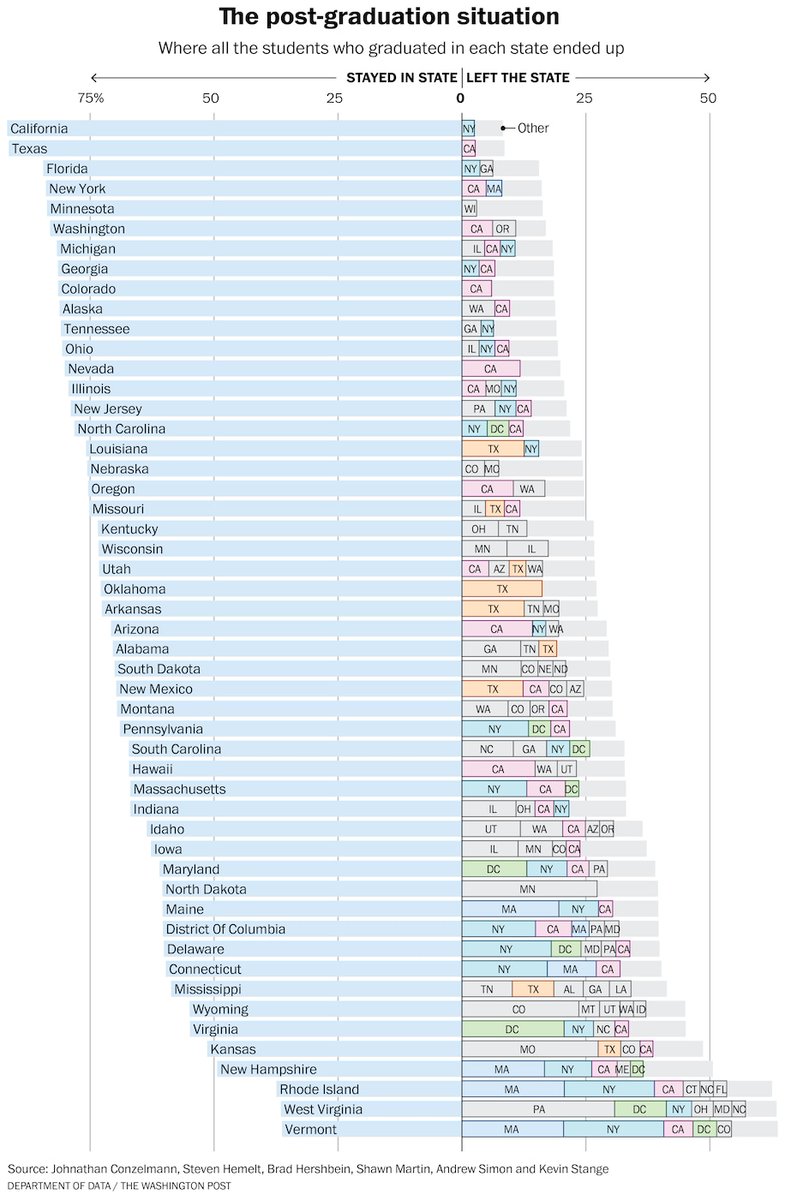
This graphic about where people go after college is ENLIGHTENING and probably something my dad would have cut out from the newspaper if it was in there in 2002. @andrewvandam https://t.co/4Z2hMwDjPX
@beccasue99@AcademicChatter Writing can be an iterative process. In college courses undergrads often turn in a final paper and then never touch it again, but with academic writing, writing and rewriting (and rewriting) is normal and they shouldn’t feel pressure to write it perfectly the first time.
Thrilled to share my @EmergAdulthd article w/ @ATKuperberg! We found financial support & living w/ family was common, & reciprocity could be a burden. Receiving help prolongs—but also facilitates—the transition to adulthood @ASA_Family @ASAnews https://t.co/pD6FsUIbft
The RCT in Oklahoma shows that fines and fees produce a criminalization of poverty. Court involvement and the risk of incarceration is piled on people who can't pay. There's no deterrence and no cost recovery 7/9
https://t.co/gKdIb6YIde
New article with @dannyjschneider on public investments in children @ASR_Journal https://t.co/TrKJglCKFD Key finding: families with less income/education use state money for spending on children. Little evidence this is the case for higher-resource families
A $1.2M NIH grant will fund sociologist Anna Mueller's research to provide schools with suicide prevention strategies. https://t.co/GVOO4th5jI via @IUNewsroom
Jen Augustine and I’s new paper in Demography (open access!): The SES-related gap in US mothers’ parenting time has closed significantly over the past 15 years.
Stop the narrative that low-SES mums aren’t as dedicated to their children.
What we found👇
https://t.co/EsvaRuz2gS
I’ve witnessed so many privileged white kids commit all manner of illegal activity while in high school & college and then go on to live successful lives without any long lasting consequence.
Published in @Slate Magazine https://t.co/h5tyoZLCDu
White, Stuart, and Morrissey (2020) find that "Black people killed in predominantly Black neighborhoods in the city in 2016 received roughly half as much news coverage as white people killed in majority white neighborhoods."
Stanford researchers(@ForrestDStuart@KaileyCWhite
& Shannon Morrissey) have found that local news media have not treated Black and Hispanic lives as equal in value to white lives in stories. Research in.@SREJournal https://t.co/wtAcosgUya
One of the more interesting and important findings is that neighborhood REALLY matters, perhaps more than individual race of victim. Victims killed in White neighborhoods receive more coverage and humanizing narratives than victims in Black and Brown neighborhoods. 3/4
My coauthors (@KaileyCWhite & Shannon Morrissey) and I read, coded, and analyzed EVERY SINGLE article on EVERY SINGLE homicide in Chicago. We discovered that articles about White victims are much longer than those about Black and Brown folks, and use more humanizing language. 2/4