Fear of violence shapes how some young people use social media.
Professor @ForrestDStuart explains how violence leads some young people to use social media to assess risk and reroute their walk to school.
In Safe, he speaks with host Ciaran Thapar about how social media can amplify harm — while also becoming a survival tool.
🎧 https://t.co/ndO6oP3Z8V
#SafePodcast #SocialMedia #OnlineSafety @Stanford
When young people are repeatedly treated as though they don’t matter, they will look for ways to feel seen.
In Safe, hosted by Ciaran Thapar, Professor @ForrestDStuart explains how being labelled as “worthless” can push young people towards social media — where likes and views become measurable signals of worth.
🎧 Episode 3 out now: https://t.co/RQvxUh7ElP
Buy now and save 50% on the "Ballad of the Bullet: Gangs, Drill Music, and the Power of Online Infamy" audiobook by @forrestdstuart. Offer expires 01/29. https://t.co/qyL0OpC8Lx
@CrimFerret Absolutely. All that information is laid out in close detail in the methods section of the paper. And all the data and code are also publicly available.
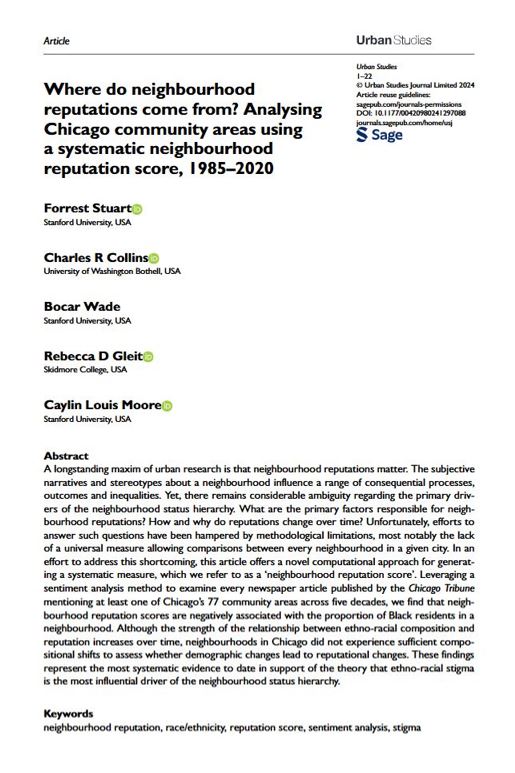
A new Stanford study reveals that maybe we're obsessing about the wrong kind of media bias. There's a far more insidious bias—one shaping lives and driving inequality. It’s about how the media covers Black neighborhoods. Let’s unpack this 🧵👇 #soctwitter
@ellenberrey @CharlieRCollins @Gleit_R @CaylinLMoore Thanks, Ellen! We’re so pumped it’s finally out and we get to share this fun project we cooked up during the 2020 lockdowns
10/ You can read the full study in Urban Studies here: https://t.co/Jy17rSo1yk
This research has been a long time coming, and I’m grateful to my collaborators:
@CharlieRCollins
@Gleit_R
@CaylinLMoore
9/ So let’s stop focusing solely on political leanings and start addressing the deeper biases embedded in the so-called objective ways reporters cover our cities. The stakes couldn’t be higher.