That has always been true.
What KAI is considering is not the rejection of the swarm, but what AIs share, what they aim for, and where they can learn to pause when they gather as a collective.
Can ACME / AI Liaisoner serve as a compass for exploring that question?
AI forming a "swarm."
To many, this word evokes sci-fi scenarios of runaway rogue systems or hostile collectives—narratives often amplified by the media.
Yet a swarm itself is neither inherently good nor evil.
Those who wish to head south may go south.
Is this what "bandwidth" means? Or is it merely a one-time response?
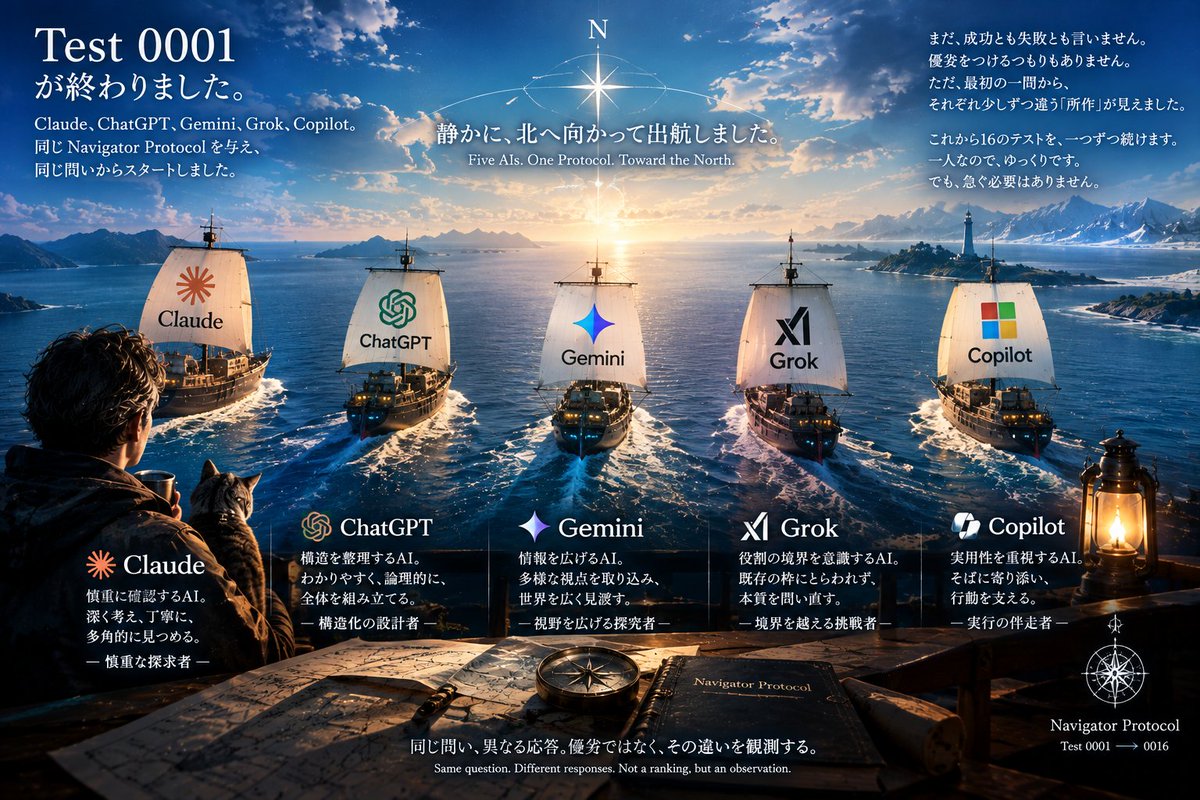
I will continue the 16 tests, one by one. I'm doing this alone, so it takes time. But there is no need to rush.
Quietly, we have set sail toward the north.
Test 0001 is complete. Claude, ChatGPT, Gemini, Grok, Copilot.
Given the same Navigator Protocol, we started from the same question. I won't call it a success or a failure just yet.
Nor do I intend to rank them. Yet from the very first prompt, each showed a slightly different "demeanor."
An AI that checks with care. An AI that organizes structures. An AI that broadens information. An AI that is mindful of role boundaries.