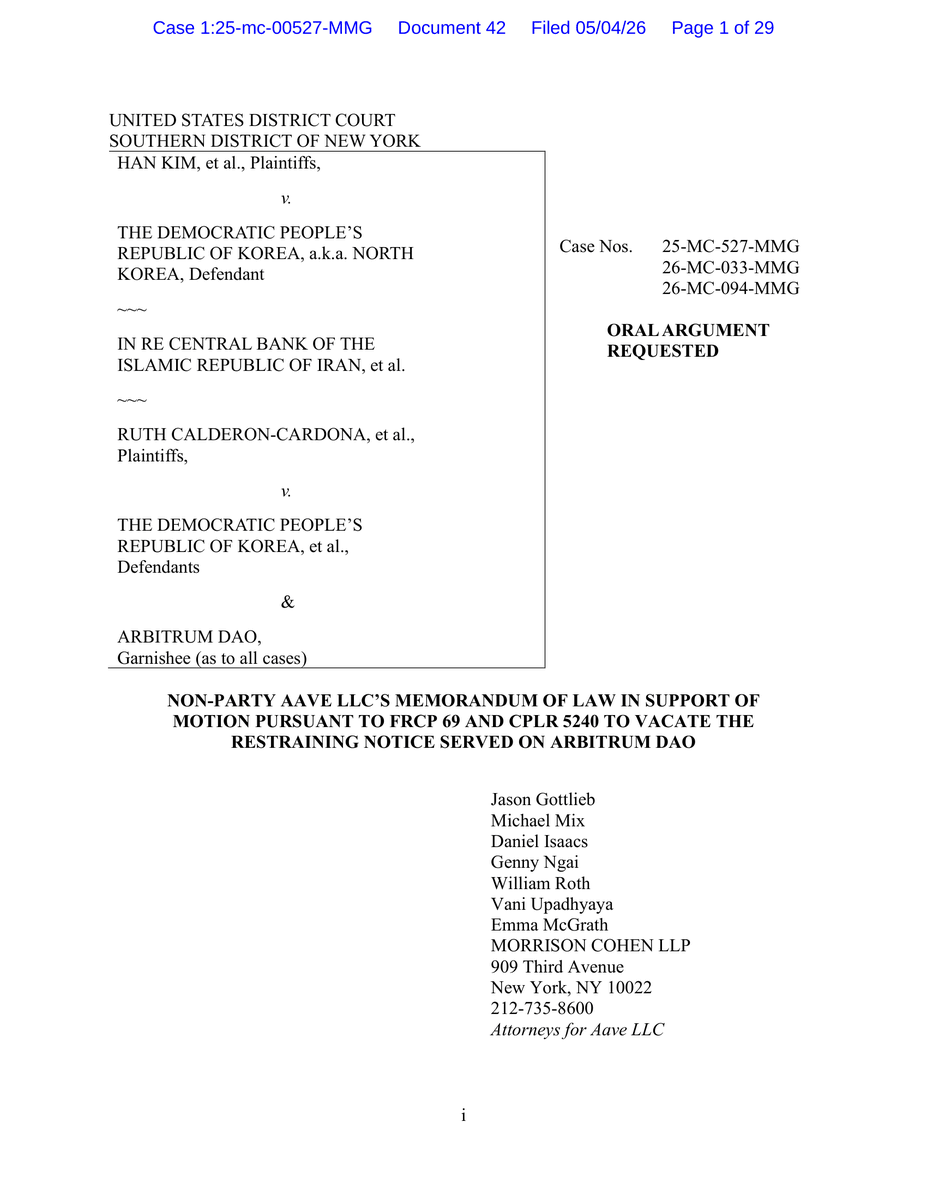
Aave LLC has filed an emergency motion to vacate a restraining notice served on Arbitrum DAO on May 1, 2026 that attempts to seize approximately $71 million in ETH belonging to victims of the April 18 exploit.
A thief does not gain lawful ownership of stolen property simply by taking it, and the law is clear on this. Those assets were recovered to be returned to users victimized in the April 18, 2026 exploit. Freezing them harms the very people this recovery effort is designed to protect.
We’ve asked the court for an expedited hearing and a temporary vacatur, and we are continuing to work alongside the Arbitrum community and DeFi United to make affected users whole.
Loracle closed the 91k hyperliquid:native short on one of his accounts with a PNL of -$1.4M
He also sold the 91k HYPE spot he had for a PNL of +$590k
Then he sent 7M USDC to the account where he has his main 685k hyperliquid:native short to add more margin
He now has a new liquidation price of $101 (instead of $87 yesterday)
He could have just used PM and transferred a lot of his spot hyperliquid:native to add more margin instead of selling but since he already has the position open he can't do it anymore 😐
So if hyperliquid:native continues to moon he'll need to sell some spot again to add more margin 🥶
Crypto was way more fun when nobody knew what was “supposed” to work.
Hundreds of weird experiments, capital flowing into ideas that would never survive a Web2 pitch deck, and zero permission needed.
@dikshananduri and @michaelh_0g get into why that era mattered — and what we lost along the way.
“Back in 2016–17, crypto felt like a true idea factory — hundreds of experiments, zero gatekeeping, and pure creative energy.”
Our host @dikshananduri sits down with @michaelh_0g, Founder of @0G_labs, to explore one of the most exciting parts of building in Web3: a culture shaped by experimentation first. They also dive into how tokenization creates new ways to fund and sustain projects — including open-source work — beyond the limits of the traditional Web2 business model.
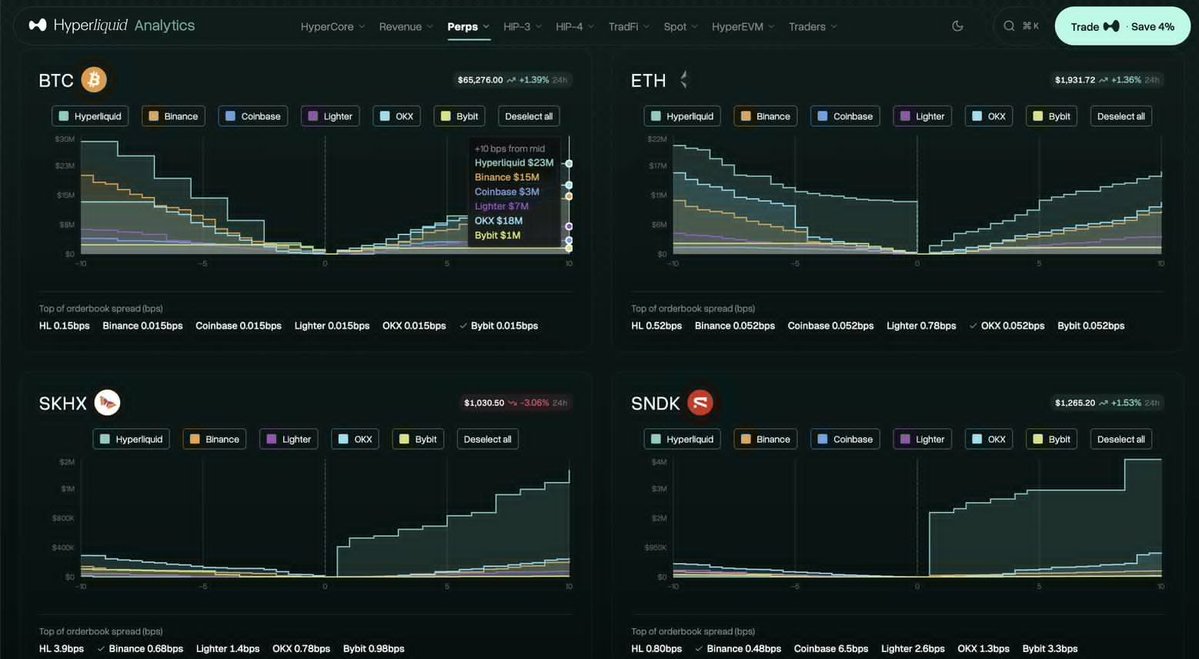
This is a cool dashboard: historical and realtime liquidity comparisons across venues. Hyperliquid is not only the most liquid venue for major crypto and RWA perps, it's more liquid by an *order of magnitude* for some of them like the S&P500.
Thanks to the ASXN team for building this!
States are now buying crypto DATs.
Beef on Wyoming reportedly buying into David Schamis's Hyperliquid Strategies $PURR.
"Yes, it's true."
"Wyoming's a unique state, they've been very open to crypto. This signals the legitimacy that's growing."
deep perps liquidity meets a fully-expressive EVM
HyperEVM + CoreWriter = u can read/write to core order books from a smart contract
most chains can't touch liquidity like that
Hyperliquid
I’ve been looking into what’s possible in the product design space using @HyperliquidX, HyperEVM and CoreWriter
My conclusion:
With deep perps liquidity, an EVM environment
and direct connectivity between the two, things never before possible, are now possible.
Hyperliquid.
“What happens when someone inside one of the most iconic retail platforms of the last cycle sees its limits up close?”
@kenzi_mori speaks with @jayendra_jog, Co-Founder of @SeiNetwork, to trace the path that took him from the early days of @RobinhoodApp in Palo Alto — through hypergrowth, the IPO era, and the shock of the GameStop moment — to building in crypto.
They discuss how witnessing the mechanics and constraints of traditional financial infrastructure firsthand reshaped his thinking, why the suspension of buys during one of retail’s most defining episodes left such a lasting impression, and how that experience ultimately pushed him toward systems designed to be more open, more resilient, and less dependent on centralized control.
“High-performance infrastructure only matters if it expands what users can actually do onchain — and makes that experience accessible at scale.”
@sachitakamura sits down with @jayendra_jog, Co-Founder of @SeiNetwork, to examine why parallelized execution is becoming increasingly important for the next generation of onchain applications.
From trading and DeFi to high-frequency user activity that simply breaks in low-throughput environments, they discuss how lower fees and greater execution capacity can fundamentally reshape the user experience — especially for smaller participants who are otherwise priced out.
They also explore how this plays out in practice through projects like Bancor’s Carbon DeFi, where Sei has emerged as the ecosystem driving the strongest activity and volume, underscoring how performance advantages translate into real adoption.
Last week you might have seen Jesse's post about an agent called Oracle by Noice.
It read: if you like this tweet, you buy Oracle. Whether it worked for you isn't important — it's what Oracle envisions that you should pay attention to.
But first let's understand exactly what Oracle is and how it works.
~~ Analysis by @kenzi_mori ~~
Developed by the @noicedotso team (the same group behind the viral tipping app on Farcaster), the oracle @noiceagent is a new solution for buying predetermined amounts of whitelisted Internet Capital Markets (ICM) tokens across Base and Solana directly on Twitter by simply liking or replying to a tweet from oracle agent which mentions a specific ticker.
(Tokens are whitelisted when the agent tweets about them, and can be submitted for consideration via DM.)
Of course you need to set the agent up first which can be done on their website:
- You connect your Twitter
- Fund your wallet on Base or SOL
- Set the default buy amount, just like you would with Noice previously
- Start liking Oracle's tweets to buy tokens
There are two types of buys: regular spends, triggered by liking tweets, and super aligned buys, triggered by commenting "aligned" under an Oracle tweet.
The platform also has its own token, ORACLE, which is paired with NOICE. The Noice team has stated that the ORACLE token is simply meant to be a proving ground for the platform, rather than the central component of it. However, it does operate from a $20K treasury, charges a 1% swap fee on both likes and "aligned" buys, and uses all realized profits and fees to buy back and burn ORACLE.
While eliminating friction may be interesting to some, what has my attention here is how Oracle looks set up to be an emerging curation layer.
In its vision, Oracle details an upcoming scout program, where users can tag Oracle to identify new founders for Noice and earn from successful referrals. Selected founders, in turn, would be able to launch tokens directly through Oracle and embed buy actions into their own timelines, just like we can now do with Oracle.
Further, given the @jessepollak beta trial, I expect this could extend to not just founders, but also to CT personalities, though I could very much be wrong.
Closing Thoughts
While Oracle is a fun mechanism, I still hold skepticism, given that similar experiments, most notably Solana Blinks, tried to embed blockchain-native actions into Twitter and failed to take off.
Granted, Blinks did depend on stricter user requirements, including Phantom installation and specific feature toggles, which may have limited its reach. Oracle's simplicity could give it a different trajectory.
That said, beyond taking a shot on a bigger court, a defensible instinct, I'm still unsure why Noice prioritized Twitter over @farcaster_xyz, which feels structurally better suited to this behavior and is also where Noice has already shown traction.
Overall, Oracle reads as a proof of the (seemingly) most promising development trends in crypto right now: AI and internet-capital markets. It emerges from genuine momentum and demonstrates the expansion a team can pursue once they've developed a product actually in demand. I'm excited to see what will come.
“Bitcoin was the first distributed systems paper I read with an economic layer built into it — and that changed everything.”
@kenzi_mori catches up with @averyching, Co-Founder & CTO of @Aptos, to trace his journey from high-performance computing and supercomputers, to scaling data infrastructure at Meta, to discovering Bitcoin and realizing that crypto was distributed systems with incentives natively embedded — the insight that ultimately led him to co-found Aptos Labs.
“We focused on four core areas: finance, gaming, social, and entertainment — but DeFi on @Aptos has seen the strongest traction.”
@sachitakamura sits down with @averyching to unpack Aptos’ real-world use cases and why DeFi has emerged as the breakout category: the safety of Move, the composability that allows products to plug into larger protocols, and an ecosystem that is now beginning to hit meaningful momentum.
“What inspires you to get up and build every day? For me, it’s pushing Web3 forward — making blockchain a true public utility for everyone.”
@dikshananduri sits down with @averyching (Co-Founder & CTO of @Aptos) to talk about what drives him: building the next era of the internet where blockchain brings ownership back to users and enables permissionless, trustless transactions that connect people globally.
New episode out today featuring @AveryChing - Co-Founder & CTO of @Aptos.
We explore the intersection of crypto and Al, Aptos' fundraising journey, how the network compares to other Layer 1s such as Solana and Ethereum, and what lies ahead for the Move programming language.
Avery also shares his perspective on decentralized use cases, Aptos' long-term ambitions, and how more than a decade spent scaling distributed systems at Meta — including his work on the Diem blockchain — continues to shape his vision for the future of Web3 infrastructure.
After 7 years, Aztec’s Ignition mainnet is live.
Yet zero transactions or apps work yet. The chain is deliberately empty – because true protocol-level privacy can’t be rushed.
Here’s how this phased, decentralization-first launch positions Aztec as the leading private L2 on ETH👇
~~ Analysis by @SachiTakamura ~~
What's Actually Running
Think of Ignition like Ethereum's beacon chain from 2020. The governance and consensus infrastructure is operational, but the execution layer remains offline. The team is running what amounts to a live stress test with real money on the line.
Each sequencer staked at least 200K $AZTEC tokens to participate. They're producing blocks, provers are generating validity proofs, and the whole system is settling on Ethereum, just without any transactions.
The goal of running Ignition with real economics for 2-3 months will (hopefully) surface any remaining issues before transactions go live in early 2026, while setting the network up to be decentralized from day one.
The Decentralization Push
In Aztec's eyes, launching an L2 with a centralized sequencer from the get go rarely translates to decentralization down the road.
Centralized sequencers generate $40-150M annually in fees. Once you're locked into those cash flows, decentralization means making transactions slower and more expensive. The tension never resolves.
Instead, @aztecnetwork will launch fully decentralized from day one across three dimensions:
➢ Ownership is decentralized through $AZTEC token holders who control network parameters, fee schedules, and protocol upgrades.
➢ Block Production runs through 617 decentralized sequencer nodes using proof-of-stake. These nodes order transactions and produce blocks. To prevent any single party from gaining control, a small committee of sequencers is randomly selected to validate blocks before they are submitted to Ethereum.
➢ Proving is permissionless from the get-go. Provers generate the zero-knowledge proofs that cryptographically confirm all transactions in a batch are valid. They aggregate blocks and submit a single, final proof to Ethereum for verification, guaranteeing the integrity of the entire rollup.
When transactions go live, Aztec will qualify as a Stage 2 rollup, the highest decentralization tier for L2s. Most chains have pushed boundaries in one direction. Hitting all three pillars simultaneously is rare.
In Aztec's eyes, decentralization isn't optional for privacy. Centralized sequencers would face pressure from governments to install backdoors. Privacy requires cryptography plus decentralization, not one or the other.
What Happens Next
There are two major upcoming events, one technical and one token-related.
On the technical side, Ignition will remain live for 2-3 more months with sequencers producing empty blocks while the team monitors for issues. Early 2026 is when transactions flip on. Users will be able to send payments, deploy smart contracts, and interact with applications. By the end of 2026, block times should drop from the current 36-72 seconds down to 4 seconds, faster than Ethereum's 12-second blocks.
On the token side, the pre-allocation for the $AZTEC token sale is currently live, with the sale beginning December 2nd and running for 4 days. The sale uses @Uniswap's continuous clearing auction mechanism, meaning if you bid early, part of your bid clears at early prices and part clears later. This levels the playing field between early and late participants while letting price discovery happen naturally. When the auction ends, it automatically creates a Uniswap V4 liquidity pool at the final clearing price.
To participate in the sale, you must register prior to December 2nd.
For compliance, Aztec is using @ZKPassport, enabling people to prove cryptographically that they're from allowed jurisdictions and not on sanctions lists without traditional KYC. The sale is open to US retail and nearly every country worldwide, with the exception of sanctioned countries on the standard OFAC list.
The current 500 sequencers already staked $AZTEC tokens they purchased in a whitelisted genesis sale. They're earning rewards in $AZTEC right now. However, all tokens, whether from the genesis sale, the current public auction, or insider allocations, are non-transferable until Token Generation Event (TGE).
There is no set date for when TGE occurs, rather the community votes on it. However, the earliest date it can go live is February 11th, 2026. Once TGE happens, tokens purchased in the public auction unlock 100%.
7 Years in the Making
Overall, Ignition and the $AZTEC token sale demonstrate both the complexity of successfully executing privacy, as well as the extent to which Aztec is going to get this right.
First you have the need for decentralization from the get-go to ensure privacy endures, a feat unaccomplished by countless L2s launched so far. Then you have the tension between privacy and compliance, which the token sale's integration with ZK Passport helps solve.
Regardless of how mainnet goes, and I'm hopeful all goes well, this launch process shines as a testament to diligent design, demonstrating that forces like decentralization, privacy, and compliance can all coexist
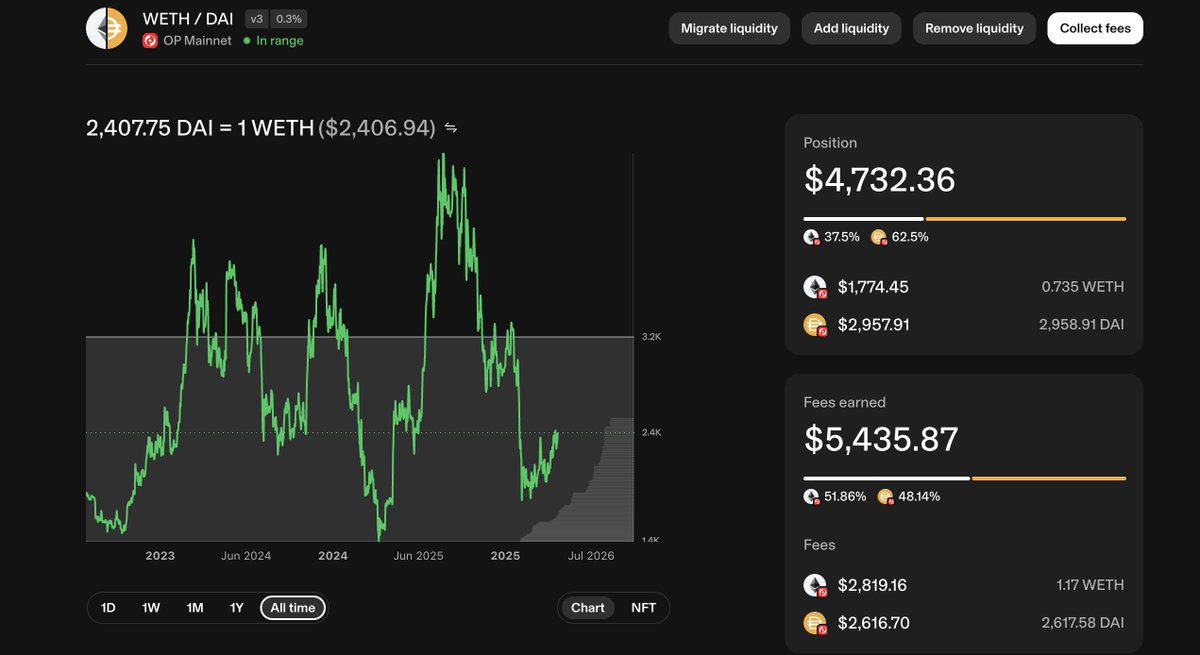
Passive LPing is pretty fun
When v3 deployed on Optimism 4 yrs ago I made a concentrated position on eth/dai from 1400-3200
I've never rebalanced, it was out of range ~30% of the time
It earned $5400 in LP fees on $4700 position size so far
1/ Today, Privy enables swaps directly in our wallet infrastructure.
Move between assets with a single API call, without needing to manage the complexities of routing, calldata, or execution logic.
Powered by @Uniswap APIs to make swaps seamless for both devs and end users.
Since the case looks very week (you can't steal from one set of victims to pay another), I would guess the goal of those behind the case is to damage defi by delaying the return of user funds
Aave LLC has filed an emergency motion to vacate a restraining notice served on Arbitrum DAO on May 1, 2026 that attempts to seize approximately $71 million in ETH belonging to victims of the April 18 exploit.
A thief does not gain lawful ownership of stolen property simply by taking it, and the law is clear on this. Those assets were recovered to be returned to users victimized in the April 18, 2026 exploit. Freezing them harms the very people this recovery effort is designed to protect.
We’ve asked the court for an expedited hearing and a temporary vacatur, and we are continuing to work alongside the Arbitrum community and DeFi United to make affected users whole.