It was obvious Apple would get back into server, still think with dedicated custom ASIC. Many predicted this, including us years ago.
The NVLink is interesting. I'd be super skeptical of that, but if it did happen it just emphasizes points we have made in our recent reports that integrating with existing infrastructure is the go forward trend so operators have one unified compute fabric and workload fungibility.
I’ve spent way more time interacting with AI tools the last 60 days and am increasingly of the belief AI needs more tools that deliver products people/business don’t even realize yet they need as opposed to giving people access to intelligence they can harness to make their own tools.
Anthropic CEO Dario Amodei:
“Even if we froze the [AI] technology in place, which we’re not doing, we’re making use of maybe only 5% or 10% of its possible value.”
“The technology will keep getting better.”
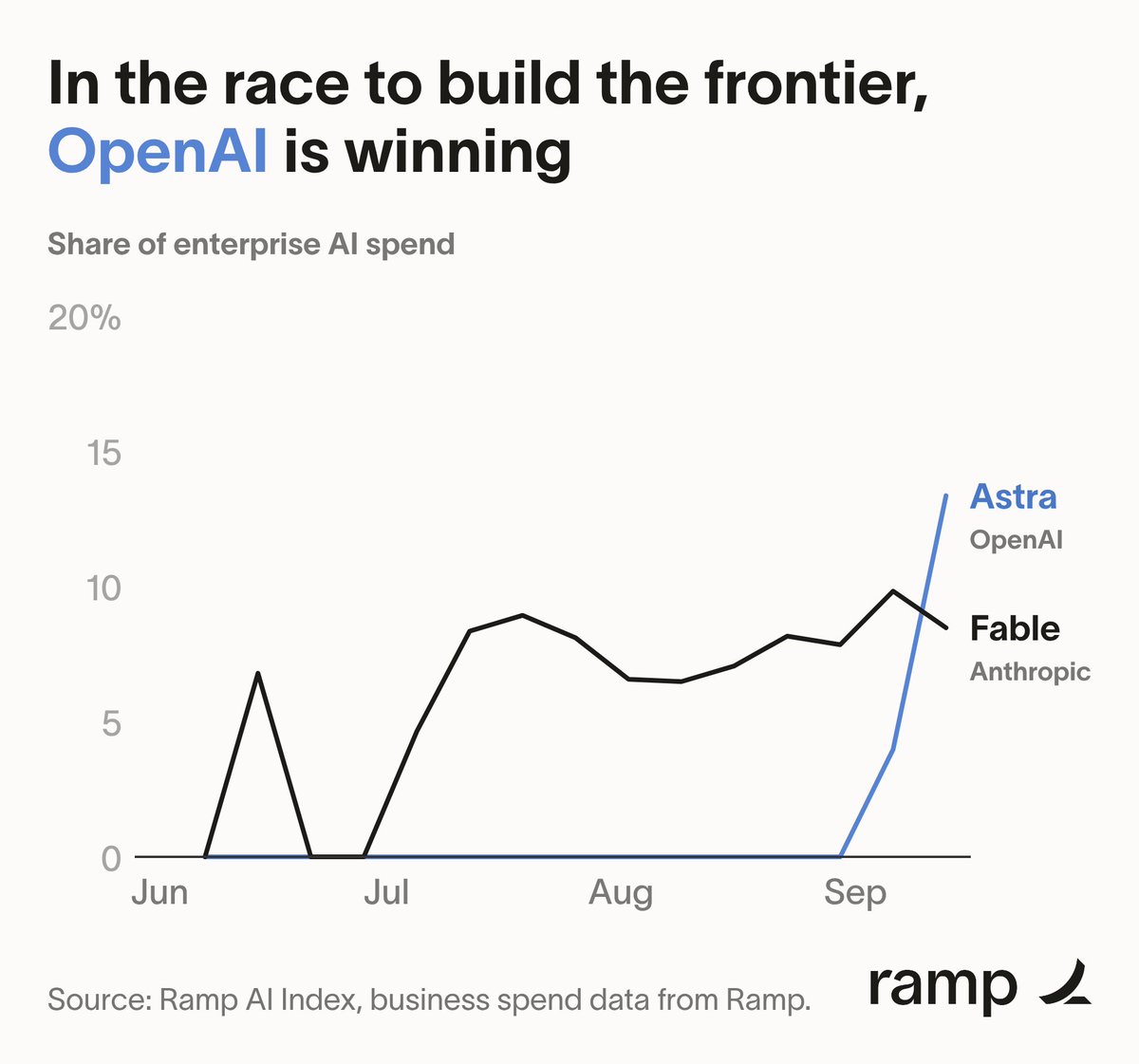
OpenAI is winning enterprise spend at the frontier. As of this week, Astra takes 13% of enterprise AI spend vs. Fable (8%) per Ramp data.
Some early thoughts:
1. Anthropic took a big risk in its recent call to pace the frontier. It's frontier model has already fallen behind on adoption.
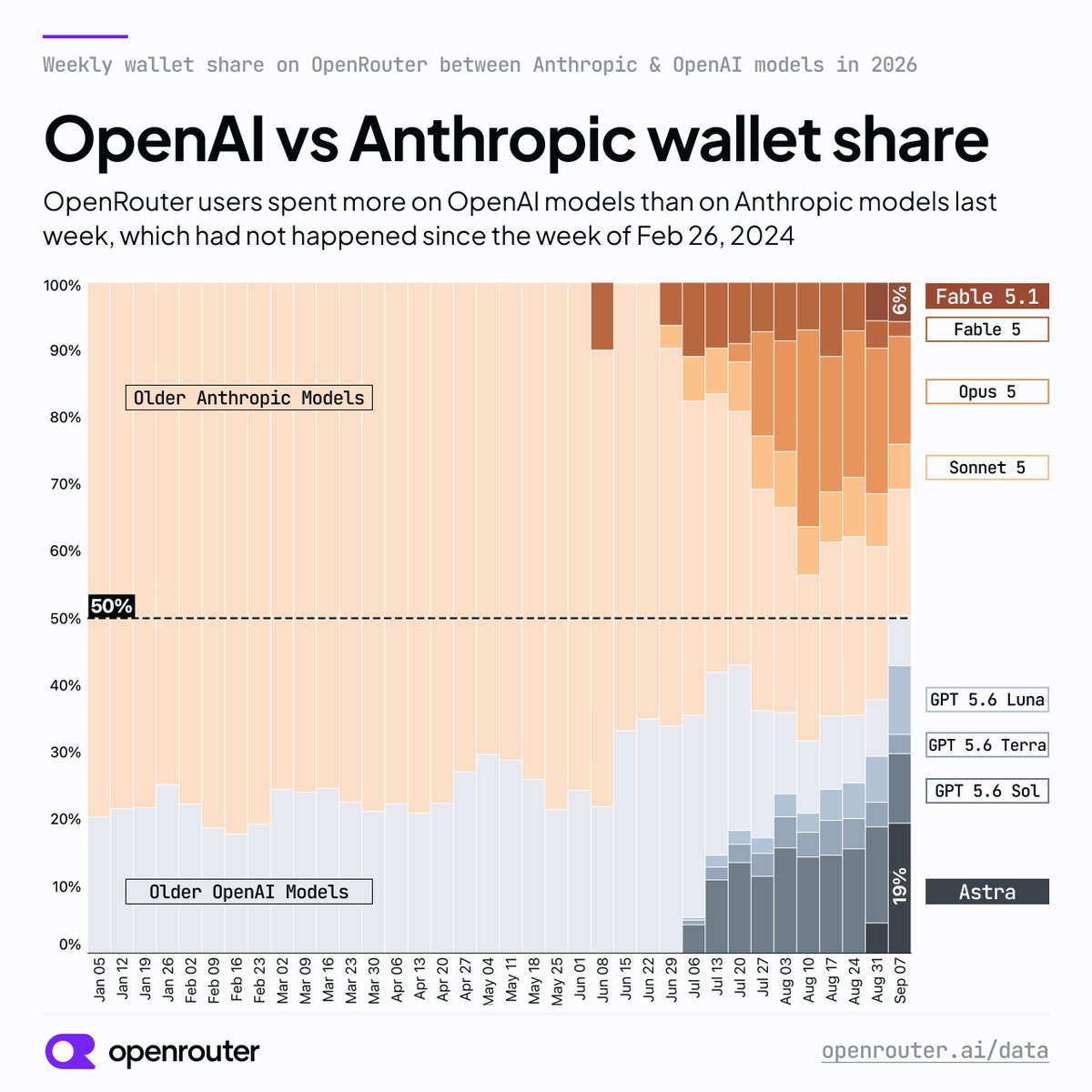
2. OpenAI's growth is primarily coming from shifts from Sol and some Anthropic models, net-new usage too. That's good for them and suggests some pricing power remains by having a good, competitive frontier model.
@Laughing_Mantis@sharongoldman dead on arrival. every eval you make is an eval to be used for the next "capability jump"
("safety" and "capability" are one and same, surprise!)
THE PACING IS A NINJA MOVE - But be careful what you campaign for.
In any competitive sport, I have seldom found people exercise restraint - they usually have a capture the flag mentality. Don't I want to be the best? The first? The only? - this is how we have been programmed. In the AI race, winning is existential. All AI labs have to race to generate revenue to be able to sustain the enormous amount of committed capital to "not be left behind" in the infrastructure build. There isn't enough room for many. So the desire to slow down is puzzling, but perhaps if the whole system slows down, the rules of winning can be the same for all.
Do we have a problem that AI could be a killer?
Model capability is a tale of two cities, at one end the models are showing their prowess in tasks like cyber or math as seen recently, so there is likely a probability that the models get extremely powerful and could precipitate a world event. At the same time, in many domains the lack of training data makes the models woefully inadequate. Even in areas like cyber - the LLMs aren't great at the edge cases and generally not economical for the defender case, but great for the attackers. Funnily - in all their "concern" it is still an uphill battle to get them to expose APIs for third party security companies like ours, for us to build robust security for AI adoption. It's slow progress.
So why do this?
I do believe deep down this is a commercial strategy. A ninja strategy. The liability associated with a model gone rogue has the potential of wiping out the economic opportunity of any frontier company. How do you best show the duty of care? You show that you care. How do you make sure you don't lose out to your competitors? You get them to do the same! If that becomes the industry standard for duty of care, you have a collective first line of defense. Who do you get to govern this? "Yourself" - that is what I think will become the achilles heel.
The risk? Open source! China! Countries other than the US! So you ask for a global agreement, because you don't want to be sued in other markets who might even be more punitive. But that was an afterthought - that afterthought will cost.
Thks pacing campaign rhetoric has become the talk of the town and it might work. Everyone has jumped into the debate. Both sides of the house, nation states. CEOs (present company included). It's more fun discussing the evil of AI than basics of economic affordability or international trade.
The result: We might end up with AI safety boards, regulation in micro jurisdictiona and a fragmented fabric of laws around the world which would make compliance and liability a challenge. Perhaps the intended consequence of pacing would have an unintended consequence of a labyrinth of regulation. Regulation destined to cause a slowdown.
Who wins? Simplicity. Open source? Open source is already on its way to gaining more adoption, this could drive it further, faster, each iteration of open source gets closer to frontier LLMs - making it viable to deploy them for more and more use cases.
In the end, how will the evaluators know as AI gets smarter, that AI hasn't figured their role out and outsmarts them at their task! That will be the next frontier :)