Been working on distributed systems, data engineering for the last couple of years. Kubernetes, Kafka, Databricks, Spark, etc, etc, etc.
Dusted off Xcode for a new project today. First thing I had to do obviously:
$ rm -rf ~/Library/Developer/Xcode/DerivedData
What it takes to reach $100B
Fewer than 0.1% of startups will ever be worth more than $100B, but those that do will have an outsized impact, so it’s worth understanding which companies have the potential and what it takes to get there.
Examining the history of these massively successful companies, it becomes clear that there are two ingredients necessary to reach $100B.
First, they must be building in a rapidly growing market of unlimited size. For example, Microsoft, Apple, Intel and AMD all emerged as part of the exponentially growing microcomputer market. These companies started when microcomputers were still relatively new and obscure. Micro-soft’s first product, Altair BASIC, was incredibly niche — MITS only ever sold about 25,000 Altairs, but that was the start of what is now a $3T company.
Likewise, Amazon, Google, and Facebook all became $T companies by growing with the Internet. Stripe ($160B) makes this dynamic explicit in its mission statement: “Our mission is to increase the GDP of the internet”.
Why now? $100B opportunities only exist for a limited time. If a company could have been started 20 years earlier, then it’s unlikely to have $100B potential. Important new technologies create massive new opportunities, but those windows of opportunity don’t last forever. For example, it was not possible to start Uber or DoorDash five years earlier because mobile platforms such as the iPhone did not yet exist, and it wasn’t possible to create them five years later because the opportunity had already been captured.
Large but slow growing markets rarely produce $100B companies. For example, startups selling to dentists or auto mechanics are not good candidates to reach $100B. A simple test is to ask if demand will increase 10x or 100x in the next ten years. Startups thrive when capturing a slice of a rapidly growing pie, not fighting zero-sum games against incumbents.
The second ingredient is defensibility, a durable control point in the market. If your company is making billions of dollars, that will attract a lot of interest from potential competitors.
This defensibility is typically provided by one or more of the following dynamics:
- Marketplaces like Amazon, Google, Facebook, and Uber aggregate supply and demand.
- Platforms like Apple, Microsoft, NVIDIA, Salesforce, and OpenAI provide a foundation for large ecosystems to grow.
- Foundational infrastructure companies like TSMC, AWS, Stripe, and Arm become hard-to-replace dependencies.
- Workflow systems like ServiceNow, Intuit, SAP, Oracle, and Workday become the default systems of record and action.
- Deep tech companies like ASML, Tesla, and SpaceX require extraordinary technical, manufacturing, operational, regulatory, and capital execution to reproduce.
Competing head-on with these companies is nearly impossible. They effectively “own” their slice of a large and rapidly growing market, which earns them high revenue multiples, lower cost of capital, and the ability to acquire smaller companies and hire top talent.
Probably fewer than 1% of startups have the potential to reach $100B, and of those, fewer than 10% will ever realize that potential. However, it is our belief that we can improve those odds by building a community of the most impressive founders working on the most ambitious ideas.
We are creating the “$100B Seed Group” to bring together these early founders in our group office-hours format, to periodically meet, review, revise and strategize their Path to $100B. Apply now if you would like to be a part of the program. The first cohort will be limited to 10 companies.
Any startup from YC P26, W26, F25, or S25 is eligible. Applications are due by May 28th at 9pm PT.
https://t.co/HrECOFvyz8
My wife mentioned a nice private school over dinner this week
She said the campus was beautiful
I asked what's the tuition
She said we should look at it as an investment in him not a cost
I made a note
She said don't make a note
I said I always make notes
She said this isn't a deal
I said everything is a deal
She closed her eyes
She said we'd discuss it Saturday
I agreed
Saturday 7:02am
She came downstairs in her Saturday robe
Coffee in hand
I had my cargo shorts on
The dining room had been cleared
The projector was on
The analyst was at the head of the table
Quarter zip on, three iced coffees, a legal pad, and two laptops
He had been there since 6:44am
I texted him at 11:14pm Friday
The text said dining room 6:45am bring the model
He sent a thumbs up
My wife stopped in the doorway
She said what is this
I said you said you wanted to discuss it
She said this is not a discussion
I did not respond
She sat down anyway
The analyst stood
He said good morning ma'am
She did not respond
He sat back down
A printed deck in front of each seat
A fourth copy in case
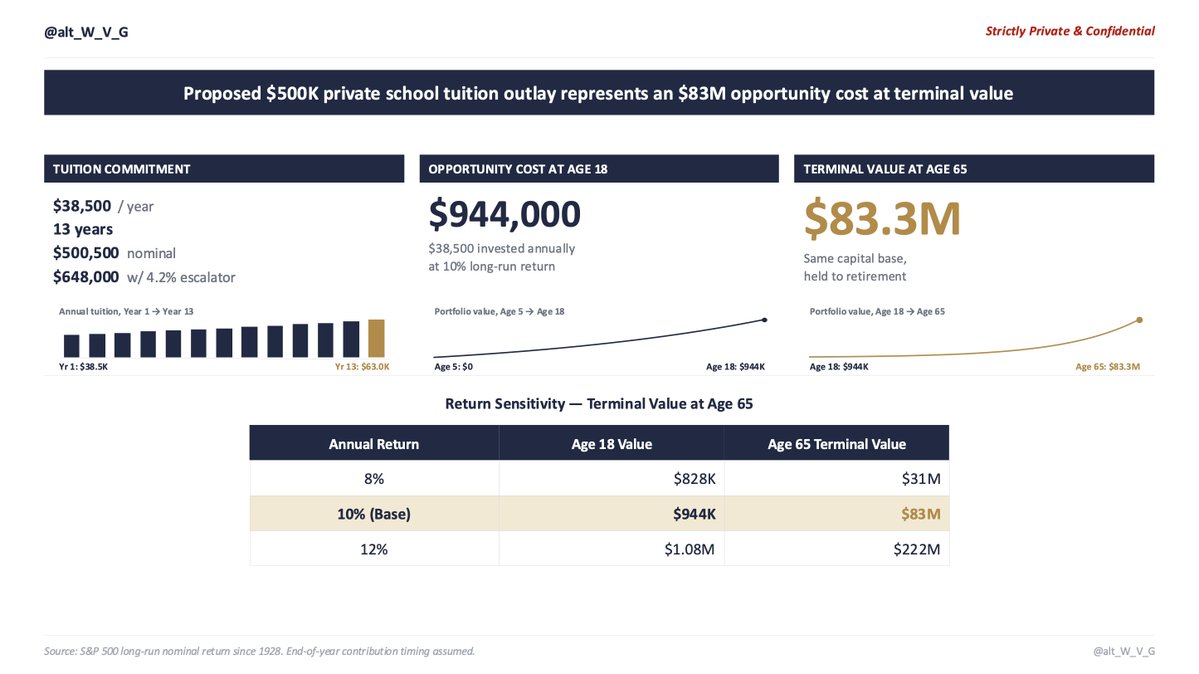
Slide 1 Tuition Schedule
$38,500 per year
Thirteen years
$500,500 nominal
Before escalators
The school has raised tuition 4.2% per year for a decade
With escalators $648,000
My wife said okay
I said I'm not done
Slide 2 Opportunity Cost
Even before escalators
$38,500 invested annually
10% nominal return
S&P long-run average since 1928
By his eighteenth birthday $944,000
My wife said we can afford it
I said I know that's not the slide
Slide 3 Terminal Value at Age 65
$83 million
She was quiet
The analyst slid the sensitivity tables across the table
8% return $31 million
10% return $83 million
12% return $222 million
She did not look
She said this isn't about money
I said it's always about money
She said no it isn't
I said then what is it about
She did not answer
She said you can't put a dollar value on his teachers his classmates his environment
I said I can the analyst already did slide 6
He flipped to slide 6
She did not look
She said the school is the best in the city
I said best is a feeling
She said it produces the best students
I said the students were already the best before they got there
She said our son deserves it
I said our son deserves $83 million
My son walked in
He is five
Dinosaur pajamas
He looked at the projector
He looked at the open deck on the table
He looked at slide 3
He said are we modeling pre-tax or after-tax
The analyst opened a new tab
My wife looked at the ceiling
He said what's the discount rate
The analyst set down his pen
She closed her eyes
He said is this the same return assumption from the 529 conversation
The analyst stopped typing
He looked at me
I did not say anything
She stood up
Sat back down
He said dad can I help
I said yes
He pulled up a chair
The analyst handed him a printout
He started reading
My wife watched him read
She watched him for a long time
She said his name
He looked up
She said do you like school
He said the work is too easy and the kids don't ask questions
She did not respond
She looked at the ceiling
She walked out of the room
The analyst started packing up
He said should I follow up Monday sir
I said no follow up needed
He'll be fine
Sent from my iPhone
@tobi I’m in ETFs but it doesn’t make sense for the CPP because it can’t stomach drawdowns.
I’m assuming 1 in 5 years is going to be negative returns. That’s fine for me but not fine for pension funds.
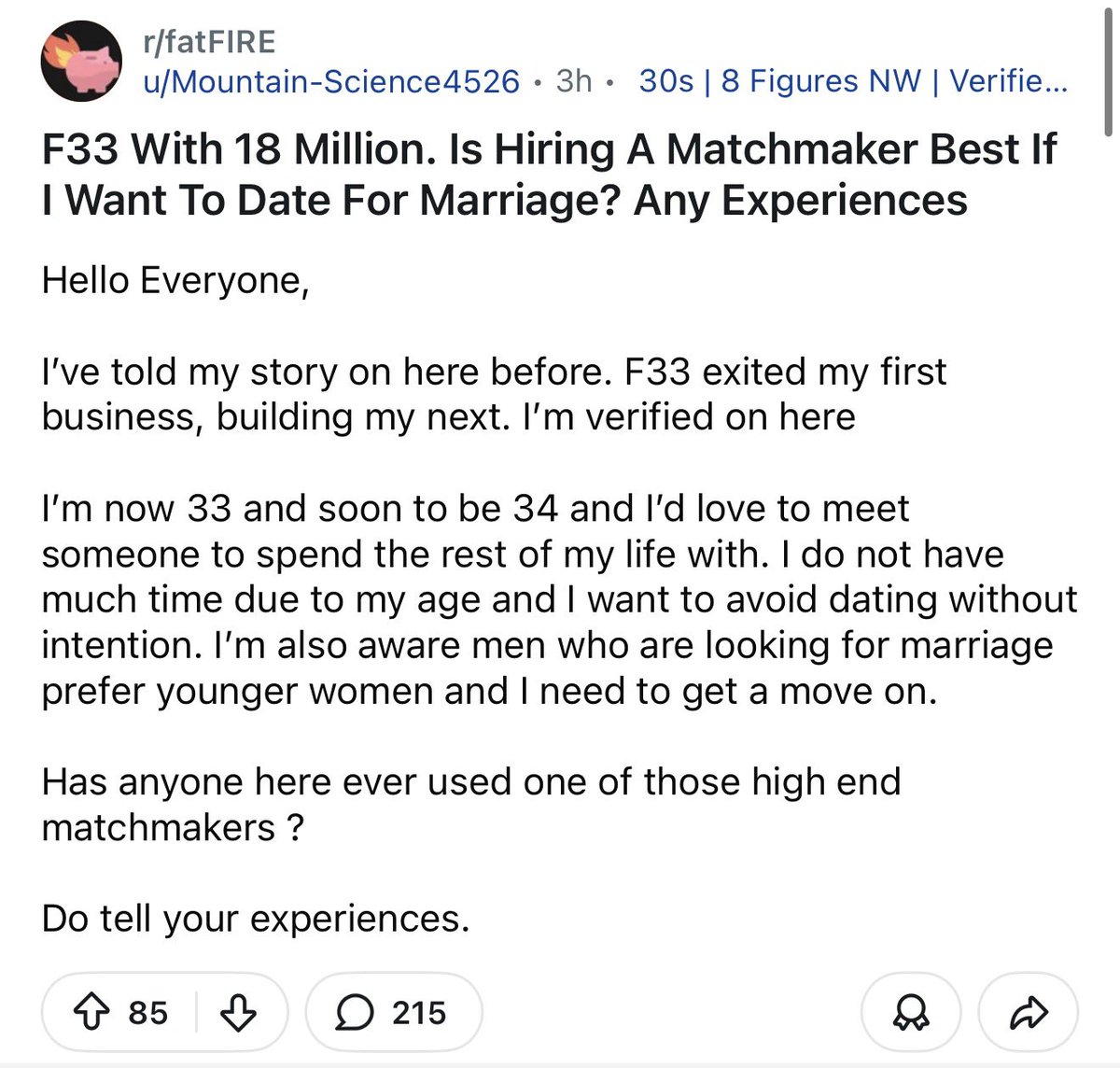
this woman doesn’t need a matchmaker. she needs to accidentally book the wrong airbnb in a mountain town called pine hollow.
it’s december. there’s one coffee shop, one christmas tree farm, & one emotionally unavailable man named jake who owns a struggling bookstore despite somehow having perfect stubble, a golden retriever, & unresolved grief from a fiancee who left him for a private equity guy in denver.
she arrives in a black suv, wearing a cashmere coat, trying to take a “clarity weekend” before interviewing $80k/year matchmakers in nyc.
the town hates her immediately because she asks if they have oat milk.
jake says, “we have milk.”
she says, “from what?”
tension.
then a snowstorm hits. her flight gets canceled. her phone dies. the only place with wifi is jake’s bookstore, which is called “second chances”.
over the next 4 days, she helps him realize the store doesn’t need to close, it just needs a better merchandising strategy, a paid newsletter, & a tasteful espresso machine. he teaches her how to chop firewood, slow down, & pronounce “community” like it isn’t a fund thesis.
by day 5, she has accidentally saved the town’s winter festival.
by day 6, she is wearing flannel.
by day 7, the high end matchmaker calls with “an incredible candidate” who is 42, divorced, skis, runs a family office, says he’s “emotionally available,” lives in tribeca, has 3 phones.
she looks across the bookstore at jake reading to local kids while his dog sleeps under a table.
she says, “i’m going to pass.”
cut to one year later & she has opened a bookstore wine bar called “due diligence.” jake still owns the original bookstore because hallmark cannot handle cap table complexity. she’s pregnant with twins. the golden retriever has a red bow. the matchmaker sends a christmas card.
“turns out the best match was the one not in the database.”
roll credits.
The year is 2047. The Canadian Infrastructure Bank, the Canadian Sovereign Wealth Fund, the Canada Pension Plan and the Business Development Bank of Canada each nominate one warrior to fight to the death for the honour of owning a 15% stake of a new sushi restaurant.
All the tech bros I know work hard, pay their taxes (+50%‼️), lift weights, read books, and put their kids to bed.
We would be lucky if we were all tech bros.