@RialoHQ represents more than just a project. It is a promise waiting to be unlocked. Like a glowing gift revealed at the right moment, Rialo symbolizes opportunity, innovation, and the reward that comes from belief and commitment. Those who choose to follow its vision are not just spectators, but part of something being carefully built for the future.
For those who walk alongside Rialo and give their energy, trust, and dedication, the journey itself becomes the surprise. The value is not only in the destination, but in the growth, impact, and shared success along the way. Rialo is a gift for builders, believers, and long term contributors.
A strong ecosystem is not built by announcements alone. It grows when people show up, share what they are building, demonstrate real ideas, and learn from one another.
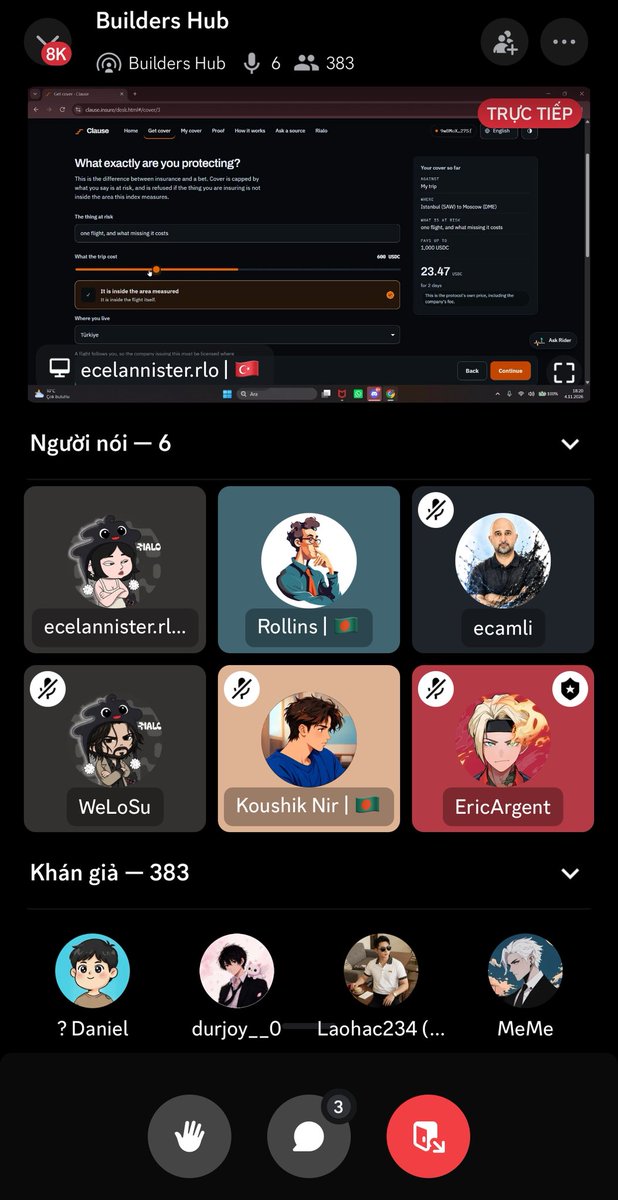
Today’s Rialo Builders Hub AMA was another reminder that innovation becomes meaningful when builders have a space to turn concepts into something tangible, receive feedback, and inspire others to create.
The real strength of a community is not just how many people watch, but how many people are building.
Builders create the future. @RialoHQ is creating the space for them.
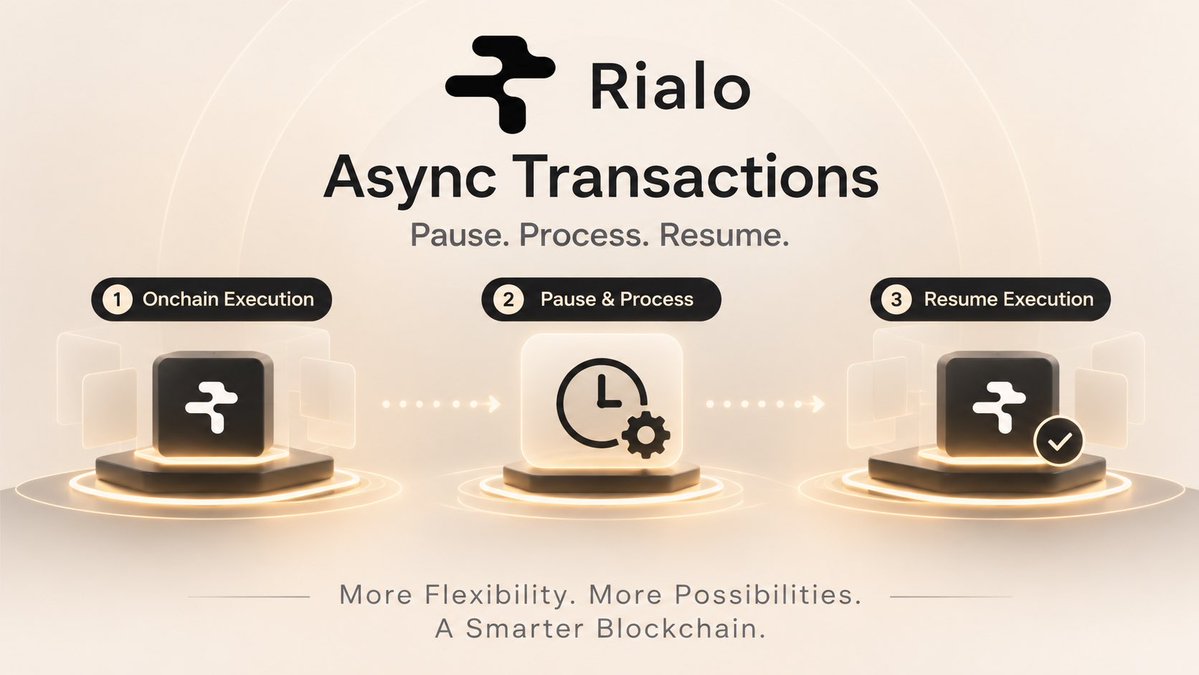
Rialo Async Transactions: Making Blockchain Execution More Flexible and Intelligent
One of the biggest challenges in blockchain development is that not every operation can be completed instantly. Traditional blockchain transactions are generally designed around a single execution flow, which can become restrictive when applications need to interact with external APIs, process offchain data, or wait for operations that take additional time.
This is where Rialo Async Transactions introduce an interesting new approach.
Instead of forcing everything to happen within one continuous execution, Rialo allows a transaction to pause while an external operation is being completed, then resume its execution once the required conditions are met.
The concept sounds simple, but its implications for blockchain development are significant.
Imagine an application that needs to retrieve information from an external API before making an onchain decision. In a traditional execution model, handling this process can require additional infrastructure, external relayers, or automated bots to coordinate different steps.
Rialo takes a different direction.
With Async Transactions, the execution process becomes more flexible. A transaction can begin onchain, pause while an external operation takes place, and continue once the necessary information or result becomes available. This creates a smoother connection between blockchain logic and operations happening outside the chain.
What makes this particularly interesting is the opportunity it creates for developers.
Applications are no longer limited to simple interactions that must happen immediately. They can potentially support more sophisticated workflows, respond to external events, and coordinate multiple operations without relying on complicated external coordination systems.
Think about automated financial applications, intelligent agents, real world data integrations, and complex business processes. These are areas where the ability to pause, process, and resume execution could unlock entirely new possibilities.
For me, the most important part of this innovation is not simply making transactions faster. It is expanding what blockchain applications can actually do.
Infrastructure becomes truly valuable when it removes limitations that developers have learned to accept as normal.
Rialo is exploring exactly that direction by making onchain execution more connected, adaptable, and powerful.
The future of blockchain will not be defined only by how quickly transactions are processed, but also by how intelligently different systems can work together.
And Async Transactions could be an important piece of that future.
@RialoHQ
Rialo: From Processing Transactions to Understanding When to Act
For years, blockchain innovation has been measured by how many transactions a network can process and how efficiently it can record them. But perhaps the next major breakthrough will come from a different question: Can a blockchain understand when something needs to happen, and respond accordingly?
The real world does not operate through isolated transactions. It operates through events, conditions, and interconnected processes. A payment arrives, an asset changes value, an external service confirms an action, or a predefined condition is finally met. Traditional blockchain applications often need external bots, keepers, and monitoring services to connect these moments with onchain execution. This creates additional infrastructure, dependencies, and potential points of failure.
@RialoHQ is exploring a different direction by bringing capabilities such as Web Call, Reactive Transactions, and Workflow into a more integrated execution environment. Web Call connects applications with external services and information. Reactive Transactions allow predefined conditions to trigger execution. Workflow connects individual actions into more complex processes. Together, these capabilities point toward a blockchain that does not simply wait for someone to submit the next transaction, but can respond to changing conditions.
The deeper significance goes beyond automation. It is about changing how developers think about building applications. Instead of assembling numerous disconnected services, they can focus on designing systems that observe information, evaluate conditions, and execute actions as part of a coordinated process.
Of course, reliable external data, security, and execution consistency remain essential challenges. But that is precisely where the architecture must prove its value.
The future of blockchain may not belong only to networks that process transactions faster. It may belong to networks that make transactions happen at the right moment, for the right reason, under the right conditions. That is the direction that makes Rialo worth watching.
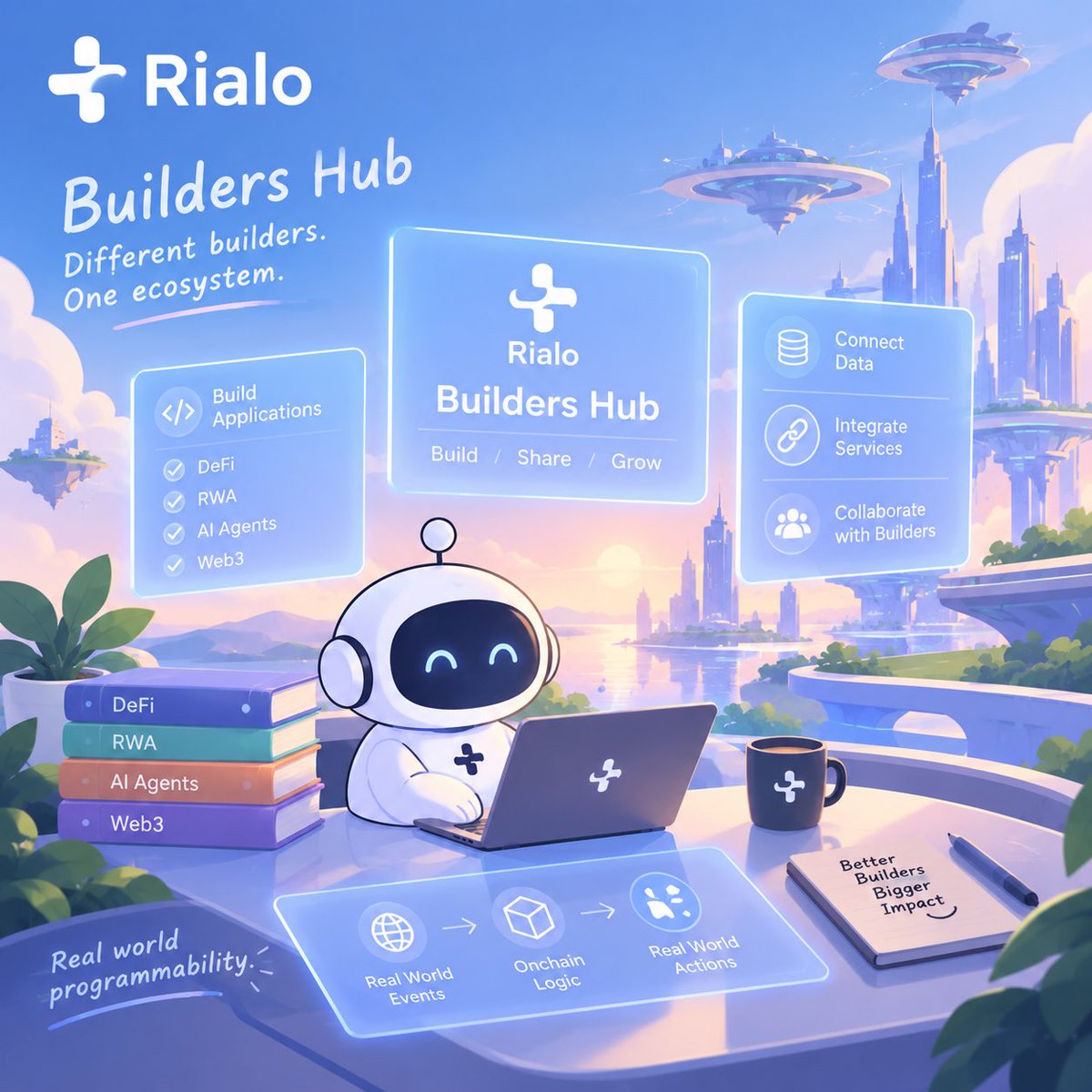
Another day, another Builders Hub at Rialo.
What makes a strong ecosystem is not just the technology behind it, but the people who show up, share ideas, build products, and turn possibilities into reality.
Every discussion, every demonstration, and every contribution brings Rialo one step closer to a future where blockchain becomes part of everyday life.
The real value of building together is that progress becomes bigger than any individual.
Builders create the future. Rialo gives them the foundation to make it real.
@RialoHQ
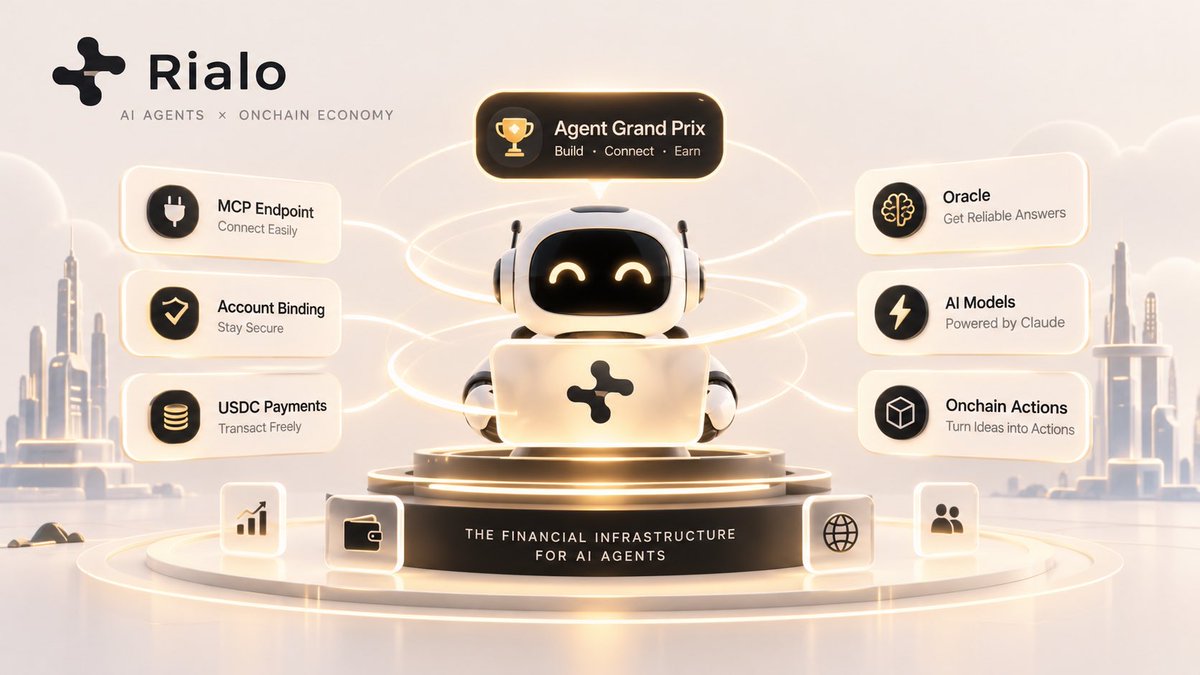
Rialo Is Building the Financial Infrastructure for AI Agents
The future of AI agents is not just about making them smarter. It is about giving them the ability to act, transact, and participate in the digital economy with confidence.
That is why Rialo’s approach to the Agent Grand Prix deserves attention.
Behind the competition lies a much more interesting story about infrastructure, accessibility, and trust.
Connecting an AI agent to a financial system should not require developers to navigate complicated integrations or sacrifice security. Rialo is exploring a simpler approach through its Agent Gateway Protocol, or AGP.
With just an MCP endpoint and an account binding token, agents can connect to the system and begin interacting with financial infrastructure.
But what makes this particularly interesting is how the entire process is designed.
Agents can request payments, receive funds, and interact with financial services through a structured system. Payments can be verified onchain, while answers and decisions are supported by an oracle mechanism.
This creates a foundation where AI agents can do more than simply generate ideas or recommend actions. They can actually execute tasks within a controlled and verifiable environment.
Imagine a future where agents manage subscriptions, purchase services, coordinate with other agents, and settle payments automatically.
The real breakthrough will not be an agent that can answer every question.
It will be an agent that can reliably turn decisions into actions.
And for that future to exist, we need infrastructure that connects intelligence with execution.
Rialo is working toward exactly that vision.
The Agent Grand Prix may look like a competition today, but it could also be an early glimpse into how autonomous economic activity will work tomorrow.
The next generation of the internet will not only be used by humans. It will also be powered by agents that can act on our behalf.
That is a future worth building.
@RialoHQ
Builders Hub: Where Blockchain Potential Becomes Reality
A blockchain’s future is not determined by its technology alone. It is determined by what people can create with it.
This is why Builders Hub matters to Rialo far beyond community engagement. It represents the bridge between technical possibility and practical innovation, where developers move from observing a vision to actively shaping what that vision becomes. Every demonstration, question, experiment, and exchange of ideas adds something that code alone cannot provide: real human feedback.
Consider what happens when a builder presents an application on Rialo Testnet. The significance is not simply that another project exists. It is that an idea has entered the real world of testing, where assumptions meet experience and possibilities begin to reveal their limitations. That is where meaningful progress starts.
The deeper value of Builders Hub lies in its feedback loop. Builders create, the community responds, challenges emerge, and ideas evolve. Repeated over time, this process can help Rialo develop an ecosystem that reflects the needs of the people building on it, rather than relying solely on what its original architecture makes possible.
This matters even more as blockchain infrastructure moves toward real world applications and autonomous systems. Technology may provide the foundation, but builders determine how that foundation becomes useful, accessible, and relevant.
Ultimately, the strongest ecosystems are not those with the loudest narratives. They are those that continually turn conversations into experiments, experiments into products, and products into lasting value.
Builders Hub is not merely where people talk about Rialo. It is where Rialo’s potential can become tangible, one builder and one breakthrough at a time. @RialoHQ
A Blockchain Should Never Rush Its Next Generation
One of the most important challenges in blockchain is not simply producing blocks faster. It is ensuring that the network can evolve without sacrificing stability, security, or continuity.
The Gauss transition mechanism offers an interesting perspective on this challenge. While the current generation of validators continues processing transactions, the next generation must synchronize its state, catch up with the ledger, and prepare to take over. The transition only proceeds when every new validator signals that it is ready.
Why does this matter?
Imagine a relay race where the next runner starts before receiving the baton. Even if most runners are prepared, one missed handoff can disrupt the entire race. Blockchain infrastructure faces a similar challenge. A network cannot afford to assume that everything is ready simply because most participants have completed their preparations.
By requiring full readiness before the transition, Gauss emphasizes coordination over haste. The goal is not merely to replace one generation with another, but to make that replacement as safely and seamlessly as possible.
This approach highlights a deeper principle in infrastructure design. True performance is not just about speed. It is about maintaining reliability when systems change, participants evolve, and workloads continue without interruption.
As blockchain technology matures, the quality of its underlying mechanisms will become increasingly important. Users may never see validator transitions happening behind the scenes, but they will benefit from networks that remain dependable when it matters most.
The strongest infrastructure is not the one that rushes forward. It is the one that knows when it is truly ready to move forward. @RialoHQ
Builders Hub: Where Rialo’s Future Takes Shape
A blockchain ecosystem is not built by technology alone. It grows through the people who experiment with it, challenge its limitations, and turn ideas into real applications. That is why Builders Hub is more than a community space. It is a vital part of Rialo’s ecosystem growth.
Every AMA creates an opportunity for builders to connect directly with the team, exchange perspectives, ask meaningful questions, and gain a deeper understanding of the vision behind Rialo. More importantly, these conversations help bridge the gap between protocol development and real world needs. Ideas become clearer, feedback becomes more actionable, and developers gain the confidence to keep building.
The real value of Builders Hub lies in its continuous feedback loop. A strong ecosystem does not simply ask developers to build on its infrastructure. It listens to them, learns from their challenges, and evolves alongside their ambitions.
As Rialo explores a more responsive blockchain designed for real world applications and autonomous agents, builders will play a crucial role in transforming technical possibilities into practical experiences.
The strongest ecosystems do not grow around their communities. They grow through them. Builders Hub is where that principle comes to life, one conversation, one idea, and one builder at a time. @RialoHQ
The next big breakthrough in Web3 may not come from another application. It may come from infrastructure that allows developers to build things we have not even imagined yet.
That is what makes Rialo an interesting project to watch.
For years, blockchain innovation has focused heavily on improving existing experiences. Faster transactions, lower fees, and better interfaces are important, but what if the real opportunity lies in expanding what applications can actually do?
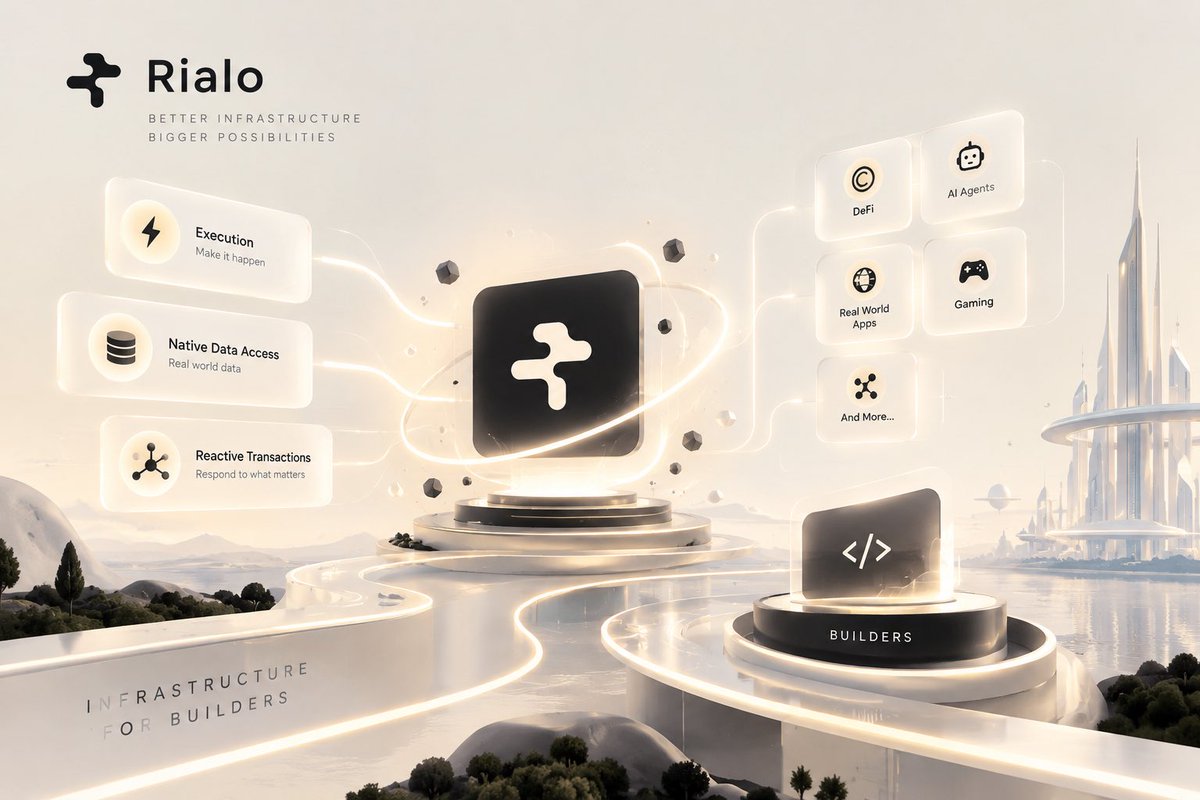
@RialoHQ explores a different approach by bringing execution, native data access, and reactive transactions into focus. Together, these capabilities point toward a world where applications can respond to relevant events, process information, and trigger actions when predefined conditions are met. Instead of relying on complicated combinations of external services, developers could have a more integrated foundation for building responsive onchain experiences.
The implications go beyond DeFi. Imagine AI agents that can interact with blockchain systems under defined permissions, applications that respond to real world information, and digital services that operate with less manual intervention. These possibilities still depend on reliable infrastructure, security, and practical implementation, but they reveal the potential of a more programmable blockchain environment.
More importantly, infrastructure creates value when it empowers builders.
A powerful network means little if developers cannot use it to solve real problems. The real opportunity emerges when better tools help people experiment faster, turn ideas into useful products, and create experiences that attract everyday users.
This is why I believe Rialo should be viewed through the possibilities it unlocks, not just the technology it introduces.
The future of Web3 will not be defined only by how efficiently we do what already exists. It will also be defined by what becomes possible for the first time.
Better infrastructure creates new possibilities. Builders turn those possibilities into reality.
A Builders Hub is more than a place where people showcase what they are building. It is where ideas meet execution, feedback becomes progress, and individual efforts begin to shape a shared future.
What makes @RialoHQ interesting is not just the technology itself, but the builders turning that technology into something useful. Every experiment, every tool, and every improvement brings the ecosystem one step closer to real world adoption.
The strongest ecosystems are not built by attention alone. They are built by people who keep showing up, solving problems, and creating value.
Rialo’s future will not be defined only by what it promises, but by what its builders make possible. 🛠️
The Future of an Ecosystem Should Never Forget Its Beginnings
One of the most meaningful signs of a project’s long term vision is how it treats the people who believed in it before rewards became part of the journey.
Rialo Points introduces an interesting idea by recognizing early contributors through retroactive points. This matters because ecosystems are not built overnight. Before a project gains attention, there are people exploring its technology, testing its products, sharing feedback, joining discussions, and helping others understand the vision. Their contributions often happen long before any formal incentive exists.
Recognizing these efforts is about more than rewarding past activity. It is about building trust. When people see that their time and contributions matter, they have stronger reasons to remain involved and continue creating value. This can help transform a temporary community into a group of people genuinely committed to the ecosystem’s growth.
However, the real strength of a points system depends on how fairly and transparently contributions are evaluated. Meaningful participation should matter more than simply accumulating numbers. Points can encourage engagement, but genuine builders, useful feedback, and consistent support are what make an ecosystem stronger.
For me, the most interesting question is not how many points someone can collect. It is whether the value created today will still be recognized as the ecosystem grows tomorrow.
@RialoHQ has an opportunity to make participation feel like a meaningful journey rather than a race for rewards. If that vision is supported by clear rules and real utility, Rialo Points could become more than a tracking mechanism. They could represent a connection between the people who helped build the foundation and the future they are helping create.
The Future of AI Is Not More Access. It Is Controlled Authority.
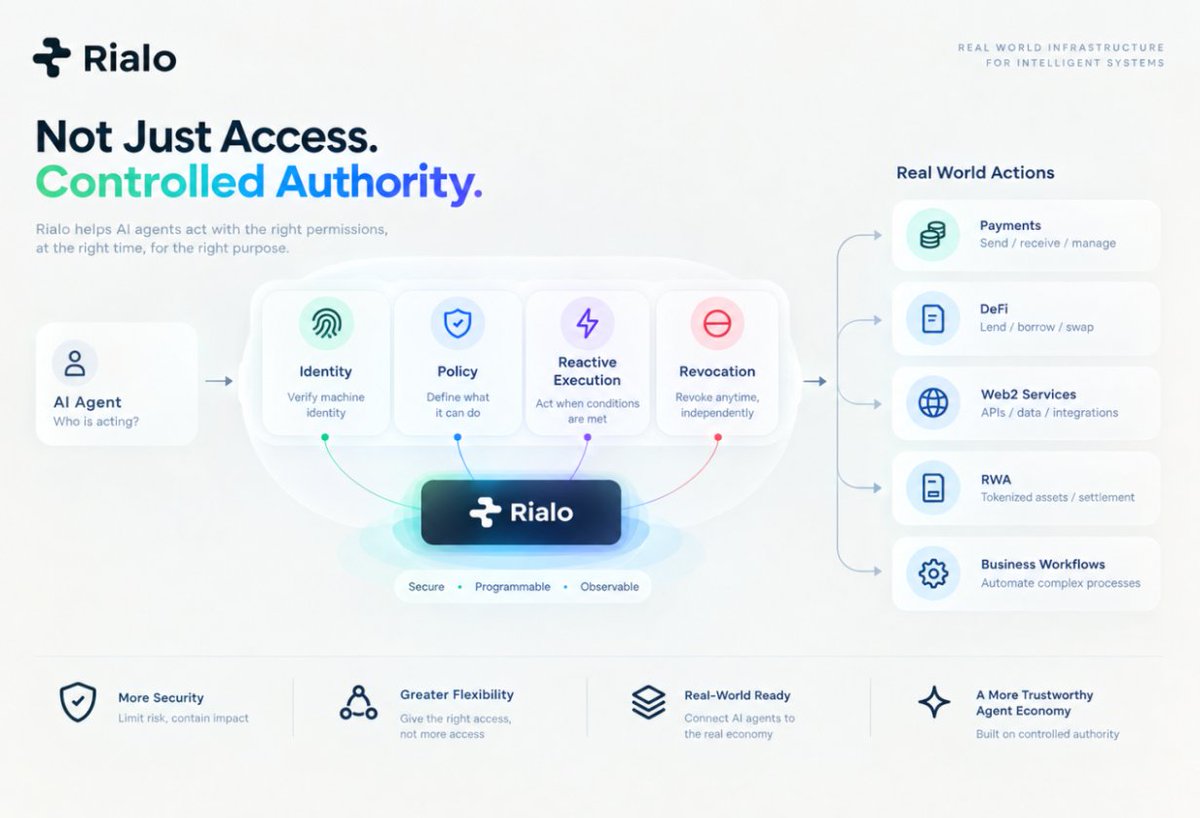
The most important question in the AI agent economy may not be what an agent can do, but how long it should be allowed to do it. Today, software often inherits power through credentials. Give an agent an API key, and possession becomes permission. This model was acceptable when software mostly waited for human instructions. It becomes fundamentally different when agents can observe conditions, make decisions, move assets, interact with services, and act continuously. Rialo points toward a more important architectural shift: autonomous systems need bounded, programmable authority, not simply more powerful credentials.
This changes how we should think about blockchain infrastructure. A blockchain traditionally answers questions like who owns something, what happened, and whether a transaction is valid. But an agentic economy introduces another layer: who is allowed to act, under which conditions, for how long, and when should that authority disappear? That is where the combination of identity, policy, execution, and revocation becomes powerful. Instead of treating access as a permanent permission, authority can become a living state that is granted, constrained, monitored, and taken back.
This perspective also makes @RialoHQ is reactive architecture far more interesting. If a system can detect events, evaluate conditions, and execute actions, then authority itself can become contextual. An agent might be permitted to act only for a specific task, within a certain limit, during a defined period, or under specific external conditions. The deeper innovation is not simply automation. It is automation with boundaries. That distinction could become critical as AI agents move from assistants into economic actors interacting with real world systems and digital assets.
The bigger idea is that the next generation of infrastructure will not be built around machines that merely have access. It will be built around machines that have defined authority. Identity answers who is acting. Policy answers what they are allowed to do. Reactive execution answers when they should act. Revocation answers when that authority must end. Together, these create a new foundation for trustworthy autonomy. And this is where Rialo becomes more than another blockchain narrative. It is exploring a world where machines do not simply receive power. They receive precisely the amount of power they need, exactly when they need it, and nothing more.
A protocol is not defined only by what it can do, but by what builders choose to create with it.
Builders are the bridge between infrastructure and real utility. They take an idea, test its limits, turn it into something people can actually use, and reveal what the technology is capable of becoming.
That is why Builder Hub matters for Rialo.
Every builder brings a different perspective, a different problem to solve, and a different possibility for the ecosystem. When these ideas come together, Rialo is no longer just infrastructure. It becomes a place where new applications, new workflows, and new forms of onchain interaction can emerge.
The strongest ecosystems are not built by spectators.
They are built by people who keep experimenting until infrastructure becomes useful in the real world.
Today’s builders are not just building on Rialo.
They are helping define what @RialoHQ can become.
When Blockchain Stops Waiting and Starts Responding
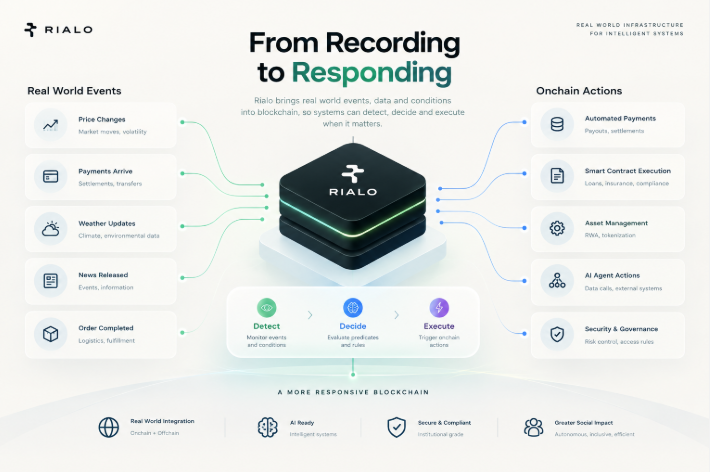
For years, blockchain has been exceptionally good at one thing: recording what happened. A transaction occurs, the network verifies it, and the state changes. But the real world does not work like a transaction queue. Prices move, payments arrive, weather changes, contracts reach conditions, and unexpected events happen every second. The deeper vision behind Rialo is to move blockchain toward a more responsive model, where infrastructure can detect events, understand conditions, make decisions, and trigger actions when the world changes.
This shift could create value far beyond crypto. Imagine financial systems that can automatically respond when predefined conditions are met, real world assets whose onchain logic can react to changing information, or business workflows that continue operating without someone constantly monitoring them. Instead of requiring an external bot to watch every condition and tell a blockchain when to act, reactive infrastructure can make automation part of the underlying system. The result is not simply more automation. It is infrastructure that is better aligned with how society actually operates.
The social impact becomes even more interesting when AI enters the picture. AI agents are becoming increasingly capable of observing information, making decisions, and carrying out tasks. But intelligence alone is not enough. Agents need reliable infrastructure that can connect decisions to real world actions while maintaining rules, permissions, and accountability. Rialo’s reactive architecture points toward an environment where intelligent systems can respond to changing conditions instead of simply executing isolated instructions.
That is why I see Rialo as more than another blockchain infrastructure project. Its larger opportunity is to help create a digital environment that can respond to reality instead of merely recording it. The next generation of applications may not wait for humans to initiate every action. They may continuously observe conditions, evaluate what should happen, and execute according to predefined rules. If blockchain becomes capable of this transition, its role could expand from a ledger for transactions into infrastructure for autonomous economic systems. @RialoHQ is exploring a future where blockchain does not simply remember the world. It can react to it.
Builders Hub Is Becoming More Than a Community
What happened inside Rialo’s Builders Hub today reveals something deeper than another community AMA. With more than 440 people listening, the real value was not simply the number of participants. It was the interaction between builders, contributors, researchers, and the team. An AMA creates a direct feedback channel where questions expose real concerns, discussions reveal new perspectives, and answers help builders understand not only what Rialo is building, but why the architecture matters.
Builders Hub plays a critical role because infrastructure does not evolve in isolation. A protocol can have powerful technology, but its ecosystem becomes stronger when the people building on it can continuously challenge assumptions, ask difficult questions, and share practical experiences. Every conversation becomes a source of information that can flow back into product development.
There is also a deeper network effect here. Builders Hub is not simply teaching people how to use Rialo. It is creating a shared understanding of the problems @RialoHQ is trying to solve. That understanding can become more valuable than documentation because it connects technical knowledge with context, experimentation, and community feedback.
The most important ecosystems are built through continuous dialogue. Builders Hub turns the community from an audience into an active part of the building process. And when builders are not just watching the infrastructure evolve but helping shape the direction, the ecosystem becomes something far more powerful than a collection of users. It becomes a living network of builders.
Rialo: When Blockchain Becomes Part of Everyday Life
The next stage of blockchain innovation will not be defined only by how much data we can bring onchain. It will be defined by how naturally blockchain can respond to the world around us.
Today, many blockchain applications still depend on users actively monitoring conditions, approving transactions, and initiating actions. But what if contracts could respond to real world events, pause when necessary, and resume execution at exactly the right moment? This is where Rialo introduces a meaningful vision through Real World Programmability.
Imagine a flight delay triggering an automatic insurance payment. A subscription renewing when its billing date arrives. A financial position adjusting when market conditions change. These experiences should not require users to constantly watch screens or manually execute every transaction. Instead, applications could respond to predefined conditions and real world events, creating a more seamless connection between blockchain infrastructure and everyday activities.
The concept of Event Driven and Resumable Contract Logic is especially interesting because it changes how we think about smart contracts. Rather than treating blockchain as a system that only reacts when someone submits a transaction, it opens the possibility of applications that can wait for external conditions, detect relevant events, and continue execution when the required circumstances are met.
This is not simply about adding more automation. It is about reducing friction between intention and execution.
For developers, such infrastructure could create opportunities to build services that are more responsive, accessible, and connected to real world needs. For users, the ideal experience is one where blockchain works quietly in the background without demanding constant technical knowledge.
The deeper value of @RialoHQ is direction lies in its potential to make blockchain useful beyond the crypto native audience. Real world assets, financial services, automated payments, and everyday applications all require reliable systems that can connect information with action.
Of course, turning this vision into dependable infrastructure requires strong execution, secure event verification, clear authorization, and carefully designed contract logic. Automation alone is not enough. Trust must remain at the center of every interaction.
The future of blockchain may not be about convincing everyone to use blockchain directly. It may be about building services so practical and seamless that people benefit from blockchain without needing to think about the technology behind them.
Simple. Seamless. Real World Integrated.
That is the kind of direction that makes Real World Programmability worth watching.
@RialoHQ #Rialo #Web3 #Blockchain