Love. Excellence. Wisdom. Freedom. In that order. I create conditions for people to reclaim agency from systems that extract it. Especially in healthcare.
@DutchRojas@MAHA_Action Oh the satire was in no way lost on me. I loved it. Especially the apparent choice of “exposure therapy” as treatment. The whole thing is bullshit…and clearly I am pissed too.
@StevenBartlett@AdamNeumann This was an excellent episode. And Adam’s point on knowing yourself deeply - knowing and living your personal values - and where you are going BEFORE you enter into a lifelong relationship resonated and is so true.
Yes…and i wonder if the highest expression of that “power” is rooted in faithfulness, honor, & love.
To your points, there’s something deeply attractive about a man’s discipline in strength & self control - physical, mental, & spiritual. It signals he is capable of providing and protecting.
And perhaps that is what allows another human being - a woman - to entrust something precious to him. To trust & feel safe in his hands because his word is good. And know he will honor what she has entrusted to him.
I am new to X and took to your posts upon my first read.
I came to X because I needed a break from the LinkedIn echo chamber. A place where my feed would be curated from scratch. Don’t get me wrong, LinkedIn has its time and place - but I found myself feeling more drained than inspired.
You & your posts spoke to the visionary, systems design, and tool/instrument optimization geek in me. And I love her. She has missed this type of intellectual exploration and inquiry.
I thank you and am grateful. ✨
@mcuban Yes & 1 step before the letter: can the organization explain its own plan w/o the broker doing the explaining? Who holds the contracts? Who decides? Who gets paid by whom? What can be verified?
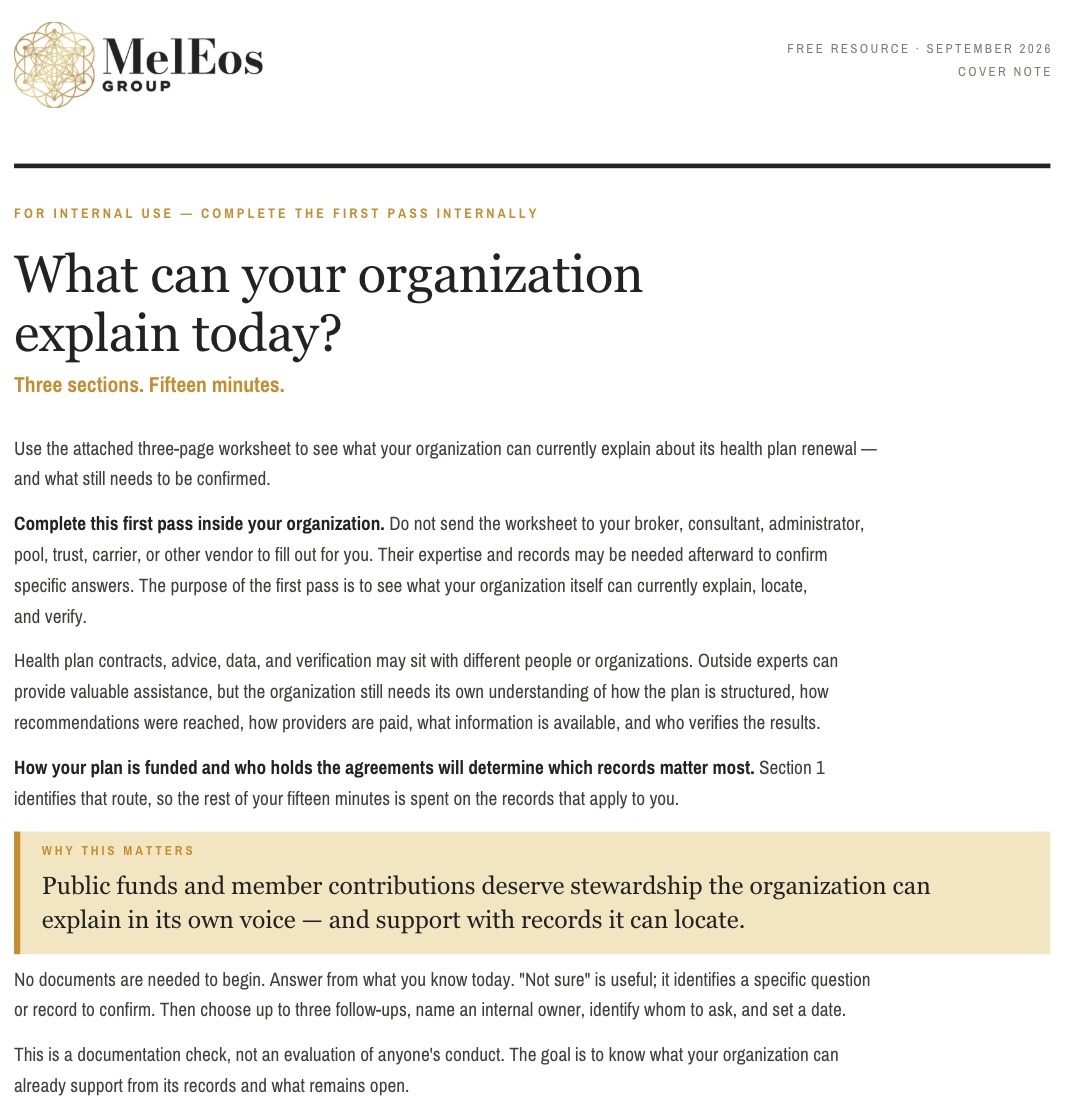
15min clarity check for public entities - Free to use.
https://t.co/zaHMF97Zho
Man this is important information.
My personal lived experience (adjacent to your points, I believe):
My ob/gyn has an independent practice.
She can perform procedures and surgeries at the hospital literally 2 blocks away.
Or she can perform procedures and several common surgeries in her office (she has a dedicated section of her office for this use).
In 2022, I chose her office.
Sure - the cost at the hospital being literally 6x more expensive than in her office played a part, but the comfort and safety of being in a more personal and intimate setting made all the difference. I trust HER. I trust her team. They held my hand and stayed with me when I came out of the anesthesia - told me to take my time and they meant it. Set and setting would have been different in the hospital - even with the same excellent physician - it's just different. So a fraction of the cost (that matters, obviously) and a profoundly safe space for something so deeply personal and frightening.
I recommend her and her practice to anyone who asks. She wants to be forever-independent. Trying to do my part in supporting her independence and spreading the word that such places & physicians exist. ✨
This is what I see when I think of the existing structure.
EMPLOYER ←→ BROKER ←→ CARRIER / PBM / TPA / VENDOR
Look at where the broker sits.
The employer depends on the broker to understand the market, compare options, negotiate, & help make the decision.
On the other side, carriers, PBMs, TPAs, & vendors know the broker controls access to a book of business they want.
That means the leverage can run both ways.
I saw this firsthand for 16 years. And that was before this level of consolidation (brokerage consolidation).
And I continue to witness it.
Brokers have real leverage with carriers. Real influence with employers. Vendors want access. Relationships matter. Volume matters. Who has the book matters.
So when I look at what Mark Cuban and legislators are doing around PBMs, TPAs and “Too Big To Care,” I think the work is absolutely necessary.
But I also keep thinking…look one layer upstream.
Because if one intermediary can influence what the employer sees, who gets considered, what gets negotiated, what gets recommended…AND has leverage over the companies trying to win that business…
that is not just an “advisor.”
That is a control point.
And now some of those control points are getting very, very big.
Important work. Needed. And…
The bill goes after healthcare middlemen that are “Too Big To Care”. I hope we run that same look one layer upstream…to the brokers. Especially with the consolidation happening there too.
I spent 16 years on the broker/agency side. I saw the leverage brokers had with employers…AND with insurance carriers…and with vendors thru the whole chain.
And that was before Gallagher bought AssuredPartners. Before this week’s Aon-USI deal announcement.
We call them “advisors”. But when you can influence what an employer sees, considers, negotiates, & ultimately buys…AND you have real leverage over the companies competing for that business…I’m not sure “advisor” still describes the role. There’s a heck of a lot more power there than “advisor” suggests.
Important work. Needed. And…
The bill goes after healthcare middlemen that are “Too Big To Care”. I hope we run that same look one layer upstream…to the brokers. Especially with the consolidation happening there too.
I spent 16 years on the broker/agency side. I saw the leverage brokers had with employers…AND with insurance carriers…and with vendors thru the whole chain.
And that was before Gallagher bought AssuredPartners. Before this week’s Aon-USI deal announcement.
We call them “advisors”. But when you can influence what an employer sees, considers, negotiates, & ultimately buys…AND you have real leverage over the companies competing for that business…I’m not sure “advisor” still describes the role. There’s a heck of a lot more power there than “advisor” suggests.
Well shit. This explains a lot.
In the context of healthcare and health insurance I hear versions of this ALL the time…
“That won’t work.”
“You can’t do that.”
“The law prohibits it.”
“Policy won’t allow it.”
And often, when you really think about it, they aren’t statements about what’s possible or impossible at all. They’re statements about cost, incentives, convenience (or someone’s inconvenience), or whose interests get protected.
Big difference.
@PeterDiamandis This may be one of the most useful distinctions I’ve read in a while. “Impossible” & “the current rules, incentives, economics, or assumptions don’t support it” are very different problems.
Apparently I’m going down an AMA rabbit hole. 🕳️ 🐇
Join me…because if you’re not a physician or don’t work somewhere in healthcare, you may read Dutch Rojas’s post and think…’okay, but why is it I should care about the AMA?’
Let’s start with CPT codes.
Every time you go to the doctor, have a procedure, get an MRI, whatever…what happened has to be translated into standardized codes so the claim can move through the healthcare payment system.
One set of codes helps describe why you were there. That’s where ICD-10 codes come in.
Another helps describe what was done. That’s CPT codes.
Very oversimplified, but useful:
ICD-10 = why
CPT = what
And here’s the part I somehow missed:
CPT is owned and copyrighted by the American Medical Association. Really?! Owned. Like they own & control the rights to them.
According to Rojas’s analysis, the AMA collected $301 million in CPT royalties in 2024. That was 55% of its revenue.
Yeah…read that again.
A private membership organization representing a minority of American physicians owns one of the primary coding systems our healthcare payment machine depends on…and generates hundreds of millions of dollars from licensing it.
I’ve spent decades in insurance & benefits. Of course I knew what CPT codes were. I understood their role in claims and billing.
I did NOT understand the business & power structure sitting behind them. Geez. How did I miss this?
And CPT is only one piece of what Rojas lays out here.
So if you’ve ever wondered why American healthcare is so damn complicated, maybe one place to start is learning who owns, controls, & makes money from the infrastructure underneath it.
I’ve been looking at infrastructure, incentives & leverage for a while.
Apparently the rabbit hole I was already in has a basement. 😂
The American Medical Association represents less than 15% of American physicians.
They collect $300 million per year by licensing the billing codes the government forces taxpayers to use.
They spent $486 million lobbying since 1998….
I’ve spent decades in insurance & benefits and I’m embarrassed by how much I did NOT fully understand about the AMA and CPT.
I suspect most Americans think something like: a medical bill is basically doctor did something + insurer does something with it + they tell me what to pay…and maybe this CMS organization, whoever they are, fits in here somewhere. Not sure.
They have no idea how much privately controlled infrastructure sits between the care they received and the bill they get. And honestly, neither had I.
Keep doing what you do, Dutch. I’ve followed you for years on LI & now that I’ve joined X, I learn something from you every day. New clean feeds are enlightening. ✨
On Monday, @mcuban made clear what “the people fucking up the negotiations need to understand.” I continue to chuckle thinking about it. Preach.
The contract he open-sourced today is what understanding looks like…one fee, and unexplained money belongs to the plan (the state, the county, the city, etc) until proven otherwise.
Apply “presumed state [plan] money” to every intermediary paid from the premium, not just the PBM.
AND that’s only sustainable if the public entity can name who holds the contracts, who gets paid when spend rises, and who is allowed to verify that what was negotiated & purchased is actually being practiced & delivered….who is responsible & who is accountable.
If a board cannot answer those questions before anything is signed, it’s not necessarily a vendor problem yet. They have an internal ownership problem. It can done internally. Takes 15 minutes to check.
The Model State Drug Contract, Explained in One Page
The problem. When a state buys prescription drugs for its employees, teachers, and retirees, it hires a middleman company to run the program. These middlemen decide which drugs are covered, which pharmacy you use, and what everything costs. Here's the catch: the middleman often makes money in ways the state can't see. It charges the state one price, pays the pharmacy a lower price, and keeps the difference. It collects discounts from drug makers and doesn't hand them all over. It sends the most expensive prescriptions to pharmacies it secretly owns. States lose hundreds of millions of dollars a year this way — and most never find out, because the contracts they sign don't let them look.
The fix is two documents. A ready-to-sign contract, and a set of bidding rules (called an RFP) that any state can use to hire a middleman under that contract.
What the contract says, in plain English:
1. One paycheck, nothing else. The middleman gets one clearly stated fee for its work. Every other dollar — every discount, rebate, or payment from anyone — belongs to the state. If a dollar shows up that the middleman can't explain, the rule is simple: it's presumed to be the state's money unless the middleman can prove otherwise with receipts.
2. No secret markups. When the middleman's own pharmacy (or one it partly owns) fills a prescription, it must charge the state what the drug actually cost, plus a stated fee — not a made-up price. And no drug can ever cost the state more than the price anyone can see publicly online at sites like https://t.co/xY30tRakLV. If the public price is lower, the state pays the lower one. Period.
3. The state sees everything, live. The middleman must send the state a constant computer feed of every claim, every payment, and every dollar it receives from anyone — not a PDF once a year, but data the state's auditors (and their software) can check every day against public prices. If the numbers don't match, the middleman owes the difference.
4. Pharmacies and patients get protected too. No clawing money back from your local pharmacy months after a prescription is filled. No forcing you to use the middleman's mail-order pharmacy. If you buy a drug cheaper with cash somewhere else, it still counts toward your deductible. And no games where making patients give up on getting their medicine gets counted as "savings."
5. Best price, guaranteed. If the middleman gives any other state a better deal, this state automatically gets that deal too. Every year, the state can check the market — and if better terms exist and the middleman won't match them, the middleman pays the difference until it does.
6. Real consequences. Cheating means paying the money back with interest, plus penalties, plus the state can fire the company. No fine print anywhere can cap what the company owes.
What the bidding rules (RFP) say: Companies don't get to rewrite this contract — they only compete on the numbers that fill in the blanks. To prove their prices are real, every bidder must take a year of the state's actual prescriptions and show, claim by claim, exactly what each one would have cost under their bid. No advertising tricks, no fancy "average discounts" — just the real bill. Lowest real bill wins. If a company demands changes to the protections, its bid is thrown out.
The bottom line. This contract doesn't ask the middleman to be honest. It's built so honesty is the only way to get paid — and so any company that objects has to explain exactly which hidden money it doesn't want the state to see.
Well done. I’ve worked with fire districts, special districts, townships, and schools for years. These are the entities making big decisions with public dollars inside contracts that have become far more complicated than they need to be.
"One stated fee" alone is a level of clarity many never get.
And this may be my favorite clause: “presumed [plan] money unless proven otherwise.” I’d like to see that principle applied well beyond state PBM contracts.
Work like this is in large part why I left the traditional broker model and built an independent third-party firm.
Every renewal season, we get some version of the same questions: What does all of this mean? Where do our premium dollars actually go? Does our advisor make more if we spend more?
And then we start getting into the questions they didn't know to ask.
Who owns the contracts? Who gets paid what and by whom? What was actually negotiated? Who checks it? And can the people making the decision explain where the public money went and why they made the decision they made?
So we turned that into a 15 minute internal snapshot worksheet public entities can do themselves before anything gets signed.
Happy to share it if useful.
You’ve played a key role in my Bitcoin journey. Grateful for WiM and for your posts/shares like this.
I left a 15yr career at an insurance agency I helped grow far beyond what any of us thought possible. After the sale to a national firm, the politics, corporate immune system, and ugliness in abuses of power became too much.
Freedom is one of my core values, so I walked away for my health, my sanity, and because I know I’m called to work that matches my moral compass. I started my own business and it’s certainly had its ups and downs and twists.
Your post - your ritual in seeing and manifesting your future showed up in my feed at just the right time today. My ideal day looks nearly identical. Thank you for sharing - I needed the moment to pause and reconnect.
@ehlJAMA@paulsummergrad 2/3 of the revenue. Wow.
When you were there, was the AMA position that CPT codes are the standard they’re ethically responsible for - or was it openly understood & intentionally designed as the thing that funded everything else? Maybe both-and…?


![KalliT4Ever's tweet photo. Well done. I’ve worked with fire districts, special districts, townships, and schools for years. These are the entities making big decisions with public dollars inside contracts that have become far more complicated than they need to be.
"One stated fee" alone is a level of clarity many never get.
And this may be my favorite clause: “presumed [plan] money unless proven otherwise.” I’d like to see that principle applied well beyond state PBM contracts.
Work like this is in large part why I left the traditional broker model and built an independent third-party firm.
Every renewal season, we get some version of the same questions: What does all of this mean? Where do our premium dollars actually go? Does our advisor make more if we spend more?
And then we start getting into the questions they didn't know to ask.
Who owns the contracts? Who gets paid what and by whom? What was actually negotiated? Who checks it? And can the people making the decision explain where the public money went and why they made the decision they made?
So we turned that into a 15 minute internal snapshot worksheet public entities can do themselves before anything gets signed.
Happy to share it if useful.](https://pbs.twimg.com/media/HQ1SVIQWoAAP6b_.jpg)





