Safaricom Plc's submission before the National Assembly's Finance & Planning Committee makes some pretty interesting disclosures:
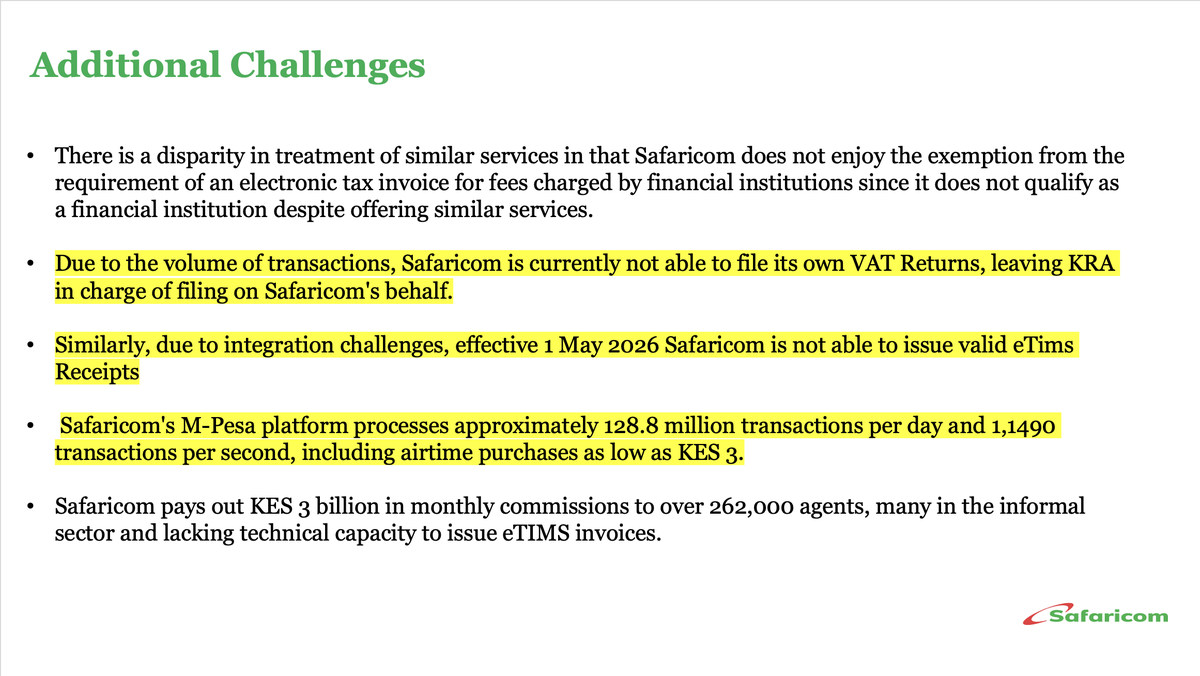
· The Telco says that due to the volume of transactions (MPesa alone processes ~ 128.8 million transactions per day and ~ 1,1490 transactions per second) KRA's system is not abled to have it file VAT returns
· The Telco says that effective May 1st, 2026 it has been unable to issue valid eTIMS receipts. It is citing integration challenges as the reason for this
Musings:
· Kenya's largest & most profitable entity is unable to integrate with the Revenue Authority's e-invoicing system. It is also unable to file its own VAT returns & has left it to the Revenue Authority to do it from a back office approach. This is very serious!
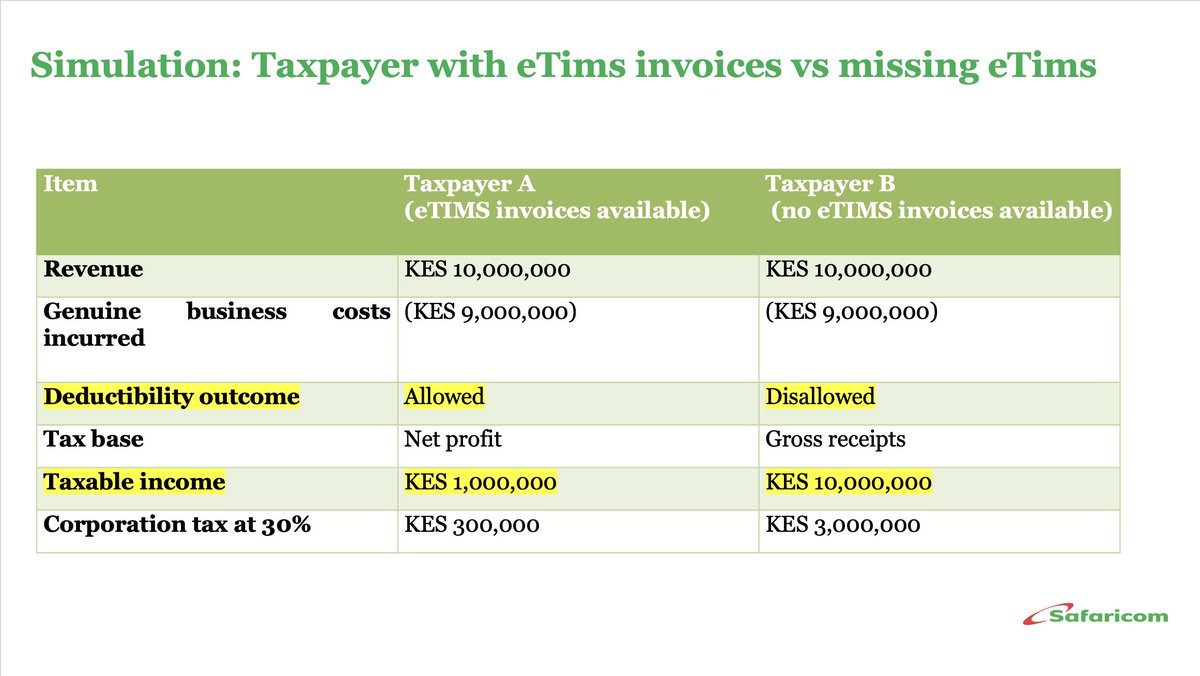
· Safaricom's submission was, in many words, asking that Sec23A of the Tax Procedures Act recognises MPesa (& mobile money receipts by extension) as valid eTIMS invoices & therefore eligible for income deductible purposes. Plausible?
· Safaricom is also asking why, unlike financial institutions, it does not enjoy the exemption from the requirement of an electronic tax invoice for fees charged despite the fact that it offers similar services
· Safaricom is also raising a fundamental question around the applicability of Sec15 of the Income Tax in as far as allowable deductions go. In the case of promotional prizes paid to individuals, how does a corporate claim the expense yet the individual does not raise an eTIMS invoice? Isn't a promotional prize an expense incurred "wholly and exclusively" in the corporate's line of business?
· Is there a case for the remit of e-invoicing to be limited to transactional taxes & not corporate income taxes?
Some scenario mapping by Coca Cola regarding Finance Bill 2026's proposal to amend the First schedule of the Excise Duty Act & slap Kes 20/litre excise on fruit juices.
The firm says there's a risk the proposal if implemented will:
· Translate into an increase of Kes 5.86/litre, translating to a 41.5% rise in excise duty on sweetened juice products
· Increase the cost of juice production by 41.0% & decrease overall profitability by 9.0%
· Translate into an 8.6% decline in income tax remittance to the Revenue Authority
· Translate into a 14.0% decline in import duty as declining volumes impact demand for raw materials
What Julians has submitted is extremely critical. Extremely.
Right now:
• You partly tell KRA what you earned
• You tell KRA what tax you owe
If finance Bill 2026 passes,
It is KRA that will strictly tell YOU:
• What you earned
• What tax you owe
How?
• By pulling data from anywhere
• eTIMS, banks, third parties, govt ministries integrations, etc
If KRA sends you a tax bill. And it is insane. And you disagree. Who must prove it is wrong?
The bill says it is you.
But here is the danger. KRA is NOT required to tell you:
• Where they got the data from
• Or how they arrived at the figures
So you are left there. Trying to fight numbers you cannot see.
And some of those numbers could be system errors.
Now ask yourself,
- How do you disprove something you don’t even understand? Are you an angel?
What Julians is saying is simple.
If KRA wants to tax you using their data, KRA must prove to you and the courts that that data is:
• Accurate
• Reliable &
• Defensible
Is that a fair argument?
Or should taxpayers just fight ghosts?
Michael Jackson and Quincy Jones listened to 800 songs to find 9. Then Quincy threw out 4 of those 9 and went back into the studio. Beat It, Human Nature, P.Y.T., and The Lady in My Life were emergency replacements for songs that were not good enough.
They spent four months just listening. Quincy and Rod Temperton sat in a Los Angeles studio in 1982, going through song after song after song from every songwriter they could pull a favor from. Most got cut after a few seconds. Of the 800, they only ended up recording around 30 with Michael actually singing. Of those 30, only 9 made the final list. And then Quincy listened to the finished album, decided 4 of his own picks were not strong enough, and pulled them. The four songs he replaced them with became some of the most famous in pop music history. The four he cut went on to become hits for other artists.
Recording those replacements almost broke the team. During the Beat It sessions, Quincy had three studios running at the same time. Eddie Van Halen was in one of them laying down his guitar solo for free. He had thought the call from Quincy was a prank his friends were pulling on him. Michael was in the next room, singing a vocal part through a cardboard tube. Engineers were mixing in the third studio. They worked five days and five nights with no sleep. At one point the speakers overloaded and caught fire. Quincy later told the BBC they had to carry engineers out of the studio on stretchers. Musicians too. Greg Phillinganes, the keyboard player on the album, said there was a moment where everyone thought it was finished, that they had nothing left to give, and Quincy was still standing there saying "It is not there yet" while Michael, almost falling apart, kept asking what they were supposed to do now.
They finally finished mixing in early November. Then they sat down to play the master back, and the album sounded weak. They had crammed too much music onto a normal vinyl record, and the grooves had to be cut so narrow that the punch was gone. So they cut a verse from "The Lady in My Life," shortened the famous 29-second intro of "Billie Jean" that Quincy had been trying to drop the entire time, and remixed almost the whole album from scratch. One song a day. Eight straight days. The only track they left alone was "The Girl Is Mine" because it was already on the radio. The final mix wrapped on November 8, 1982. The album came out 21 days later.
The wolves you hear at the start of the song "Thriller" are Michael. The engineer set up tape recorders in a barn overnight to catch his own dog howling, and the dog never made a sound. So Michael did the howls in the booth himself. Some of the background vocals on the same track were sung in the studio's shower stall. Vincent Price did his entire spoken-word horror section in three takes, and the verses he was reading had been written by Rod Temperton in a taxi on the way to the studio that same morning. Michael never wrote his songs on paper. He recorded them on a small handheld tape recorder and then sang them back from memory in the studio.
The album ended up selling around 70 million copies. It won 8 Grammys, sat at number one for 37 weeks, and produced 7 Top 10 hits out of 9 songs. At its peak it was moving a million copies a week. But all of that came after the work was done. The work itself was 800 demos, 30 recordings, 4 last-minute saves, three studios running until the speakers caught fire, and a producer who refused to put out something he did not believe in even when it meant pulling his own album apart twice. Nine tracks because they could not find more that were good enough.
Luis Diaz (44) has more goal contributions this season than:
- Vinicius Jr
- Mo Salah
- Lamine Yamal
- Bukayo Saka
- Cole Palmer
- Raphinha
- Marcus Rashford
- Florian Wirtz
- Khvicha Kvaratskhelia
One of the best in the world 🌍
The GREATEST Champions League semi-final of all-time! 😱🔥
PSG 5-4 Bayern Munich is the highest scoring single semi-final match in UCL history... ⚽
Who do YOU think will make it to the final? 👀
How we got to Sub-2 📊
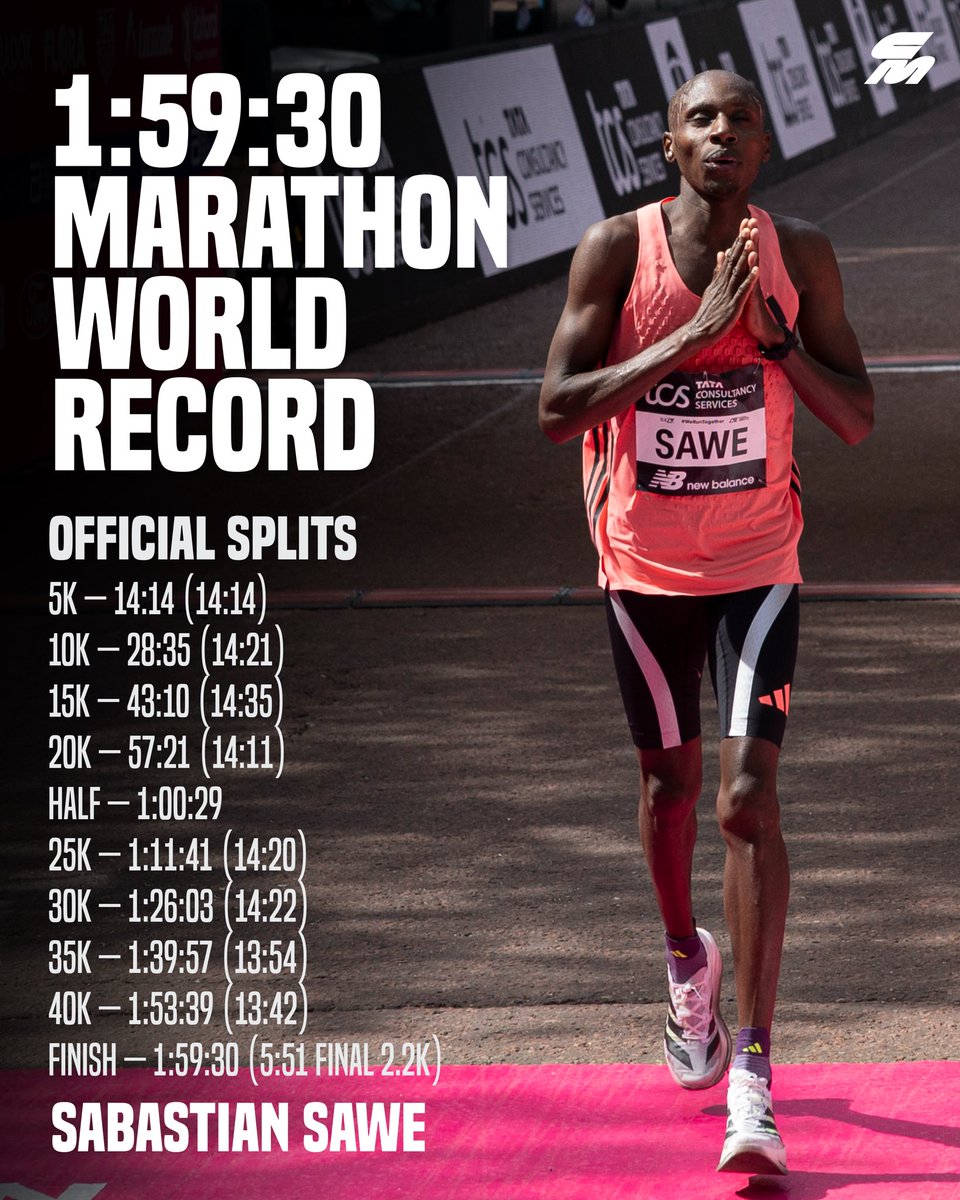
Sabastian Sawe’s world record of 1:59:30 at the 2026 London Marathon was achieved thanks to a massive negative split of 60:29-59:01. Sawe really made his money from 30K on, posting a 27:36 10K from 30K to 40K before picking it up EVEN MORE, closing the final 2.2K on 4:17 mile pace 🤯
In total, that’s 4:33 mile pace for just under two hours 😮💨
We’re going to need a few days to recover from this one… 😮💨
2 men under 2 hours. 3 men breaking the world record.
We have officially entered the new era of marathon running 🫳🎤
THE FIRST MAN IN HISTORY TO BREAK 2 HOURS IN A MARATHON!!!🤯🤯🤯
Sabastian Sawe 🇰🇪 has just shattered the World Record at the London Marathon, running 1:59:30!!!
He makes history as the first man to officially break 2 hours in the marathon.
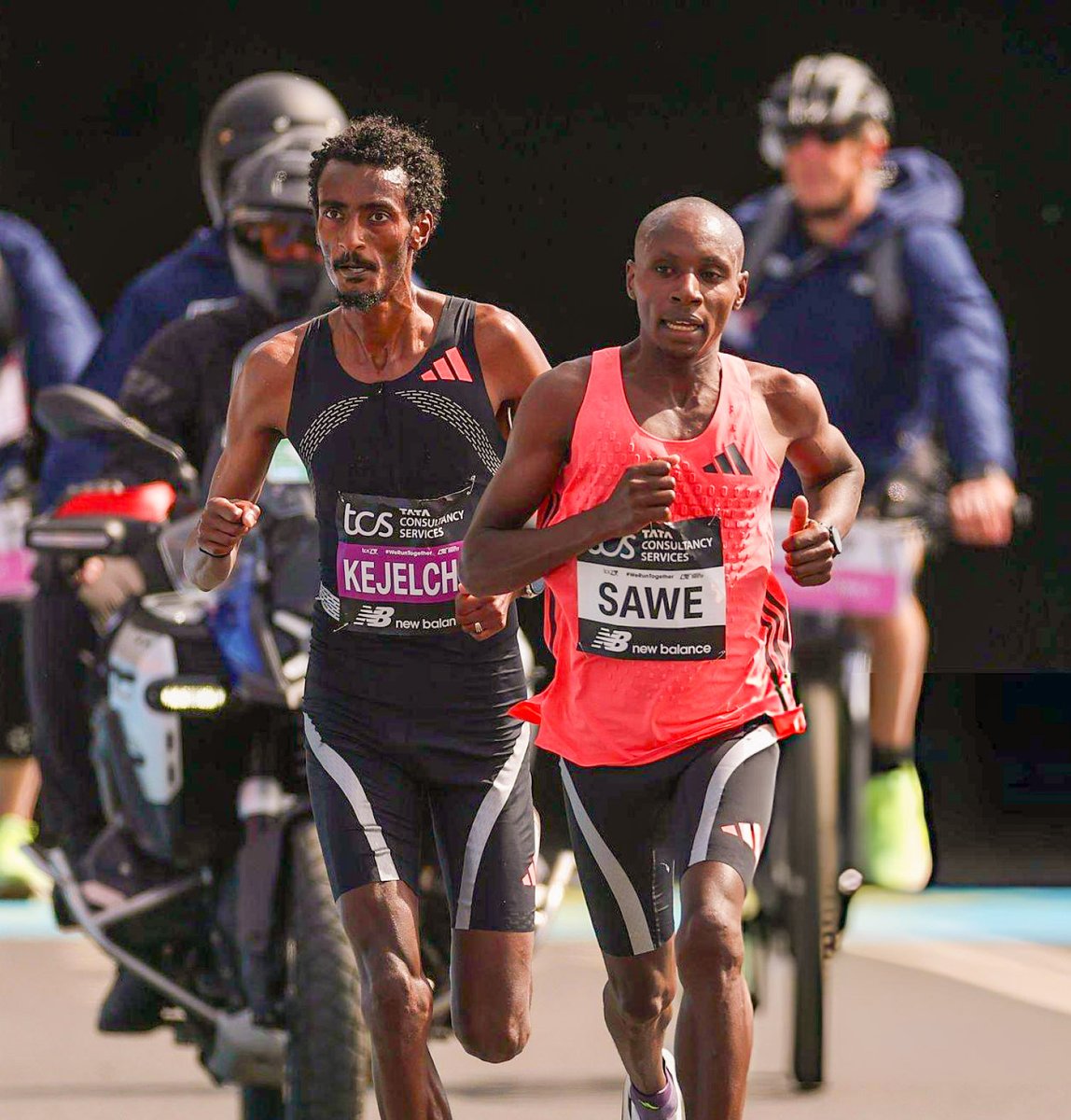
Yomif Kejelcha 🇪🇹 in his debut ran 1:59:41 to become 2nd fastest alltime, while Jacob Kiplimo 🇺🇬 finished in 2:00:28.
All under the previous World Record.
Happy birthday to Minnie Riperton, born on this day in 1947!
A soul and R&B vocal marvel from Chicago, Illinois, she honed her five-octave range in the city’s vibrant gospel and opera scenes, singing with the Gems and Rotary Connection as a teen.
Her ethereal albums like Perfect Angel (1974), featuring the whistle-register classic “Lovin’ You,” fused lush orchestration with intimate emotion, earning a gold record and inspiring generations of vocalists with her otherworldly tone.
Rest in peace, D’Angelo…
Today, the music world is mourning the loss of a true soul pioneer. According to multiple reports, the legendary singer Michael Eugene Archer, better known as D’Angelo, has died at the age of 51 after a quiet battle with pancreatic cancer.
From his breakthrough debut Brown Sugar to the richly complex Voodoo and his long-awaited return with Black Messiah, D’Angelo’s work changed the shape of modern R&B and neo-soul. He blurred lines between genres — infusing gospel, funk, jazz, hip-hop — always with a raw emotional core.
He wasn’t just an artist; he was a guiding light. His legacy will live on in every artist who strives for authenticity, depth, and a connection beyond the mainstream.
To his family, his children, his collaborators, and every fan whose heart he touched — may you find strength in his music, comfort in memories, and peace in the knowledge that his voice will echo forever.
Rest well, D.
Rest in peace, Hermeto…
The world mourns the loss of Brazil’s musical alchemist, Hermeto Pascoal, who passed at 89.
From Alagoas’ humble roots, this self-taught maestro spun sounds from teapots, bottles, and even farm animals into genre-defying symphonies.
Collaborating with legends like Miles Davis and earning Latin Grammys, he composed a song for every day of the year, each bursting with his untamed spirit. Hermeto didn’t just play music—he lived it, weaving joy and chaos into every note...