Explore Kamino's products, strategies, & opportunities while learning how onchain lending and borrowing work. This account is for educational purposes only. NFA
What is a SOL/LST loop?
You supply an LST, a liquid staking token that represents staked SOL, and borrow SOL against it in a leveraged loop
The LST value in SOL rises every epoch as staking rewards are added, meaning the LST gradually becomes worth more than SOL
On Kamino Multiply, you earn the difference between the LST yield and the SOL borrow rate - known as the spread, multiplied by your position leverage
SOL and LST are correlated, so the price movements of SOL cannot cause liquidation
Additionally an LST depeg cannot cause liquidation as the oracle uses the stake-rate price rather than the market price
Here’s how it works
As the first AUTO Fixed Rate Multiply loans come into their rollover window, here’s a reminder of how it works
Each loan runs for a 30-day term at a fixed rate, and Auto Rollover keeps the position open from one term to the next
• The rollover window opens 3 days before your loan’s end date
• A keeper bot renews the loan into a new 30-day term at the same rate, when liquidity allows, with nothing for you to sign
• Rollover is on by default. To exit instead, you can close your position before the end date
The future of onchain credit is fixed.
Why pay perp funding on your whole position when you can pay borrow costs on just the debt?
@kamino Multiply lets you turn SOL, PAXG or xStocks into leveraged positions by borrowing stablecoins against them.
GONRE
I finally got what a carry trade is after staring at it for way too long cause I'm learning at same time that I'm printing money with @onrefinance 😄 💰
so here it is✍️ :
You simply borrow usdc cheap and park it in $ONyc so it earns from reinsurance premiums that pay more and then you just keep the difference like you somehow outsmarted the ratesand also Multiply lets you do the same trick up to 2.9 times in one transaction so the little gap turns into a bigger one which feels a bit like borrowing from yourself and charging yourself interest The borrow rate still moves around though so sometimes the joke is on you and the spread shrinks when you least expect it👀
Kamino Multiply: Volatile pairs
A volatile pair supplies an asset whose price moves, like Paxos gold, xStocks or SOL, and borrows a stablecoin against it.
• Price action determines profit or loss, with leverage multiplying the both gains and losses
• Higher leverage pushes your position closer to its liquidation LTV and reduces the price drop it can absorb.
You get leveraged exposure at rates that are often much more favourable than perps, since you only pay the borrow rate on what you borrow rather than funding on the entire position.
What is a carry trade?
A carry trade borrows as asset with a lower rate against a higher yielding asset, and earns the spread between the two.
@onrefinance’s ONyc earns from reinsurance premiums, a real-world yield that sits above the cost of borrowing USDC
Multiply loops that position in one transaction up to 2.9x, so every loop adds to the spread on top of ONyc's base yield.
Here’s how it works
Every loan in the Kamino Institutional Commodity Yield vault funds a shipment of goods like copper, coffee, or fuel.
Before delivery, the loan is backed 1:1 by cash in escrow, that only pays the seller once the cargo arrives.
After release, the loan is overcollateralised by the goods themselves, and stay owned by the fund until the buyer pays.
This means the loans your deposit funds are intended to stay covered at every stage of the trade.
Here's how it works.
Loans in Kamino's Institutional Commodity Yield vault finance physical commodity shipments that repay every 1 to 3 months.
To keep most of the vault earning while giving depositors a clear exit, it pairs an Instant Liquidity buffer with an onchain withdrawal queue.
Withdrawals above that buffer join an onchain queue, and as loans are repaid, the returned USDC pays the queue first before funding any new trades.
That means you never have to keep checking the vault for free liquidity or race other depositors to exit - submit once, and your withdrawal fills automatically in order.
Here's how it works.
Where does the yield come from in Kamino's Institutional Commodity Yield vault?
Commodity traders borrow to buy goods and ship them to a buyer, then repay the loan with interest once the buyer has paid
That interest is the yield, and every loan is backed 1:1 by cash or by goods worth more than the loan
Trade finance has been reserved for banks and institutions until now, this vault opens it up to anyone on @Solana
Here’s how it works
On AUTO Fixed Rate Multiply, @kamino_swap mints AUTO from wYLDS and redeems it back directly with @HastraFi, at one exchange rate for any size
So positions open, adjust, and close with zero slippage, at the rate you’re quoted, whatever leverage you choose
Here’s how it works
Variable rates move with demand on a utilisation curve: the more of the pool that’s borrowed, the higher the rate
A fixed rate stays the same for the entire term, regardless of how much liquidity is available to borrow
This means you know exactly how much your loop costs before you open it, making returns more predictable and positions easier to size
Here’s how it works
Fixed-rate looping just got easier to maintain.
With auto-rollover on @kamino, your loan can renew into a new fixed term when the renewal conditions are met.
No need to manually repay and borrow again each time. Your position stays open, the loan gets a new end date, and your strategy keeps running.
One less thing to manage when you’re tracking the spread between your yield and borrowing cost.
Auto-rollover lets you keep a fixed-rate position running across multiple terms
When the renewal conditions are met, your loan starts a new fixed term & gets a new end date
Your position stays open, so you can continue your strategy without manually repaying and borrowing again
USDu-USDC has been the most consistently yielding stablecoin opportunity on Kamino throughout 2026
Since January, @UnitasLabs USDu has held 9%+ APY - more than triple the DeFi Dollar Rate
The top 3 farms on Kamino Liquidity are JTO incentivised
Bullish on JTO? Earn @hylo_so points & JTO rewards then deposit it into JTO-JitoSOL for:
- Trading fees
- JTO incentives
- JitoSOL native yield
Your Hylo position keeps earning while its rewards fund further JTO farming
At $19M TVL, PYUSD-USDC is Kamino Liquidity's deepest pool
- Its depth means depositing $1M still yields ~5.5%
- Instant withdrawal, no utilisation lockups
- Zero liquidation or bad debt risk
Depositing at size stays easy on Kamino Liquidity
There's plenty of options to leverage JLP, but you can also yield with liquidity provision and native yields without the looping risk
- 10% APY trading fees
- JLP perp fees
- JitoSOL staking yield
JLP-JitoSOL has maintained a 98% correlation over 30D, making IL minimal to date
Up to ~13% APY on stablecoins
Three dollar-pegged pools, each paying trading fees & incentives
Additionally, hyUSD-USDC incentives doubled this week, with 7.5x @hylo_so points on top
Stablecoins scale on Kamino Liquidity
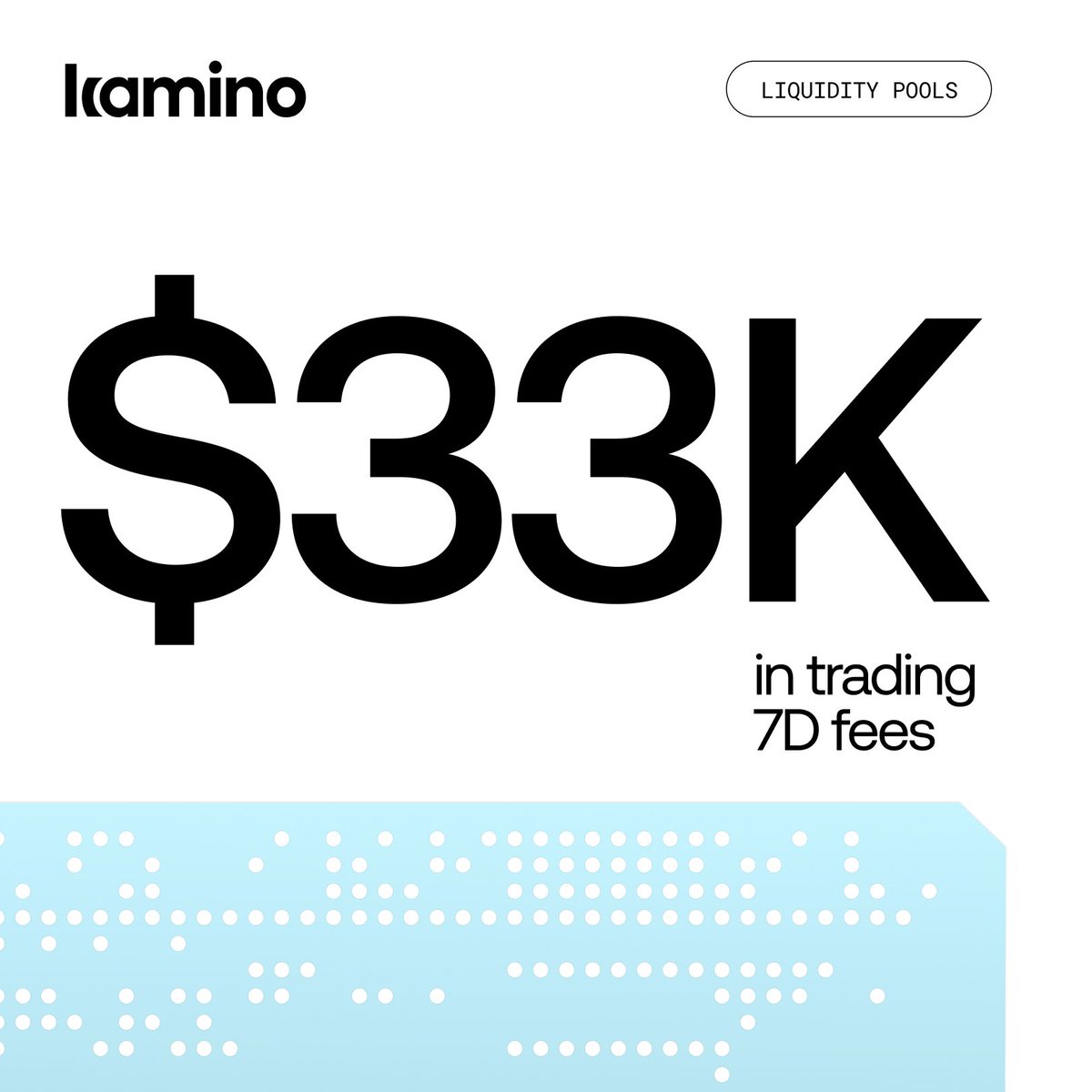
Kamino Liquidity users received over $33K in trading fees this week
Each pool auto-compounds those fees every 15 minutes, reinvesting into your position to maximise yield potential
Over $42M paid out in trading fees since 2022
@Solana's assets scale on Kamino Liquidity
hyUSD-USDC incentives just DOUBLED!
Making it the top-yielding stablecoin pool on @kamino with ~13% APY.
Earn incentives, trading fees, and Hylo XP on top.