Biologist at The Sainsbury Lab; passionate about plant pathogens and evolution; open science advocate; loves travel, food and sports; nomad and hunter-gatherer.
I just published: The night shift in the greenhouse
A night-blooming cactus, a time-lapse, and the case for hosting artists in the lab.
One night only
Hylocereus, or whatever we are calling it now
Why an immunity lab keeps a cactus
Scientists who draw
Two worlds, or one
Back to curiosity
https://t.co/gBzmVRa8vL
Excited to share our latest work! 🍅
Two evolutionarily distinct immune receptors recognize the same viral target, yet differ in their recognition spectra.
A fascinating example of convergent evolution in plant immunity!
New Episode: How to Design Flowers
@NickDesnoyer uses genetic engineering, breeding, and pathogens to design and then create flowers that don't exist anywhere else on Earth. We talked about how he does it, in a room surrounded by many of his creations.
At the start of the episode, Nick reveals his next project, called Paintunia, which is an engineered line of petunia that acts as a living canvas.
He has engineered these petunias to include an inducible gene; when he lightly touches their buds with a molecule called dexamethasone, the molecules seep into cells, switch on the gene, and cause them to make a pigment. The result is a paintable flower, where molecules literally control which colors show up in particular places. Nick’s plan is ultimately to engineer these petunias to express three separate colors, for cyan, magenta, and yellow.
Nick's ultimate dream is to build a botanical garden full of weird and wonderful flowers that exist nowhere else. We filmed this episode surrounded by flowers, and he patiently explained to me how each one gets its shape and pigmentation; how he combines breeding and genetic engineering to make new flowers; and how he searches scientific papers for mutations to figure out which plant crosses to make next.
I think he convinced me that designing new kinds of flowers makes us look more closely at nature, and appreciate it more deeply. After all, all the genes and variations he uses in the laboratory are based on designs that have evolved elsewhere. Hope you enjoy!
New Episode: How to Design Flowers
@NickDesnoyer uses genetic engineering, breeding, and pathogens to design and then create flowers that don't exist anywhere else on Earth. We talked about how he does it, in a room surrounded by many of his creations.
At the start of the episode, Nick reveals his next project, called Paintunia, which is an engineered line of petunia that acts as a living canvas.
He has engineered these petunias to include an inducible gene; when he lightly touches their buds with a molecule called dexamethasone, the molecules seep into cells, switch on the gene, and cause them to make a pigment. The result is a paintable flower, where molecules literally control which colors show up in particular places. Nick’s plan is ultimately to engineer these petunias to express three separate colors, for cyan, magenta, and yellow.
Nick's ultimate dream is to build a botanical garden full of weird and wonderful flowers that exist nowhere else. We filmed this episode surrounded by flowers, and he patiently explained to me how each one gets its shape and pigmentation; how he combines breeding and genetic engineering to make new flowers; and how he searches scientific papers for mutations to figure out which plant crosses to make next.
I think he convinced me that designing new kinds of flowers makes us look more closely at nature, and appreciate it more deeply. After all, all the genes and variations he uses in the laboratory are based on designs that have evolved elsewhere. Hope you enjoy!
We spent two weeks with Niko and shot this conversation on the final day.
I finished feeling more motivated than ever. The Paintunia, the art, and where it’s all going :)
We put together a list of 25+ stories we'd like to publish. Take a look and please pitch us! Our email is [email protected].
We pay $1+ for reported features, and $1200 for shorter essays. We're after extremely deep, mechanistic writing about big ideas in biotechnology.
@KamounLab Those are fun insights to read, i never liked the rigid lab meeting format either, we do Thursday coffee breaks every other week rather than weekly. And when feeling the need get the semi formal lab meeting. I guess being often commuincating erase the need to a planed meeting?
I've had a similar experience.
I used to be really into filling out the web forms for submitting a paper to a journal. I'd spend hours doing it. Until one day a student wrote paperpush (https://t.co/pdakRf4KIe) and I've permanently lost all interest in submitting to journals.
Scientists have sequenced the genomes of thousands of species. But for most of them, nobody knows *where the genes are*
Today we're releasing Carbon-A, an open model that finds genes directly in DNA. We used it to create a database of 566 million candidate genes across 22,617 species, from fungi to mammals (that we are sharing as well)
Why bother? A few reasons
1. Elephants rarely get cancer. Part of the explanation turned up in their genes: extra copies of a tumor-suppressor gene humans have only one of. You can't ask that kind of question about a species until someone, or some tool, has found its genes.
2. The first GLP-1 drug was based on a peptide from Gila monster venom. Nobody would have put the Gila monster on a priority list. Same for wild relatives of crops, which carry resistance to drought and disease. Many of these species have never been annotated.
3. Most of what we know about genes comes from about a dozen model species, like mice, flies and yeast. That focus worked remarkably well, but annotation pipelines still lean heavily on comparisons with them, which makes genes unique to other species easy to miss, and those can be the most interesting ones.
Carbon-A belongs to a newer family of tools that read DNA directly. It learned from known genomes, but it doesn't need a close relative to read a new one.
4. Even familiar genomes still have gaps. With our partners at Active Site and UCSD, we found RNA evidence for 239 genes missing from the reference annotations of species as common as cats, chickens, hamsters and a lab plant.
5. AlphaFold can predict the shape of a protein, but only once someone has found the gene that makes it. In a species with no annotated genes, it has nothing to work with.
Some notes on safety:
Carbon-A doesn't design DNA or predict what a gene does. It marks where genes are in DNA. This is one of the reasons we think releasing it openly is the right call.
More annotations also help health research: many species that carry or cause disease are among those covered, and work on controlling the diseases they spread often starts from their genes.
Model and database and more details in Georgia's thread 👇
🙏 A special thanks to Sophien @KamounLab.
I admire how he supports young scientists, giving them the confidence and freedom to pursue their ideas. I am truly grateful for his encouragement and support throughout this journey.
Proud to be part of the Kamounity! 🌱💚
🍅 Tomato brown rugose fruit virus spread worldwide.
For >60 years, one resistance gene protected tomatoes. This virus broke through.
A second gene confers resistance. Same viral target? Convergent evolution?
Preprint: https://t.co/9hVfpzcwUG
#EvoMPMI#NLRbiology
(1/9) 🧵
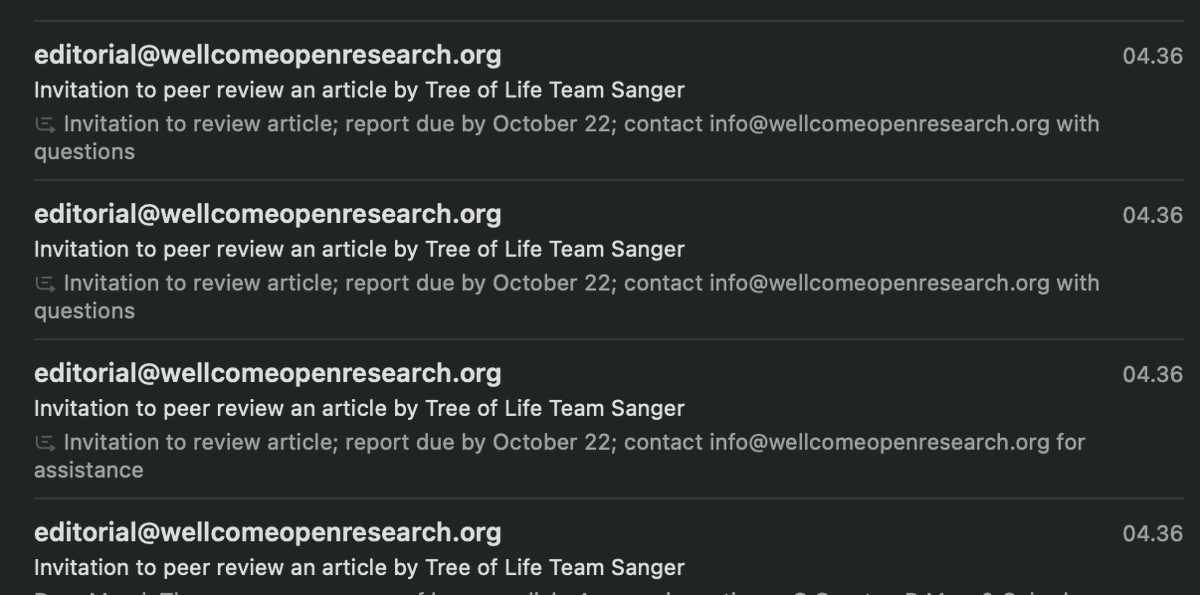
How to kill peer review: ask already swamped academics to review a @sangerinstitute Tree of Life genome “data note”.
What am I meant to review? What am I meant to comment? “Cool taxon”?
Automate routine technical checks. Use AI. Academics’ time isn’t an infinite free resource. Seriously, people. Get real.
https://t.co/7gOrtQnALy
@KamounLab@sangerinstitute Same. I reviewed a couple. I basically said the the genome is not very useful without an annotation. Nothing will change cause they separate the efforts. I won’t review them anymore unless it is a ver interesting taxa close to my research.