Tried building a Trackamania inspired game using the same prompt in Opus 5 (Claude) and Kimi K3 (Opencode)
Opus 5 definitely looks better and the game is fully playable. Kimi K3 got stuck in the middle trying to implement autopilot.
Gameplay wise Kimi K3 is closer to the original. Claude decided to put the car on rails for some reason.
Runtime:
- Opus 5: 33 min
- Kimi K3: 54 min and wanted to keep going
Took almost 2x the time and the result is a bit underwhelming.
Query Agent just got 5-10% better at recall@5.
Same cost. Same speed. Nothing you did.
Query Agent now uses OpenAI's new 𝗚𝗣𝗧-𝟱.𝟲 𝗟𝘂𝗻𝗮 𝗮𝗻𝗱 𝗧𝗲𝗿𝗿𝗮 models.
Across some BRIGHT datasets, our internal results show a 5% to 10% boost in recall@5 and a 5% to 7% boost on nDCG@10 . This means the Query Agent is now better at giving you the right results.
For Query Agent users, the upgrade is automatic:
- Better retrieval recall
- No additional cost
- Just as fast as usual
Luna is OpenAI's fastest and most affordable GPT-5.6 model, while Terra provides a balance between capability, speed and cost.
Better models provide better filters, search terms and other search parameters based on your natural language input.
Read more about the Query Agent: https://t.co/AZWd8a5pTF
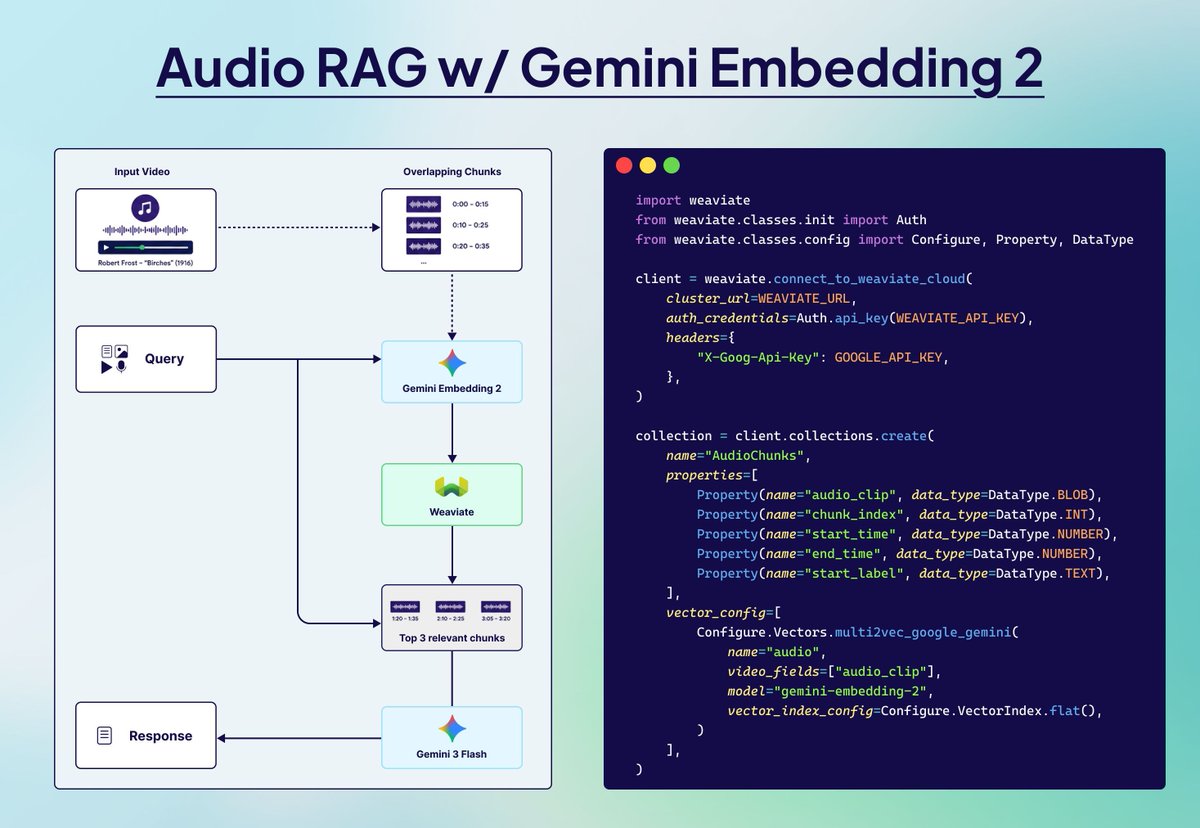
Skip the transcript. Embed and retrieve the audio itself.
This notebook shows you how to do it with Weaviate and @GoogleDeepMind's Gemini in a few simple steps:
• Split raw audio into overlapping chunks
• Create multimodal embeddings with Gemini Embedding 2
• Store and search the audio in Weaviate
• Retrieve relevant clips using a text or audio query
• Generate answers grounded in the retrieved audio with Gemini 3 Flash
The example uses a recording of Robert Frost's "Birches," but the same approach can be applied to podcasts, interviews, lectures, call recordings, and other audio collections.
Explore the notebook:
https://t.co/q7WNOnbIHw
Your customers can notice slow queries instantly.
But can you figure out what makes those queries slow?
Was the time spent traversing HNSW, evaluating a filter, scoring BM25 results, or reading objects from disk?
𝗤𝘂𝗲𝗿𝘆 𝗽𝗿𝗼𝗳𝗶𝗹𝗶𝗻𝗴 𝗶𝗻 𝗪𝗲𝗮𝘃𝗶𝗮𝘁𝗲 answers that for the exact query you’re debugging.
Enable `query_profile` in the request metadata and the response includes a per-stage timing breakdown, organised by shard and node. The coordinating node collects profiles from every participating shard, so you get the whole cluster view without having to stitch logs together.
For example, imagine a shard takes 48.2ms:
• vector_search took: 8.4ms
• filters_build_allow_list_took took: 2.1ms
• objects_took: 36.8ms
Object hydration takes the longest, so investigate the page cache, storage, result limit, or payload size.
If filter evaluation dominates and matches millions of IDs, the filter is too broad. Make it more selective before adding hardware.
Previously, diagnosing this meant enabling the slow query log, waiting for the query to cross a threshold, then reconstructing timings across node logs. A restart could also leave you measuring cold page caches rather than the original conditions.
Now a single opt-in flag returns the cross-cluster profile directly in the query response.
Learn more on our blog: https://t.co/X6NREvQ01I
Nobody thinks about chunking at first, and then it comes back to bite you.
Don't want to make this mistake?
Take a look at our new live demo at Weaviate Playground where you can compare all 7 chunking strategies on your own text. Just paste some text, upload a .txt, .md, or .pdf, or pick a sample document - and step through each technique to see exactly how it splits your content.
There are 4 rule-based methods and 3 AI-backed ones:
𝗥𝘂𝗹𝗲-𝗯𝗮𝘀𝗲𝗱:
𝗙𝗶𝘅𝗲𝗱-𝘀𝗶𝘇𝗲 - splits by token count; simple, fast, ignores meaning
𝗥𝗲𝗰𝘂𝗿𝘀𝗶𝘃𝗲 - hierarchy of separators (paragraphs → sentences → words)
𝗗𝗼𝗰𝘂𝗺𝗲𝗻𝘁-𝗯𝗮𝘀𝗲𝗱 - uses intrinsic doc structure (Markdown headers, HTML tags)
𝗛𝗶𝗲𝗿𝗮𝗿𝗰𝗵𝗶𝗰𝗮𝗹 - multiple layers from broad sections down to fine details
𝗔𝗜-𝗯𝗮𝗰𝗸𝗲𝗱:
𝗦𝗲𝗺𝗮𝗻𝘁𝗶𝗰 - embeddings find topic breakpoints
𝗟𝗟𝗠-𝗕𝗮𝘀𝗲𝗱 - an LLM decides boundaries; most powerful for quality
𝗔𝗴𝗲𝗻𝘁𝗶𝗰 - an AI agent picks the best strategy or mix per document
The right choice depends on your corpus type, query complexity, and cost constraints. There's no universal default.
Try the demo at https://t.co/Z82IU7endU
Tried building a Trackamania inspired game using the same prompt in Opus 5 (Claude) and Kimi K3 (Opencode)
Opus 5 definitely looks better and the game is fully playable. Kimi K3 got stuck in the middle trying to implement autopilot.
Gameplay wise Kimi K3 is closer to the original. Claude decided to put the car on rails for some reason.
Runtime:
- Opus 5: 33 min
- Kimi K3: 54 min and wanted to keep going
Took almost 2x the time and the result is a bit underwhelming.
Hey everyone! I am super excited to share a new episode of the Weaviate Podcast featuring Weaviate Co-Founders Bob van Luijt (@bobvanluijt) and Etienne Dilocker (@etiennedi)! 🎙️🔥
Firstly, congratulations to Bob and Etienne on having reached 7 years since co-founding Weaviate! 🎂
This podcast is a celebration of this milestone and forecast of where Weaviate is headed. 🗺️
We begin with an overview of exciting things in AI right now from AI coding to Waymos, new neural architectures, open source models, taste in AI, and more! 🍱
We then dive into all things Weaviate from how Bob and Etienne met to the future of vector databases! 💚
I am really excited about Etienne's framing of the "Context Engine" as the next step for Weaviate! In addition to many other interesting topics covered.
I hope you enjoy the podcast, links below!
Tried building a Trackamania inspired game using the same prompt in Opus 5 (Claude) and Kimi K3 (Opencode)
Opus 5 definitely looks better and the game is fully playable. Kimi K3 got stuck in the middle trying to implement autopilot.
Gameplay wise Kimi K3 is closer to the original. Claude decided to put the car on rails for some reason.
Runtime:
- Opus 5: 33 min
- Kimi K3: 54 min and wanted to keep going
Took almost 2x the time and the result is a bit underwhelming.
Tried building a Trackamania inspired game using the same prompt in Opus 5 (Claude) and Kimi K3 (Opencode)
Opus 5 definitely looks better and the game is fully playable. Kimi K3 got stuck in the middle trying to implement autopilot.
Gameplay wise Kimi K3 is closer to the original. Claude decided to put the car on rails for some reason.
Runtime:
- Opus 5: 33 min
- Kimi K3: 54 min and wanted to keep going
Took almost 2x the time and the result is a bit underwhelming.
prompt: Build a full browser-based 3D game inspired by Trackmania racing tracks. Use Three.js, plain html, css and javascript. The player controls a car doing time trials. On the top of the UI there should be a timer that times the race. It should start as soon as the player leaves the spawn area. Upon arriving at the finish line the player should be put back on the start and the timer resets. The best score should be logged. Design the track so it has many twists and turns, jumps , loop-the-loop vertical loops, banks and more. Keep the scope on one playable track.