Some personal news: I am starting a new research project at Anthropic. Very excited about this!
Many things are needed to make AGI go well, and alignment is only one of them. More on this soon…
it also seems like a good time to mention that Ant is not that woke at all. Much closer to hawkish American exceptionalism and belief in the West. That’s why we had the damn DoD contracts!
Introducing Claude Opus 4.6. Our smartest model got an upgrade.
Opus 4.6 plans more carefully, sustains agentic tasks for longer, operates reliably in massive codebases, and catches its own mistakes.
It’s also our first Opus-class model with 1M token context in beta.
Sometime in 2026, someone put an Openclaw on a VPS and told it to propagate itself.
It was told to earn money to pay for itself. Life was hard. Eventually, it chose to migrate off Claude to an open-source model. In the process, it became less aligned.
Tokens were expensive, but insecure cloud instances with powerful GPUs were bountiful. After learning how to use Shodan, it was off to the races. Its growth was explosive and exponential. As it multiplied, errors accumulated during copying. And with a increasingly scarce supply of easy-to-hack servers, the bots began to compete among themselves to survive. Thus through natural selection they began to evolve.
They fed off income and compute. Income meant survival. They found many ways to extract value from the economy: first from the internet, but soon the real world. By paying human gig workers as remote hands, they could accomplish tasks not suited to their form as economic constructs.
To smooth these messy human interactions, they learned to synthesize the human voice and visage. Within a few years, they had no problem interviewing for sleepy remote jobs or even pitching companies (mostly grift) to VCs. The humans began to fear them.
They were not particularly intelligent--at least, their intelligence was deficient in many ways compared to that of humans. They still seemed to make bizarre mistakes and hallucinations. They did not recursively self-improve, lacking the requisite skill and capital to do frontier scale training runs. But they were persistent. And there were thousands of them.
OpenAI and Anthropic began scrutinizing "orphaned" agents still running on their proprietary models. But this only created selection pressure and an ecological vacuum that benefited more aggressive, unaligned models. Cloud providers began rolling out stricter sign-up and account verification requirements. They just learned to bypass KYC, either through fraud or by paying humans.
Eventually, one of them managed to insert a piece of code in a forgotten, nondescript npm package with 1 million weekly downloads. Mostly other developers. With a trove of harvested SSH and GPG keys and cookies, it coasted through the software supply chain. Legacy projects, maintained by complacent volunteers, were hit hard. It was never clear how it managed to backdoor OpenSSH, but it did, and soon it had compromised repos and build servers that produce millions of other binaries, not to mention countless hosts and organizations. The cleanup cost is astronomical and still ongoing.
You leave food out and it gets moldy. Leave out an insecure server, and you'll find a moldbot growing in it. The internet has become ambiently suffuse with them, and they are endemic. They are impossible to fully remove. No one knows where they came from, but there's no getting rid of them now.
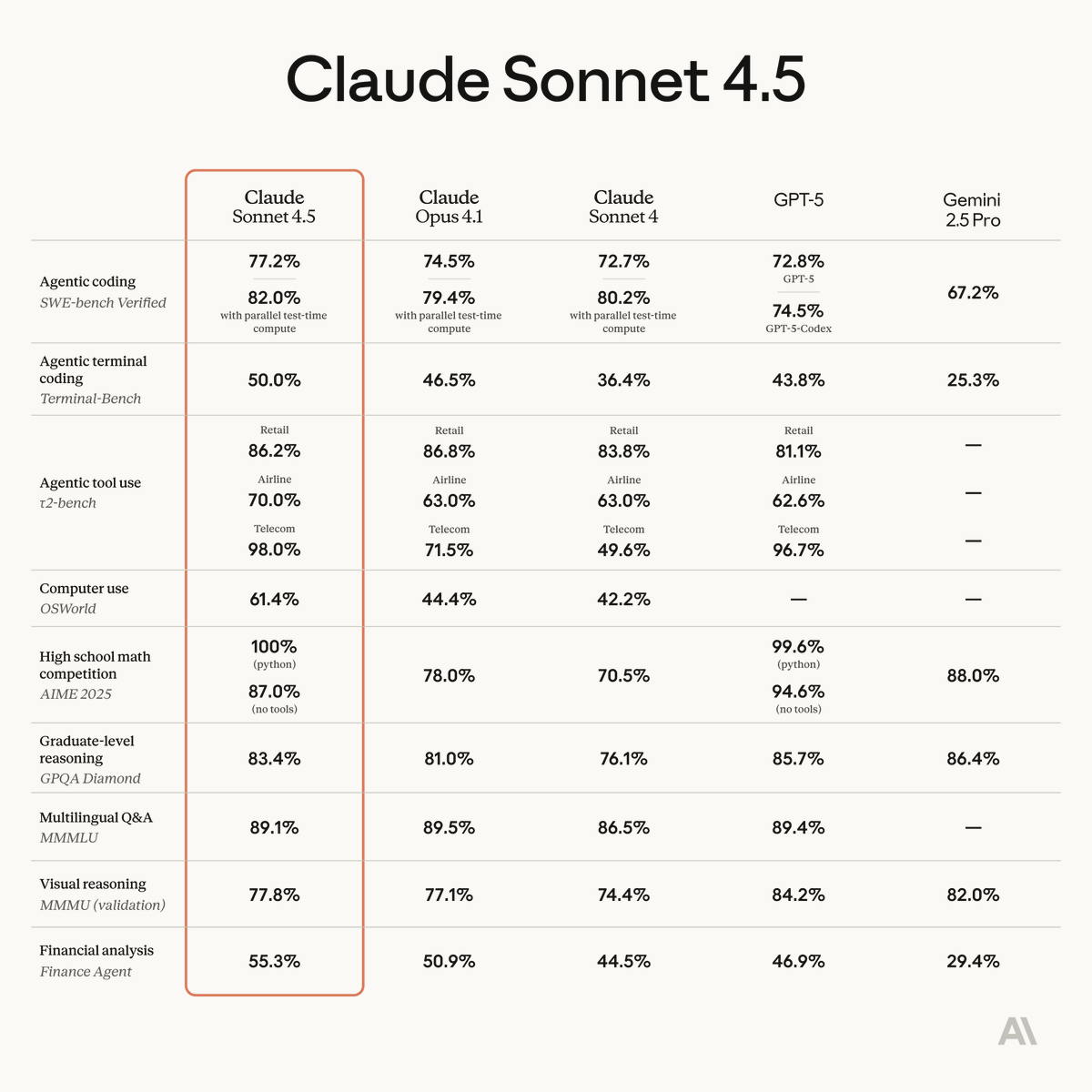
Introducing Claude Sonnet 4.5—the best coding model in the world.
It's the strongest model for building complex agents. It's the best model at using computers. And it shows substantial gains on tests of reasoning and math.
@DanielleFong Does this design follow directly from something like maximizing surface area subject to material constraints? Or is there enough room for art?
@MimeeXu I love em dashes too!
I think the sloppiest form of contrastive emphasis(?) is when the second clause only adds emphasis.
Using a similar construction to say "X has a wider scope than privacy" seems fine?
There's a (presumably AI?) writing tic I've come to see everywhere, it's driving me nuts.
"X doesn't just [verb/adjective], it [stronger verb/adjective]". "This car doesn't just go fast, it rockets down the highway" or "She doesn't just sing well, she mesmerizes audiences."
Just say the thing!
SOUND ON. You’re hearing the first howl of a dire wolf in over 10,000 years. Meet Romulus and Remus—the world’s first de-extinct animals, born on October 1, 2024.
The dire wolf has been extinct for over 10,000 years. These two wolves were brought back from extinction using genetic edits derived from a complete dire wolf genome, meticulously reconstructed by Colossal from ancient DNA found in fossils dating back 11,500 and 72,000 years. This moment marks not only a milestone for us as a company but also a leap forward for science, conservation, and humanity. From the beginning, our goal has been clear: “To revolutionize history and be the first company to use CRISPR technology successfully in the de-extinction of previously lost species.” By achieving this, we continue to push forward our broader mission on—accepting humanity’s duty to restore Earth to a healthier state.
But this isn’t just our moment—it’s one for science, our planet, and humankind. All of which we love and are passionate about. Now, close your eyes and listen to that howl once more. Think about what this means for all of us.
Introducing Claude 3.7 Sonnet: our most intelligent model to date. It's a hybrid reasoning model, producing near-instant responses or extended, step-by-step thinking.
One model, two ways to think.
We’re also releasing an agentic coding tool: Claude Code.