Eu meio que abandonei o X - estou mais no bsky. Mas aproveito para divulgar novo paper com Julia Walter sobre anos de escolaridade no Brasil, 1925-2015. O ponto é: Barro e Lee estão errados para o Brasil (como o @lucasmation já tinha apontado), então refizemos tudo +
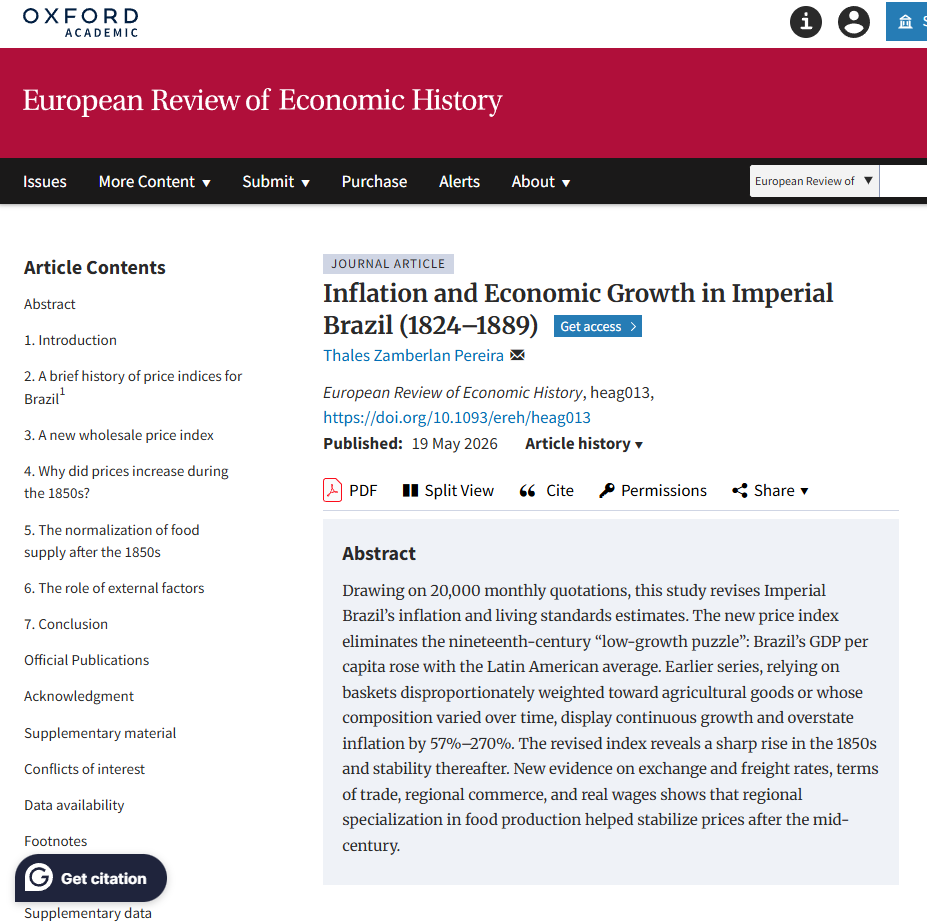
🚨New article available online!
"A new dataset of average years of schooling in Brazil, 1925–2015"
by Júlia R. Walter & @kangthomas
https://t.co/37Es0k264E
Meu texto desta quarta-feira no Valor Econômico trata, tomando como orientação o caso da Coreia do Sul, da necessidade de o Brasil concentrar esforços na educação infantil e fundamental. Ao contrário da crença de membros de diversos governos das últimas décadas, inclusive da atual gestão, o milagre econômico da Coreia do Sul não foi baseado na política industrial. A Coreia alcançou o desenvolvimento e um PIB per capita quase três vezes superior ao do Brasil por conta de investimentos contínuos em educação, começando com o ensino fundamental e em seguida o médio. Ao contrário do Brasil, o foco no ensino universitário só ocorreu após a universalização de um ensino básico de qualidade. Essa é a lição que o Brasil precisa aprender e acreditar. Do contrário, o país continuará parado em "berço esplêndido"
A post about Pope Leo XIV's encyclical on AI. Why the Pope is right, but perhaps not right enough.
Artificial intelligence is reshaping the world in front of our eyes: how we communicate, how we access information, how we work, how income and status are distributed among us, and soon how we fight and kill each other. Yet the public conversation about AI remains stuck on the minutiae of competition between labs, or on a false dichotomy between AI as a “stochastic parrot” with no real capabilities and AI as an alien superintelligence poised to take command of humanity.
The more important questions are about what we want from AI, and whether our current mindset, institutions, and control mechanisms are equal to the task of steering it toward our welfare.
It is refreshing, then, that a bold and powerful voice has weighed into this debate: Pope Leo XIV. As an economist who has long argued that technology is a matter of choice rather than fate, I find Leo’s intervention welcome and, on most points, on target. But on the most consequential question of what AI should actually be designed to do, Leo stops short.
Secular readers may bristle at the encyclical’s opening invocation of the Tower of Babel. They would be mistaken to stop reading there. Leo goes much further than most pundits, journalists and policymakers in the United States by recognizing that what happens to AI, and hence to humanity, is a under our control. There are multiple possible paths for AI, and which one we take will have sweeping consequences. He is also ahead of many commentators when he writes forcefully and unequivocally that “technology is never neutral, because it takes on the characteristics of those who devise, finance, regulate, and use it.”
These were the central themes of the book I wrote with Simon Johnson, Power and Progress: Our Thousand-Year Struggle over Technology and Prosperity. It is heartening to hear them taken up by a voice with Leo's reach.
The Pope is also right to question the current trajectory of AI in warfare and law enforcement. What was taboo only a few years ago – AI-driven mass surveillance, algorithms selecting targets for killing – has become routine. Many in Silicon Valley are now calling openly for a new military-algorithmic complex centered on AI as an instrument of American hard power. Leo captures something deep and too often ignored: “Any technology that facilitates attacks without seeing the face of human beings lowers the moral threshold of conflict.”
His call for the “disarmament of AI” follows directly from these observations. As he explains, disarming AI means “freeing it from the mentality of ‘armed’ competition, which today is not limited simply to the military context, but is also an economic and cognitive phenomenon.” His moral clarity in stating that “there is no algorithm that can make war morally acceptable” should be a warning to technologists rushing to design new weapons of mass destruction.
Underneath these specific concerns lies a more fundamental claim: that what is technically feasible is not the same as what is good for humanity, and that the difference depends on who controls the technology and what ideology and interests guide them.
Leo edges toward what I take to be the most important point about AI's future when he observes that “while AI promises to boost productivity by taking over mundane tasks, it frequently forces workers to adapt to the speed and demands of machines, rather than designing machines to work with those who work.”
But here he does not go far enough. He stops short of questioning the prevailing design philosophy of AI itself: a philosophy centered on mimicking human capabilities and automating human tasks, with the ultimate goal of artificial general intelligence (AGI) that can do everything a person can.
This philosophy rests on a mistake. It assumes that artificial intelligence and humanintelligence are fundamentally similar, and therefore machines should naturally take over whatever humans currently do. Yet these intelligences are fundamentally different.
Humans are “one-shot” learners. We form hypotheses from a few examples, mentally simulate possibilities, and refine our understanding through a social process of trial and error. This is how children learn language - imitating a few words, generalizing, and adjusting based on how others respond. We are not, however, very good at absorbing massive volumes of information or sifting through unstructured data for relevant patterns.
AI models are almost the opposite. They thrive on enormous training sets and excel at pattern recognition at scale. But they have, as yet, no genuine creativity, no real-world embodiment, and no capacity for trial-and-error learning grounded in interaction with the physical and social world.
When two things are different – you shouldn’t, and typically you couldn’t – use one to mimic the other. If you did, you would end up with suboptimal, disappointing results. It would have been a colossal mistake, and the Chicago Bulls’s legendary coach Phil Jackson would have gone down in the annals of basketball as one of the worst coaches in history, if he decided in the 1990s that because Michael Jordan was the better player, Jordan should mimic everything that Scottie Pippen and Dennis Rodman were doing in the team. The team went from championship to championship because these players worked together and complemented each other.
The same applies to AI and human skills.
The more productive path is complementarity – using AI to do what humans cannot, so that humans can do what they do best. An electrician aided by AI diagnostics, a nurse supported by AI in interpreting symptoms, a teacher using AI to personalize instruction for each student; these are the contours of a different AI future, one that raises rather than displaces human capability.
Optimists and industry insiders will respond that automation-first AI can still benefit everyone, provided redistributive policy keeps pace. But this argument has a poor track record. Forty years of digital automation have already concentrated gains at the top, hollowed out middle-skill work, and produced disappointing aggregate productivity growth. There is little reason to expect that an even more powerful round of automation, deployed by even more concentrated firms, will end differently. We can and must demand a different design.
The global stakes from the future of AI are even larger than those we can see around us in the United States. For the developing world, where billions still depend on the prospect of decent jobs as a path out of poverty, an automation-centric AI agenda is not merely suboptimal. It is simply transferring to foreclose the most important route to broad-based prosperity.
The biggest failing of today's AI industry is its refusal to recognize any of this. It is guided instead by an ideology of control (the industry’s own over humanity) and by a conviction that machines are uniformly better than humans.
As Leo rightly notes, this failure is enabled by the fact that a handful of companies now command the future of AI.
What we need is a combination of moral clarity and a serious, society-wide debate about what AI can do and what we want it to do. That debate must move beyond exhortation toward concrete choices: antitrust action against the dominant platforms, public investment in human-complementary AI, regulation of surveillance and autonomous weapons, and meaningful rights for workers and citizens over the data on which these systems are built.
The Pope's intervention makes such a debate a little more likely today than it was before.
It is now up to the rest of us to carry it further than he was willing to go.
CFP 📢 Economic Shrinking in Development — causes, consequences & governance across the Global South.
🗓 Extended abstract deadline: 1 September 2026
More information here:
https://t.co/mNXG6lAuwL #EconTwitter#economichistory#CFP
Pessoal, no próximo Encontro de Pós-Graduação da @ABPHE2 , oferecerei um minicurso sobre metodologias ativas de ensino em HE. A ideia é conectar uma aula tradicional com duas atividades com metodologias ativas. O encontro será na @uff_br em setembro. Enviem trabalhos!
Pra quem estiver em Porto Alegre, o PPGE UFRGS estará promovendo dois eventos com a Profa. Fernanda Estevan (@EconFGVSP). Na terça, o evento é voltado pra graduandos interessados em carreira acadêmica. @fceufrgs@PpgeUfrgs
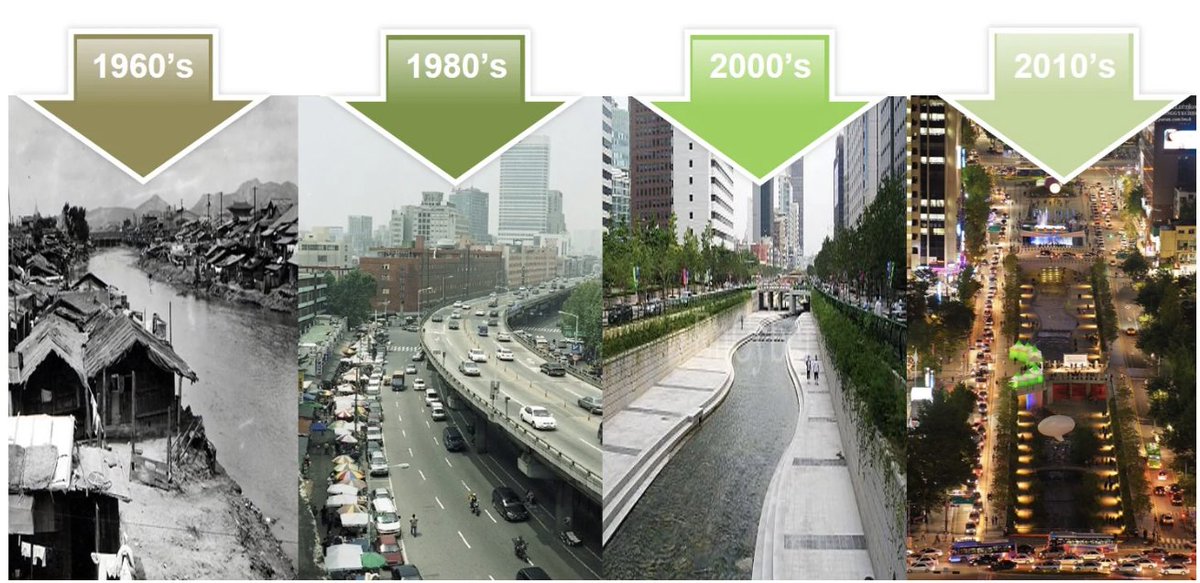
A fundamental lesson from my posts these last two weeks on modernization, industrial policy, and development is that development economics should be about understanding why South Korea got rich but Bolivia did not.
The current field has largely given up on that question. Sharply identified RCTs on small micro programs are a fine way to publish in the AER and get tenure at a fancy university, but a profession that knows everything about microfinance impact evaluations and almost nothing about industrialization has misallocated its own intellectual capital on a pretty heroic scale.
Four images of Seoul:
Since today is May Day, it would be fun to show how modernity and capitalism are related yet distinct by analyzing the video of the Soviet Anthem that was broadcast twice a day on Soviet State TV around 1984. I do this exercise with my students at UPenn when we cover the economic history of the Soviet Union (yes, I spent too much time covering it every semester), and they always enjoy it quite a bit.
https://t.co/u0nSEB3mmX
The video loops twice over the Anthem, once with subtitles in Russian and English and once with subtitles in Russian and Spanish.
We open with a shot of the Kremlin in Moscow, and we are told that we have “An unbreakable union of free republics, The Great Rus’ has sealed forever.” There you have it: right off the bat, nationalism, a fundamental aspect of modernity. Yes, we are free republics, but the Russians are really in charge. If you are Georgian or Latvian, smile and accept your destiny. If the 20th century taught us anything, it is that Marx got it wrong: religion is not the opium of the masses; nationalism is the crack cocaine, much more powerful and addictive.
Then we switch to the ultimate symbols of modernity: a rocket about to launch (yes, a bit of a phallic symbol right there), a gigantic steelworks (nothing a good communist loves more than steel) with a manly man working on it (gendered forms of labor), and oil drills (fossil capital and CO2 emissions all around; wasn’t capitalism supposed to be about fossil fuels? Well, never mind).
We continue with more manly men, dirty from hard but very manly work, building pipelines, big dams that dominate nature, trains, and nuclear power plants. No tree-hugging here: socialism is about exploiting nature, and you should get the point!
Now that we have established that this business of the Soviet Union is a creation of the Russians to quickly industrialize the land and dominate nature, we move on to show what we get out of it. First, a hospital that gives strength to the people (picking a child delivery is not casual either), a cosmonaut, and the rocket, finally firing off! We are achieving, people!
A good moment to loop back into history: the October Revolution (shots from Eisenstein’s movie), our holy father, Lenin, and how he led to more factories, more dams, and our ultimate legitimizing instrument: victory over fascism in World War II.
This seems a good moment to pivot to the modern Soviet armed forces: jets, a Victor-class nuclear submarine, paratroopers, and frontier guards (do not think about leaving without a permit! The home of the free is, more than anything, home).
Well, it is time to go back to the farmers now. We start with a handsome Russian farmer, and then we have a couple of Central Asians (not many minorities so far in the video, so we need some diversity casting) with cotton and grain from the big plains of Asia (talking about ecological degradation, nothing beats what the Soviet Union did with cotton).
Next, some miscellaneous accomplishments: a nuclear icebreaker (I believe it is from the Arktika class; yes, a true communist loves nuclear power; renewables are for petit bourgeois professors of English in California who believe in silly “degrowth” ideas), health and education services for minorities, and rail tracks.
Time to return to manly men building manly things like trucks and ships, to introduce Andropov, addressing all of us under Lenin’s statue (a fantastic shot), and to the May Day parade (this is why I am showing this video today), with a final close-up of the Lenin banner. We wrap by returning to the very beginning: the Kremlin.
As a piece of propaganda, this is magnificent work. The music by Alexander Vasilyevich Alexandrov is moving, classical but not stuffy; the lyrics (1977 version) get all the messages across, and the selection of visual themes has been curated with incredible care.
I like to show propaganda videos of regimes (including those from other totalitarian regimes) because they document how the regime wanted to be seen. I am not the one selecting the message; the Soviet Union leadership is.
And it is selecting a message of modernity: big factories, rockets, hospitals, nuclear power, and oil wells.
If your analytic framework cannot distinguish between modernity and capitalism, as most social theory cannot today, you are at a deep loss when trying to understand the Soviet Union. You are even more at a loss to understand why socialism was so attractive in the 20th century. Socialism promised underdeveloped countries a faster route to modernity. If you were a young Honduran in 1960 or a young Egyptian in 1962, you fell in love with socialism because you thought it could deliver modernity faster and better. Socialism was the ultimate engine of modernity. “Degrowth” is only for sociology lecturers with bad hairdos. Nobody with half a brain takes it seriously.
But most contemporary social theorists, which are activists, not scholars any longer, are only interested in criticizing capitalism, so they pile onto it a list of flaws, including nationalism, fossil fuel consumption, the use of nuclear power, the gendered division of labor, bureaucratic gigantism, inequality of income, wealth, and power, and many other phenomena that, at their very core, are about modernity, not about capitalism per se.
Their own ideological narrowness leads to a lack of nuance and theoretical blind alleys that are driving most of social theory to absolute irrelevance. It is a pity, because we need social theory more than ever.
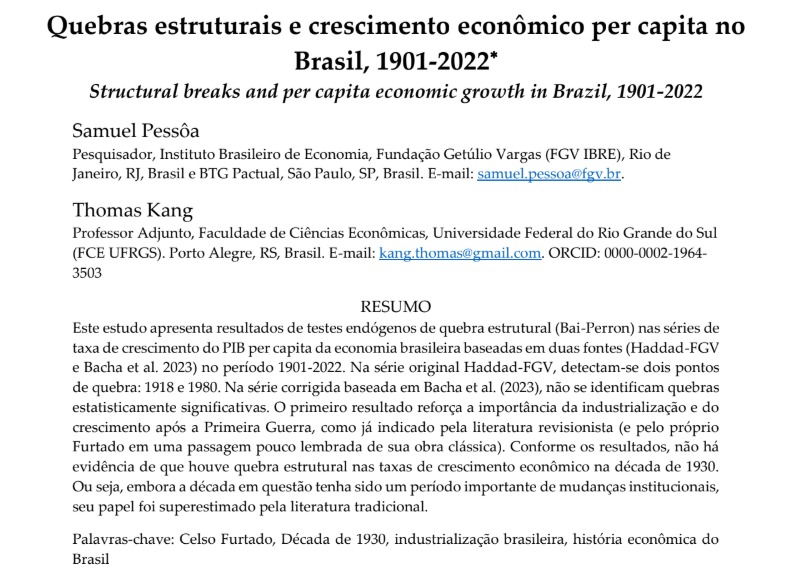
Boa notícia: "Quebras estruturais e crescimento econômico per capita no Brasil, 1901-2022", com Samuel Pessôa, aceito na Estudos Econômicos.
Quando a nossa modesta contribuição for publicada, faço um fio mais longo sobre.
Eqto isso, a versão aceita: https://t.co/paFGXEx59M
@anactedesco Explicando: tu pode ler no escuro e a luz não agride os olhos. Eu acho ótimo pra pegar no sono. Também é bom pra ler sem incomodar outra pessoa que durma no mesmo quarto. Ou no avião quando tá escuro. Enfim.
📢If you use #geobr to access spatial data of Brazil in #rstats, we'll be upgrading to v2.0.0 in a few weeks
This version includes:
- a few breaking changes💔
- several data fixes + updates🔨
- new data sets!💕
- integration with gearrow⏩
Please test the dev version, see below👇
I have been wanting to post about this since months ago.
Since this network was ruined by E.M., many interesting people left it. One of the few new accounts that brought sth interesting after that shock was @JesusFerna7026. Follow him. A rare combination of breadth and depth.
Many readers yesterday asked for more concrete examples of what I have in mind regarding the distinctions between features inherent to modernity and those inherent to “capitalism.”
Imagine we have a functioning socialist commonwealth. For simplicity, I will call it the SC.
Imagine also that this SC aims to provide state-of-the-art medical care to its citizens. This is not about superfluous consumption. It is about the desire to provide good preventive care, adequate treatment, palliative care, and so on.
Soon, you realize that you need the scientific-technological complex that develops advanced mRNA vaccines and, even more importantly, the industrial capacity to produce tens of millions of doses at short notice when a new virus arrives or an old one mutates. These are sophisticated processes that involve coordinating millions of individuals with diverse knowledge, skills, and personalities.
But it does not stop there. You will need to produce thousands of MRIs, scanners, FLASH radiotherapy machines, and all the bewildering array of equipment you find in a top hospital.
And I insist: wanting to be treated with the latest oncological equipment if you get cancer is not frivolity. It is a deep human desire that a good society (any society, really) should attempt to provide.
How are you going to accomplish all this? An SC does not want to use private property, so it relies on some form of public property. But public ownership is not the main issue. The real issue is that the SC would need to organize large bureaucratic organizations. Without them, it cannot develop and deploy vaccines, MRIs, scanners, and the rest. The need to scale is the key mechanism at play, not who owns the property.
And, because of their scale, these large bureaucratic organizations will suffer the type of problems that critics of “capitalism” attribute to “capitalism.” The organization will be impersonal and alienating, and inefficient due to career concerns, asymmetric information, conformity effects, and internal politics.
Moreover, because resource constraints hold in every human endeavor, some claims for medical treatment will be denied. The SC will not have enough resources to satisfy every medical demand (and medical demands are, for all practical purposes, unlimited), every demand for education, every demand for the environment, and every demand for this or that worthwhile cause. Sorry, yes, scarcity will always be with us, with or without AI.
Patients whose requests for medical treatment are denied will be particularly annoyed because the SC is built on the idea that such events cannot happen. At least in a “capitalist” society there is someone to blame (the “capitalist”).
Those who deny the need for large bureaucratic organizations are living in a fantasy world. I am pretty sure the day they are told they have prostate cancer, they will run to their closest large bureaucratic organization for treatment.
Those who deny the problems of large bureaucratic organizations, and how deeply irresoluble those problems are, have not seen how not-for-profits work. I have never seen more acrimonious fights than within not-for-profit organizations, where some shared sense of the common good unites members. The fights are fierce precisely because profits play no role.
I have been reading about these issues for nearly 40 years, and I have seen plenty of proposals to address the problems of large bureaucratic organizations. A favorite among many is “participation” or “more democracy” within the organization. No, sorry, more “participation” or “more democracy” only makes things worse. Yugoslavia taught us that you cannot run a large bureaucratic organization based on democratic participation (well, you only need to know some basic economics; Arrow’s impossibility theorem, anyone?).
Large bureaucratic organizations are essential to modern life, and they are full of problems, with or without “capitalism.”
This is what Weber understood and what Marx, who had an incredibly naïve view of the future, never grasped. Weber saw that bureaucracy is not a feature of “capitalism” but the institutional form modern society uses to coordinate large-scale tasks under rational, impersonal rules. Hospitals, ministries, armies, universities, and, yes, corporations all converge on the same form because it works at scale. The iron cage is not capitalist. It is modernity.
He is right I think. There are some new papers that have been surveyed in the JEL's recent paper on the "New Economic History of Russia", but still an authoritative book seems to be about to come - at least according to my brief research to prepare a lecture on the Soviet EH.