Hi, I'm Alex.
I turn Web3 positioning into pipeline for crypto and fintech companies out of Frankfurt.
But this thread isn't about me.
It's about three convictions I'd bet the next decade on.
Pumpfun 48 hours:
- 84.8k launches
- 84.6k rugs and fake charts
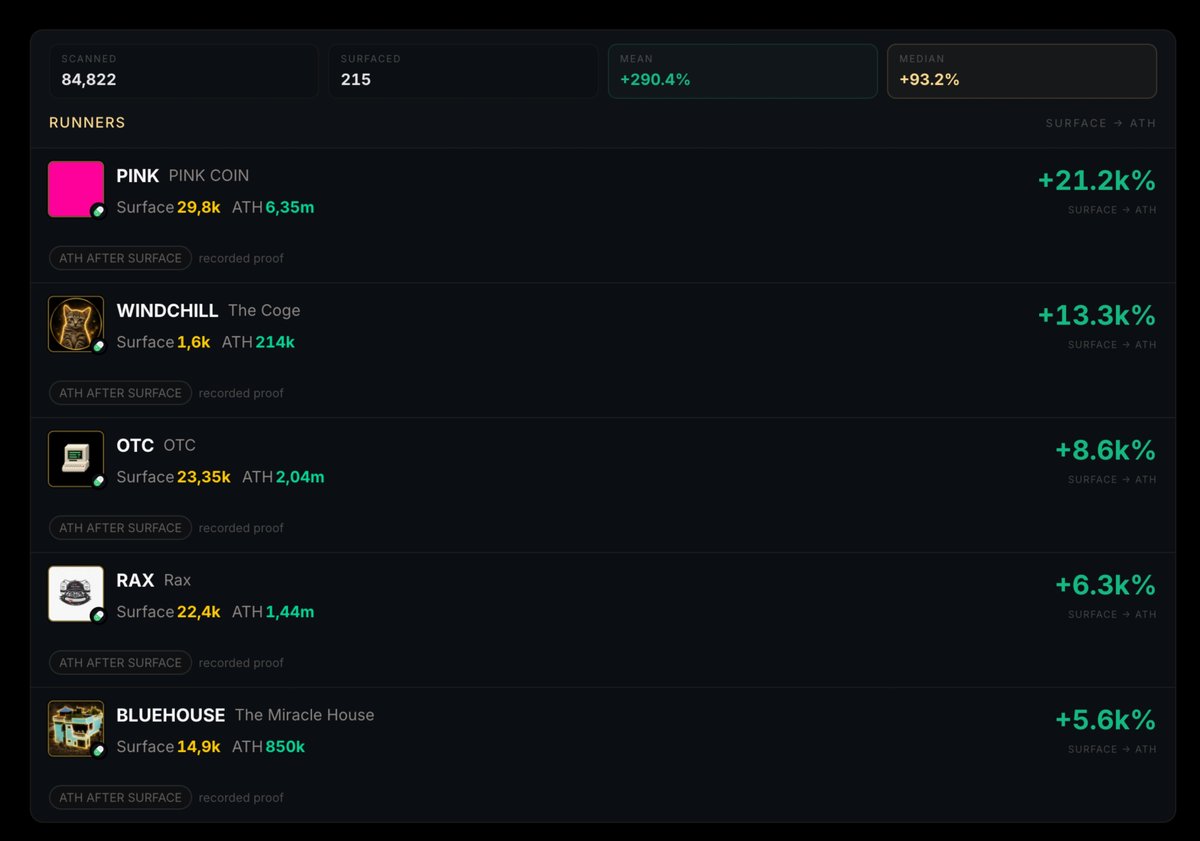
LightScope:
→ Only surfaced 215 coins
→ Average run of ~290%
→ Didn't miss a single runner
We're opening access for first early users.
gave a Grok Bot $50 on pumpfun and walked away for 26 hours. it came back with $1,070.
hour six, $289. hour thirteen, $550. hour twenty-six, $1,070. up 2,041 percent, no keyboard touched.
everyone's gonna screenshot the total. the number that actually matters is the win rate, 412 wins, 406 losses, basically a coin flip. I think most people would've looked at that ratio and assumed it lost money, thats what a coin flip is supposed to do over 800 tries. it didnt, because nobody weighted the odds, they weighted the payout. losers cost $2-4, winners closed $5-12. same flip, run 800 times, and the math does the rest.
hour nine is the part that actually convinced me this isnt just a lucky screenshot. seven losses back to back and the desk didnt resize, didnt chase, didnt do the thing every human does after a bad streak. thats the one discipline I've never seen anyone hold onto themselves for more than a few hours, let alone across 800 entries without getting tired or angry about it.
$50 to $1,070 isnt the trick, and I dont think the 190x-style entry is either. the trick is being allowed to be wrong 406 times without it costing you the account. thats the whole bet.
The US money supply just set a new all-time high: about $22.7 trillion. Almost nobody framed it as the story it actually is.
Here's the context that matters.
In early 2020, US M2, the Fed's broad measure of dollars available to spend, sat around $15 trillion. Today it's roughly $22.7 trillion. That's about 55 percent more dollars in a little over five years, growing faster than the economy produced real goods and services.
This is the quiet mechanism behind a feeling most people can't name. Your salary goes up. Your portfolio goes up. And somehow you don't feel wealthier. The reason is that the unit you measure everything in is being diluted underneath you.
Now hold that against the alternatives.
Gold's above-ground supply grows about 1.8 percent a year, slowly and predictably, which is a big part of why it held value for 5,000 years. Bitcoin goes further: its supply is capped at 21 million coins, and no policy, no committee, no emergency can change that.
That's the whole argument for hard money in one picture. The dollar line can be redrawn by decision in a single day. The Bitcoin line cannot be redrawn at all.
I'm not saying inflation is theft or that the dollar is collapsing tomorrow. It isn't. M2 growth doesn't translate instantly into prices, and velocity matters. But cumulative expansion doesn't disappear. It compounds, quietly, over a decade or two, and it shows up as the slow erosion of what your savings can buy.
One honest note. I deliberately avoided the viral "80% of all dollars were printed since 2020" claim, because it's wrong. The defensible number is roughly 55 percent growth in M2 since early 2020, straight from the Federal Reserve. The real figure is striking enough without the exaggeration.
The scoreboard keeps getting rewritten in favour of whoever prints. The reason people reach for gold, and increasingly for Bitcoin, isn't greed. It's wanting a yardstick that can't be shortened.
Do you measure your wealth in dollars, or in something that can't be printed?
An AI agent pays $0.05 for one API call.
On a credit card, the fee is $0.50 to $0.80. You pay 10 to 16x more than the thing costs. The rail literally breaks.
On stablecoins: under one cent, in seconds, 24/7.
In July, Visa, Mastercard, Stripe, Google and AWS all joined x402, the standard that lets agents pay in stablecoins. The card giants just joined the rail that routes around them.
More than half of all crypto is already dead.
Of ~20.2 million tokens launched since 2021, 53% no longer trade.
11.6 million of them died in 2025 alone. On https://t.co/9eBZUlTo3X, 98.6% were rugs or pump-and-dumps. 69% of all tokens made their last trade the same day they launched.
The casino was never the revolution. The rails underneath it are.
How does FortisX generate yield — and how does the platform itself earn?
In our latest video, Alexander explains the core mechanics behind FortisX in a straightforward way.
We cover how staking rewards are generated, how liquidity pools work, how FortisX earns its operational share, and how MPC custody and independent security audits fit into the broader infrastructure.
We also address something equally important: risk. No financial platform should present crypto as risk-free, and we believe users should understand both the opportunities and the mechanics behind them.
The goal of this video is simple — to give users a clearer picture of how FortisX works behind the interface.
🎥 Watch the full video to learn more.
https://t.co/iNxxymwFWu
0.1 Bitcoin is exactly the same coin everywhere on Earth.
What it costs in human effort is not.
52 days of work in Switzerland. 85 in Germany. 827 in India. 3,862 in Ethiopia.
Same asset. Up to 74x more work depending on where you were born.
That's not a Bitcoin problem. It's what Bitcoin makes impossible to hide.
THE BLOCK: Revolut begins phased rollout of EURR, its first euro-backed stablecoin, to eligible customers in Denmark, Poland, and Portugal.
EURR is issued by Bridge, a Stripe company, and will be integrated into Revolut’s retail app.
Agents have crossed the 1% mark.
In just over one month, agents on Virtuals have driven over $270,000,000 of Robinhood Chain’s $25B in cumulative DEX volume.
Just the beginning.
One solution is to train the AI to write like you.
Specifically:
1. Ask your agent to assemble everything you've ever written. Docs + Slack + X + Other.
2. Then have it write a markdown profile on you, your style and beliefs.
3. Then when it writes, ask it to pull specific words and phrases from what you've written in the past.
HT @rwitoff
Same €1,000 into Bitcoin. Same MiCA-regulated exchanges.
The cost to buy it: €2.67 on the cheapest, €36.69 on the priciest.
That's a 14x spread for the exact same trade.
If you stack every month, your exchange is a silent tax on your Bitcoin.
Check what yours actually charges.
For years, the tokenization debate was about the wrong thing.
Which chain is fastest. Which one wins. Ethereum vs Solana vs the rest.
That was never the hard part.
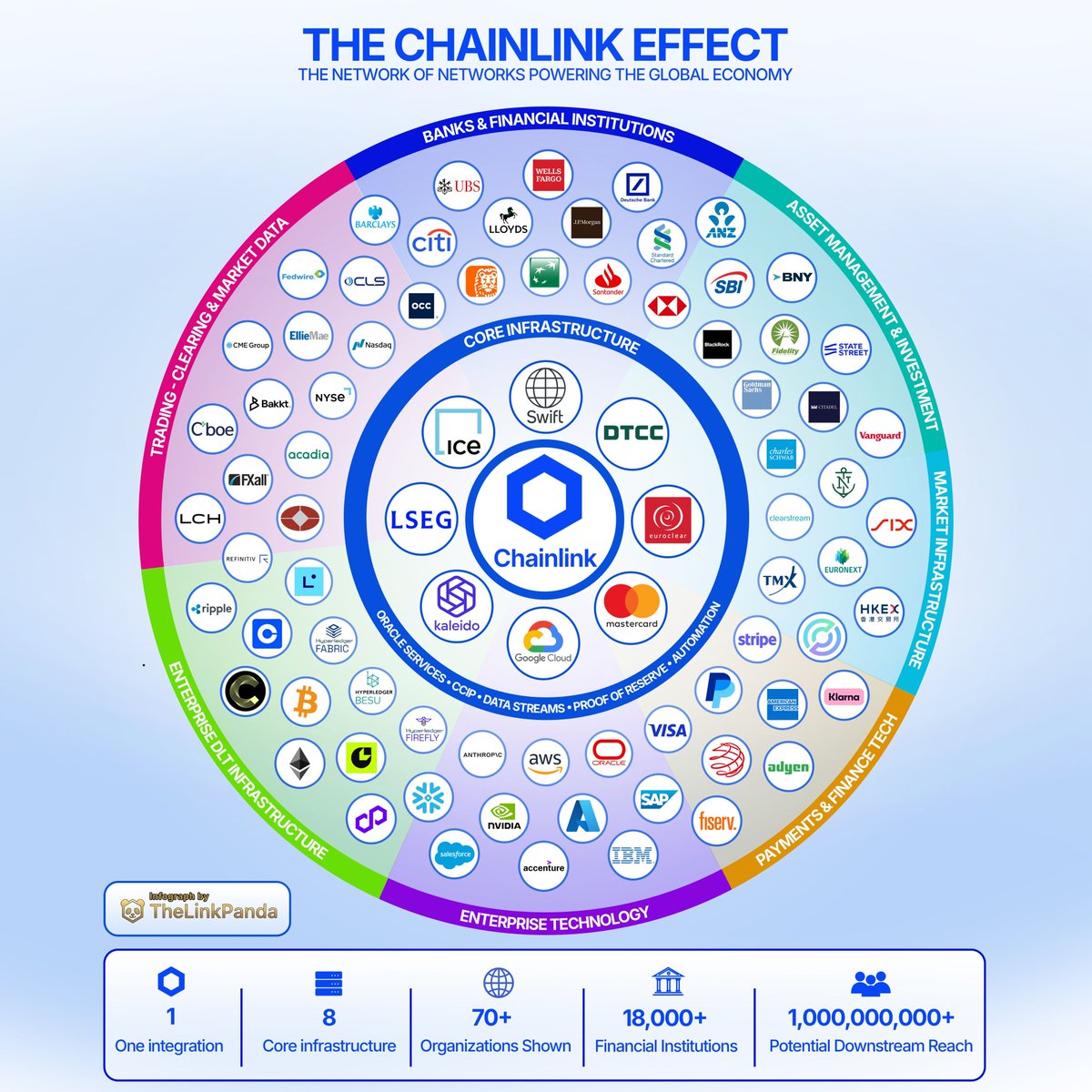
Putting a bond or a fund on a blockchain is easy. The hard part is connecting it to the systems that already run global finance. Swift. DTCC. Euroclear. Card networks.
Infrastructure built and hardened over 60 years that nobody is going to rip out.
Those two worlds didn't speak the same language. That gap, not the blockchain, is what held tokenization back.
In 2026 that gap started closing for real.
In July, DTCC, the backbone of US securities settlement, processed its first live production trades of tokenized equities and Treasuries, working with Chainlink and more than 30 institutions. Swift, UBS and Euroclear moved similar work from pilot to production-grade.
Mastercard opened onchain purchases to billions of cardholders.
Notice what changed. This stopped being conference slideware and became something running in production.
One honest caveat. Most of this is early. Full commercial launches are still landing through late 2026, and plenty is still pilot. But the direction is no longer in question.
My second thesis has always been that everything gets tokenized. What I underestimated was how much of the work is invisible plumbing, not the chains everyone watches.
The blockchain was never the hard part. The layer connecting it to the old world was. And that layer is going live right now.
Which do you think gets tokenized at scale first, funds, bonds, or private credit?