Here are 5 documentaries you should watch this weekend when you find time:
1. The Mask You Live In
2. Unknown Number: The High School Catfish
3. Cover-Up
4. BLKNWS: Terms & Conditions
5. The Solo Economy: Why Living Alone is a Global Megatrend
We have done a summary of the proposals that were rejected by MPs, why they were rejected, and the proposals that were passed.
Here is the deeper thread.
Save and share.
UPDATE: Kenya's shift to dual assessment tax regime
The National Assembly has passed two crucial provisions regarding pre-population of tax returns:
· The Revenue Authority will be obliged, in the event of an assessment borne out of pre-populated returns, to issue to the taxpayer written reasons informing the assessment source of the data captured within 30 days of the determination
· Taxpayers will be granted an opportunity to amend liabilities that are informed by pre-populated returns
CARJACKING INCIDENT.
The lorry below has fallen victim to carjacking today.
The driver was requested to go and pick a luggage from Thika ngoigwa and transport it to Eldoret, the carjackers then pulled a gun on him, tied his legs and hands and threw him into a coffee plantation...... They removed two trackers, one fitted by the bank and another one by isuzu..... the investor is going crazy because of stress..... kindly, Kenyans and our followers, let's unite and support in retrieval efforts by reposting this.
If you spot the lorry, kindly WhatsApp 0738584299.
#SafetySunday
Cleophas Malala has been left seeing with his mouth wide open after the Wamunyoro patron reportedly declared him persona non grata in the Maskio party. Word on the political streets is that Malala has lately been smelling like a certified mole. According to the highly classified Wamunyoro Intelligence Service (WIS), the former Secretary General has been spending his days chanting party slogans with the boss, but at night allegedly sneaking into State House to enjoy ugali wa wimbi, murenda, and a side dish of Kumbe Kumbe diplomacy.
The drama teacher turned politician was reportedly advised to pack his things, return to Khumsalaba, join hands with Bifoli Wakoli, and launch a Mulembe party where he can be chairman, secretary, treasurer, chief whip, and disciplinary committee all at once. Ameambiwa akanyage frame na hizo maoni zake za matakataka.
At this rate, political observers fear that anyone in DCP whose ancestral roots don't touch Mt. Kenya soil might soon be ejected faster than a burukenge caught grazing in a Managu farm. One wrong sneeze and you'll find your membership card revoked before you can say WANTAM!
Malala is said to be currently cooling his Sundus under an avocado tree in Lumakanda, holding an emergency consultative forum with boda boda riders, retired judo players, and three curious goats grazing around as he formulates his next political move. Sources say the goats are currently leading the discussion. Ni mbaya majama! Kama kawa sisi walala hoii hatuna maoni, Letu Jicho tu.👀
My dear friends and colleagues. 16 girls in Utimishi Academy were fatally set ablaze by their fellow students!!
Bad adults are not an accident. They are a project. A project that started at age 5 when a child talked back to an adult and the parent laughed and said, "Huyu mtoto ni tough kama mimi"
A project that continued at age 10 when the child threw a tantrum in public and nobody said a word.
A project that matured at age 15 when the teenager disrespected a teacher and the parent showed up at school to defend the child.
A project that graduated at age 25 when a fully grown adult cannot keep a job because they cannot take correction from anyone.
Nobody wakes up at 30 and suddenly becomes rude, entitled, dishonest, and impossible to deal with.
That software was installed early.
By parents who were allergic to the word "no."
"Mtoto wangu asiumizwe."
"Usimshoutie."
"Let the child express themselves."
Express themselves into what, exactly?
A menace?
Because that is what happened.
You let your child talk back to elders and called it confidence.
You let them break rules and called it creativity.
You let them disrespect boundaries and called it independence.
Now they are 28.
They cannot hold a relationship because they have never been told they are wrong.
They cannot keep a job because they argue with every supervisor. They cannot take feedback without crying victim.
And you are wondering what happened.
You happened.
You skipped the most important part of parenting.
Discipline.
Not beating. Discipline.
Teaching a child that actions have consequences. That "no" is a complete sentence. That apologizing is not weakness. That respecting people is not optional.
These are lessons that must be taught early. Because the world will not teach them gently.
Schools do not raise children. The internet does not raise children. TikTok does not raise children. Church does not raise children.
Parents do.
And if you refuse to correct your child, society will do it for you.
Society has no patience. No mercy. No second chances.
Prisons are full of people who were never told "sit down" at age 7.
Broken homes are full of adults who were never taught emotional regulation at age 12.
Unemployment lines are full of people who were never told "do it again properly" at age 15.
You had the chance to shape them.
You chose comfort over correction.
And now the world is dealing with the result.
Raise children with manners. With respect. With accountability. With the understanding that the world owes them nothing and character determines everything.
Otherwise, you are not raising a child.
You are manufacturing a future problem.
And society will send you the bill.
One thing about the just concluded Finance Bill 2026 stakeholder submissions, they were truly rich with simulations on the implications of the proposals.
A 🧵on some simulations that stood out for me.
Dr David Ndii to Uthamaki - Kihooto kiha?
On Uthamaki’s Bogeyman Politics: Time to call the demonization of President Ruto what it is!
In the days leading to President Ruto’s swearing in, some supporters sent apologies to the President-elect to the effect that they would not be attending the Garden Party in State House because from Kasarani they would turn right and attend to long standing matter.
The long-standing matter was historical land injustices in Kiambu. Their immediate target was the vast Kenyatta estates between Kasarani and Gatundu, but by no means the only ones.
As I wrote in the posted op-ed “Of Land and the Luo Bogeyman” when I was growing up, one could have walked from my home in Limuru to Gatundu without stepping on the land of a peasant.
The Kikuyu class cleavage—Uthamaki vs Mungiki—is arguably Kenya’s most potent political problem. It was, as the op-ed explains, the cause of the Jaramogi Jomo fallout and Moi’s ascendancy to vice president, in what I have called the Kikuyu Kalenjin “power-for-land” pact. Kikuyu class conflict has been bottled up by the political tactic of creating a siege mentality in a community by inventing external enemies—political bogeymen. Jaramogi was the first victim of bogeyman politics. When it looked like Jomo would die, and Tom Mboya seemed to be ascending to power, he was assassinated, and bogey man was expanded to the entire Luo through the 1969 oathing ceremonies. Jomo survived the 1969 heart attack, but by the mid-seventies it was a matter of how soon.
Those of us who, as we say in Gikuyu, have eaten a bit more salt, can relate the demonization of William Ruto to the Kenyatta succession political drama that played out between the Change the Constitution shenanigans and the Njonjo inquiry. Those who have not eaten as much salt can read up on the change the constitution movement in Karimi and Ochieng book “The Kenyatta Succession”.
Moi began his presidency supplicating to Uthamaki. I have recollection of Moi regularly speaking Kikuyu, and on one occasion doing a full prayer in Kikuyu. Fuata Nyayo was as an olive branch. But Uthamaki would have none of it. The bogeyman campaign began. How can we be led by a herdsman? Reassurances were given to the Kikuyu masses that Moi was a passing cloud, normal service would be resuming.
It peaked at the 1983 Rungiri church service where Kiambu tycoon Samuel Githegi, with Charles Njonjo in attendance, proclaimed that iguthua ndongoria itikinyagira nyeki (a flock led by a lame sheep does not find pasture). Many Kenyans, particularly the young and those who don’t read history, think that the political violence unleashed by multiparty politics in 1992 violence was new. The 1992 violence was in fact a replica of the political violence in the run-up to the 1963 elections.
Bogeyman Moi, the passing cloud, the limping sheep, retired on his own terms. Uthamaki was finally back in power. The paradox is that it took the political calculus of the the bogeyman axis— Moi’s Uhuru project and Raila’s Kibaki tosha—to deliver it. Moi decided that his post retirement security was to return power to Uthamaki. Raila who had hitherto calculated that power would transition within KANU, had the presence of mind to realize that a divided opposition would hand over power to his then nemesis Uhuru.
Overnight, Raila became Kikuyu hero. It was not to last. Kibaki was elected on a new political dispensation to end tribalism and enact a new constitution within 100 days. Uthamaki had other ideas, which Michuki rationalised as handling liver— the slippery nature of power. Kibaki’s capture by Uthamaki ideology cost him the 2007 re-election, and brought the country to the brink of civil war. Had Uthamaki honoured the NARC MOU, he would, in all likelihood, have been handed a second term with ease. Instead Uthamaki went about gucokia rui mukaro (returning the river to its course). John Michuki took to speaking Kikuyu in official meetings. Jomo Kenyatta’s portrait replaced Moi’s on the currency. The NARC dream died. We have been paying the price ever since.
I did a short stint advising Uhuru Kenya when he was opposition leader—short because I did not have the deferential constitution of palace courtiers that he was accustomed to. One of the pieces of advice I gave him was to rise above ethnic political mobilisation. My last conversation was a brief phone call after I saw him on TV being enthroned as muthamaki by Michuki and company. Had he heeded, he would not have ended up in ICC, but then again, he might not have become president seeing as it was ICC sympathies that propelled him.
The Uhuru-Ruto ticket was borne of an existential threat. If they did not hang together they would be hang separately. But as soon as ICC threat was out the way, Uthamaki reverted default settings. Hustler, Tanga Tanga…
Uhuru’s legacy will forever be tainted by BBI, the 2022 Bomas coup attempt, and his continuing attempts to undermine his successor. But why? Moi retired and left the stage. Kibaki retired and left the stage. Two reasons.
First, money. Take the 11000-acre Ruiru holding. The Northlands City development occupies 5,000 acres. Take a conservative figure of Sh50m per acre. That’s a tidy Sh250b monetization of land for which there is no record of purchase.
Second, dynastic hubris. The 2010 constitution outlawed individual portraits on the currency. When new designs were presented to Kibaki, with Uhuru in attendance as Finance Minister, he threw one of his famous juvenile tantrums. Compromise was reached. The portrait was replaced by replaced by KICC with Jomo’s statue prominent. I am told that he threw another one at the idea of the Bomas of Kenya Convention centre now under construction (at a lunch in Paris)—it is suspected reason was it would eclipse the KICC.
To my friend Omar Hassan. You don’t owe anyone apology for speaking the truth.
To my Kalenjin brothers and sisters — keep your cool. Even this will come to pass. Moi overcame it. William Ruto will.
To the opposition. For the last so many elections, Kikuyu voters have been mobilized to elect one of our own, and to send Raila home. They have no reason to wake up early to vote for you. Uhuru and/or Gachagua have no Kikuyu votes to deliver. They are self serving charlatans.
To Uhuru Kenyatta, Rigathi Gachagua, Uthamaki ideologues and ethnic chauvinists writ large, normal service is not resuming. The bogeyman act has run its course.
And to my fellow sons and daughters of Gikuyu and Mumbi, I have three questions. What has Uthamaki done for us? How has President Ruto wronged us? Kihooto kiha?
By Dr David Ndii - X pages
27th May 2026
BREAKING: As I promised, here is evidence showing how the Finance Bill 2026 could increase M-Pesa and digital transaction costs. Reject the Finance Bill 2026
UDA propagandists asked for evidence. Here it is.
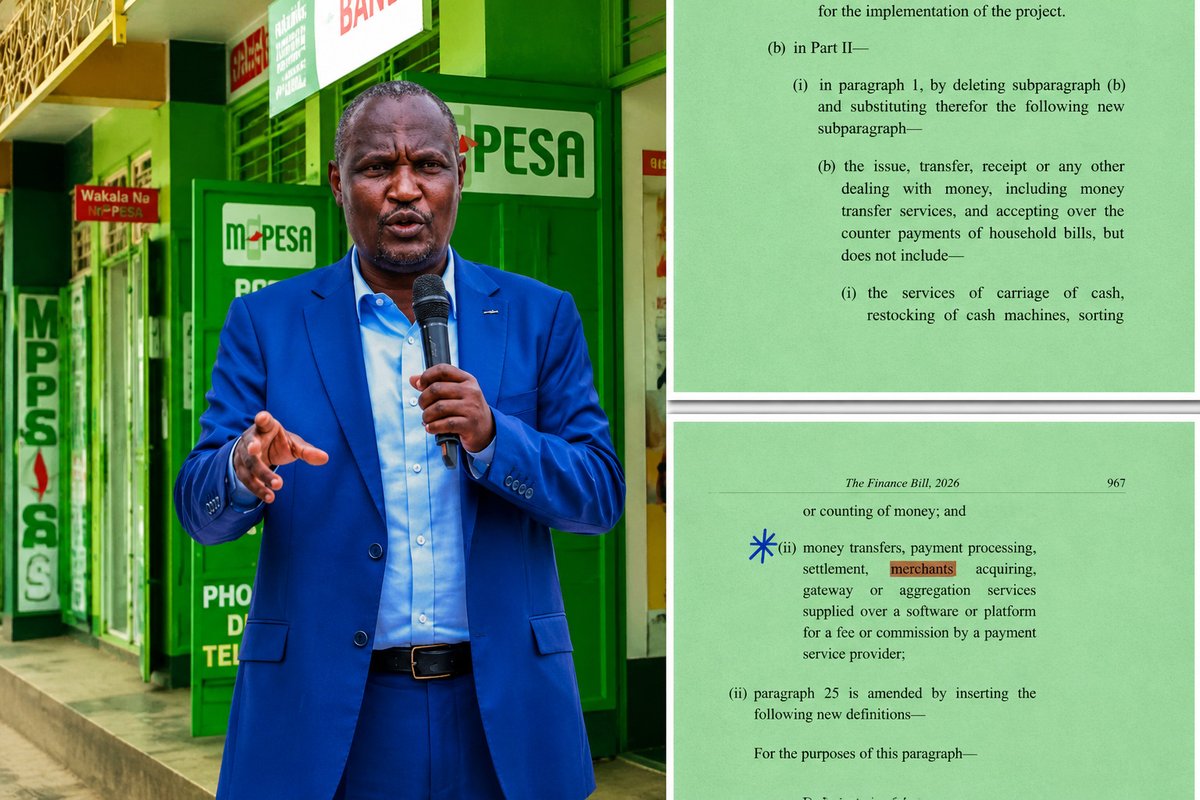
Go to pages 16 and 17 of the Finance Bill under Clause 31(b).
TWEET 2
The bill says:
“Section A of the First Schedule to the Value Added Tax Act is amended,”
Then specifically:
“in Part II.... by deleting subparagraph (b) and substituting therefor the following new paragraph...”
This is important.
Let's move to 2/5
What Julians has submitted is extremely critical. Extremely.
Right now:
• You partly tell KRA what you earned
• You tell KRA what tax you owe
If finance Bill 2026 passes,
It is KRA that will strictly tell YOU:
• What you earned
• What tax you owe
How?
• By pulling data from anywhere
• eTIMS, banks, third parties, govt ministries integrations, etc
If KRA sends you a tax bill. And it is insane. And you disagree. Who must prove it is wrong?
The bill says it is you.
But here is the danger. KRA is NOT required to tell you:
• Where they got the data from
• Or how they arrived at the figures
So you are left there. Trying to fight numbers you cannot see.
And some of those numbers could be system errors.
Now ask yourself,
- How do you disprove something you don’t even understand? Are you an angel?
What Julians is saying is simple.
If KRA wants to tax you using their data, KRA must prove to you and the courts that that data is:
• Accurate
• Reliable &
• Defensible
Is that a fair argument?
Or should taxpayers just fight ghosts?
KRA will soon be able to freeze or even seize M-Pesa and bank accounts before you can fully appeal a tax dispute.
This is one of the most dangerous proposals in the Finance Bill 2026, which is being ignored.
Right now, Section 42(8)(e) of the Tax Procedures Act protects taxpayers by stopping KRA from issuing agency notices to banks, SACCOs, employers, and M-Pesa over disputed taxes during an appeal.
But the Finance Bill 2026 by Mbadi etc seeks to DELETE paragraph (e).
If passed, KRA could recover money immediately after issuing a tax assessment, even before your appeal is concluded.
Think about how dangerous that is.
Your business can be punished first, then told to defend itself later.
Imagine waking up and finding your business account emptied over a disputed tax bill or frozen.
Suddenly, you are unable to pay Salaries, rent, etc
Your Business could stall instantly.
And remember, even under the current law, if you lose the appeal, you still eventually pay anyway.
So why is the government suddenly desperate to seize first and argue later?
NATURAL WAYS TO REDUCE BELLY FAT
Belly fat is not just about appearance. Excess fat around the waist is linked with heart disease, Type 2 diabetes, fatty liver disease, and hormone problems.
5 reliable and natural ways to reduce belly fat:
Check my comments below 👇🏾
Ruto’s Finance Bill 2026 gives KRA the power to freeze or take your money even if you have appealed a tax bill, until the dispute is fully resolved
For example Serikal sends you a tax bill of say kshs 5 million. As a business owner, you know the amount is not correct and you appeal it.
Under Ruto’s 2026 Finance Bill, KRA will simply tell your bank, SACCO, or M-Pesa to handover the kshs 5 million or freeze your accounts while the appeal case is still ongoing.
The pain this proposal will cause many business owners is unbearable.
That is why we are saying Reject Ruto’s 2026 Finance Bill.
Finance Bill 2026: Ruto’s “Forgetful Warthog” Moment 🐗
🔁 Deja Vu — What He Clearly Didn’t Learn
The 2024 Finance Bill triggered massive Gen Z protests that forced govt into full retreat — yet here we are, same playbook, 2 years later
A 23-year-old protest organiser says it best: “We are not the same people who protested in 2024. We are worse off”
Inflation is at a 2-year high — the worst possible moment to pile new taxes on ordinary Kenyans
Budget deficit has worsened from 4.7% to 5.3% of GDP — meaning the fiscal mismanagement continues unabated
💸 The Pain Points — What Gets Taxed Now
Mobile phones — 25% excise duty
Bottled water — Sh6.41 per litre, despite unreliable tap water supply
Fruit juices — Sh14.14 per litre (unsweetened); Sh20 per litre (with sugar)
Mitumba clothes — 5% customs value levy, hitting the poorest hardest
Imported furniture — 30% excise duty
Ceramic sinks, toilets, urinals — 5% of excisable value or Sh50, whichever higher
Crypto & digital wallets — 10% excise duty on every transaction fee
Gambling winnings — 20% withholding tax
🏦 The Card Swipe Trap
Interchange and merchant fees (Visa, Mastercard, mobile payment networks) now taxable as royalties
Every debit/credit card swipe could attract two separate taxes
Banks will pass costs to merchants → merchants pass to consumers
Small shopkeepers risk financial ruin if electronic invoicing systems malfunction
⚖️ KRA’s Expanded Draconian Powers
Commissioner can re-open any transaction for up to 5 years — a 5-year look-back with no upper limit
KRA can generate pre-populated tax returns using your electronic data — shifting burden of proof: you must disprove what KRA says you owe
Penalty for non-compliance with electronic tax system: higher of twice the tax due or Sh100,000 (Sh10,000 for individuals)
Tax filing deadline moved from June to April — shrinking compliance window dramatically
Nil returns now due by January 31 — squeezing small businesses with limited capacity
🏠 Landlords & Renters Feel It Too
Residential rental income tax raised from 7.5% to 10%
Non-resident rental income (foreigners earning from Kenyan property) taxed at 30% — landlords will simply pass this to tenants as higher rents
🎰 Gambling Gets Squeezed
Betting & gaming excise of 5% on every deposit
Gambling winnings subject to 20% withholding tax
A Sh1,000 bet that wins Sh10,000 = govt takes Sh2,000 immediately plus 5% on deposit plus existing excise — total tax Sh4,050 on one transaction
💊 Even Medicine Gets Hit
Previous excise exemption for glass bottles used for pharmaceutical products removed — meaning medicines get more expensive
🔑 The Revenue Target vs. Reality Gap
Govt targets Sh3.63T in 2026/27 — an ambitious figure against a backdrop of economic pain
Yet the budget deficit grows, suggesting revenue collection failures, not just revenue shortfalls
The road maintenance levy on fuel has been halved from Sh3 to Sh1.50 per litre — the only genuine relief in the entire Bill
🔥 Political Recklessness — The 2027 Election Gamble
Elections are next year — introducing punitive taxes now is political self-destruction
Gen Z is angrier, more organised, and explicitly says: “They think we are tired. They are wrong”
”The Standard” correctly calls this “tone-deaf” — a president who either doesn’t remember 2024 or doesn’t care
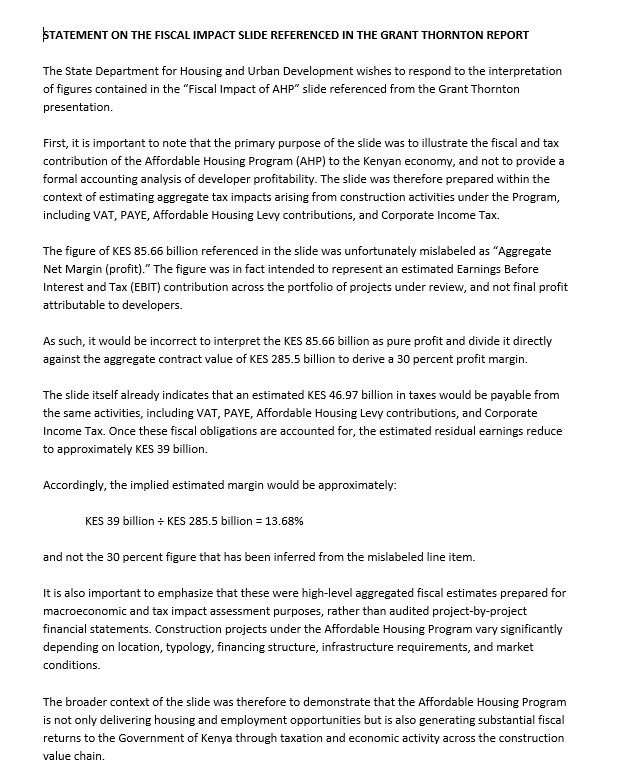
Folks, I have received this statement intended to clarify that newspaper report implying that contractors had margins of 30%. I include it here in the quest for fairness but I will review the full report and make my own comments again.
https://t.co/Ka06ozzZwk
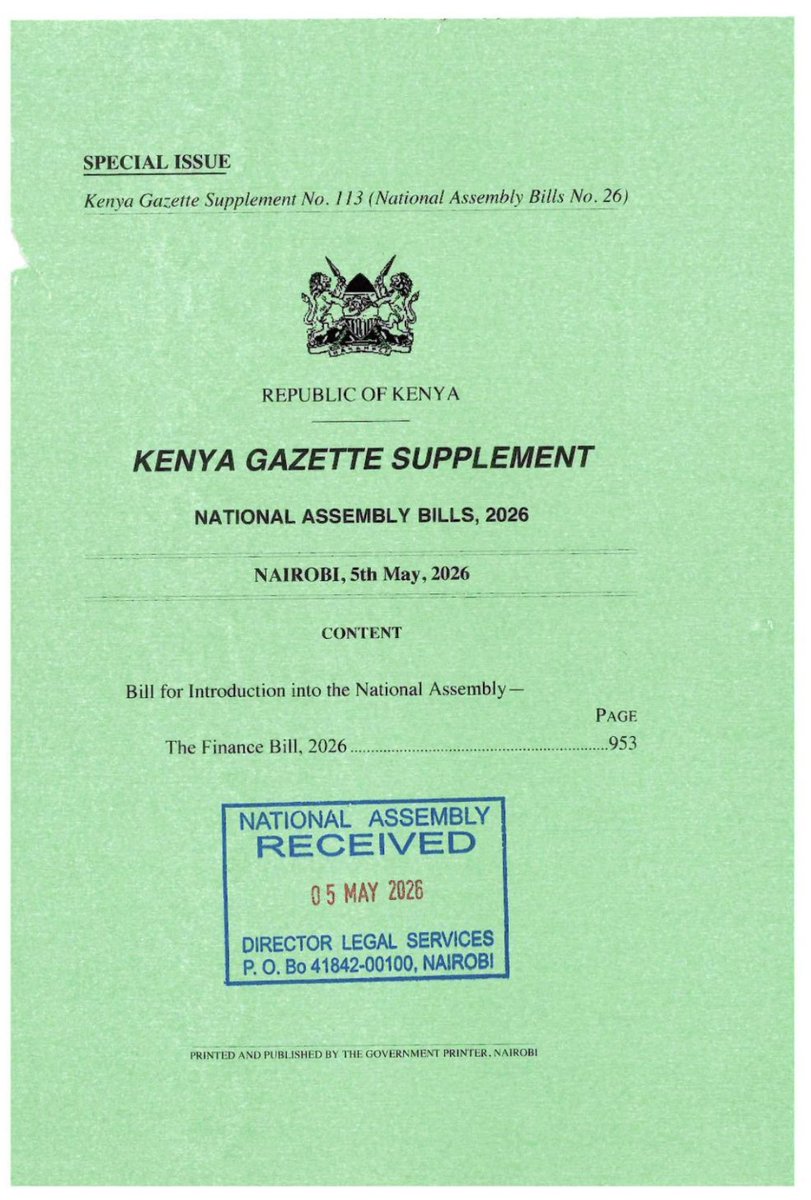
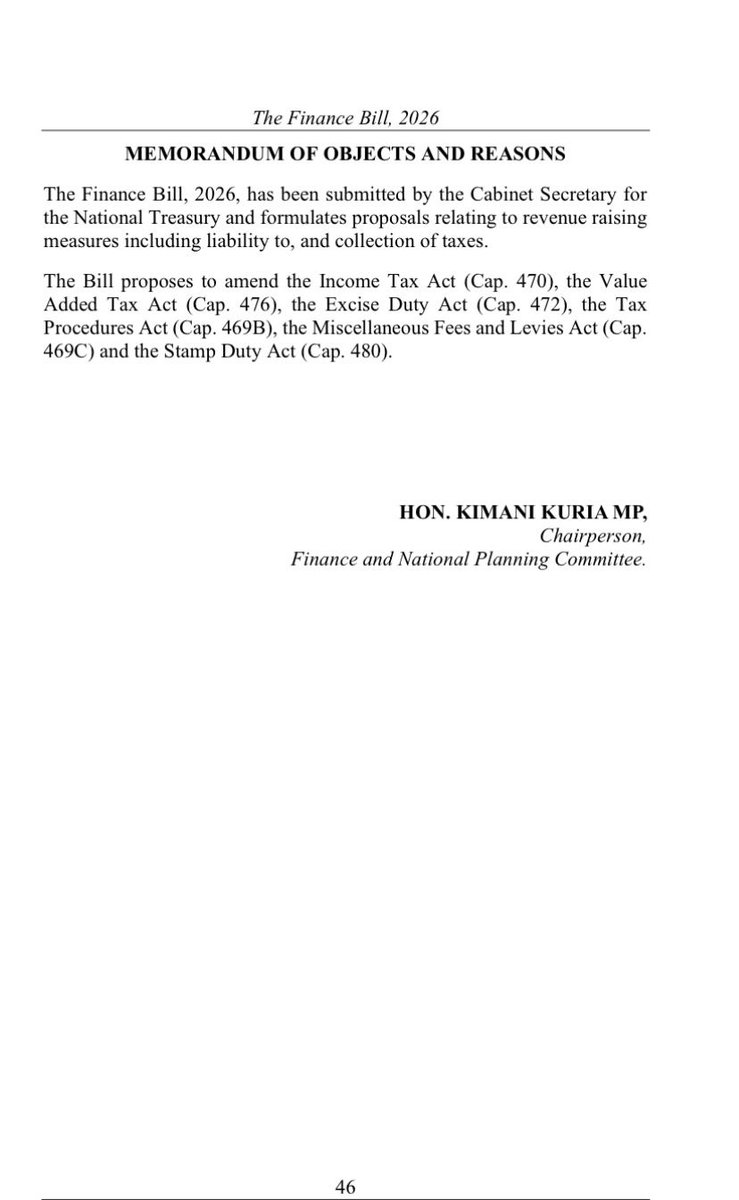
The Finance Bill, 2026 was published on 30th April and is now before Parliament and every Kenyan deserves to know what is in it.
The government targets Ksh3.63 trillion in revenue for 2026/27 and a wider budget deficit of 5.3% of GDP in the 2026/27 fiscal year (July-June) up from 4.7% in 2025/26. These are not unreasonable fiscal objectives but the manner in which the burden of achieving them is distributed is a cause for serious concern.
On tax filing timelines, the Bill moves the income tax return deadline to April 30th which is two months earlier than the current June 30th and compresses nil return filing to January 31st. This reduces the time available for audit completion, cash flow planning and compliance. For small businesses and individual traders, this is not administrative reform. It is an additional compliance cost they can ill afford.
On mitumba, the Bill inserts a new Section 12H into the Income Tax Act which deems profit at 5% of customs value payable upfront before goods are released by KRA as a final tax. A trader importing a bale worth Ksh1 million pays Ksh50,000 regardless of whether they make a profit or a loss. I cannot in good conscience describe this as equitable.
The Bill increases residential rental income tax from 7.5% to 10%. Absent a serious enforcement framework, this will drive non-compliance rather than revenue. The government must fix the enforcement gap before it increases the rate. One without the other is burden-shifting.
On digital financial services, the Bill removes existing VAT exemptions on money transfers and payment processing. These are the tools of financial inclusion that millions of Kenyans including the very people this government says it wants to reach rely on daily. Making them more expensive will not serve the objective of a broader tax base.
By including interchange and merchant service fees within the definition of management or professional fees for withholding tax purposes, the Bill introduces a compliance burden into automated banking processes. That burden will be passed on to businesses and ultimately to consumers.
The amendment to Section 24 of the Income Tax Act empowers KRA to deem at least 60% of a company's undistributed income as dividends for tax purposes. This fails to account for legitimate decisions on reinvestment, working capital and business growth. It is a retrogressive measure that sends the wrong signal to the investors Kenya needs.
A 25% excise duty on telephones for cellular and wireless networks is proposed. A phone is not a luxury. It is how Kenyans bank, communicate, conduct business and access government services. Parliament must interrogate this carefully.
On PAYE, Kenyans were led to expect relief and a restructuring of the tax bands to ease the burden on salaried workers. That proposal does not appear in this Bill. That is not a minor omission. An explanation is owed to every employed Kenyan who was waiting for it.
To be fair, the Bill is not without merit. The reduction of corporate tax for non-resident companies from 37.5% to 30% improves our investment climate. The extension of the tax amnesty to cover liabilities up to 31st December 2025 provides a genuine and welcome pathway to compliance. VAT exemptions on electric buses, bicycles, dialysers, animal feed raw materials and PPP infrastructure are sensible measures. The clarity introduced on trust taxation ensuring beneficiaries are not taxed on income already taxed at the trust level and the recognition of gratuity contributions as exempt income are also steps in the right direction.
Be that as it may, we cannot afford a repeat of June 2024. Parliament must discharge its oversight role with the seriousness this moment demands. They should not merely rubber-stamp what the Treasury has placed before it. Every clause must be scrutinised. Every punitive or ambiguous provision must be rejected or amended.
#FinanceBill2026 #PublicParticipation