U know KK, U were the most trended & popular contestant of BB15🔥😍 U were the center face of all promos,all episode thumbnails,
promotional posts,even slightest fights of kk were highlighted so much😌😎U were the only source of TRP this season
@kkundrra@kkundrra#KaranKundrra
As an AI Engineer.
Please learn:
- LLM fundamentals: tokens, context windows, embeddings, attention, temperature and sampling
- Prompt engineering, structured outputs, function calling and tool use
- RAG properly: chunking, embeddings, reranking, retrieval quality and evaluation
- Vector DBs, hybrid search, metadata filters and freshness of data
- Fine-tuning basics: LoRA, SFT, preference tuning and when not to fine-tune
- Agents, workflows, memory, retries, state machines and human approval steps
- Evals for LLM apps: hallucination checks, groundedness, latency, cost and task success rate
- Guardrails, prompt injection, data leakage and permission boundaries
- Model routing, prompt caching, token optimization and cost per successful task
- AI observability: traces for every LLM call, tool call, retrieval step and final answer
- Production APIs, rate limits, fallbacks, async jobs and handling model failures
- Building with users instead of making another generic chatbot wrapper
Most AI engineers can call an LLM API.
Very few can build an AI product that gives reliable answers, uses the right data, stays within budget, handles failures, and actually improves a real business workflow.
This is what production AI teams actually care about.
Akanksha Chamola spills fresh Tea ☕
She says every female who is not s*xually satisfied has right to file for divorce 👀
She further says, married man who perform bold kissing roles are celebrated, while married women face harsh criticism, they should also have freedom 👀
This girl legit changed my perception of her in a week! The way she accepted and described everything, i feel so bad for her. She literally has the potential to win this game. Beauty with brains. Chamola u have my heart<3 🥹♥️
#lockupp2 • #AkankshaChamola
A fearless and honest revelation Akanksha Chamola shares that she identified as bisexual and had dated women before her marriage to Gaurav Khanna.
#GauravKhanna#AkankshaChamola#Lockupp2
Akanksha revealed that she was bisexual before her marriage and had been in relationships with a few women.
She added, "Main ladkiyon ki taraf attract hoti hoon, and I like girls."
#LockUpp2#LockUpp#AkankshaChamola
2021: Applied on LinkedIn
2022: Applied on LinkedIn
2023: Applied on LinkedIn
2024: Applied on LinkedIn
2025: Applied on LinkedIn
2026:
Job seeker: "I finally got a remote job."
Friend: "What changed?"
Job seeker: "I stopped applying everywhere and started using the right remote job websites."
Here's what worked 👇
Interview experience at Zepto for 48 LPA
Round 1
DSA + Problem Solving
Round 2
Low-Level Design + DB Schema + APIs
Both rounds were conducted on BarRaiser. Even though there were only two rounds, the discussions were intense and heavily technical.
Round 1 : DSA & Problem Solving Round
This round was entirely focused on coding. The interviewer clearly mentioned at the beginning that the expectation was: Solve 2 DSA questions within roughly 25 minutes each That immediately created pressure because both correctness and speed mattered heavily. The interviewer was collaborative but also closely evaluated: coding speed, optimization, communication, naming conventions and thought process.
One thing I noticed was that they were not interested in brute-force thinking. They expected optimized solutions almost immediately.
Problem 1 : Minimum Cost For Tickets (Leetcode)
The first problem asked was: Minimum Cost For Tickets This is actually considered a fairly difficult dynamic programming problem, especially under interview pressure.
The problem gives:
> a list of travel days
> ticket costs for:1-day pass
> 7-day pass
> 30-day pass
Example :
Input: days = [1,4,6,7,8,20], costs = [2,7,15]
Output: 11
The goal is: Find the minimum total cost required to cover all travel days. At first glance, the problem can feel confusing because there are multiple overlapping choices at every step. The interviewer mainly wanted to evaluate:
recursive thinking
dynamic programming optimization
state transition understanding
Problem 2 – Daily Temperatures (Leetcode)
The second question was Daily Temperatures. This problem is a classic stack-based problem and comparatively easier once you identify the pattern.
Given an array of temperatures, for every day we need to determine: How many days must pass before a warmer temperature appears If no warmer day exists, return 0 for that position.
Example:
Input:
[73,74,75,71,69,72,76,73]
Output:
[1,1,4,2,1,1,0,0]
The interviewer specifically mentioned that this was a variation of a standard monotonic stack problem.
The brute-force approach would compare every future temperature for every index, leading to O(N²) complexity. Instead, I used a monotonic decreasing stack.
The idea is:
maintain indices in decreasing order of temperatures
whenever a warmer temperature appears, resolve pending indices
This reduces complexity to O(N). I solved this problem in around 10 minutes because I had practiced similar stack problems before.
Round 2 : Low-Level Design + Database Schema + APIs
This round was much more backend engineering focused. The interviewer asked me to: Design a Chess Game
Initially, it sounded simple, but the discussion quickly became deep. The interviewer expected:
class structures
design patterns
APIs
database schema
move validation logic
extensibility discussions
This was not just a UML exercise. The interviewer wanted to understand how I think while designing real systems.
Chess Game LLD Discussion
I started by identifying the major entities: Player, Board, Piece, Move, Game and Position. Then I discussed how inheritance can be used for chess pieces. For example: King, Queen, Bishop, Knight, Rook and Pawn. Can inherit from a base Piece class.
I also discussed: encapsulation, abstraction and polymorphism. during the design.
Design Patterns Discussion
The interviewer specifically asked where design patterns could be useful.
I discussed:
Factory Pattern for piece creation
Strategy Pattern for move validation
Singleton Pattern for game manager (optional discussion)
The interviewer seemed more interested in my reasoning than memorized definitions.
Database Schema Design
The next discussion focused on schema design.
I designed tables for players, games, moves and match history. I also explained relationships between entities and why indexing would matter for querying ongoing games efficiently.
The interviewer asked follow-up questions around:
scalability
storing board state
move history optimization
which made the discussion feel very practical.
API Design
The interviewer then asked me to define APIs.
I designed APIs such as:
Start New Game
POST /games/start
Make Move
POST /games/{id}/move
Fetch Game State
GET /games/{id}
I also explained request payloads, responses, status codes and validation handling.
This part of the interview honestly felt very similar to real backend development discussions.
Overall Experience at Zepto
Technically, the interview process at Zepto was genuinely good. The interviewers were technically strong and the rounds tested:
DSA fundamentals
optimization skills
object-oriented design
backend engineering thinking
API design capability
The main challenge was speed, time pressure and implementation clarity.
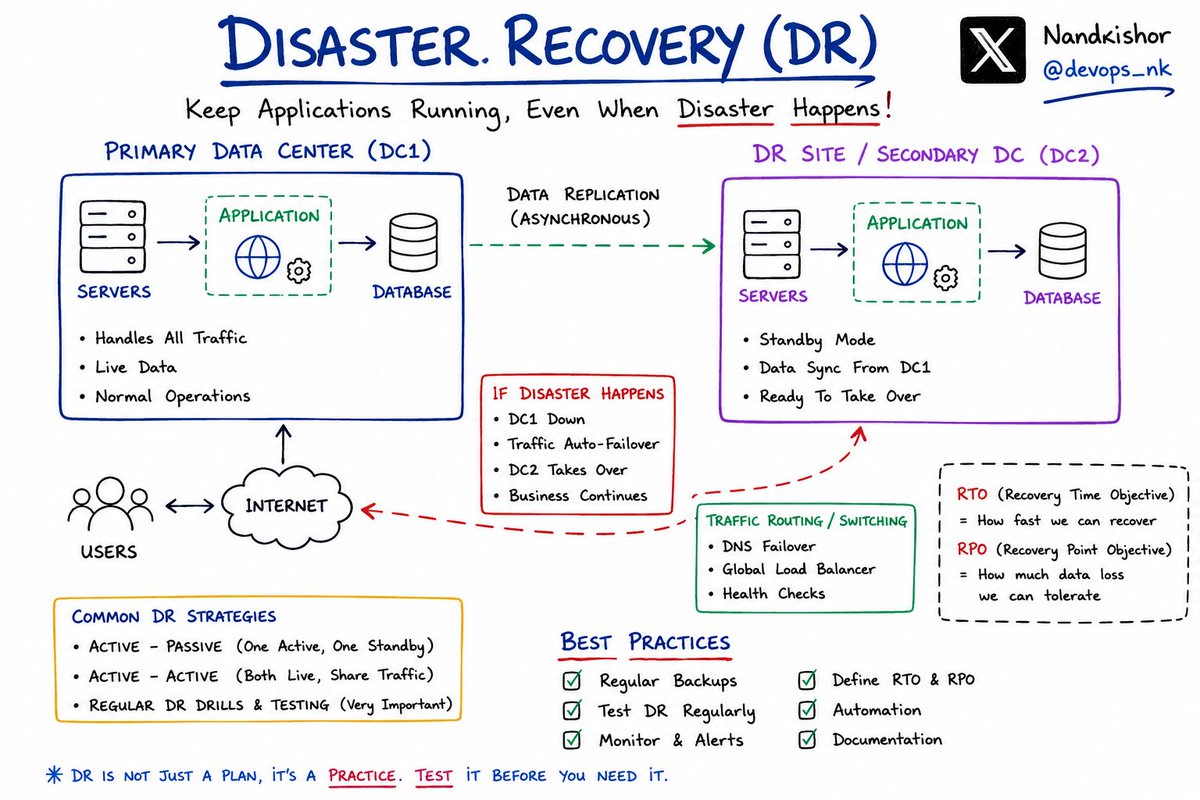
I am working today because we have a DR activity planned for the IDL application and I am doing it.
Hope everything goes smooth 🤞
BTW, what’s your strategy for handling DR in your project ?
(DR = Disaster Recovery)
Let's understand DR now: 👇
DR (Disaster Recovery) is a strategy used to recover applications, servers, databases, or entire infrastructure when a failure or outage happens.
Companies do DR to reduce downtime, prevent data loss, and keep services running during incidents like server crashes, cloud outages, cyber attacks, or data center failures.
Common DR strategies companies use 👇
Active-Passive:
• Primary DC handles all traffic
• Secondary DC stays on standby
• During failure, traffic is switched manually/automatically
Active-Active:
• Both DCs serve live traffic together
• Load balancer splits traffic across regions
• Better availability but more complex to manage
DR Drill / Rotation Testing:
Some teams intentionally route traffic like this:
Day 1 → DC1 handles traffic
Day 2 → DC2 handles traffic
Day 3 → Active-Active mode
Why?
Because DR only works if you test it regularly in production-like scenarios.
Things usually tested during DR:
• Database replication
• Kubernetes failover
• DNS/LB switching
• Application latency
• Session handling
• Cache synchronization
• Monitoring & alerts
• Rollback strategy
I hope it helps the people who heard the word 'DR' for the first time.
WTH is happening with IT industry?
First, learn html, css, JS, Python, Java, React, Backend,Databases
Then grind endlessly: DSA, LeetCode, System Design, OS, DBMS, CN
Then tools & cloud pressure: Git, Docker, AWS, Kubernetes
Then new buzzwords: AIML, GenAl, LLMs, Prompt Engineering
After all this... you might get a job for 3 Ipa😭
MTVSplitsvillaX6 on JioHotstar has turned viewers into Splitspaglus
200Mn+ Watch time hours. The ultimate screen-time steal.
Congratulations My idol @kkundrra Best Host Handsome👑✨🧿
Me first time watching #SplitsvillaX6 only one reason my idol KK🫀🥹
#KaranKundrra#TejRan
KUBERNETES ETCD (DISTRIBUTED KEY-VALUE STORE)
Think of etcd as the brain and memory of a Kubernetes cluster. Everything Kubernetes knows about your system lives here.
WHAT IS ETCD
→ is a distributed key-value database
→ stores all cluster data in a simple format:
→ key → value
→ example
→ /pods/nginx → pod configuration data
→ highly consistent and reliable storage system
WHY ETCD IS CRITICAL
→ Kubernetes cannot function without etcd
→ it holds the entire cluster state
→ if etcd is lost
→ cluster configuration is gone
→ workloads become unrecoverable without backups
WHAT ETCD STORES
→ all Kubernetes objects and metadata
→ cluster configuration
→ nodes and their status
→ pods and deployments
→ services and endpoints
→ secrets and configmaps
→ RBAC policies
→ basically everything defined via YAML is stored in etcd
HOW ETCD WORKS (SIMPLIFIED)
→ data is stored as key-value pairs
→ uses a distributed consensus algorithm called
→
→ ensures all nodes agree on the same data
→ flow
→ write request comes in
→ leader node validates request
→ data replicated to follower nodes
→ majority must agree before commit
ETCD CLUSTER ARCHITECTURE
→ runs as a cluster of multiple nodes
→ leader node
→ handles all writes
→ follower nodes
→ replicate data and serve reads
→ quorum (majority) required for consistency
→ example
→ 3 nodes → need at least 2 active
→ 5 nodes → need at least 3 active
DATA FLOW IN KUBERNETES
→ user runs kubectl apply
→ request goes to API server
→ API server writes data to etcd
→ etcd stores the new state
→ controllers watch etcd for changes
→ cluster updates accordingly
KEY FEATURES OF ETCD
→ strong consistency (no conflicting data)
→ high availability (distributed across nodes)
→ watch mechanism (real-time updates)
→ simple key-value model
→ fast reads and writes
WATCH MECHANISM (REAL-TIME UPDATES)
→ components don’t constantly poll
→ instead they “watch” etcd
→ when data changes
→ etcd notifies components instantly
→ example
→ new pod created
→ scheduler gets notified
→ pod is assigned to a node
ETCD BACKUP (CRITICAL PRACTICE)
→ take regular snapshots of etcd
→ backup command (conceptually)
→ snapshot save → stores cluster state
→ store backups externally (not inside cluster)
→ without backup
→ full cluster recovery is impossible
ETCD SECURITY
→ stores sensitive data (like secrets)
→ use TLS encryption for communication
→ enable authentication
→ restrict access via RBAC
→ encrypt secrets at rest
ETCD PERFORMANCE CONSIDERATIONS
→ keep database size optimized
→ avoid storing large objects
→ defragment regularly
→ monitor latency and disk I/O
COMMON FAILURE SCENARIOS
→ loss of quorum → cluster becomes unavailable
→ disk failure → data corruption risk
→ network partition → split-brain prevention via Raft
BEST PRACTICES
→ run odd number of nodes (3, 5, 7)
→ keep etcd isolated from workloads
→ schedule frequent backups
→ monitor health and performance
→ use SSD storage for speed
END TO END FLOW
→ user sends request
→ API server processes request
→ etcd stores cluster state
→ controllers watch for changes
→ cluster updates automatically
REAL WORLD ANALOGY
→ etcd = central brain/database
→ kubernetes API = communication system
→ controllers = workers reacting to instructions
→ cluster = system executing stored decisions
Grab the KUBERNETES EBOOK:
https://t.co/1JQaCCc17i
𝗕𝘂𝗶𝗹𝗱 𝗧𝗵𝗶𝘀 𝗘𝗻𝗱-𝘁𝗼-𝗘𝗻𝗱 𝗔𝗪𝗦 𝗗𝗲𝘃𝗢𝗽𝘀 𝗣𝗿𝗼𝗷𝗲𝗰𝘁 (𝗥𝗲𝗮𝗹 𝗣𝗿𝗼𝗱𝘂𝗰𝘁𝗶𝗼𝗻 𝗘𝘅𝗽𝗼𝘀𝘂𝗿𝗲)
You will learn more by building one hands-on project from scratch than by watching 10 YouTube tutorials.
Project Description: An OpenTelemetry-based E-commerce microservices app deployed on AWS with full CI/CD + GitOps.
🟢 Project Architecture (Industry Style)
User
→ Domain (GoDaddy)
→ Route53
→ Load Balancer
→ EKS
→ Kubernetes Services
→ 20+ Microservices
If you build this once interviews become easy.
🟢 Step 1: Infrastructure as Code (Terraform)
Use Terraform to provision everything.
What you will implement:
✅ VPC (public + private subnets)
✅ Internet Gateway
✅ Route Tables
✅ NAT Gateway
✅ Security Groups
✅ EKS Cluster using Amazon EKS
✅ S3 backend for remote state
✅ DynamoDB for state locking
👉 What you will learn:
- Real VPC networking design
- How production EKS clusters are created
- Remote state management best practices
- Terraform backend configuration
- State locking (why it matters in teams)
- This alone gives you real DevOps exposure.
🟢 Step 2: CI/CD with GitHub Actions
Use GitHub Actions
Pipeline Stages You Should Create:
🔹 Build
- Checkout code
- Setup Go
- Install dependencies
- Run unit tests
🔹 Code Quality
- Integrate golangci-lint
- Perform static analysis
🔹 Docker
- Build images
- Push to Docker Hub
🔹 Update Kubernetes Manifests
- Auto-update image tag
- Commit back to repo
👉 What you will learn:
- Automated CI pipelines
- Docker image tagging strategy
- Version control in pipelines
- Secure secret handling
- Production-grade workflow design
This is exactly what companies expect.
🟢 Step 3: Containerization
Use Docker
What you will implement:
- Containerize 20+ microservices
- Multi-stage Docker builds
- Lightweight production images
- docker-compose for local testing
👉 What you will learn:
- Microservice packaging
- Build optimization
- Local vs production environment differences
- Dependency management
🟢 Step 4: Kubernetes on AWS
Deploy everything on Kubernetes using Amazon EKS
What you will implement:
✅ Deployments
✅ Services (ClusterIP, LoadBalancer)
✅ Ingress
✅ Service Accounts (IAM roles for service accounts – IRSA)
✅ Resource limits & requests
👉 What you will learn:
- Pod scheduling
- Service-to-service communication
- Ingress + ALB integration
- Secure workload identity
- Real cluster debugging
- This is real production experience.
🟢 Step 5: GitOps with ArgoCD
Use Argo CD
What you will implement:
- Connect GitHub repo to EKS
- Enable auto-sync
- Maintain desired state = actual state
👉 What you will learn:
- GitOps workflow
- Declarative deployments
- Drift detection
- Production-grade release strategy
- Modern companies are moving toward GitOps.
🟢Step 6: Domain + Traffic Routing
Use:
- Amazon Route 53
- GoDaddy domain
Flow:
User
→ Route53
→ AWS Load Balancer
→ Ingress
→ Service
→ Pod
👉 What you will learn:
- DNS configuration
- Hosted zones
- A records / CNAME
- Real internet traffic routing
Now your project becomes public and production-like.
🎯Final Outcome
If you build this project fully: You will understand:
✔ Networking
✔ CI/CD
✔ GitOps
✔ Kubernetes
✔ IAM & Security
✔ Terraform Backend
✔ Production troubleshooting
✔ Real DevOps workflow
I have documented everything in my GitHub repository.
You can follow it step by step, and if you get stuck, feel free to take help from ChatGPT but make sure you truly understand the concepts.
𝗠𝗮𝗶𝗻 𝗣𝗿𝗼𝗷𝗲𝗰𝘁 𝗥𝗲𝗽𝗼: https://t.co/HoGVLDDXlN
𝗧𝗲𝗿𝗿𝗮𝗳𝗼𝗿𝗺 𝗥𝗲𝗽𝗼: https://t.co/VffpUPOyUn
If you found this helpful, feel free to like, retweet, and share it with aspiring DevOps engineers.
Signing off
@devops_nk 🫡