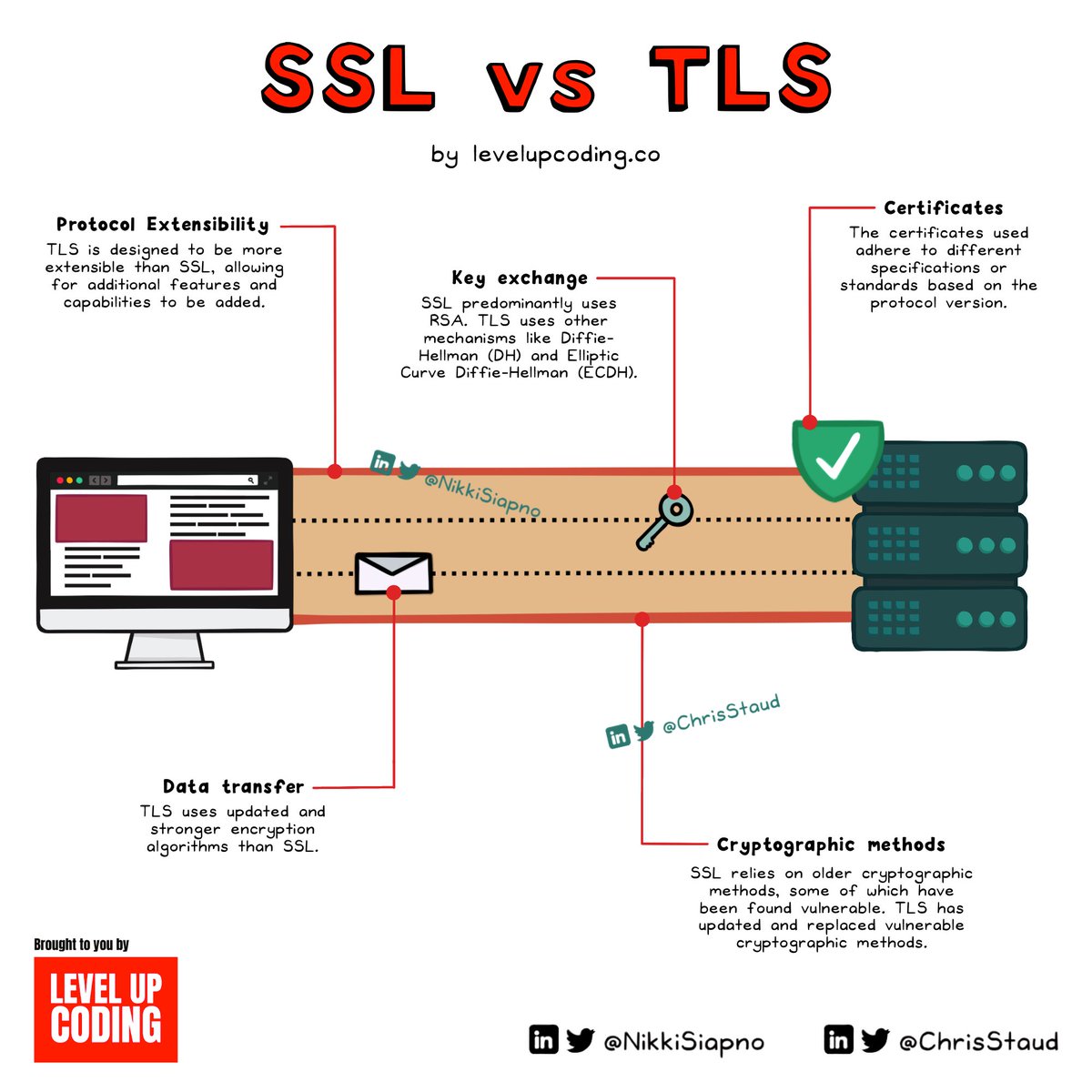
SSL vs TLS — what’s the difference?
SSL (Secure Sockets Layer) and TLS (Transport Layer Security) are cryptographic protocols designed to provide secure communication over a network. TLS is the successor to SSL and has addressed the vulnerabilities present in SSL.
To understand the differences, let’s walk through the workflow of how data is sent using these protocols:
1) Initiating communication
SSL & TLS: Before data can be sent, a connection must first be established. Both protocols work very similarly at this stage. The client and server establish a connection, usually on port 443 for web traffic (default port for HTTPS).
2) ClientHello & ServerHello messages
After establishing a connection, the client and server need to agree on security settings.
SSL: The client sends a list of supported cipher suites, and other settings. The server then sends a response selecting the SSL version, cipher suites, and other settings.
TLS: Along with supported cipher suites, and other settings, the client can also send "key share" for Diffie-Hellman (DH) or Elliptic Curve Diffie-Hellman (ECDH) (if supported). The server then sends a response selecting the TLS version, cipher suites, and other settings.
3) Server certificate
SSL & TLS: After the “ClientHello” and “ServerHello” messages have been communicated, the server sends its digital certificate to the client.
4) Key exchange
At this phase, the protocols significantly differ.
SSL: Predominantly uses RSA for key exchange.
TLS: Uses other mechanisms like Diffie-Hellman (DH), Elliptic Curve Diffie-Hellman (ECDH).
5) Client Certificate (optional)
SSL & TLS: After keys have been exchanged, the server can request a client certificate if it must validate the identity of the client.
6) Client and Server Finished messages
SSL & TLS: Once the authentication phase is complete, “Finished” messages are sent. The only difference between the protocols here is that the cryptographic computations behind the message can differ.
7) Encrypted Data Transfer
The connection has been established, settings agreed upon, and authentication has been completed—data transfer can finally begin.
SSL: Uses older encryption algorithms, some of which are vulnerable.
TLS: Uses updated and stronger encryption algorithms.
8) Termination
SSL & TLS: After the data transfer has been completed, alert messages can be sent by the client and server to terminate the connection.
Whilst SSL and TLS protocols have many similarities, TLS has overcome the vulnerabilities that came with SSL. The refined digital handshake, key exchange mechanisms, and cryptographic methods used in TLS have led to more robust encryption, enhanced security, and better extensibility.
The Hybrid Air Vehicles Airlander 10, initially known as the HAV 304, is a hybrid airship crafted by the British company Hybrid Air Vehicles (HAV). This unique aircraft features a helium airship structure along with supplementary wing and tail components. It utilizes a combination of aerostatic and aerodynamic lift principles for flight and is driven by four ducted propellers powered by diesel engines.
Using the right AI tools is like having your own personal army of robots.
20 AI tools to supercharge your productivity:
If you want tools and insights about AI, follow along for more.
Calling all fans of LIAN LI fans! Which UNI FAN is your favorite fan?
Vote for the fan you love most and go into the draw to win a set of 10 UNI FANs (of your choice!)
Bonus entries for users who share their build using #favouritefangiveaway
Enter here: https://t.co/NhseJX2Rlx
Happy Holidays! 55,000 VALORANT Points Giveaway!
To enter:
✅ Follow @M80gg & @ValorLeaks
✅ Like & RT
✅ Tag 2 friends
Ends on 12/18! Good Luck!⛄️