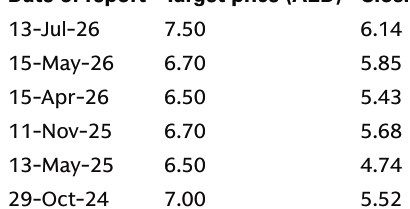
Set the six revisions against the prices that produced them — 7.70 on 6.10 today, 7.50 on 6.14, 6.70 on 5.85, 6.50 on 4.74 — and the target trails the price at a premium between 14% and 37%, clustering near 20-26%, which makes today's 26% upside closer to house convention than to a call.
My read: the rent is real and finite, the conversion into 2029 steel is the actual investment case, and the multiple stays where it is until the second one starts printing.
Diarise ADNOC Group's business plan, which management say will reset their own medium-term parameters; the November 3Q print, first with six VLCCs and five VLGCs deployed into VLCC rates already 45% lower; Eastport's contribution from 1H27; and the two attacked vessels back inside eight months.
The falsifiable marker is that 3Q print: material handling above 300kt and clean logistics EBITDA near $ 180mn. Both, and the ballast holds.
Neither, and 2026 was rent spent on hulls that arrive after the market has normalised.
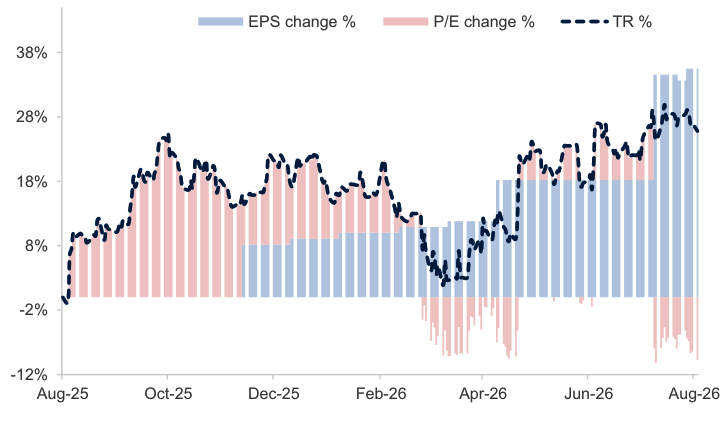
Decompose the return and the tape states it outright: about 26% total return built on EPS revisions above 35% against a P/E contracting near 10%.
Every dirham has been earned and none of it re-rated — the market marks the numbers up and the multiple down in the same session, deliberately.
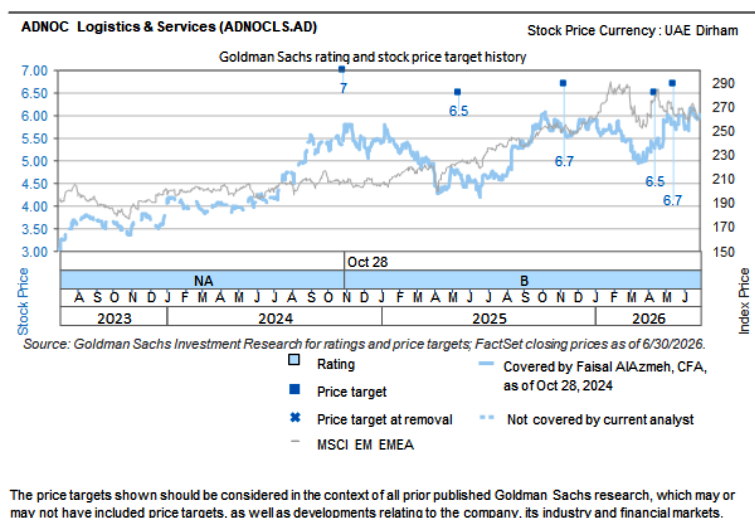
Stretch the record back and the pattern hardens: 7.00 in October 2024, down to 6.50, up to 6.70, back to 6.50, out to 7.50 in July.
A two-year round trip through a war, a tripling of quarterly profit and three guidance upgrades, ending 10% above where it began.
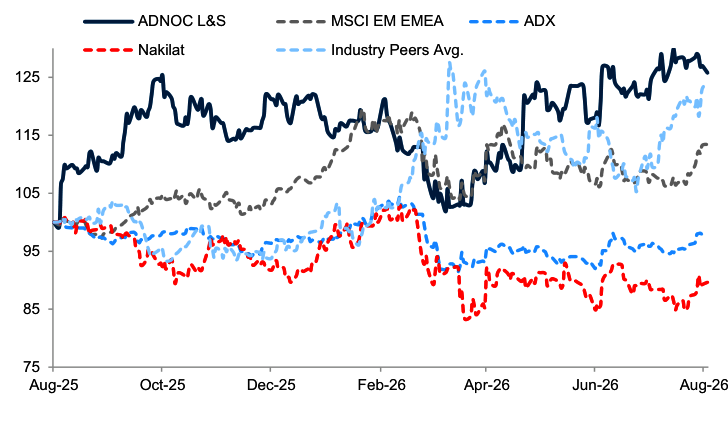
Against the peer set that spending looks like conviction: up 26% over the year with Nakilat near 89 and the ADX at 97 on the same rebased scale.
A charterer whose principal customer is its own parent beating an operator that must find its own cargoes prices a sovereign relationship, not a shipping cycle.
$GS reiterated Buy on $ADNOCLS.AD L&S late Tuesday, and its first exhibit hands you the whole argument before the report starts: FY26 EBITDA guided up mid-60% and modelled at 65%, against a medium-term CAGR of 6.3%.
A third upgrade this year that management themselves date-stamp as temporary — that isn't a growth profile, it's a rent notice, and everything after it turns on what the rent gets converted into.
Here is the tell of the whole set: the weighted spot rate quadrupling toward 400 and collapsing back near 110 inside a few months while the share price walks from roughly 5.0 to 6.0.
The market classified the rate as rent before the company did — and a multiple that declines to capitalise a windfall is precisely what licenses management to spend it instead.
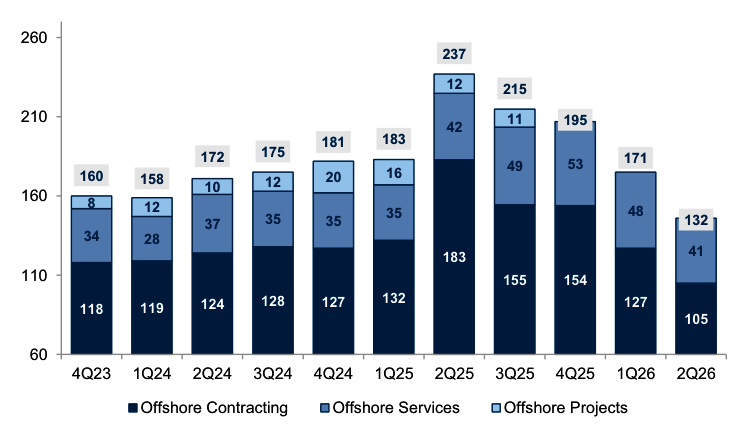
Margin says it plainer: $ 132mn against $ 237mn a year ago, offshore contracting halved to $ 105mn.
Add back the $ 27mn credit-loss charge and the $ 21mn services provision and the clean number is ~$180mn — worth having, and still below every quarter printed in 2025.
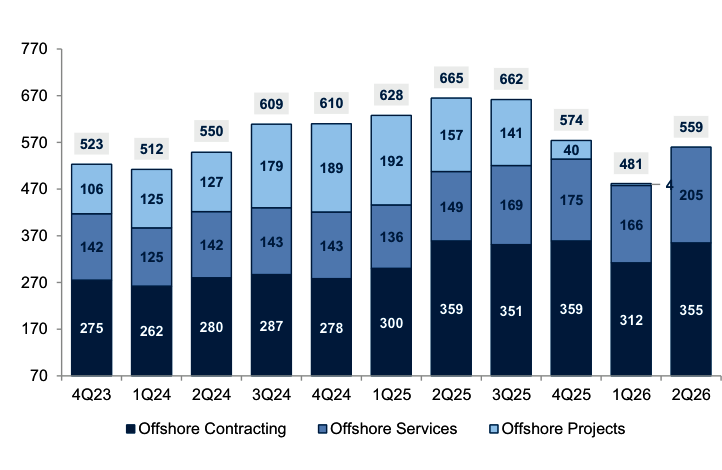
The rented barges are covering a hole: $ 559mn of segment revenue against $ 665mn a year ago, with offshore projects collapsed to $ 4mn from $ 192mn in 1Q25.
An entire sub-segment has rolled off, and offshore services growing 38% to $ 205mn is the patch over it, not the engine.
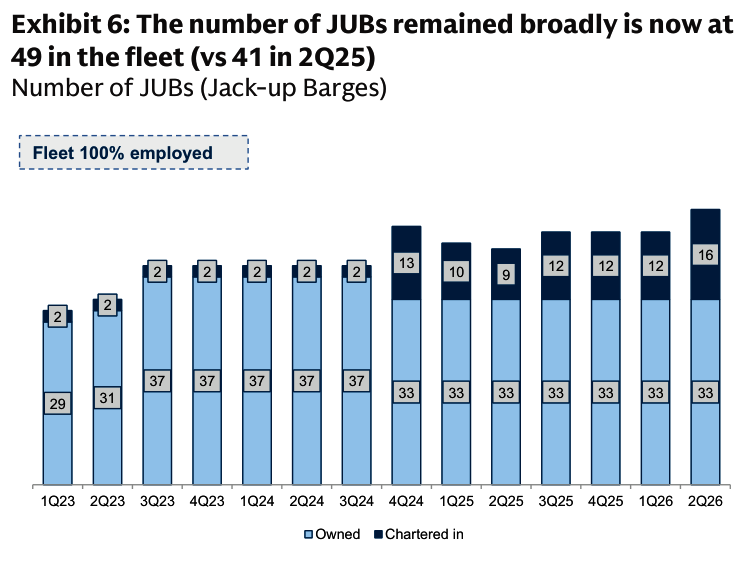
What it did choose shows in the jack-ups, and they read as the inverse trade: 49 barges in the water, but owned units pinned at 33 since 4Q24 while chartered-in tonnage goes from 2 to 16.
In shipping they own the steel and rent the earnings; in logistics they rent the steel and own the contract.
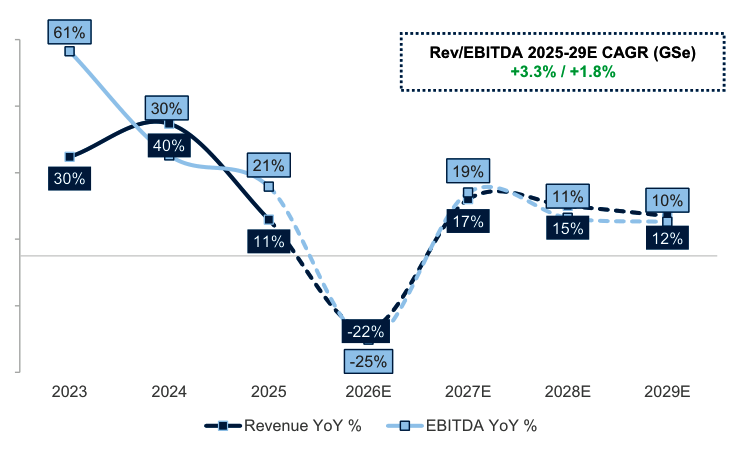
The other side of the hinge was meant to be the ballast: logistics revenue down 22% and EBITDA down 25% this year, modelled to snap back 17% and 19% in 2027 before settling into a 3.3% and 1.8% crawl to 2029.
A recovery that arrives entirely in the forecast year, after two years of disruption the company didn't choose.
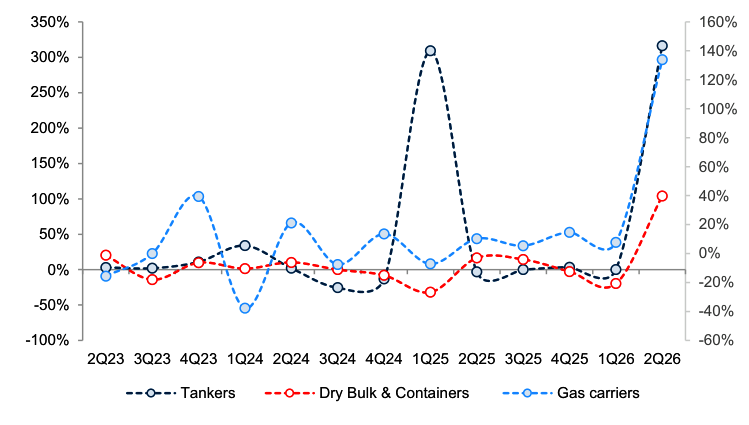
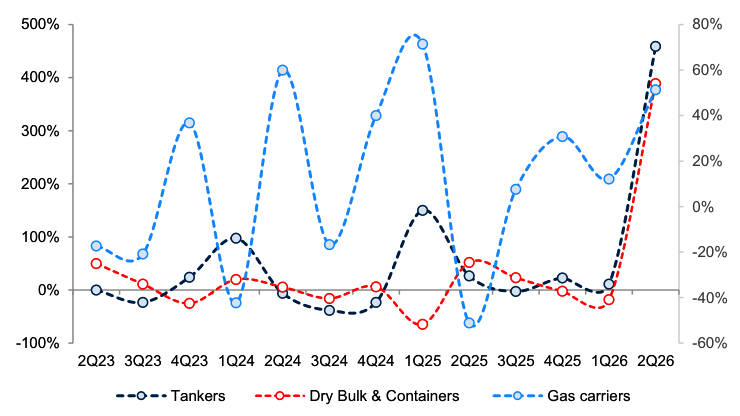
Margin follows the same asymmetry, multiplying roughly 5x quarter on quarter with tankers above 300% and dry bulk near 105%, because a rate travelling from $44,350 to $291,145 a day meets a cost base that doesn't move.
Operating leverage of that shape is a hinge, and hinges swing both ways on the same pin.
What's falling matters less than what was rising: of $1,925mn in shipping revenue, $1,695mn came from tankers on spot terms against $ 131mn from gas carriers on contracts running to 2045-48.
The line that multiplied is the line nobody has signed for — it multiplied because ADNOC needed its own molecules moved, not because Navig8 won share.
And the peak is already decaying: VLCC time-charter equivalents, the daily rate a ship clears once voyage costs are paid, are down 45% quarter on quarter so far in 3Q, with LR2 off 17% and MR off 16% and only LR1 up 12%.
Management's case is that rates fall slowly on de-escalation; the dashed segment of Goldman's own chart has them falling already.
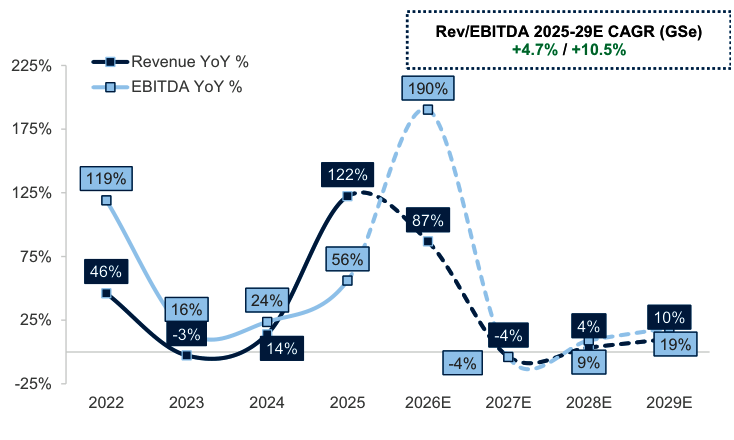
Which is why the shipping chart draws the same shape twice: EBITDA up 190% in 2026 and down 4% the following year, with the entire 10.5% CAGR to 2029 resting on delivery schedules rather than on rates.
Strip the spike and the segment compounds in single digits — the peak is the funding, not the growth.
The reason sits four rows down: capex running at 492% of depreciation this year, $2,335mn against $2,251mn of operating cash flow, which drags dividend cover to -0.3x and pushes net debt to equity from 6.5% to 15.9% by 2028.
The rent isn't funding the payout; it's funding hulls that deliver in 2029.
The valuation page answers with a shrug: a 6.8x 2026 P/E that becomes 11.5x in 2027 on the same share price, a CROCI cresting at 11.4% and fading to 6.4% by 2028, and a factor profile scoring growth, returns and multiple below the 50th percentile against both comparison sets.
Record quarter, median company.
Follow it into the P&L: $6,324mn of 2026 revenue carrying $2,494mn of EBITDA, then a modelled retreat to $5,191mn and $1,729mn the year after, EPS halving from $0.25 to $0.14 while the dividend holds at $0.05 in every forecast column.
The windfall gets booked, taxed at 3%, and sent somewhere other than the payout.