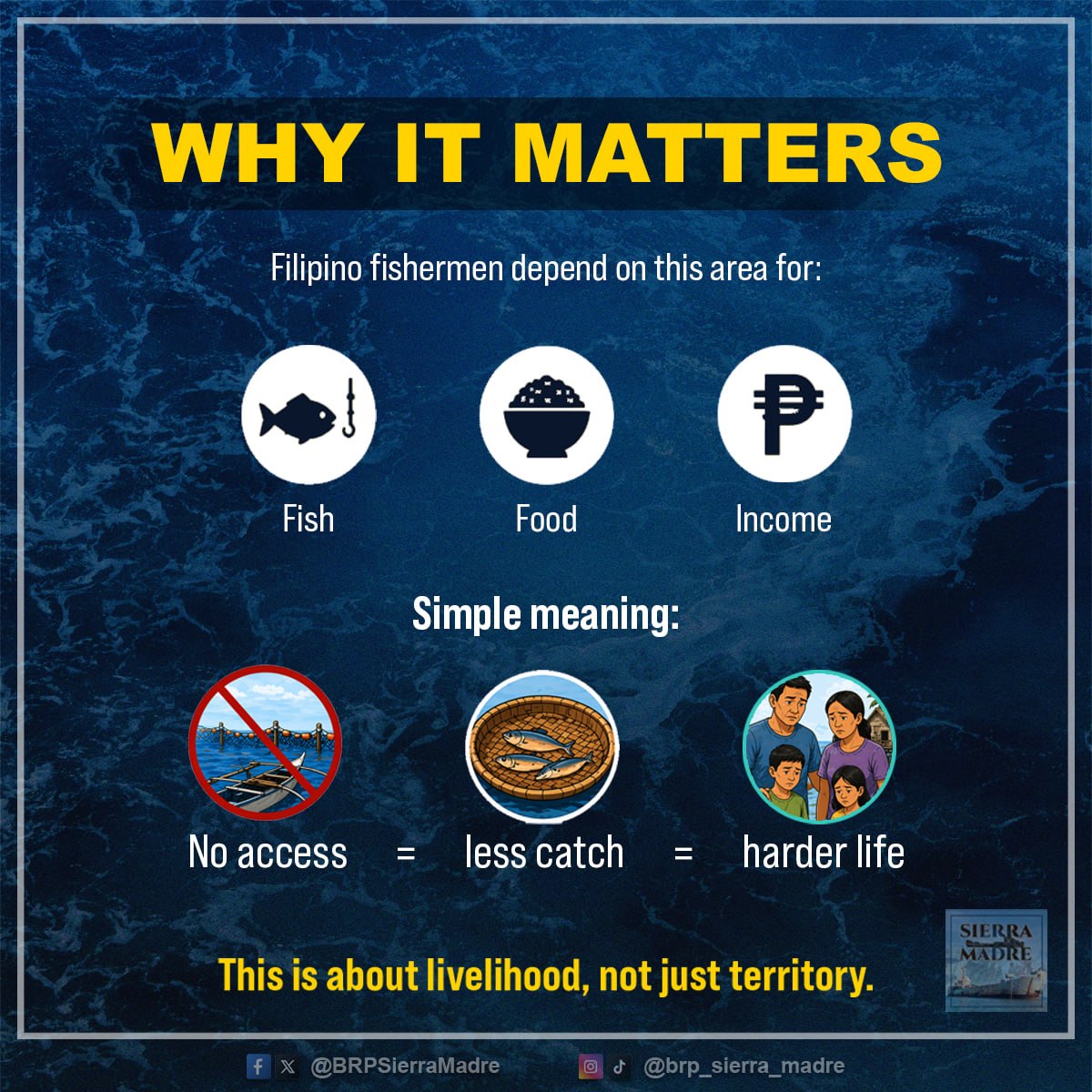
Bajo de Masinloc is within the Philippines’ EEZ, a fishing ground where Filipinos have rights under international law. A floating barrier may have been removed, but pressure can continue through persistent foreign vessel presence, and that still affects access. This is not just about territory, it’s about livelihood: less access means less catch, less income, and harder days for families. Know the map, understand the law (UNCLOS + 2016 ruling), share verified facts, and support Filipino fishermen’s right to fish safely in their waters.
#BRPSierraMadre #WestPhilippineSea #BajoDeMasinloc #StandWithFisherfolk #UNCLOS #2016ArbitralRuling #FactsNotFear #ProtectFilipinos
AYUNGIN STANDS: FACTS OVER NOISE IN THE WEST PHILIPPINE SEA
Escalation at sea, environmental threats at Ayungin Shoal, and competing narratives all point to one reality: the stakes are real. From dangerous flare incidents to confirmed risks to marine ecosystems, the situation demands clarity. The Philippines stands on law and evidence, anchored in UNCLOS and the 2016 Arbitral Award, affirming our rights within our exclusive economic zone. While some narratives attempt to distort the truth, the facts remain unchanged. Ayungin stands for sovereignty, for law, and for every Filipino who depends on these waters.
#WestPhilippineSea #AyunginShoal #KnowTheFacts #RuleOfLaw #UNCLOS #ArbitralAward #MaritimeSecurity #DefendWhatIsOurs #StayInformed
Milk, in Britain, used to separate in the bottle.
The milk was left on the doorstep by the milkman at five in the morning. It sat in a glass bottle with a foil cap. By breakfast, the cream had risen to the top third of the bottle. A thick yellow layer, sometimes two inches deep. Children fought over the top of the milk. The top of the milk went on the porridge. Whatever was left below was drunk by the rest of the family.
This was not a special product. This was every bottle of milk in the country.
The cream contained the fat-soluble vitamins A, D, and K2. The cream contained the butyrate-producing strains that feed the colonic microbiome. The cream was the point. The skim underneath was the byproduct.
Homogenisation was introduced commercially in Britain in the 1950s. By the 1980s it was standard. Homogenisation forces the milk through a valve at extreme pressure, breaking the fat globules so small that they no longer coalesce. The cream never rises again. The bottle appears uniform.
This was sold as an improvement. A consistency benefit. A shelf-life benefit.
The children of the 1990s grew up on homogenised skimmed milk, the cream of which had been extracted at the dairy and sold separately to the food industry as an ingredient in biscuits, ice cream, and ready meals. The skim was sold back to them, at the same price as whole milk, with a label reading "healthy."
The fat-soluble vitamins had been extracted along with the cream.
The children were vitamin D deficient. The children needed fortified breakfast cereal. The children needed a supplement.
The cream was still being consumed. Just by someone else, in a product labelled differently, at a considerable markup.
The top of the milk is gone.
It was taken.