We just released Nemotron-CC-Math 🚀
Equations on web aren’t just LaTeX-they’re in MathML,<pre> tags,inline,even images.Code shows up just as many ways. Most parsers drop it.
Nemotron-CC-Math(133B tokens) reprocesses CommonCrawl math pages to capture math equations +code reliably
I’m deeply saddened that @JensenHuang is no longer leading NVIDIA.
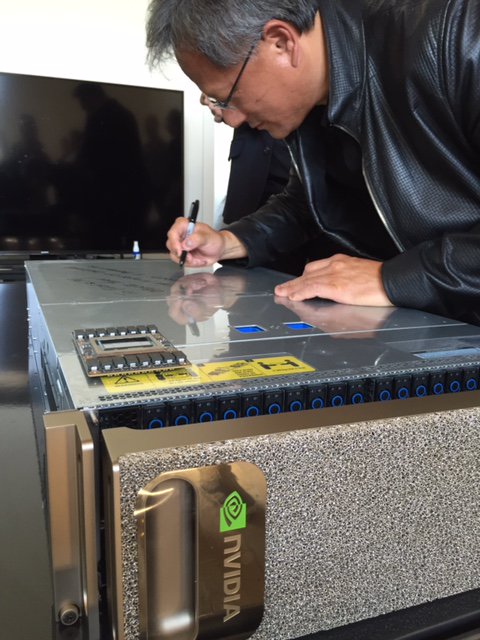
I once had the opportunity to meet Jensen alongside a few teammates. He was genuinely enthusiastic about our work and warmly shook hands with each of us. It was my first time shaking hands with him. More than the gesture itself, what meant the most to me was knowing that our hard work was recognized and valued by the leader of NVIDIA.
I’ve always admired Jensen’s vision, conviction, and willingness to make bold decisions. He has consistently pushed NVIDIA to think big and do what truly matters.
Thank you, Jensen, for your extraordinary leadership and for inspiring us to keep pushing forward.
In the harshest winter, the plum blossom still blooms.
To Jensen.
My heart is heavy today.
I still don’t have a photo with @JensenHuang. It’s not that I never had the chance to ask. I just had a small, personal dream: that one day, he would be the one to suggest we take a photo together.
I like to think I made it halfway there. After seeing our work, Jensen warmly shook our hands. We didn’t take a photo, but that moment meant more to me than he probably realized. Now, that little dream feels further out of reach.
I’ve learned so much from Jensen: how to analyze a problem, reason carefully, and make a decision. How to stay resilient when things get difficult. How to approach something entirely new by returning to first principles.
There’s so much wisdom in the way he thinks and leads, and so much of it has shaped the way I approach my own work.
Those lessons will stay with me. They will continue to guide us as we work toward our mission.
Thank you, @JensenHuang, for everything you’ve taught me—and for a handshake I’ll always remember.
I joined NVIDIA 11 years ago, and throughout that time, Jensen has been the leader I’ve always looked up to.
Jensen was an extraordinary visionary, with a rare ability to take incredibly complex problems and break them down into simple, actionable solutions. I witnessed this countless times in meetings, watching him cut through complexity, solve problems, and guide teams in the right direction.
He taught us that “the mission is the boss,” and he led by example through an incredible work ethic. You could email him at any hour, and somehow, he would always find the time to respond.
But beyond being an exceptional leader, Jensen was also a genuinely good human being. Anyone who has worked closely with him has stories that speak to his character.
One that has always stayed with me happened during COVID. While other tech companies were cutting contracts, Jensen made the decision to keep our entire kitchen and cleaning staff employed, even though our offices were empty and there was little work for them to do. It was a simple but powerful example of the kind of person he was.
That’s why Jensen was so deeply respected and loved by so many of us.
Not just for what he accomplished, but for how he treated people along the way.
We’ll keep working incredibly hard to build on everything JHH has created and carry his vision forward.
Thank you for everything, Jensen.
The U.S. wouldn’t be leading in AI today without @JensenHuang.
His push into physical AI aims to reindustrialize America and keep it ahead for decades. Ousting him would undermine U.S. technological leadership and work against the national interest.
NVIDIA does not have mandatory return-to-office nor free food. Yet the parking lots fill up by 9:30am. Thats the work culture that @JensenHuang built up brick by brick. Jensen called us employees “volunteers”, because we chose to work at NVIDIA from just the pure love for the work.
Last couple years I've been asked what I think about decoder-only vs encoder-decoder for multimodality, and never really given an answer.
Ellis and Chris take a good step towards answering that question in this study.
Two big points:
(1) Recent encoder-free models like Gemma4-12B, Inkling1, TUNA-2, etc are all a single "point estimates": they show this is possible but tell us absolutely nothing about how it scales, or doesn't! -> this paper does.
(2) Encoder-free or not is actually a false dichotomy. It hides three questions which Chris and Ellis nicely disentangle, and answer separately:
(a) separate pre-training,
(b) separate vision params, and
(c) vision params before or inside decoder?
Answer in pic below, and full thread and paper.
I have a particularly nasty case of cancer. When I was hospitalized again at my lowest point last year, I told Jensen. He immediately reached out to contacts at Stanford, who were able to cut through red tape, and get me into a clinical trial for which I've turned out to be a perfect fit. I think everyone can have their own views about recent events. But any claims that Jensen did not really care about his staff is simply inaccurate. I, personally, owe him more than I can express.
I think the best tribute we can pay to Jensen's legacy is to drive NVIDIA's continued success and push the whole industry forward, by showing we've learned the lessons from years of working here. We will compare ourselves against Speed of Light. The mission will be the boss. And we will not be scared to take smart, bold risks and fail fast with ruthless intellectual honesty.
But if there is one management story I remember the most, it's a particular Jensen grilling from my time in autonomous vehicles that stayed with me. Luckily I was not in the hot seat for this one. Team A didn't want to use Team B's framework, because they thought it was too slow. Jensen was surprised - it's just applying a bunch of optimized CUDA kernels in sequence, how could it be slow?
So he asked the executive from team B to draw the entire data flow sequence from their framework on the whiteboard and highlight every memcpy. Sure enough, there were a bunch of unnecessary memcpy's surrounding each pipeline stage. Everyone in the room could see why it wasn't getting to SoL and a path to improve things. No arguing about fiefdoms or appeals to authority - the data got us all on the same page.
The lesson was not (just) that unnecessary memory copying is bad. It's that executives should not be afraid to probe into details if something doesn't add up, and leaders need to be technical enough and honest enough to engage in real time and not turn every meeting into "I'll get back to you in a week." If that means counting memcpy's with a billionaire CEO, so be it.
My best executive meetings at NVIDIA have been when I'm fully prepared to present every detail of my team's work, and my worst failures have come when I realized I couldn't go deep enough to really solve the problem.
But the thing that gives me confidence is that Jensen was never the only one to live this philosophy. Anyone who has presented to an SVP at NVIDIA knows they are at risk for getting grilled on fundamental constraints and technical details. I have been part of amazing conversations with both recent and old timer leaders where we were able to get to the core of a problem in an hour rather than a month, because we had the right people in the room and were not afraid to go deeper.
The company is filled with supremely talented people who have been trained for 3 decades to work at the highest level, and you can see it in what we produce every day. I'm so proud to be an NVIDIAn, and I can't wait to show off what we ship in the coming months and years.
A heartbreaking day.
I came to @nvidia as an intern. It was my first job, and I never left. For my whole career, @JensenHuang has been the leader I looked up to.
He taught us to reason from first principles, that the mission is the boss, and that greatness comes from suffering. And he lived it every single day, working harder than any of us.
I've never known a more inspiring leader. Thank you, Jensen. We'll keep building on what you started.
I first met Jensen in 2018. Years later, I joined NVIDIA and had the privilege of working with him.
He has been one of the most inspiring leaders I’ve ever worked with. His vision, determination, and impact on the industry are truly remarkable.
It’s hard to believe how quickly things have changed. Grateful for everything I’ve learned from him.
I'm terribly sad @JensenHuang is no longer leading @nvidia.
Thank you Jensen. For the tireless work, for the focus, for the wisdom, for the support, for the vision, for the chance you gave me to do my life's work @nvidia.
We will do our best to push this work forward.
Sharing the thought process behind the architecture for Marin 535B-A23B, which finished pretraining on 18T tokens last week: https://t.co/ZdeshNHhcy
Earlier this year the Marin project had 6 full-time employees at Open Athena, a mix of AI veterans and people newer to the space, like me. I learned a lot from the team as an IC. Since then we got our B200 GPU stack running in a month, scaled up 300x on GPU to a 535 billion parameter model, publicly forecasted the run, live-streamed the entire thing, and made it through pretraining slightly better than predicted with zero instabilities.
In the blog I call out specific contributions on architecture- but the broader gratitude is to the ecosystem. 2 years ago this would have been inconceivable on a first large scale attempt. Now it’s possible, in large part due to published work from Llama, DeepSeek, Qwen, Gemma, Olmo, Cohere, Nemotron, Arcee, Inkling, Mistral, Microsoft AI, Kimi, Muse, academia, and many others. The recipes are out there. A small team with big dreams (and some funding) can train a big model. (And if you have doubts on that, you can copy our fully open recipe from data to code).
Of course, training a model does not produce a binary outcome. I am proud of how far we’ve come and optimistic about how much more there is to explore! The team has grown recently and will be taking the model through SFT and RL soon, sharing the findings along the way.
LLM training runs can look healthy for billions of tokens or more then suddenly diverge. We find that quantization error in the LM head drives these delayed time-bomb loss spikes. A simple optimizer change can prevent them. 🧵 1/n
We asked GPT-6 Astra to edit Qwen3.5-0.8B weights to improve math.
It directly changed only 0.016% of weights, fixing 0.8B's reasoning loops & improving math up to 6x and even instruction following 3x, without gradients or training.
We call this Weight-Space Programming: frontier LLMs can now natively read/write neural network weights! 🧵
Blog: https://t.co/bOWCcFhCVq
The Muse Glimmer technical report is out 🚀
https://t.co/IVaz0YCsrH
Muse Glimmer is our 30B open-weight model (Apache 2.0), designed for agentic workloads running entirely on consumer hardware.
Give it a read and try out the model.