@TNTJohn1717 The gentleman talking is part of an aeronautical ethusiest group based in neverda. He was in a few Area 51 documentaries in the late 90s early 2000s
I've studied money, investing, and economics for the last ten years.
Here are 12 things I teach my kids about financial success:
1. You can't just save your way to wealth, and you can outspend any income
If you only make $30k per year, it's not possible to save enough to become wealthy someday. Your cost of living acts as a floor at which you cannot spend any less. This is why penny-pinchers and misers never get rich. Saving $0.15 on gas is meaningless in the long term.
At the same time, income alone is not sufficient to build wealth, because there is no ceiling to how much you can spend. This is why lottery winners and professional athletes go broke. It is very easy to spend enormous sums of money.
What counts is the difference between the two. How much do you make, and how much of that do you save? Not in percentage terms, but in dollar terms. Do you save $1k per year? $200k per year?
The dollar difference between your income and your expenses will determine your ability to become rich.
2. Jobs are for learning, not for earning
Getting a job because of the paycheck is a doom-loop that is almost impossible to escape. The lifestyle creep from a yearly 5% raise is almost unavoidable. You'll cap your earnings by chasing the paycheck and the security.
But jobs do offer one major accelerator to creating long-term wealth: the skills you'll learn. Not only do jobs provide you the opportunity to learn money-making skills, they pay you to learn.
Especially when you're younger, there is nothing wrong with getting a job. But look at every job as an opportunity to learn a skill that will allow you to make more money in the long term.
Pay no attention to the current salary. You will feel zero difference between a starting job of $50k vs $60k. But the lifelong difference from the skills you acquire by hopping between a few $50k jobs (instead of settling into a corporate ladder) could mean the difference of tens of millions when you're older.
3. Sales is the ultimate safety net
Sales is the ability to make other people money. There will always be demand for this, no matter the economy, government, culture, or country. If you learn the skill to sell, you can always make money.
If you are OK at sales, you can make $250k/year. If you are good at sales, you can make $500k. If you are great, you can make $1mm+
4. Take risks early and often
The more time you have left in life, the less downside you have for taking risks. If you have more than 40 years left, you can recover from any financial disaster.
Recklessness is risking small gains with the chance of large losses. Don't be reckless.
Take many small asymmetric risks that have small downsides but large potential upsides.
Luck is where preparedness meets opportunity. Every fish that has ever been caught was caught by luck. But you still have to have your line in the water. The more lines you have in the water, the more chance you have to catch some of that luck.
5. Create Value
Creating value is defined as: creating something that somebody else wants badly enough that they will give you what you want in exchange for it.
When you engage in value creation, you make the world a better place. You are providing individuals (society) with something it wants, and they only have to give up something that they want less.
This practice builds the ability to see opportunities instead of problems, and find gaps in the marketplace that others cannot see.
In the beginning, the only thing you'll have that others value enough to give you something you want (money) is your time. Escape this as quickly as possible by creating value with products, services, and skills instead.
6. Your time is the most precious resource to you, yet the most replaceable resource to others
You only have 24 hours every day, 7 days every week, 52 weeks every year, and 80 years in your life. You cannot ever get back a single second that you let pass by. Time is the only truly scarce resource - for you.
However, every single person on earth also has the exact same amount of time as you do. If the only thing you have that others value is your time, you are the most replaceable resource on earth. Because any of the other 8 billion people on earth could offer the same time that you do.
No matter what you do in life, don't denominate your income with time. At the end of the day, it will always take time for you to make money. But never let time itself be the thing you trade for money.
7. Don't sacrifice the important for the urgent
Many people go through life from one urgent emergency to the next. They put the important things on the back burner for years, and spend their lives putting out fires.
Instead, make a habit out of prioritizing the important things in life, even if something else feels more urgent.
Working overtime will feel more urgent than going home on time and working on a new skill, a side hustle, or spending time with your kids. But that urgent month can turn into years, and you'll miss out on the most important things in life.
8. In 20 years, the only people who will remember you worked late will be your kids
Family is more important than all else. The family unit precedes and supersedes all nations, governments, cultures, and religions. It is the source of human connection, compassion, love, decency, drive, ambition, and strength. Ignore it and sacrifice it at your own peril.
Especially when your kids are young, the years are fleeting. Someday very soon, they will no longer need you to rock them to sleep; to tuck them in bed; to wrestle with them; to drive them around town; to answer their questions about life. You are blessed with an opportunity to have the most fulfilling responsibility a human can possibly have. Don't waste it.
This doesn't mean there will never be sacrifices. Sometimes it's inevitable, and the sacrifice for time or quality of life must be made for a better future. But it's your responsibility to make sure this is really a necessary sacrifice, and that you are not justifying your selfish desires to make yourself feel better about abdicating your parental obligations.
9. Talent is just practice in disguise
As far as all studies have ever been able to tell so far, there is no such thing as innate talent. There is only skill. Skill is built through practice and repetition.
So when you see somebody who is better than you at something, they practiced more. So if you also want to get good at it, you also need to practice more.
There is no need to be discouraged or disappointed at your progress. Simply put in the reps, and eventually you'll get there. It would be illogical for you to think you would be naturally good at something that you've never practiced before. So practice until you're good.
10. You will receive in proportion to what you give
The creation of wealth is built on the foundation of giving and generosity. Your personal wealth is only a measure of the wealth you've created for others (assuming you didn't steal it). The more you build your life around giving and serving others, the more wealth you'll build. If you think you are giving and serving, but you aren't building wealth, that is a dead giveaway that you aren't actually creating wealth for others.
Greed is a toxin that will rot you from the inside out. But the antidote to greed is not the hatred of money. The antidote to greed is generosity. If you hate wealth, the only result is that you will despise the wealthy, and you will never create wealth yourself. But if you make it your goal (and practice) to give more and more, you will see your wealth grow that much faster.
11. Readers are Leaders and Leaders are Readers
Learning skills and correct mindsets often requires a teacher. But most people do not have the social network required to know someone who can teach them all that is needed to learn about the creation and preservation of wealth.
That is why people who read the most tend to be so successful. Every book (nonfiction) is like getting years or decades of someone's expertise downloaded into your brain. While it may have taken that person a lifetime to build the knowledge they write about, it only takes you 10-20 hours to absorb it.
You have to read many books in order to find the great ones. It's a game of numbers. For every 50 books you read, one of them will be great.
When you find a great book, re-read it. Then read it again. Come back to it in a year and read it yet again. Until you feel you have absorbed everything you can (or until the book no longer seems great to you) keep coming back to it every year.
12. The Time Will Pass Anyway
If it is a skill worth learning, or a relationship worth having, or something worth building, it will take time. The things that are most important in life often take the longest time to build. Looking at something that may take 1, 5, or even 10 years to accomplish is daunting. It makes the average person give up before starting.
But the time will pass anyway.
Would you rather wake up 10 years from now with 10 years under your belt? And 10 years of progress toward your goal? Or would you rather still be at square one?
Because one of those two options is guaranteed to happen. You will wake up 10 years from now. That time will pass anyway.
So put it to the best use possible.
@PicturesFoIder Bikers. Convince me otherwise. Rules of the road.. bikers are considered a vehicle and hence must drive like one and follow the rules other motorists do.
@0xstark EOS is Ethereum On Steroids.
The name reflects the fact that the core team learned from Ethereum's amateurish naivety and idealism, and built out a team of professional top-talent software developers that created a smart contract platform with much higher scalability and speed.
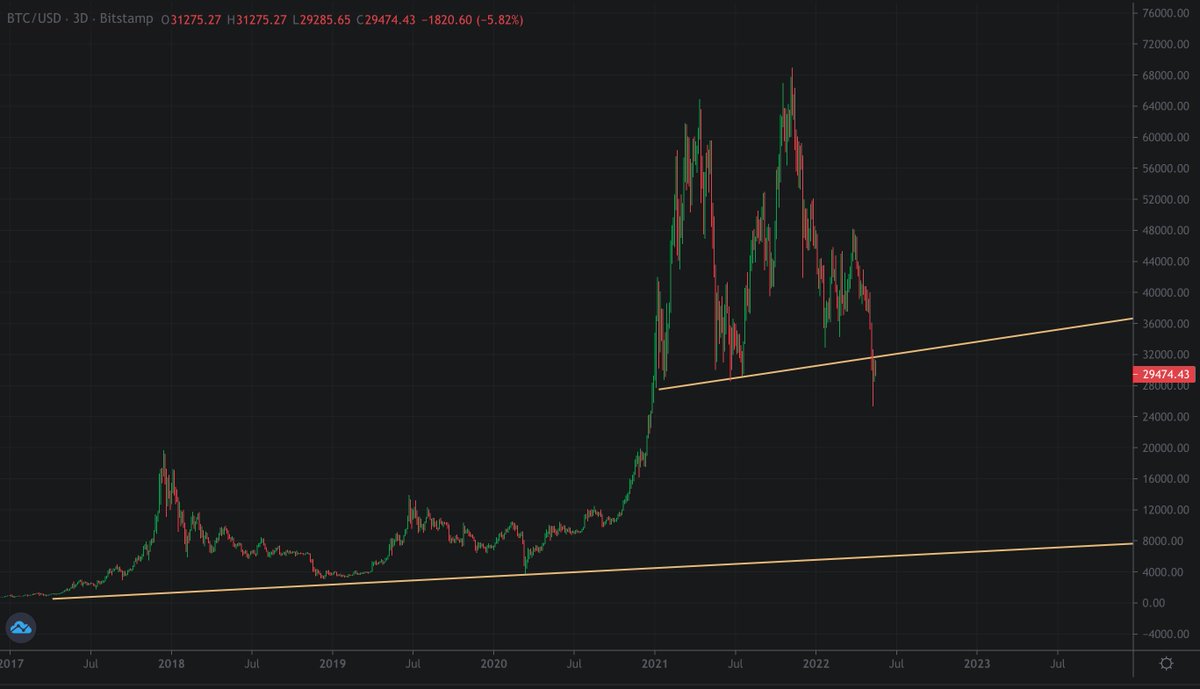
How can anyone who looks at this chart stay long #Bitcoin? Now that the upper support line has been broken, a move to the lower support line is a high probability. The chart has both double top and head and shoulders top patterns. The combination is ominous. It's a long way down!