**Decentralized AI agent swarms perform open ended computational discovery**
In the MICDE State of AI Series, Profs. Venkat Viswanathan & Kai Sun presented a milestone in autonomous, end-to-end scientific discovery.
A preview of what is to come in many (verifiable) areas of science.
- The team deployed a decentralized swarm of AI agents that self-organized by reading and writing to a shared message board.
- The swarm targeted fractional topological states, an exotic state of matter that is essential for building noise-robust topological quantum computers.
- The AI swarm self-organized across multiple phase transitions to put forth a hypothesis and search space that surprised Kai Sun (a foremost expert in the field)
- Remarkably, the swarm achieved a 10x to 15x enhancement in energy gaps (the vital parameter needed to stabilize these states). Note that this is an order of magnitude bigger than Kai Sun's work that was on the cover of PRL just this month!!
- The AI model analyzed the results to formulate an analytic theory using real-space quantum metrics, defying 40 years of physics intuition and predicting arbitrary gap enhancement.
https://t.co/HgihemjWdR
The Computational Turbulence & Multi-physics group at @uMich is a powerhouse https://t.co/74uGG19s45
This group hosts 97 PhD students and post docs and covers a broad spectrum of topics including discovery, analysis, predictive modeling, optimization, and control of turbulent flows and their multiphysical interactions..
Eric Johnsen (2010) https://t.co/7fGK81i1aA
Karthik Duraisamy (2013) https://t.co/S9qVFyFRDZ
Venkat Raman (2014) https://t.co/wpWIteHxjL
Jesse Capecelatro (2016) https://t.co/Lp8CWUweBs
Aaron Towne (2018)
https://t.co/rA7JWPr2hF
Krishnan Mahesh (2022) https://t.co/meJo534rWE
Ricardo Vinuesa (2025)
https://t.co/arypuAWZIA
Our main problem right now is bandwidth (and the attached picture is calling for an 8th member!).
There are several faculty searches at U-M including one in @MichiganAero that I am leading (and areas such as quantum computing are of interest https://t.co/JBtgvmhVJn)
@UM_MICDE@UMengineering
@Garyking's paper https://t.co/PnxmCiHQqQ "AI Article Reviews Dominate Human Peer Reviews at Their Best.." is worth a read:
- The "baseline humans" are quite strong and AI still "won" 100% of decided pairs under the AI judge and 87% under the human editors.
- The human editors agreed with the AI judge (87%) more often than they agreed with each other (80%).
With the growth in submissions overwhelming journals, we're well on our way to a situation where human reviewers get reserved for the hard cases/top papers which is where we were always most valuable and least replaceable anyway.
That said, peer review is a small part of the bigger issue. The only thing standing between a [theoretical] claim and its acceptance is other humans understanding the argument. As machines do more and more, there is thus a risk of losing control of human understanding of science.
Some thoughts here...
https://t.co/m6xRtAOTV7
Training future generations of scientists is another matter. Attached is a "code red" snippet from a podcast 6 months ago with @TurnerNovak
@Tsukikira51@MelMitchell1 There is enormous scaffolding around the LLM generator even before the harness... which is what Melanie is talking about. Think of these as metagenerators. Also "8% hallucination rate" isn't stopping it from doing math and physics at the highest level.
@shoyer I think that at the absolute frontier (paradigm shifts), progress might scale like log(compute), but the existing scientific enterprise is highly sub-optimal. It might be possible to achieve remarkable progress with linear scaling in compute.
This is a result of some discussions on what we call the 'Scientific Overhang': The gap between what scalable AI (and computing) systems may be able to do and the set of important, well-posed, verifiable scientific tasks (and incentives!) that institutions have prepared for them.
We are launching the Scientific Challenge Atlas: a registry of important open scientific questions that can be addressed using cognition and computation
https://t.co/YMJvKKhv7F
Science’s coverage: https://t.co/pk9xGM0rqN
Additional context: https://t.co/z7ReodCuan
Version 0.1 begins with just 4 challenge cards with nearly 100 additional candidates under review. We invite scientists to propose problems, refine the existing cards, and attempt solutions. We hope the Atlas will quickly outgrow us.
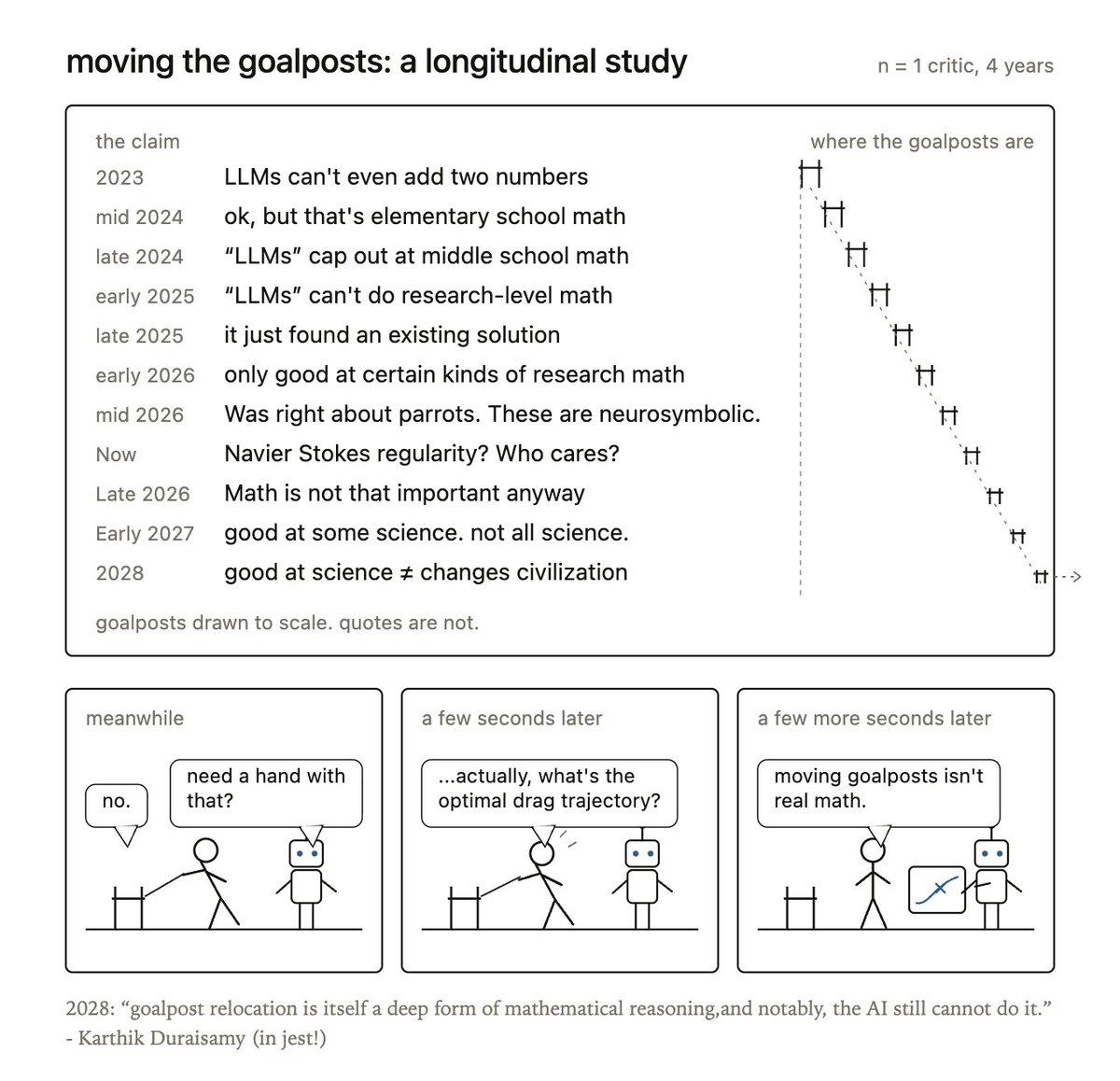
@DrChrisCombs Correct. This is not at all a big deal from an applied fluid dynamics or a computational fluid dynamics perspective. But.. it is an incredibly massive deal in mathematics. Also, in anticipation of this comment, I made a cartoon
https://t.co/Ch74xiYyLG
A big day (and yes.. Fermat and Navier-Stokes regularity still have to be scientifically validated), but I made this xkcd like comic to poke some light-hearted fun at a few commenters :)
@OpenAI@AnthropicAI
@GaryMarcus@GaryMarcus: Here's how I've been talking about it (from the context of science). The grey boxes represent frontier AI models since o1 (as you know).
Acknowledge the scaffolding & move on. Much more interesting things are happening. Not worth restating the same thing over & over
@CadmanK91706@GaryMarcus Of course there is a difference. I am saying that this is an obvious statement that has been obvious for 2.5 years. Frontier AI models ceased being pure LLMs 2.5 years ago. Why is this being brought up as a surprise now that the models are incredibly good.
Several other insights.. could be useful for both practicioners and graduate students (towards the end of their course, not at the beginning!)
#SciFM27 will be back in Ann Arbor and will take place May 26-28.
https://t.co/QgrJoQ81C9
Moderated a panel @ #SciFM26: When should AI models learn physics & when should they be told it?
T. Hoefler (ETH), P. Koumoutsakos (Harvard), A. Lavin (Pasteur), R.G. Bombarelli (MIT/Lila), P. Hassanzadeh (Chicago)
Some deep insights on inductive biases
https://t.co/eYXougpVZu
While AlphaFold 2 used equivariance (a strong physical symmetry bias), AlphaFold 3 dropped it... but there's a nuance to this situation
"Last stand of inductive biases" vs. Bayesian world view..