Rabies virus hijacks the human brain!
The rabies virus induces hydrophobia (fear of water) and aerophobia (fear of air) through host manipulation by hijacking specific areas of the rabies patient's brain. It does this to facilitate its own transmission to a new host. However, this manipulation is not perfectly effective in humans. It is more successful in dogs, resulting in violent behaviour and biting.
The rabies virus enters humans through dog saliva via a bite wound. It travels along peripheral nerves to the brain and subsequently reaches the salivary glands, where it replicates extensively, saturating the saliva with viral particles. At this point, the virus has one primary objective: transmission to a new host. It pursues this by hijacking the host's brain to induce new behaviours.
In dogs, this neural control works effectively. Infected dogs drool profusely, run wild, and bite indiscriminately, all of which facilitate viral spread. In humans, this manipulation does not always operate as efficiently, but the virus attempts it nonetheless.
After invading the brain, approximately 80% of patients develop furious rabies, characterised by hyperactivity and agitation. The remaining 20% develop the paralytic form, which presents more quietly. The virus spreads via bites laden with virus-filled saliva. It increases salivation to maximise viral load in the mouth, while spasms of the throat and larynx make swallowing extremely painful. This prevents the patient from eating, drinking, or swallowing saliva — actions that would dilute its concentration. The saliva therefore remains thick and virus-rich, optimising transmission during aggressive behaviours in furious rabies.
The virus attacks brainstem circuits governing swallowing and respiratory reflexes, specifically the neurons inhibiting the nucleus ambiguus, producing an exaggerated defensive reflex that manifests as hydrophobia and aerophobia. These are not psychological fears in the conventional sense. They are brainstem dysfunctions induced directly by viral invasion, and limbic system involvement further contributes to the hyperactivity and emotional dysregulation seen in furious rabies. This is best understood as the result of natural selection favouring viral variants that enhance host manipulation for transmission, rather than any conscious viral strategy.
Once these clinical symptoms develop, the rabies infection is almost invariably fatal.
There's a physicist at Stanford named Safi Bahcall who modeled this exact principle and the math is wild.
He calls it "phase transitions in human networks." When you're stationary, your probability of a lucky event is limited to your existing surface area: the people you already know, the places you already go, the ideas you've already been exposed to. Your opportunity window is fixed.
When you move, your collision rate with new nodes in a network increases nonlinearly. Double your movement (new conversations, new cities, new projects) and your probability of a serendipitous encounter doesn't double. It roughly quadruples. Because each new node connects you to their entire network, not just to them.
Richard Wiseman ran a 10-year study at the University of Hertfordshire tracking self-described "lucky" and "unlucky" people. The single biggest differentiator wasn't IQ, education, or family money. Lucky people scored significantly higher on one trait: openness to experience. They talked to strangers more, varied their routines more, and said yes to invitations at nearly twice the rate.
The "unlucky" group followed the same routes, ate at the same restaurants, and talked to the same 5 people. Their networks were closed loops. No new inputs, no new collisions.
Luck isn't random. Luck is surface area. And surface area is a function of movement.
The lobster emoji is doing more work than most people realize. Lobsters grow by shedding their shell when it gets too tight. The growth requires a period of total vulnerability. No protection, no armor, soft body exposed to the ocean.
That's the cost of movement nobody posts about. You have to be uncomfortable first. The new shell only hardens after you've already moved.
The KDIGO 2026 AKI/AKD draft is the most significant update in acute kidney care since 2012.
Key takeaways:
✅ AKI → AKD → CKD: the continuum is now formal
✅ Damage biomarkers enter the staging system
✅ Cystatin C + KeGFR for unreliable SCr
✅ Urine microscopy: now a formal recommendation
✅ Sick day guidance: first time in KDIGO AKI
✅ WATCH-ME: structured post-discharge follow-up
⚠️ Still a public review draft open for feedback until April 27, 2026.
KDIGO 2026 AKI/AKD Public Review Draft · March 2026
https://t.co/DEwi4BAONn
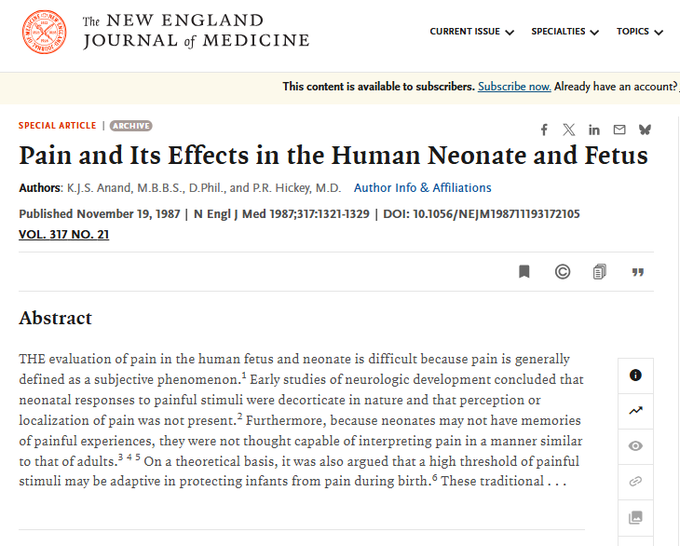
Infant surgeries were routinely performed with minimal or no anesthesia because anesthetists wrongly believed infants felt no pain due to their immature nervous systems, dismissing their responses as mere reflexes. This barbaric practice persisted until 1987, when Dr. Kanwaljeet J.S. Anand and Dr. P.R. Hickey published their groundbreaking research in the NEJM, demolishing those outdated myths.
In 1985, Dr. K.J.S. Anand had reviewed preterm neonatal surgeries and the results were shocking. He found that 76% used only muscle relaxants. This left infants awake, aware, and paralyzed during painful procedures.
In 1987, the article “Pain and Its Effects in the Human Neonate and Fetus” appeared in the New England Journal of Medicine. It combined clear evidence on pain perception in fetuses and newborns. This work changed medical practice. It led to global reforms in pediatric anesthesia that required proper pain relief for infant surgeries. The paper has been cited more than 2,700 times.
Renuka's father passed away before she turned 3. He was such a cricket tragic that he named his son Vinod after Kambli. Renuka's mother encouraged her to take up the game despite being from a village in HP. Renuka showed her CWG Bronze to all the girls in her village. She will
Devastated and deeply shocked to share that @AkshayaS90 my good friend and classmate from @IIMAhmedabad is now no more :(
Passed away in a freak accident this afternoon. She was popular on X for her #AkshayaAsks quiz questions and she has tweeted something even just 5 hours ago :(
Om Shanthi 😓
Why does sugarcane taste so sweet in India today? India’s sugarcane wasn’t always this sweet. The reason it tastes the way it does today goes back to the stubborn brilliance of one woman who fought prejudice, doubt, and even war. Thread.
1/19
England found themselves in these positions in the last two Tests and won neither. Magnificent fighting effort from India, deserved a series draw at least given the way they played.
#ENGvIND