Good morning! Just got to know this!
1/2 A whole government Ministry is unleashed on me - because I speak against unscientific practices and primitive traditional healthcare that can harm, I communicate scientific information for public and patients alike.
This was an official memo released during the Ministry of Ayush meeting on 12-6-2026 fully dedicated towards shutting down my social media presence.
Imagine - the people in this meeting were eating biscuits and drinking tea, paid for by the citizens of the country - to decide how to gag and shutdown a citizen doctor who educates people on medical science via social media.
Yesterday, my Instagram account was briefly hacked, but I got back control and removed unauthorized access within an hour.
The Article 51A(h) of the Indian Constitution outlines the fundamental duty of every citizen to develop a "scientific temper, humanism, and the spirit of inquiry and reform". Added during the 42nd Amendment in 1976, this non-justiciable directive promotes logical reasoning, critical thinking, and rationality.
The Ayush system is not scientific, it kills scientific temper, it does not promote the spirit of inquiry, it lacks logical reasoning, has the deadest version of critical thinking and none of its products and practices are rational.
The only thing that needs to be shut down, is an unscientific body like Ayush that goes against the Indian Constitution and wastes public tax money... and not me.
Also, please look closely at the person at the end, who is copied to, by the Ministry. His name is Vaidya K P Manikandan and he is the owner and founder of CNS Ayurveda Hospital, where children are treated for chronic conditions such as severe mental health disorders, autism and epilepsy (please see an official release from the hospital in the next post). One such victim of his was saved by my team (we reported it: https://t.co/eXeWt2n6N7) and he put a criminal defamation case against me and the authors (for publishing a scientific peer reviewed paper!) which was later "stayed" by the High Court of Kerala.
This has nothing to do with service to patients, but everything to do with protecting the business of alternative medicine (especially Ayurveda). These low life complaintants should be ashamed.
Sharma's son has been tragically killed in the same region where he bluntly and openly wanted a comprehensive genocide of other innocents by Zionists. His son was killed in a war of choice by those he so admires. Hate begets hate. Violence begets violence. There could not be a starker example.
#Genocide #Gaza #IranWar
A booth in Bengal's New Town with 88% Muslim voters recorded 97% votes for BJP, handing BJP the seat. CPI(M) got 1 vote, TMC 5.
'This is an impossible result, where did our votes go?' ask locals. @shinjineemjmdr@Onkeyta_ & @Holytripper heard them.
https://t.co/SM8Tbvi20v
Modi ji said that foreign trips should not be undertaken so that dollars can be saved.
On the other hand, a Union Minister is taking 75 judges and senior lawyers on a six-day trip to London.
The Chief Justice, who likened the youth to cockroaches, was also with them.
NEW: Earlier this year, an obscure startup in Texas announced that it had received at least $100 mil from one of the richest men in Asia.
We dug into the backstory. We discovered a saga involving Donald Trump Jr., Russian oil, and an Indian billionaire family’s private zoo.
44 सेकंड में बच्चे को 10 छड़ी मारी गई है..
मध्यप्रदेश में महर्षि संदीपनी वेद विद्या प्रतिष्ठान में
टीचर नामदत्तादास शेवड़े एक बच्चे को सिर्फ इसलिए पीट रहे हैं क्योंकि वह किसी दूसरे के बिस्तर पर जाकर सो गया
बच्चों को डराना था समझाना था तो दो बार मार लेता लेकिन यह तो जानवरों की तरह पीट रहा है
दिल्ली अग्निकांड में लाखों रुपए के गद्दे बिछाकर 8 लोगों की जान बचाने वाले रियाजुद्दीन और अरमान मंसूरी कह रहे हैं कि हमारा जितना नुकसान हुआ था, उसकी भरपाई हो गई है। इसलिए अब हमारे बैंक खाते में कोई भी व्यक्ति पैसा न डाले।
देश में ऐसे भी लोग होते हैं, जो ईमानदारी की मिसाल कायम करते हैं। वरना बैंक खाते में आया पैसा किसको बुरा लगता है।
Anand Patwardhan’s Award-Winning Film ‘Father, Son and Holy War’ Removed From YouTube
While Patwardhan appealed YouTube’s decision to take down the film, he said the platform rejected his review request within 15 minutes.
@kachamangobite✍️
https://t.co/HQ41OqzrLj
Long Post
CJP: The Safety Valve.
Reading various comments and reactions to the CJP over the last few weeks, from across the political spectrum, I have been baffled to discover that some of the most well-meaning commentators seem to have missed a rather simple but fundamental point. After more than a decade of BJP rule, any meaningful change in the functioning of the ruling dispensation and the institutions that operate under its influence can only come about if it is defeated electorally and removed from power. At this point, anything short of that remains manageable for the regime.
At the outset, therefore, I want to underline my position clearly: any desired transformation in the conduct of the government and the institutions it controls can only emerge through an electoral defeat of the ruling party. The vast resources at its disposal and the combination of political ruthlessness and religious hyper-nationalist fervour that sustains its support base make it exceptionally resilient to other forms of pressure.
It is also important to recognise that the notion that personal suffering or loss will eventually compel people to reconsider their political preferences has been repeatedly disproven. The avoidable tragedies associated with the COVID-19 pandemic, the Kumbh Mela, recurring train accidents, the demolition of homes and marketplaces through bulldozer actions, collapsing bridges and billboards, and countless other major and minor disasters have not significantly altered electoral behaviour. If the loss of a loved one has failed to produce such a shift, it is difficult to believe that lesser grievances will do so.
What is often overlooked in these discussions is that the BJP's political success over the past decade has not been confined to electoral victories only. Equally significant has been its success in reshaping the very terrain on which political contestation takes place. One of the most effective strategies employed by the ruling dispensation has been the gradual delegitimisation of politics itself. Through a sustained rhetorical campaign, the act of raising questions, demanding accountability, or criticising the government has increasingly been portrayed as "doing politics" in the pejorative sense of the term. As a result, politics has come to be associated not with democratic participation and public debate, but with opportunism, disruption, and bad faith.
The consequences of this shift have been profound. Public tragedies, administrative failures, and institutional shortcomings are increasingly insulated from political scrutiny through appeals not to "politicise" them. Any attempt to hold the government accountable is dismissed as an opportunistic effort to exploit suffering for political gain. Ironically, this insistence on keeping certain issues "above politics" is itself a deeply political act, for it determines which questions may be publicly debated and which must remain beyond scrutiny. The outcome is a political environment in which state failures are depoliticised while manufactured controversies and cultural anxieties are elevated to the centre of public discourse. This transformation has also altered the nature of protest movements. Increasingly, citizens feel compelled to insist that their protests are "non-political" or "above politics" in order to secure legitimacy and public sympathy.
It is no longer merely the ruling party or its supporters who argue that opposition parties should stay away from protests; citizens and protest organisers frequently make the same demand. During the anti-CAA movement and the farmers' protests, for instance, opposition leaders were often discouraged from visiting protest sites or addressing gatherings, out of concern that their presence would "politicise" the movement or allow them to derive electoral benefit from it. Similarly, protests against GST in Surat and several other issue-based mobilisations consciously sought to distance themselves from formal opposition politics in order to preserve an image of neutrality.
The result has been a steady shrinking of the public space available for oppositional politics. Unlike earlier moments of mass mobilisation, where civil society groups and opposition parties often worked in tandem, many contemporary protests consciously exclude political actors or discourage their participation. While such decisions may arise from understandable concerns, they also contribute to the broader marginalisation of opposition politics and weaken the capacity to translate public discontent into sustained political challenges. A protest that refuses politics may generate awareness and moral pressure, but it often struggles to convert that energy into institutional or electoral consequences.
While it remains to be seen how the CJP evolves, I fear that it may inadvertently reproduce many of the same tendencies. In its effort to maintain political independence and moral credibility, it may choose to distance itself from established political parties and opposition formations. In doing so, it risks severing itself from the very organisations that possess the ground-level networks, organisational capacity, and political reach necessary to translate the anger and frustration of the youth it claims to represent into meaningful electoral outcomes. Public discontent, however widespread, does not automatically become political change; it requires institutions capable of converting social energy into political power.
The second possible outcome is the well-trodden path of attempting to create a new political formation in the hope of offering an alternative to the existing regime. This, in my view, would be an even greater mistake. The experience of the anti-corruption movement and the subsequent emergence of the AAP should serve as a cautionary example. Whatever its original intentions, the creation of a new political outfit in the current conjuncture would likely do little more than fragment the anti-BJP political space further. Rather than weakening the ruling regime, it would add another layer to the already complex landscape of intra-opposition competition and contestation.
Having said that, it is difficult not to notice the relative ease with which this movement has been permitted to organise itself and occupy public space. Over the past few weeks, political organisations such as the NSUI and the IYC have been mobilising around many of the same issues; their protests have largely been met with the familiar repertoire of state repression that is water cannons, mass detentions, barricading, and, in some instances, violent lathi-charges. Similar responses have been witnessed in the recent workers' protests in Noida and in numerous other mobilisations that, in one way or another, posed a direct political challenge to the ruling regime or threatened its electoral support base.
Against this backdrop, the state's comparatively restrained response to the CJP protests appears noteworthy. Whether intentional or otherwise, the impression created is that the government has been willing to allow a controlled expression of public anger and frustration. This is not to question the sincerity of the protesters or the legitimacy of their grievances. Rather, it is to draw attention to the political consequences of a protest that remains detached from organised opposition politics.
One possible reading is that permitting such a movement to gather momentum serves as a mechanism through which public anger can be channelled, expressed, and eventually exhausted without being translated into a broader political change. In other words, the protest functions as a safety valve: citizens are allowed to vent their frustrations, but in a manner that remains disconnected from the electoral arena where political power is actually contested. The anger is real, the grievances are real, but the pathways through which that anger could be converted into electoral costs for the ruling party remain blocked.
Finally, the farmers' protest concluded just before the UP Assembly elections, following the government's decision to repeal the three farm laws. By that point, more than 700 farmers had reportedly lost their lives, thousands had endured months of hardship, and numerous protesters continued to face police cases. Given the scale of the mobilisation and the sacrifices involved, many political commentators argued that the movement would have significant electoral consequences for the BJP, particularly in western UP, one of the regions most deeply affected by the agitation.
The results, however, told a different story. Despite widespread expectations of an electoral backlash, the BJP largely retained its political dominance in the region and, in some constituencies, even increased its vote share. This outcome should caution us against assuming a straightforward relationship between public anger, successful protest movements, and electoral behaviour. The fact that a government is compelled to concede to a movement's demands does not necessarily translate into a corresponding shift in voting patterns.
This raises an important question in the context of the present movement. Suppose, and it remains a very large supposition, that sustained public pressure eventually compels the Education Minister to resign and the immediate objective of the agitation is achieved. What follows then? Will such a victory lead to a meaningful reassessment of political loyalties and electoral choices among those participating in or supporting the movement? Or will it instead reinforce the comforting but ultimately misleading belief that the government is responsive to public demands and capable of self-correction without any broader political consequences?
#cjp #cjp_protest
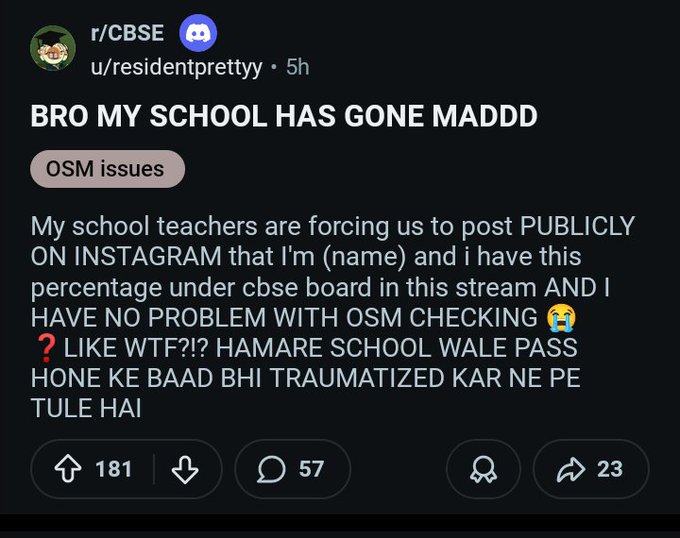
Instructions have been issued by the Ed ministry and CBSE to schools to record videos of students praising the on screen marking system and post them on school social media handles. After completely mismanaging the entire system, CBSE has now shifted into shameless PR damage control mode, as if manufactured appreciation can erase public anger, confusion, and institutional failure.
Forcing schools and students into staged praise campaigns after such widespread criticism is honestly pathetic. Instead of answering serious questions, fixing loopholes, and taking accountability, they are busy manufacturing positive optics for social media. This is not how an education system behaves. This is how insecure institutions try to bury failure under propaganda.
My overall percentage increased from 84% to 91% after the correction of my Chemistry paper.
That’s how serious answer sheet errors can be. Many students with low marks may be blaming themselves, while the real issue could actually be an evaluation mistake or checking error.
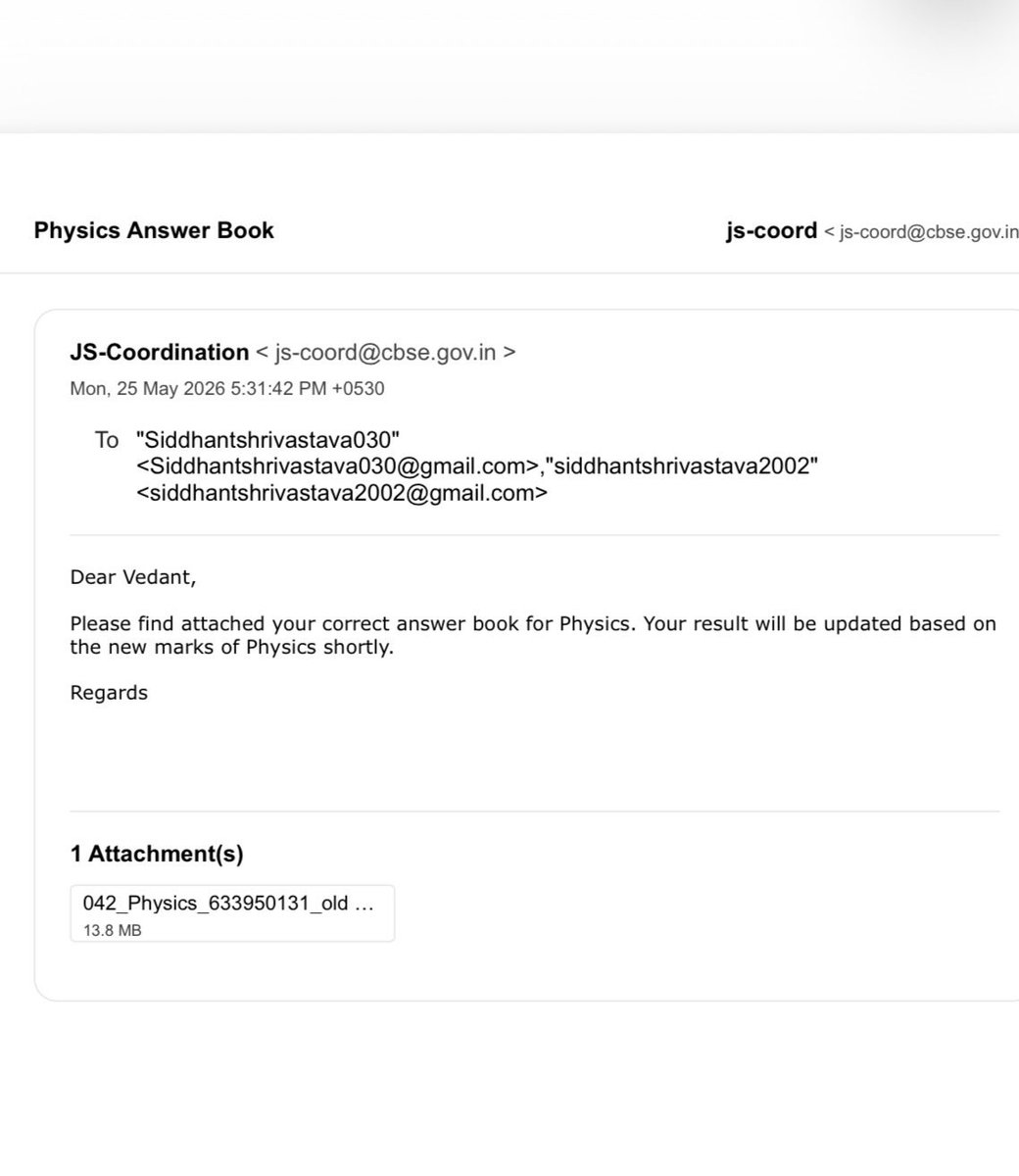
JS-Coordination wrote to Vedant today attaching his correct answer book and confirming that
-The error was real.
-The student was right.
For all those who thought a young 12th class student was a ‘Pakistani’ - Govt of India doesn’t think so. CBSE has accepted the mistake and issued him his answer sheet.
https://t.co/f5Fhi8vzeR
We got to know from abp news that cbse will take necessary actions to resolve this issue we will coordinate with them for the next steps thankyou abp news and @Ajatikaa for raising this issue
I studied for an entire year.
I sacrificed sleep, peace of mind, outings, everything for these exams.
And now I don’t even know whether MY actual Physics paper was checked.
Do students really deserve this?
I am a CBSE Class 12 student.
After receiving unexpectedly low marks in Physics, we applied for photocopies of my answer sheets through the CBSE reevaluation process.
Today we received the copies.
And I am shattered because the Physics answer sheet uploaded by CBSE is not mine
If Rubio knew the history or architecture, he wouldn't have posed for a picture here. This monument was built out for the love of emperor's Iranian wife, crafted by the genius of Iranian architects — meanwhile his government today threatens to wipe out Iranian civilization, insulting other civilizations.
Watched a beautiful video today of a person in crutches selling American Sweet Corn in a unique way. We can see such things only in Bharat. Sand used brilliantly.
He sells Bhutta in Balco Market, Patparganj ❤️❤️❤️ But with a Twist.
Let's share this Widely. If anyone visits IP Extension, say a Hello to Him from FI. Inspiring.
Radhe Radhe 🔥🔥🔥
#FI