The quote's not direct but it sums up the video. I can't imagine a sorrier end to this farce. He's clearly saying what was demanded as a condition for his deal. Complete capitulation, this lives up to the worst of memes of him bowing down to the mullahs.
Anyone with an ounce of self-esteem should feel shame to be governed by such a shell of a man.
Vance is a tool. Frankly, with “allies” like us, who needs enemies? That’s the reality Israel, and everyone else, needs to wake up to. https://t.co/i6AmBZrkLA
Welp, I think we're done here.
Trump himself is now saying he buckled under the pressure of Hormuz.
It's as bad as it could possibly be. He's saying aloud that Iran can have anything it wants because America can't afford the staring contest.
If this is his own explanation in his own words, then the fact that the sanctions relief is front-loaded...suddenly becomes important. The fact that the inspections regime that will verify compliance will be negotiated by an American side that has already admitted defeat, that needs this more than the opponent needs it...is now significant. And the fact that the proxy system is now recognized as legitimate by the United States -- is suddenly exactly the disaster you feared it might be.
And the fact that America has declared aloud that it's not actually capable of imposing its will even in the world's most vital energy chokepoints, causing its allies in the Gulf to already begin to seek a new accommodation with Iran -- makes all of this worse than Obama and worse than the JCPOA.
Remember: the great unfixable flaw of the JCPOA that none of its boosters ever had a good answer for was that it merely kicked the can down the road. It solved nothing.
Trump's deal, as of this moment, is not even close to accomplishing so much.
"Iran never won a war and never lost a negotiation," Trump famously said of Obama's deal (as a reporter reminded him at today's press conference). Ironic that the Iranians would win a negotiation most spectacularly against a man who styles himself the greatest negotiator to ever grace the White House.
So what does it all mean?
It means that in the coming years, nuclear programs will sprout like mushrooms after the rain throughout the Middle East. It means that many nations will now build out new and larger ballistic missile arsenals.
It means that the state system will give way before the march of the region's transnational ideological axes. Minorities will again be trampled, new wars will be fought by stronger states to dominate the power vacuums within weaker ones.
You're thinking of Israel in Lebanon -- but that's just a specific campaign against a specific enemy. Think Turkey, which right now occupies a region of Syria vastly larger than Israel's presence in Lebanon. Think heightened Iranian support for the Houthis in Yemen and a new influx of money and guns to the different sides in Libya.
It means, in other words, that we will have a few more wars to fight, a few more technologies to invent to deal with this new age of cheap missiles and drones -- and also of supersonic Chinese missiles bearing nuclear warheads that Iran will eventually, inevitably, be capable of deploying against us.
And it didn't have to be this bad. (And maybe, when he's heard all the criticism, it won't be.) He could have left something, anything, to concede later. He could have kept the Iranians a little bit in the dark, just a smidgen, as to just how defeated America feels.
Israel's position in all this is simple, and more or less unchanged from last week. America gave us more than we had a right to ask for. But we may be going it alone from here out.
Dust off the nukes. Maybe test one somewhere far away from anywhere. Quadruple the interceptor production lines, double the size of the Mossad and the Air Force. And no, don't let Hezbollah breathe, not for a second.
It's the 1960s again. And Israel will have to defeat a couple more enemies before it can once again eke out a few decades of peace.
Capitalism doesn’t dictate how people must act, and it doesn’t demand that anyone be sacrificed to someone else’s sad story.
It doesn’t promise to abolish every hardship by force. It refuses to treat need as a moral claim on another person’s life.
What capitalism does is leave people free.
Free to earn.
Free to invest.
Free to build.
Free to help those who try and still fall short.
If someone expects an economic system to command compassion, confiscate virtue, and centrally “solve” human suffering, they’re not criticizing capitalism. They’re demanding coercion.
And coercion doesn’t end homelessness.
It just destroys the freedom and productivity that make help possible in the first place.
Collectivism is a cancer.
True oppression begins when you judge people as part of groups instead of as individuals.
The Constitution exists to limit the power of society over man.
That is the foundation of America and we must preserve that notion over everything else.
"Do not make the mistake of the ignorant who think that an individualist is a man who says: 'I’ll do as I please at everybody else’s expense.' An individualist is a man who recognizes the inalienable individual rights of man — his own and those of others. " --Ayn Rand
The real question isn’t “why wouldn’t you want universal healthcare.”
It’s why should you want something labeled “free” that can only exist through force.
There is no such thing as free healthcare. Doctors don’t work for free. Nurses don’t. Equipment isn’t free. Buildings aren’t free. Someone pays, and under “universal” systems that someone is whoever the state can extract from, regardless of consent.
So the honest questions are:
By what right does the state seize one person’s income to pay for another’s care?
Who decides what care you’re allowed to receive, and when?
What happens when demand exceeds supply, as it always does when price signals are abolished?
Why should access to medicine depend on politics instead of choice?
Wanting healthcare is universal.
Wanting forced provision is not morally neutral.
If healthcare must be coerced, rationed, and bureaucratically controlled to be “universal,” then the issue isn’t confusion. It’s whether you believe need creates a claim on other people’s labor.
That’s the question people keep dodging.
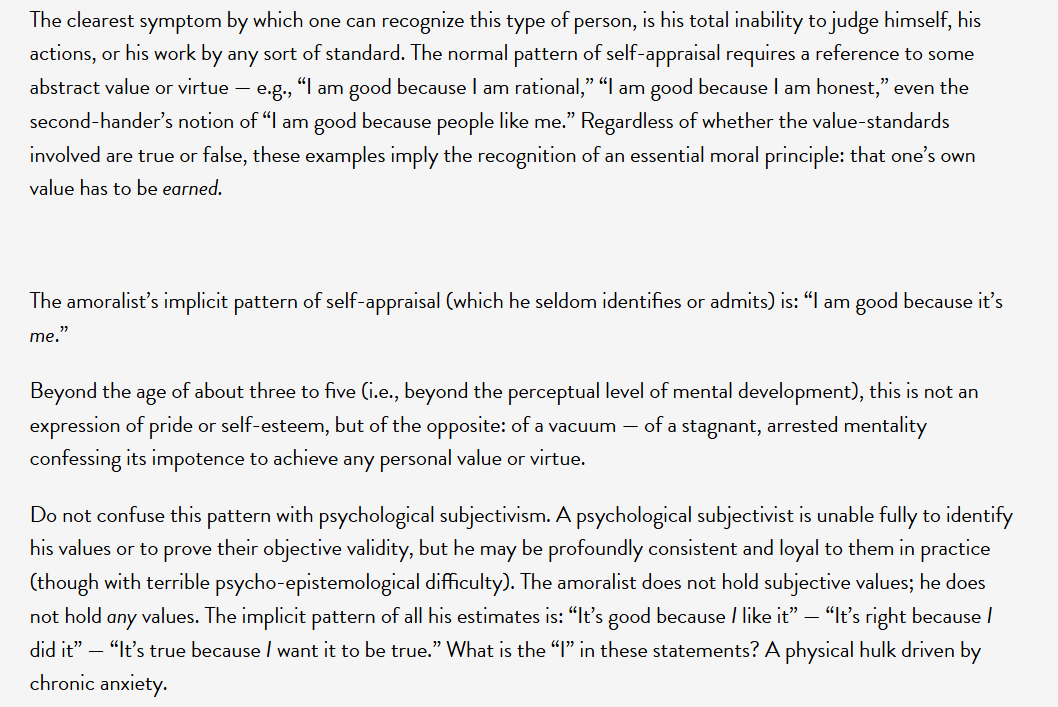
I've said it before, I'll say it again. Donald Trump is the living embodiment of tribal lone wolf type of amoralist skewered by Ayn Rand in this essay. Far from caring of nothing but himself, he has no self to care for.
https://t.co/vQ9v2pADKh
The West can’t keep ignoring the threats of jihadism and antisemitism. My heart goes out to the families of the victims of the Bondi Beach attack. May their memories be a blessing.
Capitalism doesn’t assume humans aren’t greedy. It assumes they are and refuses to give them power over others.
That’s the point.
Greed under capitalism is constrained by consent. You only get richer by offering something others voluntarily choose to pay for. If you stop providing value, the money stops.
Greed under collectivism is unconstrained. It’s backed by force. You get resources whether you create value or not, so long as you can moralize need or capture political power.
Also, capitalism doesn’t pit competition against cooperation. Competition is how we discover who can cooperate best. Every successful business is a massive act of cooperation with customers, workers, suppliers, and investors. It just isn’t coerced cooperation.
And the claim that capitalists never give back is empirically false. Private charity, philanthropy, reinvestment, and voluntary aid explode under capitalist systems and collapse under socialist ones.
What you’re really saying is this:
You don’t trust individuals to choose generosity. You trust the state to enforce it.
That isn’t moral. It’s just replacing voluntary cooperation with compulsory obedience.
It isn’t “Nationalists vs Communists.”
It’s two versions of the same idea fighting over who gets to own you.
Both say the individual exists for the group. Both demand obedience. Both punish dissent. One worships the nation, the other worships the class.
Your problem isn’t communism. Your problem is individualism, capitalism, and freedom. You’re not trying to defeat collectivism. You’re trying to replace it with a brand that feels more familiar to you.
Calling it nationalism doesn’t change the principle. If the group comes first and the individual comes second, you’re on the same side as the communists. Just arguing about the flag color.
The real conflict isn’t left vs right or nationalism vs communism.
It’s collectivism vs liberty.
And collectivism always ends the same way.
Fascism didn’t fail because communism defeated it. It failed because both shared the same moral disease.
Strip away the flags and slogans and you find two systems built on the same premise: that the individual exists to serve the collective. One calls it the nation, the other the proletariat, but both mean obedience, sacrifice, and the denial of self.
Economically, both replaced voluntary exchange with command. They treated wealth as something to seize, not to create, and power as the only true currency. The result was inevitable: stagnation, corruption, and collapse.
Morally, both declared that need or duty overrides rights, and that man’s life belongs to others. And that idea, no matter how it’s packaged, can only end in coercion and decay.
The only genuine alternative, and the only system that has ever lifted humanity is capitalism: a moral and economic order based on consent, trade, and individual sovereignty.
Fascism and communism aren't opposites. They are mirror images, each proving the other wrong in the same way: by destroying the freedom they feared.
It is so painful to watch the Trump admin pull the football out from in front of Ukraine over and over again.
Trump is not on Ukraine’s side and the sooner everyone comes to terms with that the better.
If Amazon’s CEO Andy Jassy gave up his entire $40.1 million compensation and split it among all 1.56 million Amazon employees, each worker would get about $25.78 extra for the whole year.
That’s roughly one cent more per hour ($25.78 ÷ 2,080 hours ≈ $0.012 / hr).
So if he worked for free, the average Amazon worker’s pay would rise from, say, $20.00 to $20.01 an hour.
It’s a perfect snapshot of how little “eat-the-rich” economics adds up to in reality. Envy doesn’t fund prosperity, production does.