@RokoMijic@allTheYud The Pulgas Water Temple! Crazy to see my wedding venue with a presumably-AI-aged Yud (though honestly I can't quite see the resemblence, maybe I'm just not good at imagining folks in 30 years)
@Nition@pangram This is cool, glad you're doing it.
I imagine there are probably some false positives, but I know of exactly 0 verified examples.
Thanks for putting money on the line to turn absence of evidence into decently-strong evidence of absence.
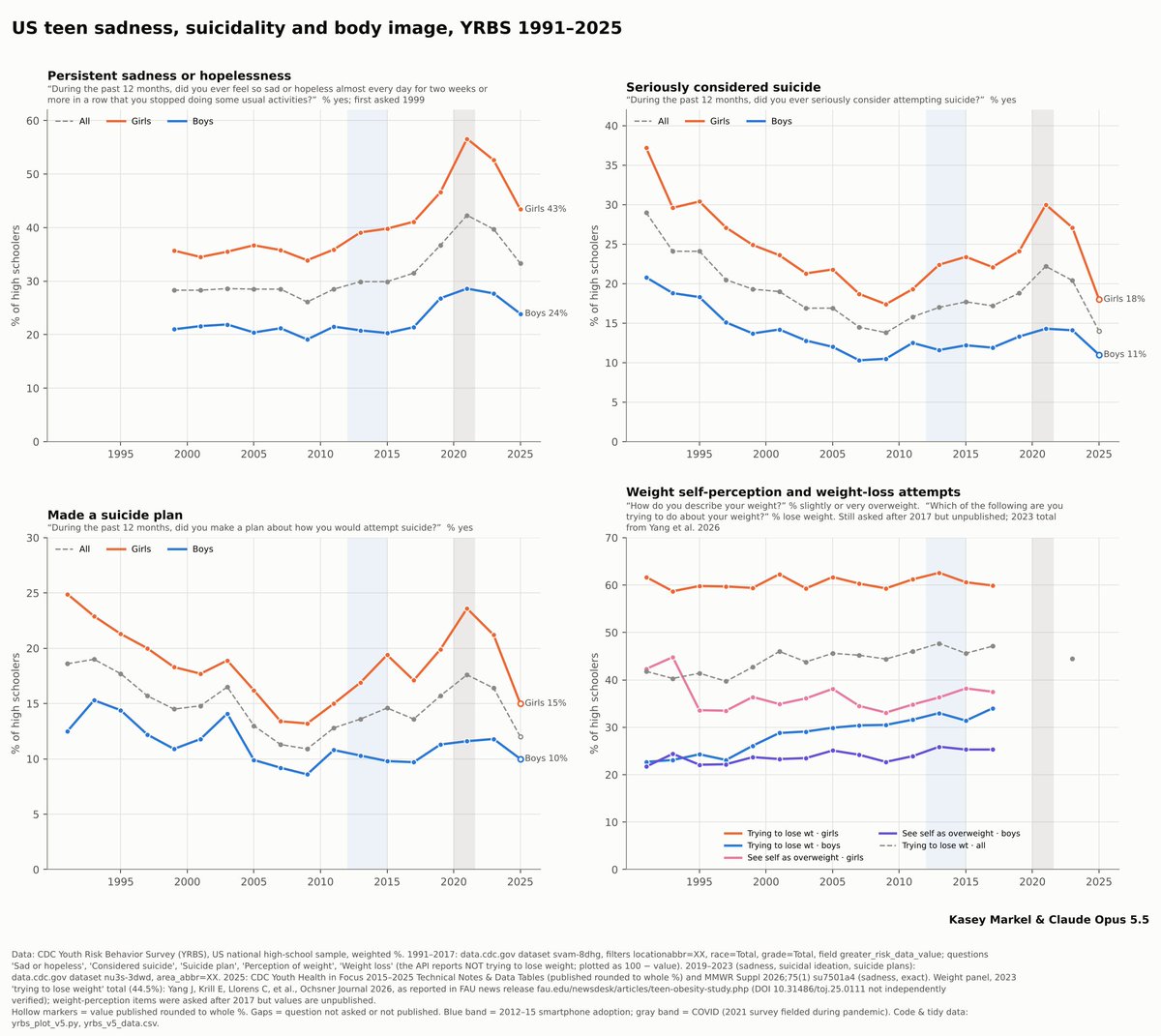
My graphs here are from asking Claude to make 25 plots from the CDC Youth Risk Behavior survey then picking the most informative ones.
A panel that was quite troubling: skipping school due to feeling unsafe is way up.
But I suspect that's not due to phones or social media.
Smartphones and social media were rolled out in a way that makes causal inference very hard, but I'm updating against the Anxious Generation hypothesis.
It's not clear there's much correlation between smartphones / social media and mental health, or that outcomes are worsening.
Yeah this kind of data should *never* have been used as a central causal argument, one way or another.
But alas, that's what Haidt did. Now the data is turning against him (and others who made similar arguments...I think Haidt foolishly got seduced by Twenge's silly arguments). I wrote about this here: https://t.co/6SpF8FSOgs
We're seeing the same thing in Australian data (attaching some).
That doesn't mean there can't be some nuanced effects. But it does mean that The Anxious Generation is now obsolete only 2 years after publication, and a lot of people wasted their money on that book.
@bchesky@DanielLurie Very cool, thanks!
I've been dreaming recently that some of the tech fortune would go to making SF better.
Cleaner, safer, with well-maintained drinking fountains and bathrooms where they're needed, new parks on old industrial sites...
Make SF amazing!
@marcusabramovi1 The first doesn't strike me as accurate, I like the next two and will take on your crusade to push to use those where applicable (e.g. shared objectives), the last mostly feels meaningless - applies equally to North Korea and the UK.
Also, competitor > rival? Less loaded.
@The_Sublimatory@AndyMasley I think you very well could be right, but that it's worth running the experiment. If the data center is externally silent, pretty, and maybe builds some bike lanes and nice sidewalk and a little setback public park, I think it would be loved.
@The_Sublimatory@AndyMasley Why not? Think people would reject beautiful new buildings? Think we can't get our act together enough to build the things that are widely agreed to be beautiful? Think there is no such broad consensus in the first place? Something else?
@MatthewAckerma3@AndyMasley Yeah, there are bad ways to achieve these.
1. Public investment in basic science avoids both
2. I admit most are against me, but I find factory farming morally abhorrent and wanna find some scalable alternative
3. I'm confused about this one - brutalism was never popular
@jamexnik_ Thanks for correcting my false assumption!
How does easy gene editing make pesticides obsolete? Presumably not BT cause editing can't get you there - metabolic engineering for bad-flavor molecules for pests?
If you're keeping it a secret, be assured it's not trivial to guess.
@PirateWires@nic_carter So happy someone's done this - I've been skeptical for a long time on the basis of "greenhouses are quiet, do data centers really need more fans than greenhouses?"
Computers just seem not that loud compared to factories, or shipping (trucks backing up), etc.
@Scott_Wiener Climate change is real and at least mostly anthropogenic, but nowhere near qualifying as *the* crisis of our time - it's not even in the top 5.
@IsaacKing314@max_spero_ I agree it would be nice, but I see why they don't - exposing the secret sauce risks revealing secrets on how to beat it (at least temporarily, before Pangram updates to counter).