I build marketing SaaS that survive AI disruption.
Founder @Uprankly
Sharing product thinking & SaaS strategy
Sometimes building products others may scale.
A while back I came across the idea of a distribution product.
Not the core product.
A complementary free tool whose main job is to introduce the core product to the right audience.
Think about the role that free WordPress plugins and free Shopify apps play.
Many of them aren't the business.
They're the distribution channel.
They get in front of the exact users who may later need a more powerful paid solution.
The reason this matters:
One of the hardest parts of SaaS isn't building.
It's distribution.
Getting in front of the right users is expensive.
It takes skill.
And it takes time.
Not every product category allows for a standalone free tool.
But when product selection and distribution product fit together, something interesting happens:
The free product becomes the acquisition engine for the paid product.
That's not just a revenue advantage.
It's often a valuation advantage.
Distribution built into the product is hard to compete with.
Not a big launch — just shipping in public 🙂
Link Pro is live on production after a long time in staging.
It runs your entire link building workflow in one place:
- Prospect quality sites — filter by DR, traffic, niche
- Enrich with SEO metrics + verified emails + LinkedIn contacts, all built in (no Hunter / Ahrefs / Moz)
- AI-personalised cold outreach with scheduled follow-ups
- Send from your own Gmail / Outlook / SMTP, with rotation to protect deliverability
- Track every reply + placed link
- Close the link gap with your competitors, campaign by campaign
- Collaborate with team + clients in one workspace
Basically replaces 6 tools and 4 spreadsheets.
We built it for SEO agencies and professionals — from the experience of running a link building agency since 2006.
Honestly, I wish I'd shipped it 5 years ago.
The good thing is links still matter. They're a key ranking factor — and increasingly a confidence signal that shapes how LLMs filter, retrieve, and cite content.
If you try it, tell me what's broken. I'd rather hear it from you than find it later 🙏
uprankly(.)com/link-pro
Execution SaaS isn’t a dashboard anymore.
It’s a loop:
Detect → Decide → Execute → Track → Learn
- Agents run it.
- Systems remember it.
- Outcomes improve over time.
The new threat model for founders:
For years, competition meant alternatives.
The shift is from competition → substitution.
Before:
- Tools competed with alternatives.
- Users compared options and chose one.
Now:
- Entire categories are being bypassed.
- AI agents don’t compete with tools.
- They absorb the underlying tasks.
Products don’t lose to better competitors.
They become unnecessary.
Subscribed to many newsletters, but honestly I hardly open most of them. Yours I read as soon as it hits my inbox.
I even take notes because you share honest, insightful strategies that actually worked for you.
Many of them I’ve reused and found super useful for myself and others. Btw, I’ve also shared your newsletter + your profile with my friends to follow 🔥
Building Link Pro took time.
Building the infra took even longer.
Now it’s starting to pay off.
One system.
Multiple opportunities.
Execution is everything.
AI just made execution free.
So what's valuable?
This 👇
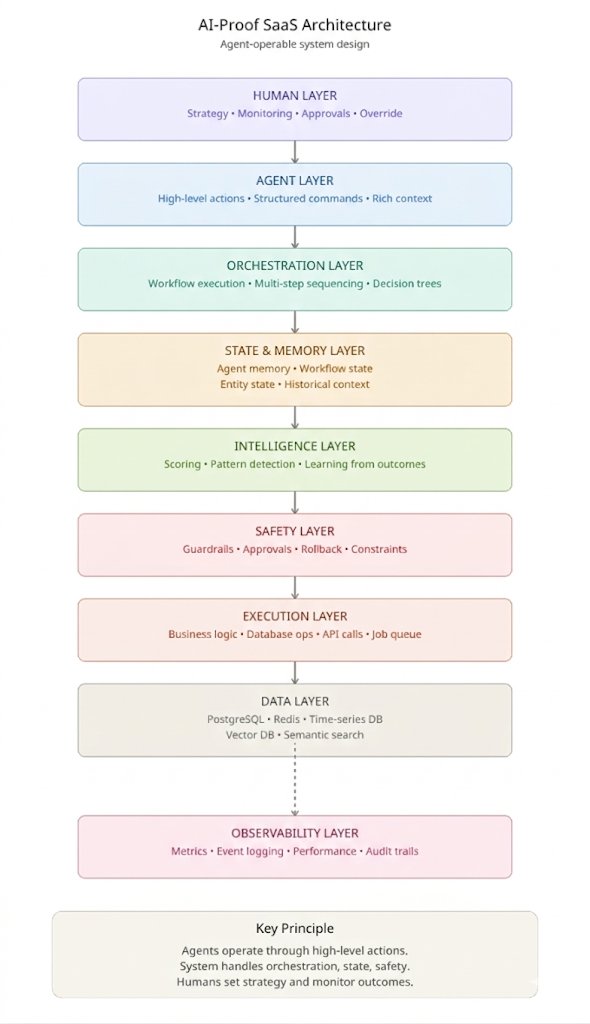
9 layers of orchestration, intelligence, and safety
that AI alone can't replicate.
Your moat isn't features anymore.
It's architecture.
AI changed everything.
One prompt can now:
build
design
write
execute
So why does SaaS still matter?
⚠️ Hidden limitation:
AI still lacks:
– persistent memory across workflows
– long-term planning
– structured business context
– accountability & tracking
– safe execution boundaries
That’s exactly where SaaS wins.
Not in outputs.
In systems that run reliably over time.
SaaS is dead" vs "$50k MRR this month"
Both keep showing up on my feed.
Here's how I make sense of it:
AI is replacing SaaS that generate outputs.
It is NOT replacing SaaS that run ongoing processes.
Examples:
Generating a report → AI can do this now.
Running a workflow daily, tracking state, alerting on changes → still needs SaaS.
The SaaS dying:
• Output tools
• Content generators
• Basic analysis tools
The SaaS surviving:
• Execution tools
• Workflow systems
• Monitoring platforms
• Infrastructure software
Not all SaaS is the same category.
Post-AI, the formula flipped.
Before:
- Build first.
- Figure out distribution later.
Now:
- Distribution is the main game.
- When building becomes easy,
- distribution becomes the moat.
It’s not just SEO + paid.
Those come later.
The real leverage:
– social
– founder brand
– word of mouth
– outreach
– building in public
New rule:
Be distribution-first — or stay invisible.
For SaaS, the moat is no longer code.
- Code is generated.
- Boilerplate is automated.
- CRUD apps are trivial to ship.
What remains durable is distribution.
Own:
– a Reddit pipeline
– an SEO engine
– an X audience
– an email list
– partnerships
You win.
The best SaaS isn’t invented.
It’s extracted from lived problems.
Develop deep knowledge in a specific industry.
Experience recurring pain inside it.
Solve those problems manually (service / agency).
Turn that solution into software.
Market to people who share your pain.
You don’t guess.
You don’t brainstorm randomly.
You build from experience.
That’s where real product-market fit starts.
In the past 4 years, I've built a bunch of SaaS products and taken them to market.
Some succeeded. Some failed.
The ones that made it now generate 7 figures in combined ARR.
And I learned a ton!
Here are my top 5 takeaways 👇
→ Distribution first
Build a distribution channel before building the product. It could be a LinkedIn audience, an email list, or learning how to run effective ads on Google/YouTube/Facebook (for me, the ads were a game-changer!)
→ Don't sell features
Sell an improvement in your user's life.
No one cares about using your product, especially what tech it's built with - they care about achieving something faster/better/easier.
→ Be omnipresent
Try to show up everywhere! On multiple social platforms (big and small), on search results, Reddit answers, blog posts - as many places as you can. And make sure you show up often. You'll be surprised how much you need to "self-promote" - but if you show everywhere, the impact of each touchpoint will start having an exponentially stronger effect.
→ Create multiple revenue streams
Don't just rely on monthly subscriptions. Add yearly plans, consider offering lifetime deals, experiment with usage-based pricing, etc. As your product grows, consider splitting it into multiple smaller Micro SaaS rather than building a monolith.
→ Reduce live support dependency
Your team should never be included in the value chain! Your app should deliver all value by itself without human intervention from either founders or team members (that's the "ideal" you should strive for, at least).
Instead of support tickets, offer self-serve solutions like AI chatbots and well-crafted knowledge bases so users can find help themselves easily (yes, most users prefer that if it's done right!)
Even though it may seem like big, VC-backed SaaS teams have the edge, bootstrapped Micro SaaS still has its place.
It's never been easier to enter, experiment, and incrementally build a profitable business for a loyal user base.
Most SaaS founders think the product kills them.
Truth: poor distribution kills 10× more.
So I’m building a Distribution Playbook —
my own scars + tactics from founders who actually won.
The engine:
Stage 0 — Visibility
Layer 1 — Listening
Layer 1.1 — Conversation
Layer 1.2 — Launch Surface Sweep
Layer 2 — Structured Outreach
Layer 3 — Proof
Turning “build and hope”
into a repeatable system.
If a solo builder can move from guessing
to structured distribution — so can you.
Have ideas to add?
DMs open.
The Hard Truth 👇
SaaS doesn’t fail because:
– The code isn’t perfect
– The UI isn’t clean
– The tech stack isn’t modern
It fails because:
Nobody cares yet.
Distribution isn’t marketing fluff.
Distribution is putting your product
in front of people who already feel the pain.
Build less.
Distribute more.
I've acquired 11+ startups for ~$4m total and here's everything I've learned about acquisitions
context: I've been part of 2 kinds of acquisitions, and most founders only think about one of them.
1. traffic acquisitions
so while growing Tweet Hunter, I realized that the product wasn’t the bottleneck - distribution was
now instead of pouring all our energy into building distribution from scratch, we acquired small tools that already had it - like whatToTweet .com
most of these products had little or no monetization, from a traditional lens, they looked uninteresting, but they ranked on Google for specific keywords, were shared on X, and attracted exactly the audience we wanted
the acquisition wasn’t about extracting money from those tools. it was about redirecting attention toward TweetHunter in a way that compounded over time
2. revenue acquisition
the other category of acquisitions I’ve worked on - like Feather, Typeform, and Captain Growth - fit the more conventional model
in these cases, the goal was to take over the product, integrate it into a larger ecosystem, or grow it independently
the mistake most people do here is focusing too much on present metrics
you’re not buying what the product is today, you’re buying what it could become with better distribution, positioning, and execution
the product is just the starting point
buy product - improve it - increase revenue
⚠️ when founders talk about acquisitions, they almost always mean the second type
very few people consider micro-acquisitions of tiny tools as a deliberate growth strategy for their main product
that blind spot is where a lot of asymmetric opportunities live
small products are easier to acquire, easier to integrate, and often unlock disproportionate upside
for me, revenue is an outcome - distribution, traffic, and attention are inputs.
once you start viewing acquisitions through that lens, the strategy changes completely
instead of asking, “how much money does this make today?” you start asking, “what does this unlock for the rest of the business?”
that shift opens up a much larger opportunity set and changes how you think about scale
hope it helps! 🙏