@FightinPhils26@JeffAnderson_ Then why are white women the biggest beneficiary of affirmative action? The bar was lowered when systematic racism made sure ⚫️ 🇺🇸 were taught in dilapidated schools & were brutalized when ⚫️🇺🇸's attending white schools. ⚫️🇺🇸 are more than owed.
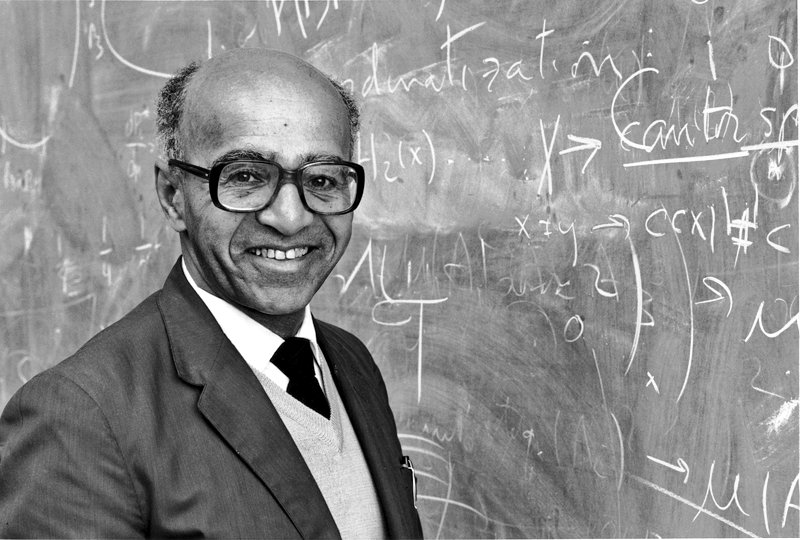
David Blackwell (1919–2010) was one of the greatest probabilists and statisticians of the 20th century. Born in Centralia, Illinois, he earned his PhD in mathematics from the University of Illinois at just 22 under Joseph L. Doob. Despite facing racial discrimination, he became the first Black tenured professor at University of California, Berkeley.
Blackwell made foundational contributions to probability, statistics, game theory, and decision processes. He is best known for the Rao–Blackwell Theorem (with Calyampudi Radhakrishna Rao), which improves statistical estimators using sufficient statistics. His work on Markov decision processes, dynamic programming, and repeated games deeply influenced modern probability theory and later areas like reinforcement learning and machine learning.
Known for both brilliance and humility, Blackwell inspired generations of mathematicians and became a historic figure in American mathematics.
NeurIPS authors: remember to write papers not just for the reviewers who barely skim them, but also for the chatbots who actually read them and write the reviews.
Nobody ever talks about how the concept of the Individual must be so integral to what the universe is trying to accomplish that it's willing to lose the memory of itself, and possibly the integrity of its entire structure, in order to do so. That's how valuable you are.
There's a physicist at Stanford named Safi Bahcall who modeled this exact principle and the math is wild.
He calls it "phase transitions in human networks." When you're stationary, your probability of a lucky event is limited to your existing surface area: the people you already know, the places you already go, the ideas you've already been exposed to. Your opportunity window is fixed.
When you move, your collision rate with new nodes in a network increases nonlinearly. Double your movement (new conversations, new cities, new projects) and your probability of a serendipitous encounter doesn't double. It roughly quadruples. Because each new node connects you to their entire network, not just to them.
Richard Wiseman ran a 10-year study at the University of Hertfordshire tracking self-described "lucky" and "unlucky" people. The single biggest differentiator wasn't IQ, education, or family money. Lucky people scored significantly higher on one trait: openness to experience. They talked to strangers more, varied their routines more, and said yes to invitations at nearly twice the rate.
The "unlucky" group followed the same routes, ate at the same restaurants, and talked to the same 5 people. Their networks were closed loops. No new inputs, no new collisions.
Luck isn't random. Luck is surface area. And surface area is a function of movement.
The lobster emoji is doing more work than most people realize. Lobsters grow by shedding their shell when it gets too tight. The growth requires a period of total vulnerability. No protection, no armor, soft body exposed to the ocean.
That's the cost of movement nobody posts about. You have to be uncomfortable first. The new shell only hardens after you've already moved.
As an astrophysicist, I was convinced of a Creator by the ingenuity of the observable universe; but I have to admit that biology is even more convincing. The incredible machinery of a living cell is far more complex than the structure of an entire galaxy of stars.