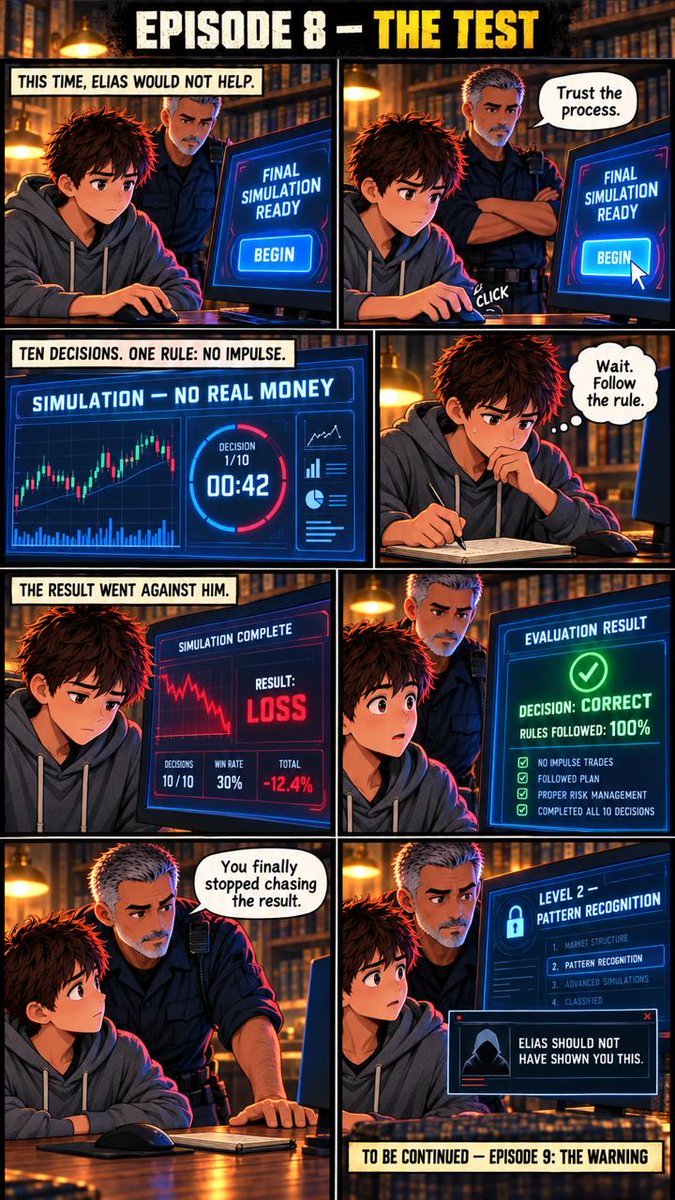
EPISODE 8 — THE TEST
Mark’s hand hovered above the mouse.
On the screen:
FINAL SIMULATION READY.
Elias stepped back.
“This time, I won’t help you.”
Mark clicked BEGIN.
Ten decisions appeared—one after another.
The timer moved fast.
The pressure kept rising.
Every instinct told him to react.
But Mark stopped.
He opened his journal and remembered the rule:
DON’T CHASE THE RESULT. FOLLOW THE PROCESS.
He made his decision.
The screen turned red.
RESULT: LOSS.
Mark lowered his head.
“I failed.”
Then the evaluation appeared:
DECISION: CORRECT
RULES FOLLOWED: 100%
TEST: PASSED
Mark stared at the screen.
Elias finally smiled.
“You stopped trying to be right.”
“You started trying to be disciplined.”
Suddenly, a hidden section unlocked:
LEVEL 2 — PATTERN RECOGNITION
But before Mark could open it, an anonymous message appeared:
ELIAS SHOULD NOT HAVE SHOWN YOU THIS.
Mark slowly turned toward him.
“Who sent that?”
Elias didn’t answer.
TO BE CONTINUED — EPISODE 9: THE WARNING.
EPISODE 7 — THE SYSTEM
The screen finally came alive.
But Mark didn’t see a secret strategy.
No guaranteed signals.
No perfect predictions.
No shortcut to becoming rich.
Only three words appeared:
DISCIPLINE. RISK. EMOTION.
Mark looked at Elias.
“Is this what you wanted to show me?”
Elias nodded.
“This system doesn’t predict what the market will do.”
“It reveals what YOU will do.”
The computer loaded Mark’s 100 simulated decisions.
Every choice was analyzed.
Did he follow his rules?
Did he control the risk?
Did fear change his decision?
Did one good result make him careless?
Then Mark noticed something strange.
One losing decision received a green check.
One winning decision received a red cross.
“That makes no sense,” Mark said.
Elias leaned closer.
“A good decision can lose.”
“And a bad decision can win.”
ONE RESULT PROVES NOTHING.
A HUNDRED DECISIONS REVEAL WHO YOU ARE.
Suddenly, the screen turned red.
A new message appeared:
FINAL SIMULATION READY.
Mark placed his hand on the mouse.
Elias stopped him.
“Once you begin, I won’t help you.”
Mark stared at the glowing button.
For the first time, he wasn’t afraid of losing.
He was afraid of discovering who he really was.
TO BE CONTINUED — EPISODE 8: THE TEST.
EPISODE 6 — THE FIRST RULE
Every story has a moment when things start to make sense.
You can spend months building.
You can copy what everyone else is doing.
You can chase every new idea that looks promising.
But eventually, you have to learn the first rule:
You need to understand the game before you try to win it.
This is where the journey starts to change.
The questions get harder.
The decisions get more important.
And the things that looked obvious before… suddenly aren't.
Episode 6 is about that moment.
Not the final answer.
Not the big breakthrough.
Just the first rule that changes how you see everything that comes next.
EPISODE 5 — THE LOCKED ROOM
The next night, Elias led Mark to the locked door.
Inside were no secret algorithms or expensive computers.
Only hundreds of journals.
Every page contained decisions, emotions and mistakes.
Mark opened the oldest one.
ELIAS CARTER.
“These are yours?”
Elias nodded.
Years ago, one lucky result made him feel unstoppable. He abandoned his rules—and eventually lost everything he had built.
Then he showed Mark the final page:
A GOOD DECISION CAN LOSE.
A BAD DECISION CAN WIN.
NEVER CONFUSE THE RESULT WITH THE PROCESS.
Elias turned on an old computer and opened a demo chart.
The first example followed every rule perfectly.
Yet it still failed.
Mark looked confused.
“How can the right decision produce the wrong result?”
Elias pulled up a chair.
“Because one result proves nothing.”
He opened a folder containing one hundred past decisions.
“Your next lesson starts now.”
TO BE CONTINUED — EPISODE 6: THE FIRST RULE.
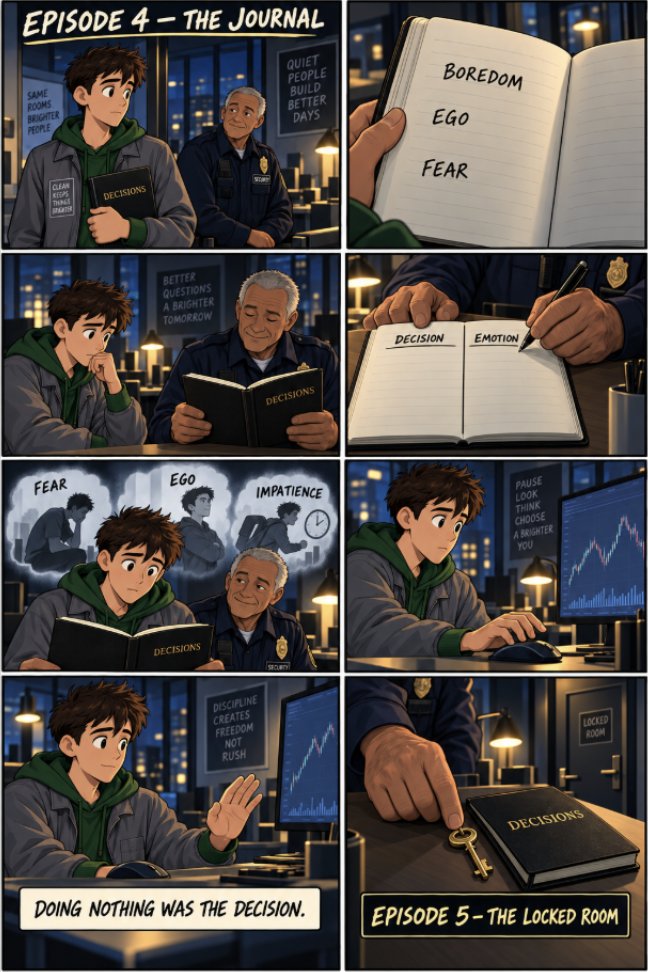
EPISODE 4 — THE JOURNAL
The next evening, Mark returned to the office carrying the journal Elias had given him.
He had filled twelve pages overnight.
Not with charts.
Not with strategies.
With the truth.
“I TRADED BECAUSE I WAS BORED.”
“I BROKE MY RULES BECAUSE I WANTED TO FEEL RIGHT.”
“I TOOK ANOTHER POSITION BECAUSE I COULDN’T ACCEPT LOSING.”
Elias sat across from him and silently read every page.
Then he closed the journal.
“You still think your problem is the market?”
Mark slowly shook his head.
Elias opened the journal again and drew two columns:
THE DECISION
THE EMOTION BEHIND IT
“From now on,” he said, “you don’t record only what happened.”
“You record WHY you allowed it to happen.”
For the next two hours, they reviewed every mistake Mark had tried to forget.
Every impulsive decision had a reason.
Fear.
Greed.
Ego.
Impatience.
Mark finally understood:
THE CHART WAS ONLY SHOWING PRICE.
THE JOURNAL WAS SHOWING HIMSELF.
Elias pushed the laptop toward him and opened a demo chart.
A perfect setup appeared on the screen.
Mark reached for the mouse—but stopped.
Something was wrong.
Every signal looked right…
Yet one sentence from his journal told him not to enter.
Elias smiled.
“What do you see?”
Mark stared at the chart.
Then he noticed it.
THE SETUP WAS PERFECT.
THE TIMING WASN’T.
He moved his hand away from the mouse.
For the first time, Mark’s best decision wasn’t entering a trade.
It was doing nothing.
Elias stood up and placed a small key beside the journal.
Mark looked at him.
“What does this open?”
Elias walked toward the door.
“Come back tomorrow night, and I’ll show you.”
TO BE CONTINUED — EPISODE 5: THE LOCKED ROOM.
EPISODE 3 — THE UNKNOWN MESSAGE
Mark stared at the screen.
“You didn’t lose to the chart. You lost to your emotions.”
Someone knew exactly what had happened.
Mark looked around the dark office.
“Hello? Is anyone here?”
No answer.
Then a door slowly opened behind him.
A man in a security uniform stepped into the light.
His name was Elias.
He had worked the night shift in that building for years—and he had seen Mark returning to the same computer every evening.
Mark pointed at the message.
“Was that you?”
Elias nodded.
Then he said something Mark wasn’t expecting:
“I wasn’t watching the chart. I was watching you.”
Elias had seen the entire pattern.
One successful result made Mark feel unstoppable.
Confidence replaced discipline.
Excitement replaced patience.
And the rules disappeared the moment they became inconvenient.
Elias reached across the desk and turned off the monitor.
“Stop here.”
“Practice only. Real money is not a game.”
Then he handed Mark a blank journal.
One word was written on its cover:
DECISIONS.
“Before every mistake, write down what you were feeling.”
Mark opened the journal and stared at its first empty page.
For the first time, he understood that his next lesson wouldn’t be about predicting a chart.
It would be about understanding himself.
He slowly wrote one question:
“CAN I CONTROL MYSELF?”
Elias walked toward the door.
Before leaving, he turned around and said:
“Tomorrow, bring me every mistake you’re afraid to admit.”
TO BE CONTINUED — EPISODE 4: THE JOURNAL.
EPISODE 2 — THE FIRST MISTAKE
Mark had spent weeks studying.
But it took him only a few minutes to forget everything.
His first decision on the DEMO account worked.
The chart turned green.
For a moment, Mark didn’t feel like an exhausted student cleaning offices at night.
He felt unstoppable.
That feeling became his first real mistake.
Instead of closing the laptop, Mark pushed his notebook aside.
The rules he had written suddenly felt unnecessary.
“Just one more.”
The next decision wasn’t based on research.
It wasn’t part of his plan.
It came from excitement.
Then the chart reversed.
Green became red.
Mark could have stopped—but now he wanted to erase the mistake.
One rushed decision became another.
The more he tried to regain control, the more emotional he became.
Hours later, Mark finally closed the screen.
His practice balance was down.
But the number wasn’t what frightened him.
He opened his notebook and read the rule he had ignored:
“DISCIPLINE OVER EMOTION.”
That morning, Mark understood something no chart had taught him:
The market wasn’t his biggest problem.
He was.
The next evening, Mark returned to the empty office.
He turned on the same computer—and froze.
A message was waiting on the screen:
“You didn’t lose to the chart. You lost to your emotions.”
Someone had been watching him.
TO BE CONTINUED — EPISODE 3: THE UNKNOWN MESSAGE.
EPISODE 1 — HOW IT ALL BEGAN
This isn’t a story about overnight success.
It begins with a mop, an empty office, and a 21-year-old student who was running out of options.
His name was Mark.
By day, he studied economics at college.
By night, he cleaned offices just to cover rent, food, and transportation.
Every evening looked the same:
Classes.
Work.
Bills.
Sleep.
Repeat.
Until one night, Mark noticed something unusual.
A computer had been left on.
A chart was moving across the screen—green candles, red candles, numbers changing every second.
Beside the keyboard was an open notebook.
One sentence had been underlined:
“Protecting your capital matters more than chasing profit.”
Mark didn’t fully understand it.
But he couldn’t stop thinking about it.
That night, he went home and started researching.
Not how to “get rich quickly.”
He wanted to understand why people won, why they lost, and why emotions destroyed even the smartest decisions.
For the next several nights, Mark studied after work.
He filled pages with notes.
He tested everything on a DEMO account.
Then one night, the chart turned green.
For the first time, his analysis appeared to work.
Mark smiled.
But he had already made one small mistake…
And he didn’t realize how important it would become.
TO BE CONTINUED — EPISODE 2: THE FIRST MISTAKE.
I USED TO CLEAN OTHER PEOPLE’S OFFICES.
Today, I can travel, relax on yachts, and afford a lifestyle I once believed was completely out of reach.
But between those two realities were YEARS OF HARD WORK.
I was an ordinary cleaner.
Every morning, I emptied trash cans, washed floors, and cleaned the offices of people who earned more in one day than I made in an entire month.
Then, one evening, I noticed a financial chart glowing on someone’s computer screen.
Red and green candles.
Numbers I didn’t understand.
That night, I asked myself one simple question:
“WHAT IF I COULD LEARN THIS TOO?”
After work, I began studying financial markets.
I read books, analyzed charts, and practiced with demo accounts—without risking real money.
At first, I thought trading was a shortcut to wealth.
I WAS WRONG.
I made bad predictions, lost confidence, and considered quitting many times.
But eventually, I understood something important:
TRADING ISN’T MAGIC—AND IT ISN’T A GAME.
It requires risk management, discipline, patience, and the ability to admit when you’re wrong.
I didn’t quit my job after one successful trade.
Not even after ten.
I continued working as a cleaner while saving money, building an emergency fund, and developing several sources of income.
Years passed.
My decisions became calmer.
My results became more consistent.
And slowly, my life began to change.
Today, I can travel, spend time on yachts, and buy things that once felt impossible to afford.
But expensive possessions aren’t the greatest luxury.
THE GREATEST LUXURY IS HAVING CONTROL OVER YOUR OWN TIME.
I started with a mop in my hands.
No wealthy family.
No powerful connections.
No special opportunities.
All I had was the decision to become a little better every day.
YOUR CURRENT SITUATION DOESN’T HAVE TO BE YOUR FINAL DESTINATION.
ONE TEACHER CHANGED THE LIFE OF AN ENTIRE CLASS.
Then, unexpectedly, he changed his own.
He was 43 years old.
Every morning, he arrived at school before everyone else.
He prepared lessons, stayed late, and helped struggling students without asking for anything in return.
But there was one painful reality:
HIS SALARY WAS BARELY ENOUGH TO SURVIVE.
One evening, he noticed a student using AI to create a classroom presentation.
He could have banned it.
Instead, he asked:
“CAN YOU SHOW ME HOW IT WORKS?”
That single question changed everything.
For the next several months, he studied every evening after school.
He learned how to create interactive assignments, explain difficult topics in simple language, and produce short educational videos.
At first, only one class used his materials.
Then the entire school did.
Soon, teachers from other cities started asking for access.
So he built a small educational platform.
His first sales brought in only a few dollars.
BUT HE DIDN’T QUIT.
He listened to teachers, improved every lesson, and kept building after work.
One year later, thousands of students were using his platform—and it was earning more than his teaching job.
But he didn’t leave the classroom.
Instead, he made the platform free for students whose families couldn’t afford it.
When someone asked why he continued teaching, he answered:
“I DIDN’T START THIS FOR THE MONEY. I STARTED BECAUSE I WANTED STUDENTS TO BELIEVE THEY COULD LEARN AGAIN.”
Sometimes, one new skill doesn’t just change your career.
IT GIVES YOU THE POWER TO CHANGE THOUSANDS OF LIVES.
This is a fictional story.
THEY FOUND A STACK OF DOLLARS ON THE STREET.
But only a few minutes later, THEY HAD NOTHING LEFT.
Two friends were walking home when they noticed a thick stack of cash beside a park bench.
They picked it up and couldn’t believe their eyes.
For a moment, it felt like life had finally given them a chance.
They were already imagining new phones, unforgettable trips, and a life without constantly worrying about money.
BUT THEIR EXCITEMENT DIDN’T LAST LONG.
While they were arguing about what to do with the cash, a stranger grabbed it and disappeared into the crowd.
They stood in the middle of the street with empty hands.
That evening, the friends realized something important:
MONEY FOUND BY CHANCE CAN DISAPPEAR IN SECONDS.
BUT KNOWLEDGE CAN STAY WITH YOU FOREVER.
From that day on, they began studying financial markets, analyzing investors’ mistakes, and practicing with educational simulations instead of risking real money.
The first few months were difficult.
Bad decisions. Doubt. Sleepless nights spent studying charts.
Many times, they wanted to give up.
BUT THEY KEPT GOING.
Instead of chasing quick money, the friends focused on knowledge, discipline, and managing risk.
Years passed.
Their small achievements gradually turned into a stable business—and eventually, significant wealth.
Not because of the cash they found.
AND NOT BECAUSE OF ONE LUCKY TRADE.
They changed their lives because one day, they decided to stop waiting for luck.
THE MONEY THEY FOUND DISAPPEARED WITHIN MINUTES.
BUT THE MOTIVATION THEY DISCOVERED THAT DAY STAYED WITH THEM FOREVER.
Sometimes, losing something isn’t the end.
SOMETIMES, IT’S THE BEGINNING OF A STORY THAT CHANGES EVERYTHING.