What if users don’t want a different agent on every website?
We explored this in a new post, coauthored with @0xidanlevin and @andreban 🎉
https://t.co/EvVWJHfX0q
A short thread 🧵 1/4
Is it more like “I want to INTERACT with my agent and not your agent?” - I understand the sentiment as your agent has all the context on your end, but I would not cross out A2A use cases - business might want to expose their agent to have control on how their brand is presented and to ensure great user experience, then your agent can just work with the other agent 🤔 curious about your thoughts on this !
My thinking is that there is a place for many different interactions and there are very valid use cases for people to browse the web even without any agent (for example entertainment - reading, videos, browsing what’s new in stores), and then we have whole spectrum of offloading more and more work to agents;
Having said that I am very excited for more fully automated use cases (chores);
I did write more about it on my blog https://t.co/6qsTyp8WSE - curious to hear your thoughts on this 💡
@blackgirlbytes I experiment with WebMCP, MCP, A2A, Agentic Web etc and you can find my write ups here : https://t.co/KTqDx6ERG6 if that’s something you are interested in 😀
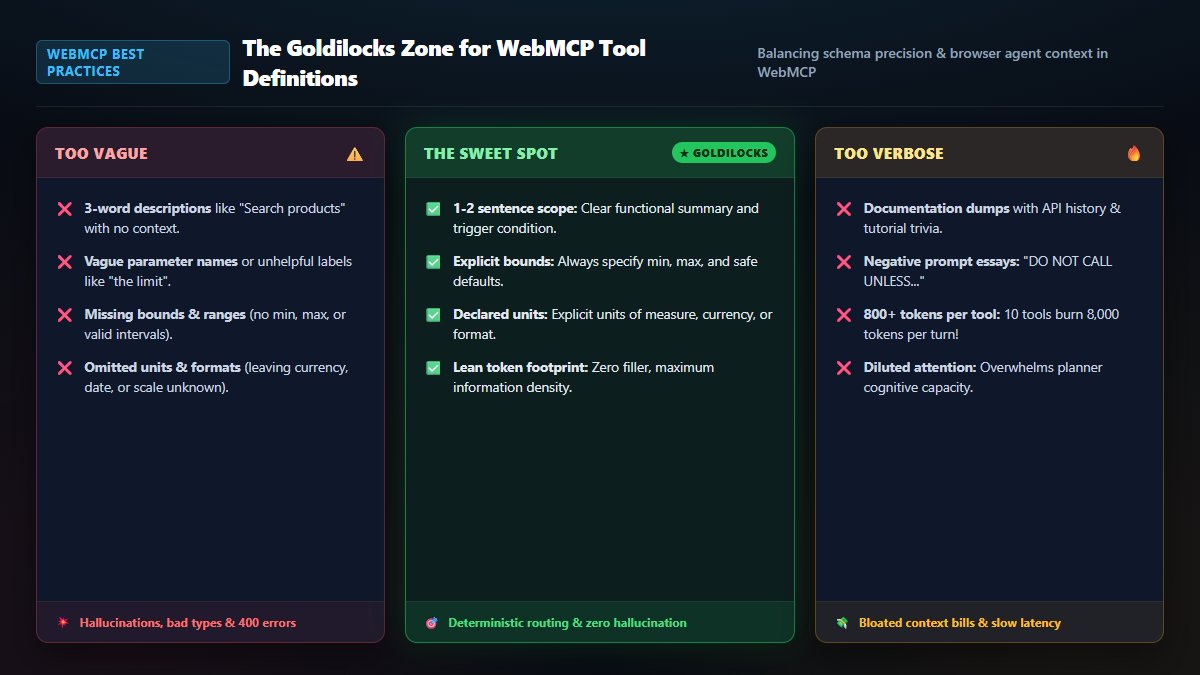
I analyzed 545 websites implementing Chrome WebMCP.
Across thousands of tool definitions, two common issues show up again and again:
1. Vagueness (under-specification)
2. Verbosity (context bloat)
Here’s what I found and how to hit the sweet spot 🧵👇
#WebMCP#AI
Want to understand how WebMCP works?
@kaskulikowski from Google covers how agents interact with websites, why semantic HTML matters, how WebMCP exposes structured tools, and how to implement, debug, and evaluate them.
Watch Kasper’s full presentation:
https://t.co/ZINRyADBlJ
I’m excited to share that we've added a consequential hint to the WebMCP spec! Here’s what you need to know about it:
For site devs: consequentialHint should be set to true when WebMCP tools may perform a high-stakes action: anything that might need explicit user permission in order to execute. If you’re going to make a purchase, send an email, or book travel, it would be beneficial to set this to true.
annotations: {
consequentialHint: true
}
For agent/model devs: the agent should regard this hint as a time to take a step back, ask for user verification- if there’s an alignment tool critic, it should be judging whether or not a consequential action is appropriate given the user’s request.
The interesting thing about hints like this, unlike other web specs, is that both the site and the agent have to get it right for this to work well. If one side exposes a hint and the other doesn’t honor it, it’s not doing much. And alternatively, if the site dev doesn’t expose but the agent is looking for it… you get it.
But combined, it’s powerful. It can create a safeguard against generating an action a user might not want or be expecting. And it gives more tools to developers to have precision in what should be occurring on their site. So the collective effect can keep users safer.
@SubhavMathur@dkundel That’s very cool! I was recently experimenting with voice control for coding agents, it’s a very underestimated pattern!
Another thought on this pattern that I wrote about on my blog is that such agents can support many different modalities, making tech much more accessible!
Super excited about how WebMCP can change the open web as we know it. You also still got a few days to join our WebMCP hackathon. If you want to learn more about what this is all about, I got you! 👇 https://t.co/vIMTn5zzI8