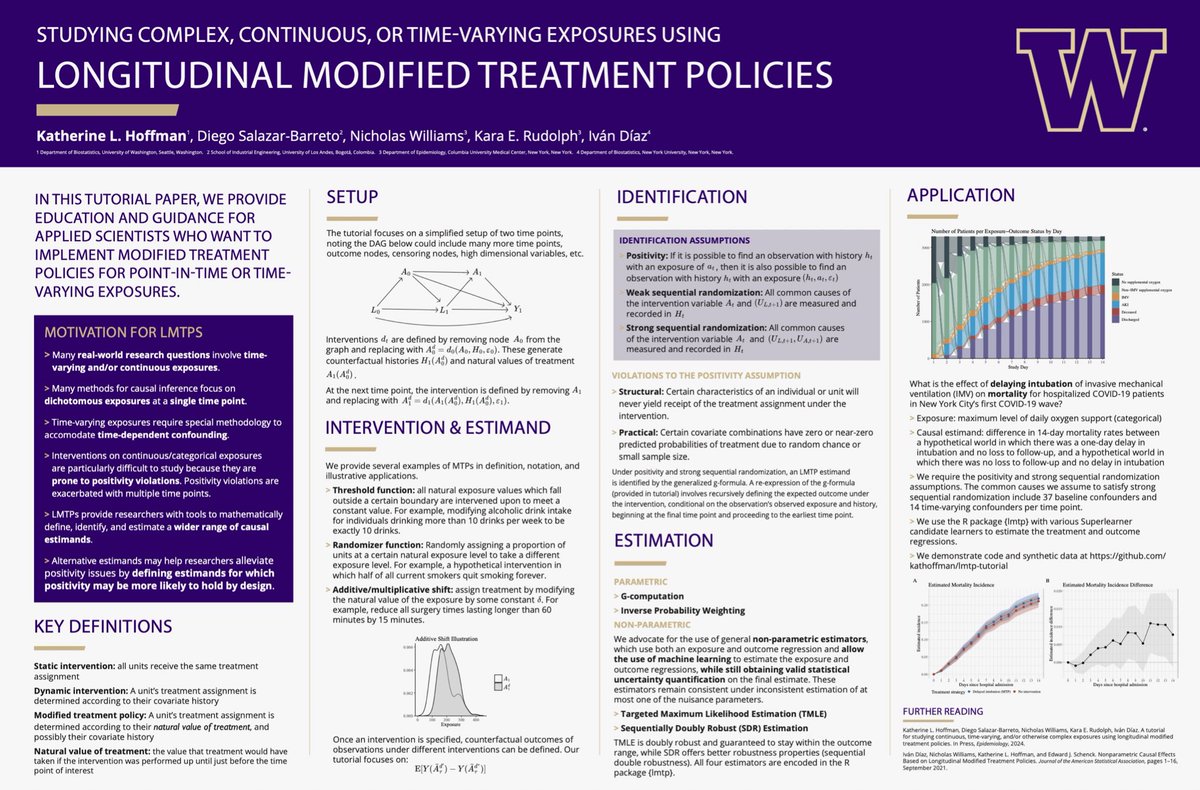
A tutorial on Longitudinal Modified Treatment Policies-- a flexible method for defining, identifying, and estimating causal parameters of interest-- is now in @EpidemiologyLWW!
🔗https://t.co/0L1lcQJ7Lp
cc🌟coauthors: @dasalazarb @nickWillyamz @kara_rudolph@ildiazm
updated tutorial on Longitudinal Modified Treatment Policies is now on arxiv!
🔗 https://t.co/lX6fKzGTTS
for those at ACIC, i'll be hanging out by this poster today from 5-6:30pm and would love to chat about LMTPs, methodology tutorials, etc.
Starts October 2! PhD applicants applying to @UWBiostat and @UWStat may use a pre-application review service designed for applicants from historically marginalized groups. Information: https://t.co/wAfvVxySml
Our Division is hosting its inaugural yearly Biostatistics Symposium, and this year the topic is Causal Inference! We have an exciting lineup of speakers listed below. If you are in the NYC area, please join us! Link to register in the QR below.
Many of my students struggle with the distinction between Ordinary Least Squares (OLS) and Maximum Likelihood Estimation (MLE).
To clarify, we use an interactive #Python dashboard that fits parameters to a Gaussian distribution based on a given dataset.
This visual approach helps them see the difference: OLS minimizes the mismatch between the model and the data, while MLE maximizes the likelihood of the data given the model parameters. With this tool, the concepts become much clearer!
I share it on #GitHub @ https://t.co/lNdq4FF4Bl ∀. #DataScience #MachineLearning
As application season rolls around again, here's your reminder that materials from my successful applications are available on my website (NSF-GRFP, Google PhD Fellowship, Stanford data science postdoc, and CS faculty job search): https://t.co/6jZZtGclCZ
amazing resource for PhD applicants by @drlucylai below!
tag-teaming off her with my own post on my Biostatistics PhD application experience (applied Fall '22) ⤵️
https://t.co/vIJFQ4uGJL
✨it's PhD application season again!✨ i am re-sharing my popular guide on applying for PhD programs in STEM, that has now been viewed 60k+ times over the past 6 years😍 please RT and share with anyone that might find it useful! https://t.co/GZjrcU5kjg
I can't remember the last time I renamed variables manually in #rstats. I always use my data dictionary for renaming! That way, if I ever need to update names in the future, I'm only updating once in my data dictionary, not in both my data dictionary and script. 🙌
We’re seeking a new chair to lead a dedicated team of faculty, staff, and students who are passionate about developing and using rigorous quantitative methods to improve the well-being of communities in the United States and around the world. https://t.co/Imi564eheO
Thank you to @AmstatNews for the support, and so many mentors for guidance/encouragement.
Extra thanks to @ildiazm for helping me start methods research pre-PhD.
Looking forward to year 2 at @UWBiostat!!
Congrats to @uwbiostat PhD student Kat Hoffman who has received the Gertrude M. Cox Scholarship. The award recognizes Hoffman’s methodological research developing machine-learning based methods drawing on causal inference on longitudinal interventions. https://t.co/Ee9eZ6AA1k
@AdanBecerraPhD @EpidemiologyLWW@dasalazarb @nickWillyamz @kara_rudolph@ildiazm you can definitely define an estimand that is a contrast of counterfactual outcomes under an intervention that occurs sometime during a longitudinal study period--so in that sense, yes
don't think you can (currently) go after the exact same estimand as in DID, though!
A tutorial on Longitudinal Modified Treatment Policies-- a flexible method for defining, identifying, and estimating causal parameters of interest-- is now in @EpidemiologyLWW!
🔗https://t.co/0L1lcQJ7Lp
cc🌟coauthors: @dasalazarb @nickWillyamz @kara_rudolph@ildiazm
updated tutorial on Longitudinal Modified Treatment Policies is now on arxiv!
🔗 https://t.co/lX6fKzGTTS
for those at ACIC, i'll be hanging out by this poster today from 5-6:30pm and would love to chat about LMTPs, methodology tutorials, etc.
thank you @BhramarBioStat for years of encouragement, going all the way back to when I was an undergrad-- giving me an invitation to attend summer BDSI talks as soon as you learned I lived locally 💛💙
Michigan will miss you!
@guhbao theres definitely some overlap in the R packages {lmtp} and {ltmle}! here's some diffs:
- lmtp can be used for MTP estimands (intervening on natural value of treatment)
- lmtp encodes an additional estimator (SDR) for static/dynamic/MTPs
- lmtp does not encode MSMs
@guhbao theres definitely some overlap in the R packages {lmtp} and {ltmle}! here's some diffs:
- lmtp can be used for MTP estimands (intervening on natural value of treatment)
- lmtp encodes an additional estimator (SDR) for static/dynamic/MTPs
- lmtp does not encode MSMs
updated tutorial on Longitudinal Modified Treatment Policies is now on arxiv!
🔗 https://t.co/lX6fKzGTTS
for those at ACIC, i'll be hanging out by this poster today from 5-6:30pm and would love to chat about LMTPs, methodology tutorials, etc.
new tutorial paper! 🤩 check it out if you're looking to add a general causal inference method to your toolbox. 🧰
LMTP + #rstats pkg {lmtp} is especially useful for time-varying data and/or continuous exposures.
🔗 : https://t.co/oHLjpZ49nn
pre-print highlights ⬇️ 1/n
@ibddoctor yeah! you could consider estimands involving interventions where you modify the natural value of treatment dose at some or all of your 8 week intervals (e.g. decrease by X% or X units, or decrease from ordinal categories e.g. high dose to medium dose, medium dose to low dose)