Traveling home after the NEC 2024 in Bordeaux with great researchers, collaborators, and friends 😍🧠🤓 thanks for the amazing time with Geek discussions, fascinating #appliedneuroscience, social dinners 🍷 and of course partying and dancing 💃🪩
#Neuroergonomics#Neuroscience
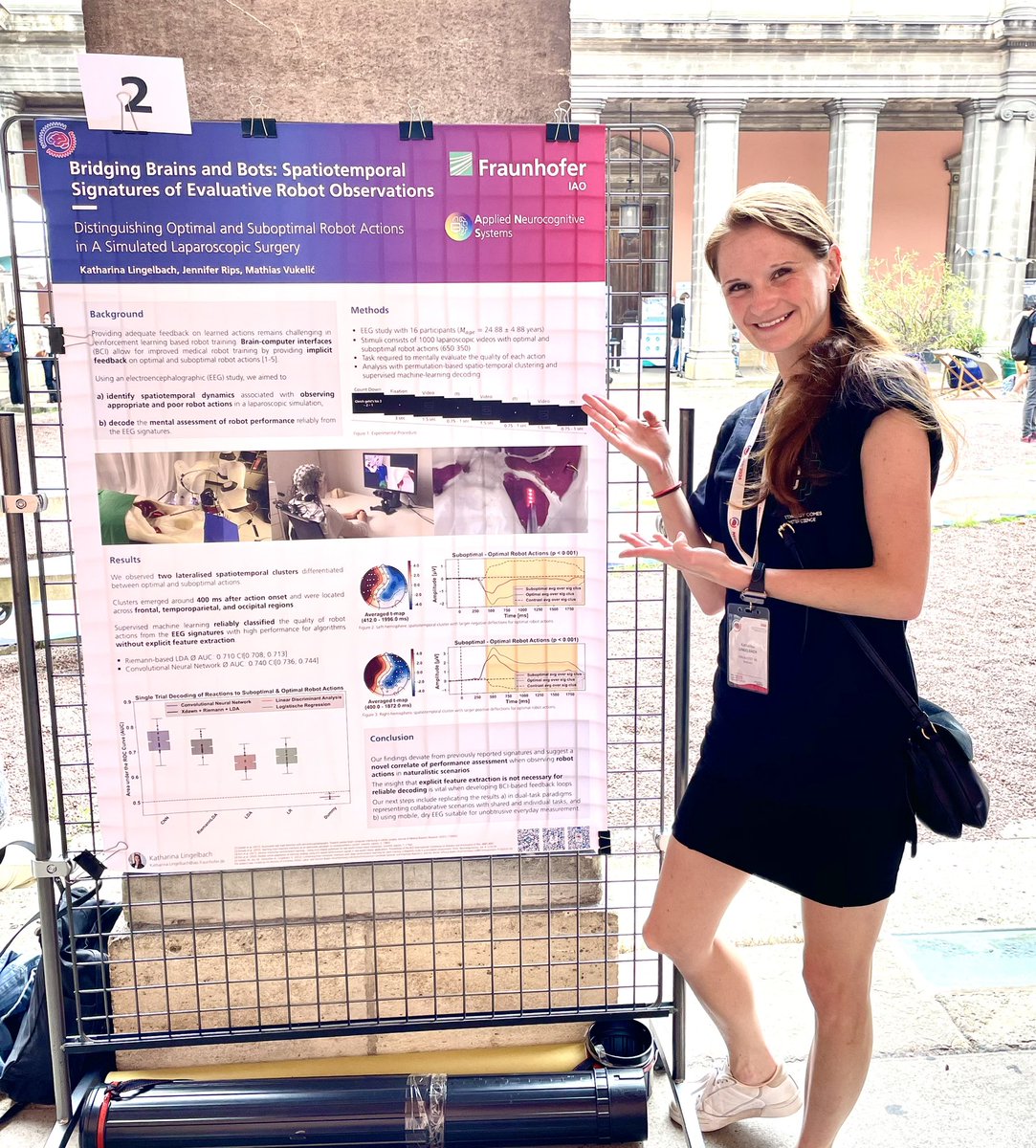
✨ After a fantastic start of the NEC 24, with great workshops and an inspiring opening keynote on Explainable ML, the first poster session is starting soon! 🎉 If you're interested in Human-Robot Interactions and EEG-based ML, drop by at Poster 4 and have a chat! 🤖🧠
Have we mentioned that the IGOR Prize winner is Julius Welzel? Congratulations to Julius for his work on MOTION-BIDS: Extending the Brain Imaging Data Structure specification for reproducible research! 🥳#PuG2024#IGOR#OpenScience
Missed his poster? Here you go!
For those interested in visual short-term memory (VSTM), #EEG, #VR, and their combination:
👉 https://t.co/3mEFb2amSy
🔎 We explored whether we can use VR🥽 to study EEG〰️ markers of VSTM: CDA and lateralized alpha power.
🫣 Spoiler: both can be measured in a VR setup.
(1/6)
Happening now at #PuG2024: Symposium S26 on Mnemonic Processing of Immersive Environments, featuring our own MBE @flxklotz with an exciting talk about short-term memory, EEG and VR 🧠 yay for @mbe_lab!
Research on the role of cognitive effort on emotion regulation is presented by @ch_scheffel at #PuG2024 showing data over three studies and across different regulation phases 👏
🚀 Symposium Alert 🚀
🧠✨ I am excited to chair the upcoming symposium, where the speakers will delve into the fascinating interplay between cognitive and emotional processes and their underlying neurophysiological mechanisms.
Intrigued? Join us at 1 pm🧠#PuG2024@bioDGPs_DGPA
@ch_scheffel discusses the role of cognitive effort in emotion regulation. His research investigates the effects of effort and emotion regulation in different task phases including post-regulatory effects with physiological and subjective methods!
@_Anya_________ will present her EEG research on temporal and frequency-specific signatures of emotional interference inhibition and emotion-cognition integration🧠😎
Using intracranial recordings and scalp recordings, @eweidner_1 will show how attention to valence tunes emotion processing in the face processing network and amygdala and how this interaction changes over time!
🚨 New Paper Alert with @sabrinagado 🚨🎉 We uncovered lateralized prefrontal cortex activity🧠using #fNIRS in real-world scenarios 🌍✈️ with different workload levels 📊 and emotional speech distractions 🗣️Eager for more details? 🤓⬇️ #neuroscience
https://t.co/W6Q4jYqUMl
@sabrinagado One main insight of the study was that lateralized hemispheric processing, regulating emotional speech distractions and integrating emotional and cognitive processes, is influenced by workload levels and stimulus characteristics.
@sabrinagado A cross-over interaction indicated workload-dependent left hemispheric inhibition processes during negative distractions and high workload. For positive emotional distractions under low workload, we observed left PFC recruitment associated with speech-related processes.
@sabrinagado Our investigation identified hemispheric asymmetries especially in the left inferior frontal gyrus (IFG) and orbitofrontal cortex (OFC), during the presentation of negative and positive emotional speech distractions at different workload levels.
@sabrinagado 18 participants engaged in a monitoring-control task, mimicking common air traffic controller requirements with either low or high workload, while concurrently being exposed to emotional speech distractions of positive, negative, and neutral valence.