Fiddler on the Roof was (and is) a far more successful play in Japan than America. The plot—about traditional shtetl life clashing with modernity—apparently struck a chord there.
One Japanese producer asked a visiting critic, “How did Americans write such a Japanese story?”
Which rice? How the evidence changes the answer
The article examines why brown rice’s nutritional advantages have produced less decisive health findings than one might expect.
Mannnyy, mannyyy thoughts on #RamayanaMovie (possible spoilers)
_____
First, credit where credit is due. The scale of Ramayana (the waterfalls, the forests, the palaces, the creatures)... it's all quite decently realised. This isn’t a film you watch for three hours and fifteen minutes and come out complaining about the CG. That whole Pushpaka Vimanam sequence, especially, looked cool: the movement of the vehicle, the camera angles, the texture of Jatayu’s body, the claw slicing through Ravana's head… But there's a difference between giving something texture and giving it... life. Kumbakarna, for instance, looks large as a Potter troll, but his eyes and expressions feel strangely dead, no? I thought this was true of the whole film in a sense.
I felt surprisingly little throughout. Not the awe the film wanted me to feel when Ranbir Kapoor first walks in as Rama. Not the warmth when Sai Pallavi’s Sita first gazes at him. Not the sorrow when Dasaratha awkwardly collapses as Rama leaves Ayodhya. Not even the surge of feeling when Ranbir, as Rama, yells his oath to rescue Sita. And I wondered: Why was I feeling this distance?
The temptation is to blame familiarity. We have grown up with this story, watched television adaptations, heard episodes getting narrated over and over. We know who lifts the bow, who demands the exile, who kidnaps Sita. But knowing what happens needn’t necessarily diminish the pleasure of watching it happen... What does this Rama feel? What does his Sita see in him? What happens to a family when a promise becomes more important than the happiness of everyone in it? What if it causes the death of a good king?
Somewhere at the beginning, I thought director Nitesh Tiwari had a new approach. He begins the film with Ravana and his clan being treated as slaves. We see young Ravana as a boy practising music, but then, his mother, played by Shobana, humiliates and goads him towards weapons and war. There’s something compelling in that beginning: a mother’s ambitions for her son, a son turning to war to please his mother...
So, of course, Ravana goes into a frightening penance, receives boons from Brahma... But then, the film tamely switches to Ayodhya for Rama’s birth, suddenly happy to settle into a procession of familiar milestones. Rama’s training. The swayamvara. Kaikeyi’s demands. The exile. The characters existing just as tools to get us from one episode to the next. If Mandharai poisons Kaikeyi’s mind, I’d have liked to know where such bitterness comes from. If Kaikeyi moves from adoration for Rama to demanding such a terrible punishment for him, what fear has become more powerful than that affection? The film gets her to the decision required by the story. I would have rather seen the terrible process of Kaikeyi arriving there.
Something similar happens with Rakul Preet Singh’s Soorpanakha. We see her grief over her husband’s death, and later, her desire for Rama. Those feelings needn’t contradict each other; desire is perhaps an escape from grief and loneliness. But the film doesn't help you make these connections, making Hanumanesque leaps between emotions, leaving us to imagine the connections.
This is perhaps why I was most alive when the film sat with Ravana. Yash brings investment and swagger, certainly, but he also gets something the others are rarely allowed: a mind that pulls in different directions. My favourite idea in this film is the reinterpretation of his ten heads as voices within him, voices that argue, tempt and rebuke. Here, finally, is a character whose internal life becomes part of the drama.
One of his voices rebukes him for giving up music. I loved the possibility contained in that moment. What happened to the boy with the instrument? Does he miss that life? Does his mother recognise what her ambitions have made of him? How has their relationship changed now that he has achieved what she wanted? We glimpse this softer Ravana, but get no time to really stay with him.
There are some minor choices I liked. Like Sita getting to do a bit of fighting. Like Sita questioning Ravana about the Vedas, so he can prove his assumed identity. These details give the characters something to do beyond occupying their familiar positions in the story. So it would be unfair to say the film invents nothing. But these inventions unfortunately don't translate into richer, emotional experiences. And it's sad because I have been convinced for a while that the beauty of our mythology lies not as much in battle and scale, but in intimate conflicts, in desire and suffering, in greed and punishment, in attachment and loss. There may be public events of great magnitude, but they often result in such private pain.
Take Rama’s commitment to honouring a promise. We understand why it makes him noble. But surely the drama lies in what that commitment costs him, in the feelings he must live through while choosing to do what he believes is right. His goodness needn’t make him emotionally inaccessible, coldly stoic. If anything, the strength required to act justly despite anger, temptation or sorrow ought to make him more moving. And his decision affects so many others. Rama leaves for the forest, but it becomes Sita's life too, it snatches Lakshmana from his family. Their willingness needn't make their sacrifice smaller. What does Rama feel about the people who love him accepting these hardships alongside him?
There’s a moment, presented as a love scene, when Rama talks about how Sita’s presence makes the exile almost enjoyable for him. She blushes. It’s a lovely thought, but I'd rather have experienced it: the hardship her affection eases, any small joys they find together, the fulfillment being together brings all three of them. Instead, the film rushes to the next story beat.
Ranbir seems strangely flat. It's hard to tell what's happening within him. This attempt to play straightfaced nobility has somehow turned into opaqueness. When he yells an oath at the end, it feels uncharacteristically loud. And it's not like there isn't enough time to establish Rama, considering much of the first half tracks his birth through his adulthood, marriage and banishment at such rapid pace. After interval, it suddenly remembers to slow down, like with the Vidyutjihva confrontation. But as much as the fight allows for more Yash time (and that's always a good thing), why linger over this fight rather than the consequences of the exile? Why not create opportunities for the deity to feel more... human?
While on battle scenes, the Jatayu battle is quite the spectacle, but as the great concluding movement of this first part, I got thinking about another first-part film which ends with the death of a creature loyal to the protagonist: Dobby in Deathly Hallows 1. That film, of course, has the advantage of affection accumulated across earlier films. But the comparison just reminded me how much a scene of sacrifice depends on what we bring into it, and not the act itself. Rendering can only do so much.
Perhaps that’s what kept me at a distance throughout Ramayana. It knows these moments are important. It knows we know they are important. And it seems to think this shared knowledge is enough. It expects that the feelings are all already there and expects that scale and music will summon them, even if they aren't earned within this film. But with any adaptation, I want to see what this specific telling has discovered within the original story: in a mother’s ambition, in a brother’s loyalty, in a wife’s companionship, in a great man’s difficult choice. This film really needed life and intimacy. And these qualities, no money can buy, not even thousands of crores.
Trump, who initially appeared unfazed by the results of the Tuesday night midterms, has become angrier as he’s watched coverage of the historic losses, we're told. That sour mood has spread throughout the West Wing, which has become increasingly factionalized in recent days. https://t.co/DBoS09C2RZ
Susie Wiles is out as White House Chief of Staff, replaced by Stephen Miller. Wiles will be moved to Trump's political operation. This suggests three things:
1. There will be no meaningful check on Trump's worst instincts.
2. Some of the most divisive policies of this administration will likely continue unabated and may grow more extreme.
3. Appointing Wiles to lead his political operation suggests that Trump hopes to anoint his successor and influence who becomes the Republican presidential nominee in 2028.
First, this suggests that Trump may not grasp the scale of America's repudiation of his policies in the midterm elections. Rather than reassessing those policies, he appears to be consolidating authority around someone closely associated with their implementation. Second, it could increase the likelihood that the next president of the United States will be a Democrat and that Democrats will gain more seats in the Senate and possibly the House in 2028.
The problem with personalist leaders is that they tend to exist in an information bubble that reinforces their existing beliefs and filters out contradictory evidence. Three well-established mechanisms contribute to this phenomenon: preference falsification, in which subordinates conceal their genuine views to avoid displeasing the leader; motivated reasoning, in which information is interpreted to support existing beliefs; and information cascades, in which individuals adopt the prevailing position rather than independently evaluating the evidence. Together, these mechanisms can produce a profoundly distorted understanding of political reality, particularly in systems where personal loyalty is rewarded and dissent is discouraged.
Thinking of Trump right now, I am reminded of the dictator in Gabriel García Márquez's The Autumn of the Patriarch, who becomes increasingly isolated from reality as his rule draws to an end. Surrounded by subordinates who reinforce his beliefs and conceal inconvenient truths, he gradually loses touch with the world around him, even as he continues to wield enormous power.
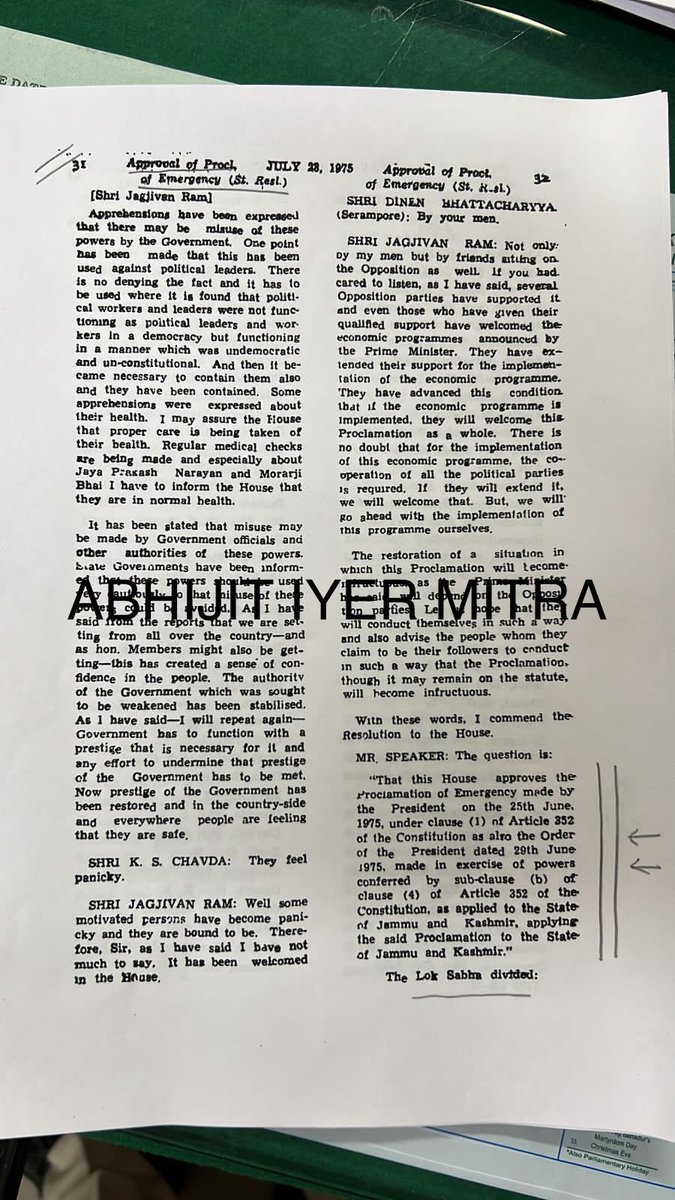
Reminder that Ro Khanna’s grandfather, Amarnath Vidyalankar, aided the destruction of democracy in India by supporting Indira Gandhi’s Emergency.
An event which not only suspended democracy in India on the whim of the Nehru-Gandhi family, which Khanna is associated with, but also includes horrors such as:
-8 MILLION forced sterilizations with 1,774 deaths linked to it
-110,000 mass arrests without trial
-Various police firings on democracy activists killing hundreds
-Suppression of the press
-Subversion of the Constitution
CC: @Iyervval
This is one of the best illustrations of SIP I have seen in recent times, using the ("North Indian" story of*) Deepavali connection beautifully! Tremendous job by the agency Colads!
Observe the nuance! The vaanar sena first throw stones at random into the sea (towards Lanka). And they all sink pointlessly, of course. The narrative is not simply implying that small stones gather a mighty bridge. Instead, the narrative asserts that 'niyam se' (using a rule or a principle) is the thing missing earlier, and that's what makes a bridge of random small stones possible (where to place which kind of stone). That bridges (pun intended) perfectly towards SIP!
Then, notice how the bridge gets built, but doesn't take the vaanar sena to Lanka. Instead, the writing quickly moves to winning Lanka via the bridge, and Lord Ram getting back to Ayodhya. That smartly envelopes the purpose of the bridge - reaching Lanka was not the prize, winning over Raavan and getting back to Ayodhya was. This is important because the need was to connect SIPs to 'dreams' (things people want to invest for and acquire, like home, car, etc.).
And despite it being produced via AI, the chosen texture, that of a stop-motion animation—is truly wonderful for the chosen narrative device, that of a sutradhar telling a story to a nukkad theater audience. Tahir Shaikh's lyrics are excellent, with a rhythm and pull that makes it hummable, and his own music (made with Suno) is perfectly on point.
In a way, it is heartening and frightening at the same time, on two ends of the spectrum - how (largely) effortless it is to bring a great idea (which comes first) to life with AI (visuals and music), and how much effort this would have taken in a non-AI period (just 2-3 years ago) and the number of people who may have been gainfully employed for producing this work!
*There are other stories behind Deepavali in India besides Lord Ram-Raavan, including Lord Krishna defeating Narakasura in Tamil Nadu, Kali Pooja in Bengal, among others.
#advertising #marketing #deepavali
In 1978, Vietnam invaded Cambodia for exactly the same reason Israel invaded Gaza after October 7. Prior to the Vietnamese counterattack, Cambodia invaded Vietnam and massacred thousands of innocent civilians. By counter invading Cambodia, Vietnam’s forces put an end to one of the most brutal regimes of the 20th century, the Khmer Rouge, who murdered around two million Cambodians, Western foreigners, and thousands of Vietnamese. In the process, the Khmer Rouge reduced Cambodia to a third world hellhole worse than anything you can possibly imagine.
The international community, however, was not at all impressed by the fact that Vietnam dared to defend itself and its citizens, let alone end a genocidal totalitarian regime.
The UN, US, the UK, China, France, Netherlands, Thailand, Malaysia, Indonesia, Singapore, the Philippines, Japan, West Germany, and Sweden all condemned Vietnam and sanctioned it for years.
You see, taking an immoral and murderous stance disguised as a moral ground and virtue isn’t a new practice and isn’t just a tool for bashing Israel.
Vietnam, however, didn’t give a fuck, it did what it had to do in order to protect its people, and by eliminating the Khmer Rouge, it undoubtedly made the world a better place.
Sometimes, justice and goodness require the combination of ignoring background noises from nations and governments who are addicted to peace at all costs, and applying force that can break an entire system.
‘The electoral legacy of our Age of Migration and the studied mismanagement of multiculturalism, is low-trust, low-consensus societies… interethnic competition, institutional capture and a shift in how government manages the public.’
@WSJFreeEx
https://t.co/ebX0sqoPpf