@NJTRANSIT Why aren’t email notifications being sent? Why is there no information in the app? Noe we have to go to Twitter/X to figure out what’s going on?!?
So fun to collaborate with @GiannarelliL on this! This discovery opens new possibilities for understanding cardiovascular risks in cancer survivors and the role of immune checkpoints in atherosclerosis 🎯 @ICOSociety@CardioOncology
🚨 New discovery alert! 🚨
In this month’s issue of @NatureCVR, we identify a dendritic cell population that acts as a hub for immune checkpoint communication within human atherosclerotic plaques. @NYULHCVRC@ChiaraGiannare1
https://t.co/aBk1GhsPFO
FASCIN1+ DCs in mouse and human plaques are a key target of immunotherapies linked to accelerated atherosclerotic plaque progression and increased risk of stroke and myocardial infarction in cancer survivors. #CardioOncology
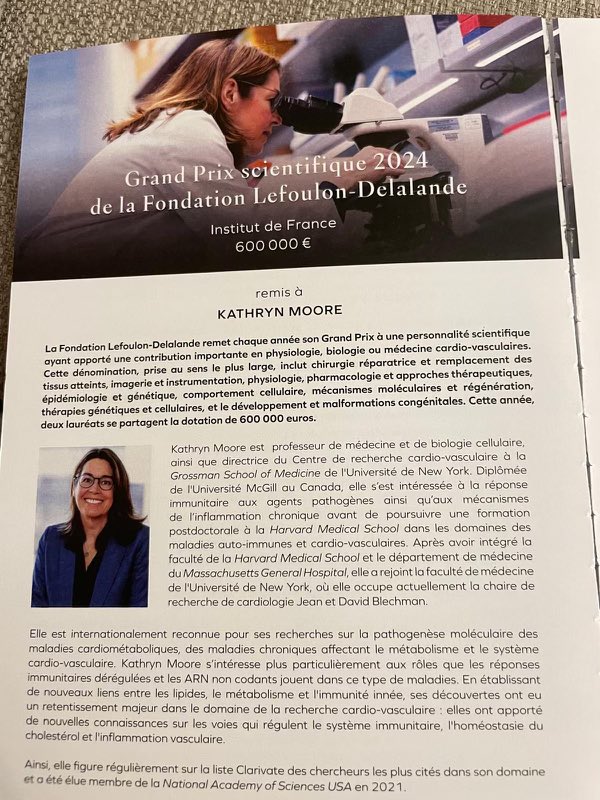
Thrilled to see the outstanding contributions of the 2 recipients of the @InstitutFrance Grand Prix Scientifique Lefoulon Delalande — one of the 🌎 most important prizes in #CardiovascularResearch. So proud to see 🇨🇦 scientist @KathrynMooreLab up there!
Big day for MooreLab at #VascularDiscovery24! @FazliBozal is competing for the Investigator in Training Award & @aacnewman13 for Emerging Scientist Award for Women Award. 🤞
Beyond excited that @KateyRayner was appointed to be the next CSO of the @HeartInstitute! In addition to being a stellar scientist, a tremendous colleague & leader in cardiovascular research, this is also a historical moment b/c she will be the first woman CSO at our institute!
Using mouse models of Irg1 deficiency, we show that loss of this pathways aggravates atherosclerosis, increasing plaque size, macrophage content, and inflammatory signaling including IL-1b (2/5)
Treatment of mice with advanced atherosclerosis using an itaconate derivative, 4-OI, led to beneficial plaque remodeling, highlighting its potential as a novel therapeutic strategy (4/5)
We show that the enzyme IRG1/ACOD1, responsible for producing the immunomodulatory metabolite itaconate, is expressed in human and mouse atherosclerotic plaques. Intriguingly, its expression decreases with disease progression suggesting loss of this protective mechanism (1/5)